Biodegradable Insulated Panel Market Size
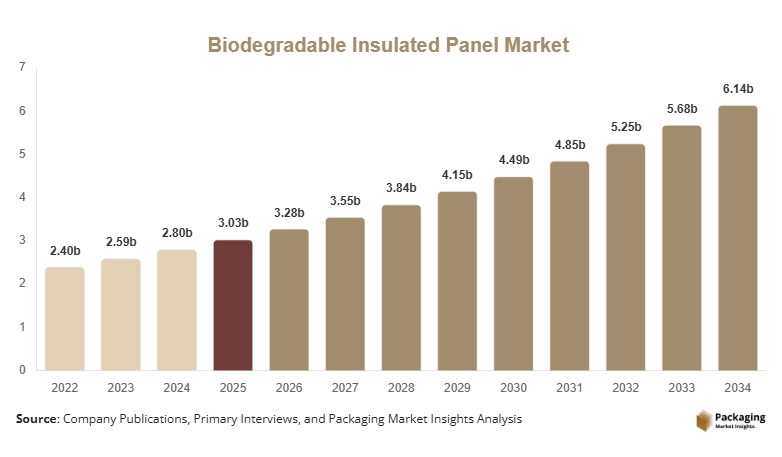
Biodegradable Insulated Panel market size is projected at USD 3.28 billion in 2026 and is expected to hit USD 6.14 billion by 2034 with a CAGR of 8.15%. The report analyzes production capacity, consumption trends, pricing, technology developments, market segmentation, and the competitive landscape across major regions. The assessment covers historical data from 2022–2024, the 2025 base year, and forecasts through 2034, evaluating more than 35 countries, 220 manufacturers, and annual production exceeding 540 million insulated panels.
The Biodegradable Insulated Panel market consists of insulation products manufactured from renewable and biodegradable materials including plant fibers, starch derivatives, agricultural waste, and bio-composites. Global production exceeded 540 million panels in 2025, with plant fiber panels contributing approximately 46% of total output, bio-composite panels 34%, and starch-based panels 20%. Building & construction accounted for nearly 58% of total demand, while cold chain packaging represented 24% and industrial insulation contributed 18%. Sustainable insulation adoption exceeded 41% in newly certified green buildings, strengthening the Biodegradable Insulated Panel market.
Explore more data points, trends and opportunities Download Free Sample Report
Biodegradable Insulated Panel Trends
Rising Adoption of Sustainable Construction Materials
Green construction projects continue to accelerate demand for biodegradable insulation products. Production of plant fiber insulated panels exceeded 248 million units during 2025, reflecting annual growth of 11.8%. More than 48% of commercial green buildings incorporated biodegradable insulation materials, while recycled bio-content usage increased by 19% year over year. Continuous innovation in thermal insulation technologies supports the Biodegradable Insulated Panel market.
Manufacturers are integrating advanced compression molding, bio-resin technologies, and automated production systems to improve panel durability and insulation efficiency. Manufacturing productivity increased by 16%, while panel thermal conductivity improved by nearly 12% compared with previous-generation products. Demand from cold chain logistics expanded by 9.7%, reinforcing the Biodegradable Insulated Panel market.
Biodegradable Insulated Panel Market Drivers
Growing Demand for Sustainable Building Materials
Global investments in green construction exceeded USD 650 billion during 2025, while environmentally certified buildings increased by 14% worldwide. More than 310 million biodegradable insulation panels were supplied to residential and commercial projects, supported by stricter building energy regulations and sustainability initiatives, accelerating Biodegradable Insulated Panel market growth.
Biodegradable Insulated Panel Market Restraints
Higher Manufacturing Costs Compared with Conventional Insulation
Production costs for biodegradable insulated panels remain approximately 18–25% higher than conventional foam insulation products. Bio-based raw materials account for nearly 57% of manufacturing expenses, while supply chain fluctuations increased logistics costs by 9% during 2025. These cost pressures continue to limit broader Biodegradable Insulated Panel market adoption.
Biodegradable Insulated Panel Market Opportunities
Expansion of Circular Economy and Bio-Based Manufacturing
Government sustainability incentives and circular economy initiatives continue to generate significant opportunities. Investments in biodegradable insulation manufacturing exceeded USD 2.6 billion, while demand for recyclable insulation products increased by 17% in 2025. More than 53% of green infrastructure projects specify bio-based insulation materials, creating long-term opportunities for the Biodegradable Insulated Panel market.
Challenges in Biodegradable Insulated Panel Market
Balancing Thermal Performance with Material Sustainability
Manufacturers face ongoing challenges in improving thermal resistance while maintaining biodegradability and structural durability. Research spending increased by 15%, while product certification costs rose by approximately 8%. Achieving long service life, moisture resistance, and competitive pricing remains a major challenge affecting the Biodegradable Insulated Panel market.
Report Scope
| Report Metric | Details |
|---|---|
| Market Size in 2025 | USD 3.03 billion |
| Market Size in 2026 | USD 3.28 billion |
| Market Size in 2034 | USD 6.14 billion |
| CAGR | 8.15% (2026-2034) |
| Base Year for Estimation | 2025 |
| Historical Data | 2022-2024 |
| Forecast Period | 2026-2034 |
| Report Coverage | Revenue Forecast, Competitive Landscape, Supply Chain Disruption, Growth Factors, Environment & Regulatory Landscape and Trends |
| Geographies Covered | North America, Europe, APAC, Middle East and Africa, LATAM |
| Countries Covered | U.S., Canada, U.K., Germany, France, Spain, Italy, Russia, Nordic, Benelux, Rest of Europe, China, South Korea, Japan, India, Australia, Singapore, Taiwan, South East Asia, Rest of Asia-Pacific, UAE, Turky, Saudi Arabia, South Africa, Egypt, Nigeria, Rest of MEA, Brazil, Mexico, Argentina, Chile, Colombia, Rest of LATAM |
Explore more data points, trends and opportunities Download Free Sample Report
Biodegradable Insulated Panel Market Segmentation
The market is segmented by material and end use. Plant fiber panels dominate with approximately 46% market share, followed by bio-composite panels at 34% and starch-based panels at 20%. Building & construction applications account for nearly 58% of total demand, followed by cold chain packaging at 24% and industrial insulation at 18%.
By Material
Plant fiber panels account for approximately 46% of the market, with annual production exceeding 248 million units. Manufactured using hemp, bamboo, kenaf, and agricultural fibers, these panels provide thermal conductivity between 0.035–0.045 W/mK while supporting sustainable construction.
Starch-based panels contribute approximately 20% of market demand, with production surpassing 108 million units annually. These panels offer lightweight insulation properties and biodegradability suitable for packaging and temporary construction applications.
Bio-composite panels represent approximately 34% of the market, producing more than 184 million units annually. These products combine natural fibers with bio-resins to provide improved mechanical strength and thermal efficiency.
By End Use
Building & construction dominates with nearly 58% market share, consuming over 313 million panels annually. Residential and commercial green buildings utilize biodegradable insulated panels to improve energy efficiency and reduce environmental impact.
Cold chain packaging accounts for approximately 24% of demand, utilizing more than 130 million insulated panels annually for temperature-sensitive food, pharmaceutical, and healthcare logistics.
Industrial insulation contributes approximately 18% of total demand, with production exceeding 97 million panels annually. These products are increasingly adopted in manufacturing facilities and industrial equipment requiring environmentally friendly insulation solutions.
Biodegradable Insulated Panel Market Segmentations
Material
- Plant Fiber Panels
- Starch-Based Panels
- Bio-Composite Panels
End Use
- Building & Construction
- Cold Chain Packaging
- Industrial Insulation
Biodegradable Insulated Panel Regional Outlook
North America
North America accounted for approximately 29% of global revenue in 2025, producing over 157 million insulated panels annually. The United States generated nearly 81% of regional demand through sustainable residential and commercial construction projects.
Europe
Europe represented approximately 33% of the global market, with production exceeding 178 million panels annually. Germany, France, the United Kingdom, and the Nordic countries collectively accounted for more than 72% of regional consumption due to stringent energy-efficiency regulations.
Asia-Pacific
Asia-Pacific held approximately 31% of global demand, producing over 167 million insulated panels annually. China, Japan, India, and South Korea together contributed nearly 69% of regional production through rapid infrastructure development and green building initiatives.
Latin America
Latin America represented approximately 4% of the global market. Brazil and Mexico contributed more than 70% of regional demand as sustainable building practices continued to expand.
Middle East & Africa
The Middle East & Africa accounted for approximately 3% of the market, supported by increasing investments in energy-efficient infrastructure and environmentally sustainable construction materials.
Top players in Biodegradable Insulated Panel Market
- BASF SE
- Saint-Gobain S.A.
- Kingspan Group plc
- Rockwool A/S
- Owens Corning
- Hempitecture Inc.
- NatureWorks LLC
- Soprema Group
- Steico SE
- Pavatex SA
- Gutex Holzfaserplattenwerk
- Knauf Insulation
BASF SE
-
Estimated market share: 10–12%.
-
BASF maintains a strong position through advanced bio-based material technologies, sustainable insulation solutions, and continuous investment in low-carbon construction materials. The company focuses on innovative biodegradable insulation products for commercial and residential construction while expanding research into renewable raw materials and energy-efficient manufacturing processes.
Kingspan Group plc
-
Estimated market share: 8–10%.
-
Kingspan Group is a leading provider of high-performance insulation products with increasing investment in sustainable and bio-based panel technologies. The company continues expanding production capacity, improving thermal performance, and developing environmentally responsible insulation systems for global construction and industrial applications.