Bio Plastic Packaging Market Size and Growth
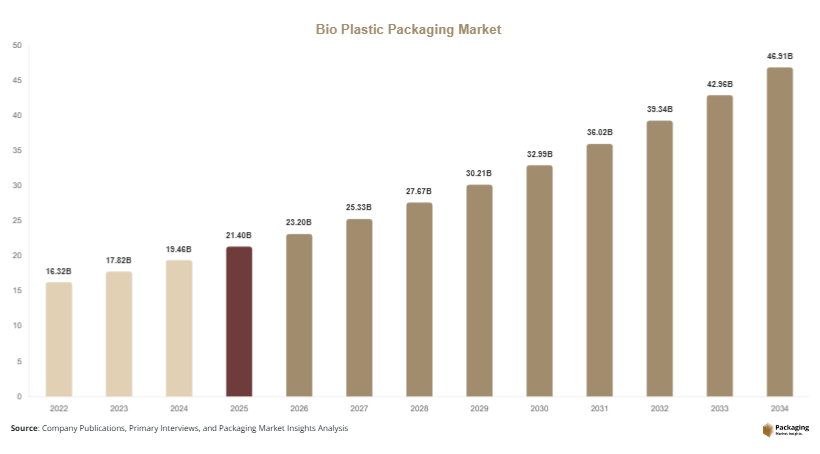
The global bio plastic packaging market size was valued at approximately USD 21.4 billion in 2025 and is projected to reach nearly USD 23.2 billion in 2026. By 2034, the market is forecasted to reach around USD 46.8 billion, expanding at a CAGR of 9.2% during 2025–2034. Bio plastic packaging materials are derived from renewable biomass sources such as corn starch, sugarcane, cellulose, and vegetable oils, making them a preferred alternative to conventional petroleum-based plastics. The global bio plastic packaging market is witnessing strong growth due to increasing environmental awareness, rising government regulations on single-use plastics, and growing adoption of sustainable packaging solutions across industries.
One of the primary growth factors driving the market is the increasing implementation of environmental policies restricting the use of traditional plastic packaging. Governments across North America, Europe, and Asia Pacific are introducing regulations encouraging biodegradable and compostable packaging materials. Another important factor supporting market expansion is the growing consumer preference for sustainable products and environmentally responsible brands. Food and beverage companies, cosmetic manufacturers, and e-commerce retailers are increasingly adopting bio plastic packaging to strengthen brand image and meet sustainability goals.
Key Highlights
- Europe dominated the market with a 36.8% share in 2025.
- Asia Pacific is projected to grow at the fastest CAGR of 10.1%.
- Flexible bio plastic packaging led the product segment with a 34.5% share.
- PLA materials dominated with a 31.9% share.
- Food & beverage applications led the market with 48.6% share.
- The US remained the dominant country with a market size of USD 4.6 billion in 2025 and USD 5.0 billion in 2026.
Explore more data points, trends and opportunities Download Free Sample Report
Market Trends
Rising Adoption of Compostable Flexible Packaging
The demand for compostable flexible packaging is increasing significantly across the bio plastic packaging market. Food manufacturers, retailers, and e-commerce companies are replacing traditional plastic films and pouches with compostable alternatives derived from renewable materials. Compostable packaging offers advantages such as reduced landfill waste, improved environmental compliance, and enhanced consumer appeal. Companies are also investing in advanced flexible bio plastic films that provide improved moisture resistance and shelf-life performance. Growing awareness regarding plastic pollution and increasing restrictions on single-use packaging are accelerating the shift toward compostable flexible packaging solutions across global consumer markets.
Expansion of Bio-Based Packaging in E-Commerce Applications
The rapid growth of e-commerce is encouraging packaging manufacturers to develop sustainable shipping materials using bio plastics. Online retailers are increasingly adopting biodegradable mailers, cushioning materials, and protective films to reduce environmental impact and improve sustainability performance. Bio plastic packaging products are becoming more durable and lightweight, making them suitable for transportation and logistics operations. Consumer preference for eco-friendly online shopping experiences is also supporting adoption of renewable packaging materials. In addition, several global retail brands are introducing packaging reduction targets that encourage suppliers to use recyclable and bio-based packaging alternatives.
Market Drivers
Increasing Government Regulations on Conventional Plastics
Government regulations restricting the use of traditional petroleum-based plastics are a major driver of the bio plastic packaging market. Many countries have introduced bans, taxes, and recycling mandates targeting single-use plastic packaging products. These regulations are encouraging manufacturers to adopt biodegradable and compostable alternatives derived from renewable sources. Food service companies, supermarkets, and consumer goods manufacturers are increasingly transitioning toward bio plastic packaging to comply with environmental standards and avoid penalties. Regulatory support for sustainable packaging solutions is expected to continue driving investment and product innovation across the market during the forecast period.
Growing Consumer Preference for Sustainable Packaging
Consumer demand for environmentally responsible products is significantly influencing packaging decisions across industries. Buyers increasingly prefer brands that use sustainable packaging materials with lower environmental impact. Bio plastic packaging helps companies strengthen brand reputation while meeting consumer expectations regarding waste reduction and sustainability. This trend is especially visible in food & beverage, cosmetics, and personal care industries where packaging plays an important role in purchasing decisions. Rising awareness regarding climate change, marine pollution, and landfill waste is expected to support long-term demand for bio-based packaging solutions globally.
Market Restraint
High Production Costs Compared to Conventional Plastics
One of the major restraints affecting the bio plastic packaging market is the relatively high production cost associated with bio-based polymers and compostable materials. Manufacturing bio plastics often requires specialized processing technologies, renewable raw materials, and advanced production systems that increase overall operational expenses. Conventional petroleum-based plastics remain more cost-effective in high-volume packaging applications, particularly in price-sensitive markets where companies prioritize affordability.
For example, compostable packaging used in food service applications can cost significantly more than traditional plastic alternatives due to limited production scale and raw material availability. Small and medium-sized businesses may face financial challenges when transitioning to bio plastic packaging systems, especially in regions with limited recycling or composting infrastructure. In addition, fluctuations in agricultural feedstock prices such as corn starch and sugarcane can impact material costs and profit margins for manufacturers. These pricing challenges may slow adoption rates in developing markets despite increasing sustainability awareness.
Market Opportunities
Development of Advanced Biodegradable Polymers
Advancements in biodegradable polymer technology present substantial growth opportunities for the bio plastic packaging market. Packaging manufacturers are investing in next-generation materials with improved strength, flexibility, barrier protection, and heat resistance. These innovations are enabling bio plastics to compete more effectively with conventional plastics across demanding packaging applications. Improved material performance is supporting wider use of biodegradable packaging in food preservation, pharmaceutical packaging, and industrial packaging sectors. Growing research and development activities aimed at enhancing compostability and recyclability are expected to create new revenue opportunities for packaging companies during the forecast period.
Expansion of Sustainable Packaging in Emerging Economies
Emerging economies in Asia Pacific, Latin America, and the Middle East are creating significant opportunities for bio plastic packaging suppliers. Rapid urbanization, rising disposable incomes, and increasing awareness regarding environmental sustainability are driving demand for eco-friendly packaging materials. Governments in several developing countries are introducing plastic waste reduction initiatives and encouraging investments in sustainable manufacturing industries. International food and beverage brands operating in these regions are also increasing adoption of bio-based packaging to align with global sustainability goals. Expanding retail and e-commerce sectors are expected to further accelerate demand for sustainable packaging solutions.
Report Scope
| Report Metric | Details |
|---|---|
| Market Size in 2025 | USD 21.4 Billion |
| Market Size in 2026 | USD 23.2 Billion |
| Market Size in 2034 | USD 46.8 Billion |
| CAGR | 9.2% (2026-2034) |
| Base Year for Estimation | 2025 |
| Historical Data | 2022-2024 |
| Forecast Period | 2026-2034 |
| Report Coverage | Revenue Forecast, Competitive Landscape, Supply Chain Disruption, Growth Factors, Environment & Regulatory Landscape and Trends |
| Geographies Covered | North America, Europe, APAC, Middle East and Africa, LATAM |
| Countries Covered | U.S., Canada, U.K., Germany, France, Spain, Italy, Russia, Nordic, Benelux, Rest of Europe, China, South Korea, Japan, India, Australia, Singapore, Taiwan, South East Asia, Rest of Asia-Pacific, UAE, Turky, Saudi Arabia, South Africa, Egypt, Nigeria, Rest of MEA, Brazil, Mexico, Argentina, Chile, Colombia, Rest of LATAM |
Explore more data points, trends and opportunities Download Free Sample Report
Segmental Analysis
By Product Type
Flexible bio plastic packaging dominated the market in 2024, accounting for approximately 34.5% of the total market share. Flexible packaging solutions such as pouches, films, and wraps are widely used because they offer lightweight structures, reduced material consumption, and lower transportation costs. Food and beverage companies increasingly prefer flexible bio plastic packaging due to its ability to maintain product freshness while supporting sustainability goals. Advancements in biodegradable film technology and improved moisture barrier performance are also supporting wider adoption across retail and e-commerce packaging applications. Flexible formats provide convenience and compatibility with automated packaging systems, further strengthening market demand.
Compostable rigid packaging is projected to be the fastest-growing subsegment, registering a CAGR of 10.4% during the forecast period. Increasing demand for sustainable food containers, cosmetic packaging, and healthcare packaging solutions is supporting segment growth. Compostable rigid packaging products provide improved structural strength and durability while reducing long-term environmental impact. Restaurants, food delivery companies, and consumer goods manufacturers are increasingly adopting compostable containers and trays to comply with sustainability regulations and consumer preferences. Technological improvements in bio-based polymer molding and heat resistance are expected to further accelerate adoption within industrial and commercial packaging sectors.
By Material
PLA materials accounted for the largest share of 31.9% in 2024 due to their wide availability, compostability, and compatibility with food packaging applications. Polylactic acid is derived from renewable resources such as corn starch and sugarcane, making it a preferred material for sustainable packaging solutions. PLA packaging products are commonly used for cups, trays, bottles, and flexible films due to their transparency and ease of processing. Packaging manufacturers continue improving PLA formulations to enhance heat resistance and durability, supporting broader application opportunities across retail and food packaging industries.
PHA materials are expected to witness the fastest growth, expanding at a CAGR of 11.2% during the forecast period. Polyhydroxyalkanoates offer strong biodegradability characteristics and can decompose naturally in various environmental conditions, including marine environments. Increasing research investments and technological advancements are improving production efficiency and material performance for PHA-based packaging products. Food packaging companies and sustainability-focused brands are increasingly exploring PHA materials as alternatives to conventional plastics. Rising environmental concerns regarding ocean pollution and plastic waste are expected to drive strong demand for these biodegradable polymer solutions globally.
By Application
Food & beverage applications held the dominant market share of 48.6% in 2024 due to increasing demand for sustainable food containers, beverage bottles, trays, and flexible packaging films. Restaurants, supermarkets, and packaged food companies are adopting bio plastic packaging to reduce environmental impact and comply with changing regulations regarding single-use plastics. Bio-based packaging materials help maintain product freshness while supporting brand sustainability initiatives. Rising demand for organic and environmentally friendly food products is also contributing to higher adoption of biodegradable packaging solutions across the food industry.
Healthcare packaging is projected to register the fastest CAGR of 9.8% during the forecast period. Pharmaceutical companies and healthcare providers are increasingly exploring sustainable packaging materials for medical products, diagnostic kits, and healthcare consumables. Bio plastic packaging offers opportunities to reduce medical waste while maintaining required safety and barrier performance standards. Growing sustainability commitments within healthcare organizations and rising regulatory focus on environmentally responsible medical packaging are expected to support segment growth. Technological advancements improving sterilization compatibility and durability of bio plastic materials are also contributing to increased adoption within healthcare applications.
Bio Plastic Packaging Market Segmentations
B Product Type
- Flexible Bio Plastic Packaging
- Compostable Rigid Packaging
- Bottles & Containers
- Films & Wraps
- Trays & Clamshells
By Material
- PLA
- PHA
- Starch Blends
- Bio-PET
By Application
- Food & Beverage
- Healthcare Packaging
- Personal Care & Cosmetics
- Consumer Goods
Regional Analysis
North America
North America accounted for approximately 24.6% of the global bio plastic packaging market share in 2025 and is projected to grow at a CAGR of 8.7% during the forecast period. The region benefits from increasing environmental regulations, rising consumer demand for sustainable products, and growing investments in biodegradable packaging technologies. Food and beverage companies across the United States and Canada are increasingly adopting bio plastic packaging to meet sustainability commitments and reduce reliance on petroleum-based plastics.
The United States dominates the North American market due to its strong sustainable packaging industry and expanding eco-conscious consumer base. A unique growth factor is the rapid adoption of compostable packaging solutions within food delivery and online retail industries. Major retailers and restaurant chains are introducing sustainable packaging targets that continue driving demand for bio plastic materials.
Europe
Europe held the largest market share of 36.8% in 2025 and is expected to grow at a CAGR of 8.9% through 2034. Strict environmental regulations and strong circular economy initiatives are major factors supporting market growth in the region. Governments across Europe continue implementing policies encouraging compostable and recyclable packaging materials. Consumer preference for environmentally friendly packaging solutions is also significantly influencing market demand across retail and food industries.
Germany remains the dominant country within the European bio plastic packaging market due to its advanced recycling infrastructure and strong focus on sustainable manufacturing. A unique growth factor is the country’s extensive investment in industrial composting and waste management systems that support adoption of biodegradable packaging products across multiple industries.
Asia Pacific
Asia Pacific accounted for approximately 28.4% of the global market share in 2025 and is projected to register the fastest CAGR of 10.1% during the forecast period. Rapid urbanization, expanding food packaging demand, and increasing government initiatives to reduce plastic waste are supporting strong market growth across the region. Growing manufacturing activities and rising consumer awareness regarding sustainability are also contributing to increasing adoption of bio plastic packaging products.
China dominates the regional market due to its large packaging manufacturing industry and increasing environmental regulations on conventional plastics. A unique growth factor is the rapid expansion of sustainable e-commerce packaging solutions driven by the country’s growing online retail sector. Packaging companies are increasing investments in biodegradable shipping materials and compostable packaging technologies.
Middle East & Africa
The Middle East & Africa region represented approximately 4.9% of the global bio plastic packaging market share in 2025 and is projected to grow at a CAGR of 7.6% during the forecast period. Rising awareness regarding plastic pollution and increasing government sustainability initiatives are supporting market development. Food packaging and retail sectors are gradually adopting biodegradable packaging alternatives to improve environmental performance and comply with changing regulations.
The United Arab Emirates remains the dominant market in the region due to its growing focus on sustainability and waste reduction programs. A unique growth factor is the increasing adoption of eco-friendly packaging solutions within hospitality and tourism industries, where businesses are emphasizing sustainable operations to attract environmentally conscious consumers.
Latin America
Latin America accounted for approximately 5.3% of the global bio plastic packaging market share in 2025 and is expected to grow at a CAGR of 8.4% during the forecast period. Expanding food processing industries, increasing retail packaging demand, and rising environmental awareness are contributing to market growth across the region. Governments are introducing initiatives encouraging biodegradable materials and reducing dependency on conventional plastics.
Brazil dominates the Latin American market due to its abundant agricultural resources and growing bio-based materials industry. A unique growth factor is the country’s strong sugarcane production capacity, which supports local manufacturing of renewable bio plastic materials used in sustainable packaging applications.
Competitive Landscape
The bio plastic packaging market is highly competitive, with global packaging manufacturers focusing on sustainable material innovation, production expansion, and strategic partnerships. Companies are investing heavily in biodegradable polymers, recyclable packaging technologies, and renewable feedstock sourcing to strengthen market position. Demand for compostable and eco-friendly packaging products is encouraging manufacturers to develop advanced bio-based materials suitable for food, healthcare, and industrial applications.
NatureWorks LLC remains one of the leading companies in the market due to its extensive PLA biopolymer production capabilities and global distribution network. In 2024, the company announced expansion of its biopolymer manufacturing capacity in Asia Pacific to support rising demand for sustainable packaging materials.
Other major players operating in the market include BASF SE, Novamont S.p.A., TotalEnergies Corbion, and Amcor Plc. These companies are emphasizing recyclable material development, strategic acquisitions, and long-term sustainability initiatives to expand their global market presence and improve production efficiency.
Key Players List
- NatureWorks LLC
- BASF SE
- Novamont S.p.A.
- TotalEnergies Corbion
- Amcor Plc
- TIPA Corp Ltd.
- Mondi Group
- Smurfit Kappa Group
- Sealed Air Corporation
- Danimer Scientific
- Vegware Ltd.
- Biome Bioplastics
- Plantic Technologies
- Mitsubishi Chemical Group
- FKuR Kunststoff GmbH