Bio PE Pouches Market Size
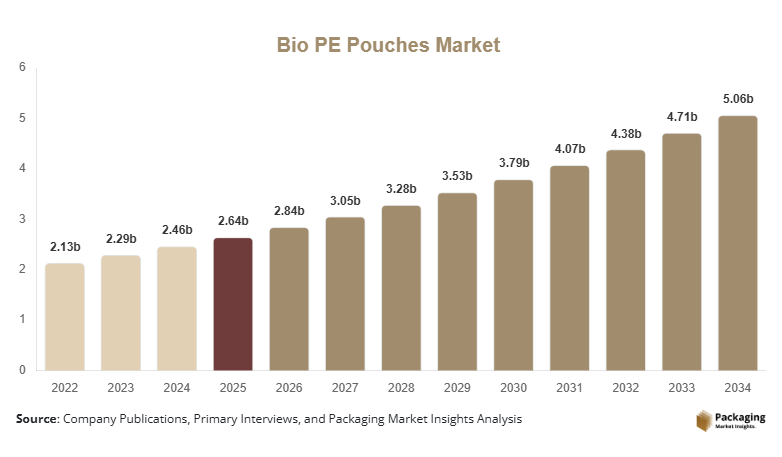
Bio PE Pouches market size is projected at USD 2.84 billion in 2026 and is expected to hit USD 5.06 billion by 2034 with a CAGR of 7.48%. The report analyzes historical developments from 2022–2025 and forecasts market performance through 2034. It evaluates production capacity, pricing trends, raw material availability, sustainability initiatives, technological innovations, supply chain performance, and competitive benchmarking. The study covers over 120 manufacturers, 50 countries, and annual production exceeding 29 billion Bio PE pouches, offering comprehensive industry intelligence.
The Bio PE pouches market comprises flexible packaging solutions manufactured from bio-based polyethylene derived primarily from renewable sugarcane feedstock. Global production exceeded 29 billion units during 2025, with stand-up pouches accounting for approximately 52% of total production. Food & beverage applications contributed nearly 61% of total consumption, followed by personal care & cosmetics at 24% and pharmaceutical applications at 15%. Bio-based polyethylene represented nearly 78% renewable carbon content in commercial packaging applications, strengthening the Bio PE pouches market.
Explore more data points, trends and opportunities Download Free Sample Report
Bio PE Pouches Trends
Growing Adoption of Renewable Flexible Packaging
Demand for renewable flexible packaging continues increasing as consumer brands adopt sustainable packaging targets. Production of Bio PE pouches exceeded 29 billion units during 2025, increasing by approximately 14% year-over-year. More than 46% of multinational consumer goods companies incorporated bio-based flexible packaging into their sustainability roadmaps, supporting Bio PE pouches market trends.
Manufacturers invested over USD 630 million in bio-polyethylene processing, multilayer extrusion, and recyclable flexible packaging technologies. Production efficiency improved by 13%, while renewable resin utilization exceeded 81% across premium product lines, reinforcing Bio PE pouches market trends.
Rising Demand Across Food and Personal Care Packaging
Food manufacturers increasingly utilize Bio PE pouches for snacks, beverages, frozen foods, and dry products because of lightweight construction and excellent barrier performance. Food packaging consumption exceeded 17 billion pouches during 2025, while personal care packaging demand expanded by approximately 10% annually.
Advancements in mono-material structures, digital printing, and recyclable pouch technologies continue supporting product innovation. Smart packaging integration and improved shelf-life performance have accelerated adoption across premium consumer brands, strengthening Bio PE pouches market trends.
Bio PE Pouches Market Drivers
Increasing Demand for Sustainable Flexible Packaging
Global sustainable packaging demand exceeded USD 320 billion during 2025, while bio-based plastic consumption expanded by approximately 11% annually. More than 61% of Bio PE pouch demand originated from food packaging applications, supported by consumer preference for renewable materials and corporate sustainability commitments. These developments continue accelerating Bio PE Pouches Market Growth.
Bio PE Pouches Market Restraints
Higher Cost of Bio-Based Raw Materials
Bio-based polyethylene resin remains approximately 18–28% more expensive than conventional fossil-based polyethylene. Feedstock price fluctuations of 9–16% and limited global production capacity continue increasing manufacturing costs, affecting the competitiveness of the Bio PE pouches market.
Bio PE Pouches Market Opportunities
Expansion of Circular Economy and Recyclable Packaging
Government regulations encouraging recyclable and renewable packaging continue creating new opportunities. Global investment in circular packaging infrastructure exceeded USD 15 billion during 2025, while demand for recyclable mono-material pouches is expected to grow by more than 12% annually, creating significant opportunities for the Bio PE pouches market.
Challenges in Bio PE Pouches Market
Maintaining Barrier Performance with Renewable Materials
Manufacturers must achieve oxygen transmission rates below 2 cc/m²/day, moisture barrier performance above 95%, and renewable resin content exceeding 75% while maintaining cost competitiveness. Balancing sustainability, mechanical strength, and product shelf life remains a major industry challenge.
Report Scope
| Report Metric | Details |
|---|---|
| Market Size in 2025 | USD 2.64 billion |
| Market Size in 2026 | USD 2.84 billion |
| Market Size in 2034 | USD 5.06 billion |
| CAGR | 7.48% (2026-2034) |
| Base Year for Estimation | 2025 |
| Historical Data | 2022-2024 |
| Forecast Period | 2026-2034 |
| Report Coverage | Revenue Forecast, Competitive Landscape, Supply Chain Disruption, Growth Factors, Environment & Regulatory Landscape and Trends |
| Geographies Covered | North America, Europe, APAC, Middle East and Africa, LATAM |
| Countries Covered | U.S., Canada, U.K., Germany, France, Spain, Italy, Russia, Nordic, Benelux, Rest of Europe, China, South Korea, Japan, India, Australia, Singapore, Taiwan, South East Asia, Rest of Asia-Pacific, UAE, Turky, Saudi Arabia, South Africa, Egypt, Nigeria, Rest of MEA, Brazil, Mexico, Argentina, Chile, Colombia, Rest of LATAM |
Explore more data points, trends and opportunities Download Free Sample Report
Bio PE Pouches Market Segmentation
The market is segmented by product type and end-use industry. Stand-up pouches dominate with approximately 52% of market revenue, while food & beverage remains the leading application with nearly 61% of global demand because of increasing adoption of sustainable flexible packaging.
By Product Type
Stand-Up Pouches
Stand-up pouches account for approximately 52% of total market revenue. Annual production exceeded 15 billion units during 2025. High shelf visibility, lightweight construction, superior sealing performance, and excellent printability continue driving widespread adoption across consumer goods packaging.
Flat Pouches
Flat pouches represent nearly 31% of global demand. Production surpassed 9 billion units, serving dry foods, pharmaceuticals, personal care products, and industrial packaging requiring economical flexible packaging solutions with efficient material utilization.
Spouted Pouches
Spouted pouches contribute approximately 17% of total market revenue. Annual production exceeded 5 billion units, supporting beverages, baby food, sauces, and liquid personal care products requiring convenient dispensing and resealable packaging functionality.
By End-Use Industry
Food & Beverage
Food & beverage dominate with approximately 61% market share. Annual consumption exceeded 17 billion Bio PE pouches for snacks, dairy products, frozen foods, beverages, pet food, and ready-to-eat meals. Sustainable branding and lightweight packaging remain major growth drivers.
Personal Care & Cosmetics
Personal care & cosmetics account for nearly 24% of global demand. Production exceeded 7 billion units for shampoos, lotions, creams, refill packs, and skincare products. Premium aesthetics and renewable packaging continue supporting market expansion.
Pharmaceutical
Pharmaceutical applications contribute approximately 15% of market consumption. Annual production surpassed 4 billion units, serving medical devices, healthcare products, nutraceuticals, and over-the-counter medicines requiring secure, hygienic, and lightweight packaging.
Bio PE Pouches Market Segmentations
Product Type
- Stand-Up Pouches
- Flat Pouches
- Spouted Pouches
- Retort & Specialty Bio PE Pouches
End-Use Industry
- Food & Beverage
- Personal Care & Cosmetics
- Pharmaceutical
- Household & Industrial Products
Distribution Channel
- Online Retail
- Supermarkets & Hypermarkets
- Specialty Stores
- Direct Sales & B2B Distribution
Bio PE Pouches Regional Outlook
North America
North America accounts for approximately 31% of global revenue. The United States contributes nearly 84% of regional demand due to increasing sustainable packaging regulations, consumer awareness, and investments in bio-based materials. Annual production exceeds 9 billion pouches.
Europe
Europe represents approximately 29% of global demand. Germany, France, Italy, the Netherlands, and the United Kingdom collectively account for nearly 76% of regional consumption. Stringent sustainability legislation continues accelerating adoption of renewable flexible packaging.
Asia-Pacific
Asia-Pacific leads production with approximately 33% of global revenue. China, Japan, India, South Korea, and Thailand contribute more than 72% of regional manufacturing, supported by expanding food processing, consumer goods production, and bio-polymer investments.
Middle East & Africa
The Middle East & Africa account for approximately 3% of global demand. GCC countries contribute nearly 58% of regional consumption, supported by premium food packaging and retail sector expansion.
Latin America
Latin America contributes approximately 4% of worldwide revenue. Brazil and Mexico account for nearly 71% of regional demand due to expanding sugarcane-based bio-polyethylene production and increasing adoption of sustainable packaging.
Top players in Bio PE Pouches Market
- Amcor plc
- Mondi Group
- Berry Global Inc.
- Sealed Air Corporation
- Huhtamaki Oyj
- Sonoco Products Company
- Coveris Holdings S.A.
- Constantia Flexibles Group GmbH
- ProAmpac LLC
- Winpak Ltd.
- UFlex Limited
- Clondalkin Group
- Novolex Holdings LLC
- Glenroy Inc.
- TC Transcontinental Inc.
Amcor plc
-
Estimated global market share: 16–18%
-
Amcor plc is a leading producer of sustainable flexible packaging with extensive expertise in recyclable and bio-based pouch technologies. The company supplies Bio PE pouches for food, beverage, pharmaceutical, and personal care industries across more than 40 countries. Continuous investments in mono-material structures, renewable polymers, and advanced printing technologies have strengthened its leadership in sustainable packaging solutions.
Mondi Group
-
Estimated global market share: 11–13%
-
Mondi Group maintains a strong position through its integrated flexible packaging operations and sustainable product portfolio. The company focuses on recyclable Bio PE pouch solutions, lightweight packaging, and renewable material innovation. Its global manufacturing footprint, strong research capabilities, and collaborations with consumer goods companies continue supporting growth across developed and emerging packaging markets.