Bio Based Packaging Market Size and Growth
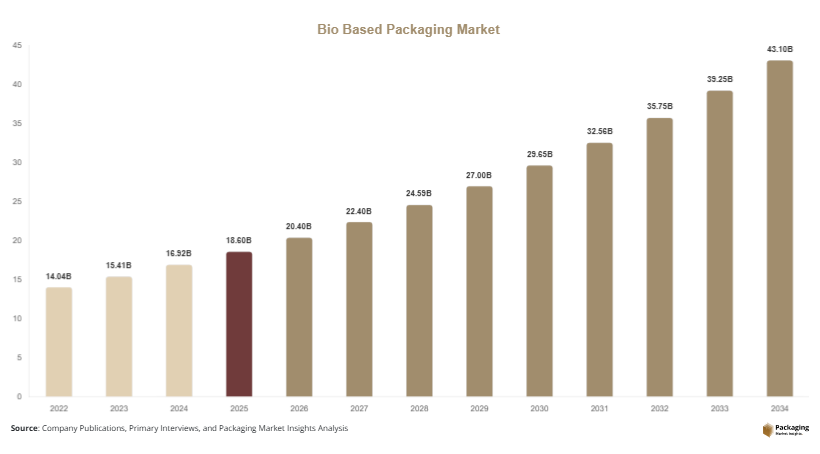
The global bio based packaging market is experiencing steady expansion, driven by growing environmental awareness, regulatory pressure, and evolving consumer preferences toward sustainable materials. The market size was estimated at USD 18.6 billion in 2025 and is projected to reach USD 20.4 billion in 2026. Over the forecast period, the market is expected to reach approximately USD 42.8 billion by 2034, expanding at a compound annual growth rate (CAGR) of 9.8% from 2025 to 2034. This growth reflects a structural shift in packaging practices across industries such as food & beverage, pharmaceuticals, and personal care.
One of the primary growth factors is the increasing adoption of biodegradable and compostable materials derived from renewable resources such as starch, cellulose, and polylactic acid (PLA). Governments across major economies are implementing strict regulations to reduce plastic waste, encouraging manufacturers to transition toward bio-based alternatives. Additionally, rising investments in research and development are improving the performance characteristics of bio-based packaging, including durability, barrier properties, and shelf-life extension.
Key Highlights:
- Market size reached USD 18.6 billion in 2025
- Expected to grow at a CAGR of 9.8% (2025–2034)
- Forecasted value of USD 42.8 billion by 2034
- Strong demand from food & beverage and e-commerce sectors
- Increasing regulatory support for sustainable packaging
Explore more data points, trends and opportunities Download Free Sample Report
Market Trends
Rising Adoption of Compostable and Biodegradable Materials
A key trend shaping the bio based packaging market is the growing adoption of compostable and biodegradable materials. Manufacturers are increasingly focusing on materials such as polylactic acid (PLA), polyhydroxyalkanoates (PHA), and starch-based polymers. These materials decompose naturally, reducing landfill waste and environmental pollution. Companies are also investing in advanced compostable films and coatings that provide similar functionality to conventional plastics. This trend is gaining traction in the food packaging segment, where sustainability and product safety are critical. Retailers and food service providers are actively shifting toward compostable packaging to meet sustainability targets and comply with environmental regulations.
Integration of Smart and Functional Packaging Solutions
Another emerging trend is the integration of smart packaging technologies with bio-based materials. Manufacturers are developing packaging solutions that include features such as freshness indicators, antimicrobial coatings, and oxygen barriers. These innovations enhance product shelf life and improve consumer experience while maintaining sustainability. The demand for functional packaging is particularly high in the pharmaceutical and food sectors. Additionally, advancements in printing and labeling technologies are enabling brands to incorporate digital features such as QR codes for traceability and consumer engagement. This convergence of sustainability and functionality is expected to drive further adoption of bio-based packaging solutions.
Market Drivers
Stringent Environmental Regulations and Policies
Governments worldwide are implementing stringent regulations to curb plastic waste, which is significantly driving the bio based packaging market. Policies such as bans on single-use plastics, extended producer responsibility (EPR), and carbon emission reduction targets are pushing manufacturers to adopt sustainable alternatives. Regulatory frameworks in regions such as Europe and North America are particularly strict, compelling companies to invest in bio-based materials. Compliance with these regulations not only helps avoid penalties but also enhances brand reputation. As governments continue to tighten environmental standards, the demand for bio-based packaging is expected to grow steadily across multiple industries.
Increasing Consumer Awareness and Preference for Sustainability
Consumer awareness regarding environmental sustainability has grown significantly in recent years. This shift in consumer behavior is a major driver for the adoption of bio-based packaging. Customers are increasingly choosing products with eco-friendly packaging, influencing companies to redesign their packaging strategies. Brands are leveraging sustainable packaging as a marketing tool to attract environmentally conscious consumers. This trend is particularly evident among younger demographics, who prioritize sustainability in purchasing decisions. As a result, companies are investing in bio-based packaging solutions to align with consumer expectations and strengthen their market position.
Market Restraint
High Production Costs and Limited Infrastructure
Despite its growth potential, the bio based packaging market faces a significant restraint in the form of high production costs and limited infrastructure. Bio-based materials often require specialized processing techniques and raw materials, which can be more expensive than conventional plastics. Additionally, the lack of large-scale production facilities and supply chain limitations further increases costs. This price disparity makes it challenging for small and medium-sized enterprises to adopt bio-based packaging solutions.
The impact of this restraint is particularly evident in developing regions, where cost sensitivity is high. For example, food manufacturers in emerging markets often prioritize cost efficiency over sustainability, limiting the adoption of bio-based packaging. Moreover, the absence of proper composting and recycling infrastructure reduces the effectiveness of biodegradable materials. Addressing these challenges requires significant investments in infrastructure development and technological innovation to achieve cost parity with traditional packaging solutions.
Market Opportunities
Expansion in Emerging Markets
Emerging economies present a significant growth opportunity for the bio based packaging market. Rapid urbanization, increasing disposable income, and growing environmental awareness are driving demand for sustainable packaging solutions in these regions. Governments in countries such as India, Brazil, and Southeast Asian nations are introducing policies to reduce plastic waste, creating a favorable environment for bio-based packaging adoption. Additionally, the expansion of retail and e-commerce sectors is increasing the demand for packaging materials. Companies that invest in localized production and distribution networks can capitalize on these opportunities and gain a competitive advantage in high-growth markets.
Technological Advancements in Bio-Polymers
Advancements in bio-polymer technology offer substantial opportunities for market growth. Researchers are developing new materials with improved mechanical strength, thermal stability, and barrier properties. These innovations are addressing the limitations of traditional bio-based materials, making them suitable for a wider range of applications. For instance, the development of multi-layer bio-based films is enabling their use in high-performance packaging applications. Additionally, advancements in manufacturing processes are reducing production costs and improving scalability. As technology continues to evolve, bio-based packaging is expected to become more competitive and widely adopted across industries.
Report Scope
| Report Metric | Details |
|---|---|
| Market Size in 2025 | USD 18.6 Billion |
| Market Size in 2026 | USD 20.4 Billion |
| Market Size in 2034 | USD 42.8 Billion |
| CAGR | 9.8% (2026-2034) |
| Base Year for Estimation | 2025 |
| Historical Data | 2022-2024 |
| Forecast Period | 2026-2034 |
| Report Coverage | Revenue Forecast, Competitive Landscape, Supply Chain Disruption, Growth Factors, Environment & Regulatory Landscape and Trends |
| Geographies Covered | North America, Europe, APAC, Middle East and Africa, LATAM |
| Countries Covered | U.S., Canada, U.K., Germany, France, Spain, Italy, Russia, Nordic, Benelux, Rest of Europe, China, South Korea, Japan, India, Australia, Singapore, Taiwan, South East Asia, Rest of Asia-Pacific, UAE, Turky, Saudi Arabia, South Africa, Egypt, Nigeria, Rest of MEA, Brazil, Mexico, Argentina, Chile, Colombia, Rest of LATAM |
Explore more data points, trends and opportunities Download Free Sample Report
Segmental Analysis
By Type
The flexible packaging segment dominated the bio based packaging market in 2024, accounting for approximately 55% of the total market share. Flexible packaging solutions, including films, pouches, and wraps, are widely used due to their lightweight nature, cost efficiency, and versatility. These packaging formats are particularly popular in the food and beverage industry, where they provide excellent barrier properties and extend product shelf life. Additionally, flexible bio-based materials are easier to process and require less raw material compared to rigid packaging, making them a preferred choice among manufacturers.
The rigid packaging segment is expected to be the fastest-growing segment, with a projected CAGR of 10.5% during the forecast period. This growth is driven by increasing demand for sustainable alternatives to traditional plastic containers, bottles, and trays. Rigid bio-based packaging offers enhanced durability and structural integrity, making it suitable for applications in the pharmaceutical and personal care industries. Furthermore, advancements in material technology are improving the performance characteristics of rigid bio-based packaging, supporting its adoption across various sectors.
By Material
The polylactic acid (PLA) segment held the largest market share in 2024, accounting for approximately 40% of the total market. PLA is widely used due to its biodegradability, transparency, and compatibility with existing manufacturing processes. It is commonly used in food packaging applications such as cups, containers, and films. The increasing demand for compostable packaging solutions is driving the adoption of PLA-based materials. Additionally, the availability of raw materials such as corn and sugarcane supports the large-scale production of PLA.
The polyhydroxyalkanoates (PHA) segment is expected to grow at the highest CAGR of 11.8% during the forecast period. PHA materials offer superior biodegradability and can decompose in various environments, including marine conditions. This makes them an attractive option for addressing plastic pollution. The growth of the PHA segment is driven by increasing investments in research and development and the development of cost-effective production processes. As technological advancements continue, PHA is expected to gain significant traction in the bio-based packaging market.
By End-Use Industry
The food and beverage segment dominated the market in 2024, accounting for approximately 60% of the total market share. The high demand for packaging solutions that ensure food safety and extend shelf life is driving the adoption of bio-based packaging in this segment. Additionally, increasing consumer preference for sustainable products is encouraging food manufacturers to adopt eco-friendly packaging solutions. The growth of the e-commerce sector is also contributing to the demand for innovative packaging solutions in the food and beverage industry.
The pharmaceutical segment is projected to be the fastest-growing segment, with a CAGR of 10.9% during the forecast period. The increasing demand for sustainable packaging solutions in the healthcare sector is driving this growth. Bio-based packaging offers advantages such as reduced environmental impact and improved compliance with regulatory requirements. Additionally, advancements in material technology are enabling the development of high-performance packaging solutions that meet the stringent requirements of the pharmaceutical industry.
Bio Based Packaging Market Segmentations
Type
- Flexible Packaging
- Rigid Packaging
Material
- Polylactic Acid (PLA)
- Polyhydroxyalkanoates (PHA)
- Starch Blends
- Cellulose-Based Materials
End-Use Industry
- Food & Beverage
- Pharmaceuticals
- Personal Care
- Industrial
Regional Analysis
North America
North America accounted for approximately 28% of the global bio based packaging market share in 2025, with a projected CAGR of 8.7% during the forecast period. The region benefits from strong regulatory frameworks and high consumer awareness regarding environmental sustainability. The presence of established packaging companies and advanced manufacturing capabilities further supports market growth. Increasing demand from the food and beverage sector is also contributing to the expansion of bio-based packaging solutions.
The United States dominates the regional market due to its well-developed packaging industry and strong focus on innovation. A key growth factor in the country is the increasing adoption of sustainable packaging by major retail and e-commerce companies. These organizations are setting ambitious sustainability targets, driving the demand for bio-based materials. Additionally, government initiatives promoting recycling and composting infrastructure are supporting market growth.
Europe
Europe held a market share of around 30% in 2025 and is expected to grow at a CAGR of 9.2% during the forecast period. The region is a leader in sustainability initiatives, with stringent regulations aimed at reducing plastic waste. Policies such as the European Green Deal are encouraging the adoption of bio-based packaging solutions. The presence of a strong regulatory framework and high environmental awareness among consumers are key factors driving market growth.
Germany is the dominant country in the European market, supported by its advanced manufacturing sector and focus on sustainability. A unique growth factor in Germany is the strong collaboration between government, industry, and research institutions. This collaboration is driving innovation in bio-based materials and improving their performance characteristics. Additionally, the country’s well-established recycling infrastructure supports the effective use of sustainable packaging solutions.
Asia Pacific
Asia Pacific accounted for approximately 25% of the global market share in 2025 and is expected to register the highest CAGR of 11.2% during the forecast period. Rapid industrialization, urbanization, and increasing environmental awareness are driving market growth in the region. The expanding food and beverage industry and growing e-commerce sector are also contributing to the demand for bio-based packaging solutions.
China dominates the Asia Pacific market due to its large manufacturing base and increasing focus on sustainability. A key growth factor in China is the government’s strict regulations on plastic waste management. These regulations are encouraging companies to adopt eco-friendly packaging solutions. Additionally, the availability of raw materials and low production costs make China a key hub for bio-based packaging manufacturing.
Middle East & Africa
The Middle East & Africa region held a market share of approximately 9% in 2025 and is expected to grow at a CAGR of 8.3%. The market is gradually gaining traction due to increasing awareness of environmental issues and government initiatives to reduce plastic waste. The growth of the retail and food service sectors is also contributing to the demand for sustainable packaging solutions.
The United Arab Emirates is a key market in the region, driven by its focus on sustainability and innovation. A unique growth factor in the UAE is the government’s commitment to reducing plastic waste through initiatives such as bans on single-use plastics. These policies are encouraging businesses to adopt bio-based packaging solutions, supporting market growth.
Latin America
Latin America accounted for around 8% of the global market share in 2025 and is projected to grow at a CAGR of 9.0% during the forecast period. The region is witnessing increasing demand for sustainable packaging solutions due to rising environmental concerns and regulatory support. The growth of the food and beverage industry is also driving the adoption of bio-based packaging.
Brazil dominates the Latin American market due to its large agricultural base and availability of raw materials for bio-based packaging. A key growth factor in Brazil is the increasing use of sugarcane-based polymers in packaging applications. These materials offer a sustainable alternative to conventional plastics and are gaining popularity among manufacturers and consumers alike.
Competitive Landscape
The bio based packaging market is characterized by moderate competition, with several global and regional players focusing on innovation and sustainability. Leading companies are investing in research and development to enhance the performance and cost efficiency of bio-based materials. Strategic partnerships, mergers, and acquisitions are common strategies adopted by market players to expand their market presence.
One of the leading companies in the market is Amcor plc, which has been actively investing in sustainable packaging solutions. The company recently introduced a new range of bio-based flexible packaging products aimed at reducing carbon footprint. Other key players are focusing on expanding their production capacities and developing innovative materials to meet the growing demand for eco-friendly packaging.
Key Players List
- Amcor plc
- Tetra Pak International S.A.
- Sealed Air Corporation
- Mondi Group
- Smurfit Kappa Group
- DS Smith Plc
- BASF SE
- NatureWorks LLC
- Novamont S.p.A.
- Stora Enso Oyj
- Huhtamaki Oyj
- WestRock Company
- Berry Global Inc.
- International Paper Company
- UPM-Kymmene Corporation