Bimodal HDPE Market Size and Growth
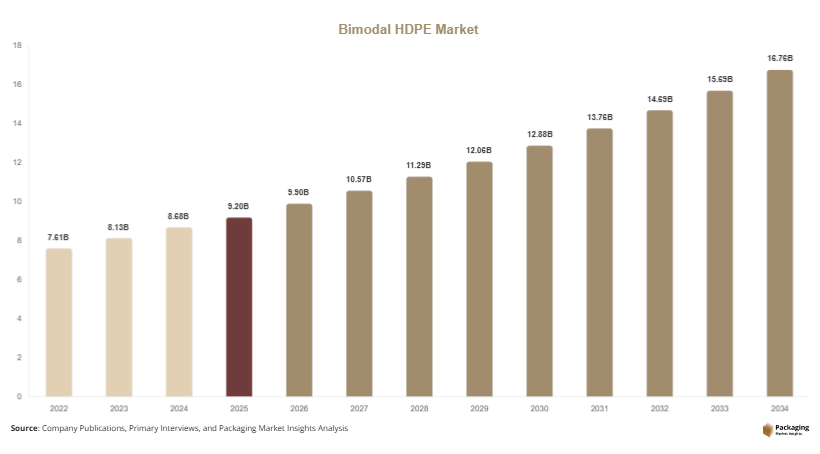
The global bimodal HDPE market size was valued at USD 9.2 billion in 2025 and is expected to reach USD 9.9 billion in 2026, reflecting steady growth. Over the forecast period from 2025 to 2034, the market is projected to expand at a CAGR of 6.8%, reaching approximately USD 17.5 billion by 2034.
Bimodal HDPE, characterized by its unique dual molecular weight distribution, combines high strength and flexibility, making it suitable for applications such as injection molding, blow molding, pipe manufacturing, and industrial films. The material’s superior mechanical properties, resistance to environmental stress cracking, and chemical inertness have made it a preferred choice in the packaging, automotive, and construction industries.
Key Highlights:
- The market size reached USD 9.2 billion in 2025, reflecting the growing adoption of bimodal HDPE across packaging, construction, and automotive sectors. Its superior mechanical properties and versatility have contributed to this valuation.
- It is expected to grow at a CAGR of 6.8% from 2025 to 2034, driven by rising demand for high-performance polymers and increasing industrial applications globally.
- The market is forecasted to reach USD 17.5 billion by 2034, supported by expansion in infrastructure, packaging innovations, and automotive production requirements.
- There is strong demand from packaging, construction, and automotive sectors, as these industries require durable, flexible, and chemically resistant materials to enhance product performance.
- Rising adoption in sustainable and recyclable applications is promoting market growth, with companies focusing on eco-friendly polymers to meet regulatory standards and consumer preferences.
Explore more data points, trends and opportunities Download Free Sample Report
Market Trends
Increased Use in Sustainable Packaging Solutions
The bimodal HDPE market is experiencing a significant shift toward sustainable packaging applications. Manufacturers are increasingly using this polymer to produce lightweight, durable, and recyclable containers for food, beverages, and consumer goods. The material’s high strength-to-weight ratio allows companies to reduce plastic usage without compromising performance, aligning with sustainability goals. Additionally, the growing preference for mono-material packaging systems in recyclable plastics has positioned bimodal HDPE as a favored choice, enabling end-of-life recycling and compliance with regional environmental regulations. This trend is expected to continue as consumer awareness and governmental pressures for sustainable packaging increase globally.
Expansion in Industrial Piping and Infrastructure
Another notable trend is the growing use of bimodal HDPE in industrial piping and infrastructure projects. Due to its excellent stress-crack resistance, chemical stability, and high tensile strength, the material is increasingly adopted for gas and water distribution, sewer systems, and industrial pipelines. Advances in pipe extrusion technology and fusion welding techniques have enhanced the efficiency and reliability of HDPE piping systems. Governments’ infrastructure development programs, particularly in urbanization and rural water supply, are also contributing to increased adoption. This trend reflects the expanding role of bimodal HDPE beyond packaging into high-performance industrial applications.
Market Drivers
Growth of the Packaging Industry
The rising global demand for flexible and rigid packaging materials is a primary driver of the bimodal HDPE market. Packaging applications, particularly in food, beverages, and consumer goods, require materials that combine strength, flexibility, and chemical resistance. Bimodal HDPE fulfills these requirements while offering cost advantages and improved processability. The rapid expansion of e-commerce and home delivery services has further boosted demand, as companies seek durable, lightweight, and recyclable materials to ensure product safety during transit. Packaging regulations and sustainability initiatives are accelerating the transition from conventional plastics to advanced polymers such as bimodal HDPE.
Expansion in Construction and Automotive Applications
Bimodal HDPE’s high mechanical performance and durability make it ideal for construction and automotive applications. In the construction sector, it is used for pipes, geomembranes, and fittings that require chemical resistance and long-term reliability. Similarly, in the automotive industry, it is employed for fuel tanks, under-the-hood components, and protective covers due to its strength, lightweight properties, and processability. Increasing investments in infrastructure projects, urban development, and automotive production are driving material consumption. The ability to optimize molecular weight distribution to meet specific application requirements further strengthens the adoption of bimodal HDPE across these sectors.
Market Restraint
High Raw Material Costs and Price Volatility
Despite its advantages, the bimodal HDPE market faces challenges due to high raw material costs and price volatility of ethylene feedstock. Fluctuations in petrochemical prices can directly affect production costs, making it less economically attractive for small and medium enterprises. In addition, the complexity of bimodal HDPE production, requiring advanced polymerization processes and catalysts, adds to the cost. These factors can limit market penetration in price-sensitive regions. For example, in developing economies, where conventional HDPE or alternative polymers are cheaper, the adoption rate of bimodal HDPE may be restrained. Consequently, market players are focusing on process optimization and bulk production strategies to mitigate these challenges and maintain competitive pricing.
Market Opportunities
Development of Specialty Bimodal HDPE Grades
Manufacturers have opportunities to develop specialty grades of bimodal HDPE tailored for specific applications, such as high-strength industrial films, high-pressure pipes, and chemical-resistant containers. Innovations in catalyst technology and polymerization control can create materials with enhanced tensile strength, impact resistance, and processability. Specialty grades enable penetration into niche markets such as pharmaceuticals, high-performance packaging, and advanced infrastructure projects, offering higher margins and long-term growth prospects. As industries seek performance-driven polymer solutions, the demand for customized bimodal HDPE products is expected to rise significantly.
Expansion in Emerging Markets
Emerging markets in Asia Pacific, Latin America, and the Middle East & Africa present significant opportunities for bimodal HDPE growth. Increasing urbanization, industrialization, and infrastructure development are driving polymer consumption in these regions. Additionally, growing awareness of sustainable and recyclable materials is creating demand for high-performance HDPE variants. Companies can capitalize on low production costs and expanding consumer bases in emerging economies to establish strong market presence. Government initiatives supporting water distribution, waste management, and industrial expansion also create avenues for increased adoption of bimodal HDPE in high-performance piping and industrial applications.
Report Scope
| Report Metric | Details |
|---|---|
| Market Size in 2025 | USD 9.2 Billion |
| Market Size in 2026 | USD 9.9 Billion |
| Market Size in 2034 | USD 17.5 Billion |
| CAGR | 6.8% (2026-2034) |
| Base Year for Estimation | 2025 |
| Historical Data | 2022-2024 |
| Forecast Period | 2026-2034 |
| Report Coverage | Revenue Forecast, Competitive Landscape, Supply Chain Disruption, Growth Factors, Environment & Regulatory Landscape and Trends |
| Geographies Covered | North America, Europe, APAC, Middle East and Africa, LATAM |
| Countries Covered | U.S., Canada, U.K., Germany, France, Spain, Italy, Russia, Nordic, Benelux, Rest of Europe, China, South Korea, Japan, India, Australia, Singapore, Taiwan, South East Asia, Rest of Asia-Pacific, UAE, Turky, Saudi Arabia, South Africa, Egypt, Nigeria, Rest of MEA, Brazil, Mexico, Argentina, Chile, Colombia, Rest of LATAM |
Explore more data points, trends and opportunities Download Free Sample Report
Segmental Analysis
By Type
The n-bimodal HDPE segment dominated in 2024, accounting for approximately 44% of the market share. It is widely used in injection molding, blow molding, and industrial pipe manufacturing due to its balanced strength and flexibility. The segment’s dominance is due to its cost-effectiveness, availability, and suitability for large-scale applications.
The iso-bimodal HDPE segment is the fastest-growing, expected to grow at a CAGR of 8%. Its high impact resistance, chemical stability, and processability make it suitable for high-performance packaging, automotive parts, and specialty industrial applications. Increasing R&D in polymer blends and new catalyst technologies further drive growth.
By Application
The packaging segment dominated in 2024, representing 42% of market share. It includes flexible films, bottles, and containers for food, beverage, and consumer goods. The demand is driven by increasing requirements for recyclable, lightweight, and durable materials that meet regulatory and consumer sustainability standards.
The piping and construction segment is fastest-growing, with a projected CAGR of 7.8%. Its growth is fueled by large-scale infrastructure projects requiring stress-resistant, chemically stable, and durable polymers for water, gas, and industrial pipelines.
By End-Use Industry
The automotive and transportation segment dominated in 2024, accounting for 40% of total consumption. Bimodal HDPE is used in fuel tanks, protective covers, and under-the-hood components due to its lightweight properties, high strength, and processability. Increasing demand for fuel-efficient and lightweight vehicles supports segment growth.
The consumer goods and healthcare segment is fastest-growing, with a projected CAGR of 7.5%. Applications include packaging, containers, and industrial products requiring chemical resistance, durability, and sustainability. Rising disposable income and growth in healthcare infrastructure drive adoption.
Bimodal HDPE Market Segmentations
By Type
- n-Bimodal HDPE
- iso-Bimodal HDPE
- Other HDPE Variants
By Application
- Packaging
- Piping & Construction
- Industrial Films
- Automotive Components
- Others
By End-Use Industry
- Automotive & Transportation
- Construction
- Consumer Goods & Healthcare
- Packaging & Industrial
Regional Analysis
North America
North America accounted for approximately 27% of the global bimodal HDPE market in 2025 and is projected to grow at a CAGR of 5.8% from 2025 to 2034. The region benefits from advanced polymer production infrastructure, a well-established packaging industry, and high demand from industrial applications. Regulatory emphasis on sustainability and recycling is promoting the adoption of advanced HDPE grades.
The United States dominates North America’s market due to its mature packaging and automotive sectors. A unique growth factor is the widespread use of HDPE in high-density pipe systems for municipal water and gas distribution, which requires bimodal HDPE for enhanced stress-crack resistance and longevity.
Europe
Europe held 25% of the market share in 2025, expected to grow at a CAGR of 6.1%. Demand is driven by the packaging industry’s transition toward recyclable materials and high-performance polymers. Countries such as Germany and France have stringent environmental policies, which favor the adoption of bimodal HDPE over conventional polymers.
Germany leads due to robust industrial infrastructure and high polymer technology adoption. A key growth factor is the integration of HDPE into sustainable packaging solutions and renewable resource-based polymer blends, which are gaining traction among consumer goods manufacturers and industrial users.
Asia Pacific
Asia Pacific is the fastest-growing region, accounting for 30% of the market in 2025 and expected to grow at a CAGR of 7.9%. Rapid industrialization, urbanization, and increased demand for high-performance polymers in packaging, construction, and automotive sectors are driving growth.
China dominates due to its massive infrastructure projects and packaging industry expansion. A unique growth factor is the increasing adoption of e-commerce-driven packaging solutions, requiring lightweight, durable, and recyclable bimodal HDPE films for shipment and storage.
Middle East & Africa
The Middle East & Africa accounted for 8% of the market in 2025, with a projected CAGR of 6.2%. Growth is influenced by infrastructure development projects, oil and gas pipeline expansion, and rising awareness of high-performance polymers.
The United Arab Emirates leads in adoption, driven by government-backed infrastructure initiatives and the oil and gas sector’s demand for chemically resistant and durable HDPE piping. Advanced polymer applications in construction and industrial facilities further support growth.
Latin America
Latin America represented 10% of the market share in 2025 and is expected to grow at a CAGR of 6.5%. Expansion is primarily driven by increasing urbanization, growth of the packaging industry, and rising industrial polymer consumption.
Brazil dominates due to its expanding food and beverage sector, infrastructure investments, and adoption of HDPE in industrial piping and packaging. The availability of local ethylene feedstock also reduces production costs, supporting market growth.
Competitive Landscape
The bimodal HDPE market is moderately consolidated, with top players competing based on product innovation, sustainability, and global reach. Leading companies focus on expanding product portfolios, investing in R&D, and strengthening regional presence.
Eastman Chemical Company leads the market, recently investing in advanced polymerization facilities to produce high-performance bimodal HDPE for industrial and packaging applications. Other key players include Royal Dutch Shell plc, BASF SE, ExxonMobil Corporation, and Celanese Corporation, all of which are adopting strategies such as strategic partnerships, acquisitions, and product innovations to strengthen market positioning.
Recent developments include the launch of specialty HDPE grades for high-strength industrial films, expansion of production capacities in Asia Pacific, and strategic collaborations with infrastructure and packaging companies.
Key Players List
- Eastman Chemical Company
- Royal Dutch Shell plc
- BASF SE
- ExxonMobil Corporation
- Celanese Corporation
- LG Chem Ltd.
- Mitsubishi Chemical Corporation
- INEOS Group Holdings S.A.
- Dow Inc.
- Sinopec Group
- LyondellBasell Industries
- SABIC
- TotalEnergies
- Formosa Plastics Corporation
- Braskem S.A.