Biaxially Oriented Polyethylene Terephthalate Films Market Size and Growth
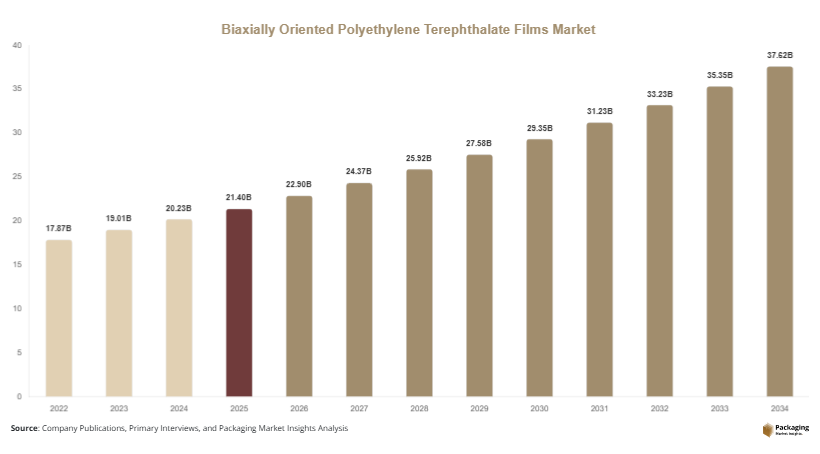
The biaxially oriented polyethylene terephthalate films market is experiencing steady growth due to increasing demand across packaging, electrical, and industrial applications. BOPET films are widely recognized for their high tensile strength, dimensional stability, transparency, and excellent barrier properties. These characteristics make them suitable for flexible packaging, insulation, and labeling applications. In 2025, the global market size is estimated at USD 21.4 billion, and it is projected to reach USD 22.9 billion in 2026. Over the forecast period from 2025 to 2034, the market is expected to expand at a CAGR of 6.4%, reaching approximately USD 39.8 billion by 2034.
One of the key growth factors is the increasing demand for flexible packaging solutions. BOPET films are extensively used in food and beverage packaging due to their ability to preserve product freshness and extend shelf life. The growing consumption of packaged food products, particularly in urban areas, is driving the demand for these films.
Key Highlights:
- Market size valued at USD 21.4 billion in 2025
- Expected to reach USD 39.8 billion by 2034
- CAGR of 6.4% during 2025–2034
- Rising demand for flexible and high-performance packaging materials
- Increasing applications in electronics and industrial sectors
Explore more data points, trends and opportunities Download Free Sample Report
Market Trends
Growing Adoption of Recyclable and Sustainable Films
Sustainability is becoming a central focus in the biaxially oriented polyethylene terephthalate films market. Manufacturers are increasingly developing recyclable and environmentally friendly BOPET films to reduce plastic waste. The adoption of mono-material structures and bio-based polymers is gaining traction as companies aim to meet regulatory requirements. Additionally, advancements in recycling technologies are enabling the reuse of PET materials, supporting circular economy initiatives. This trend is expected to drive innovation and influence product development strategies across the market.
Increasing Demand for High-Performance Specialty Films
The demand for high-performance BOPET films with enhanced functionalities is rising across various industries. Films with properties such as heat resistance, electrical insulation, and optical clarity are gaining importance in electronics and industrial applications. In packaging, high-barrier films are used to extend shelf life and maintain product quality. The integration of advanced coatings and nanotechnology is enabling the development of films with improved performance characteristics. This trend reflects the growing need for materials that can meet specific application requirements.
Market Drivers
Expansion of the Flexible Packaging Industry
The rapid growth of the flexible packaging industry is a major driver of the biaxially oriented polyethylene terephthalate films market. Increasing demand for lightweight, durable, and cost-effective packaging solutions is boosting the adoption of BOPET films. These films offer excellent barrier properties, making them suitable for food and beverage packaging. The rise of e-commerce and changing consumer lifestyles are further contributing to the demand for flexible packaging solutions. Companies are focusing on improving packaging efficiency and reducing costs, which is driving market growth.
Growth in Electronics and Electrical Applications
The expanding electronics sector is another key driver of the market. BOPET films are widely used in electrical insulation and electronic components due to their high dielectric strength and thermal stability. The increasing adoption of electronic devices, including smartphones, laptops, and wearable devices, is driving demand for these films. Additionally, the growth of renewable energy systems, such as solar panels, is creating new opportunities for BOPET film applications.
Market Restraint
Environmental Concerns and Recycling Challenges
Environmental concerns related to plastic waste pose a significant challenge for the biaxially oriented polyethylene terephthalate films market. Although PET is recyclable, the recycling process for multi-layer films can be complex and costly. This complexity can limit the adoption of BOPET films in regions with strict environmental regulations. For example, certain packaging applications require multi-layer structures to achieve desired barrier properties, making recycling difficult. Additionally, the increasing focus on reducing plastic usage is encouraging the adoption of alternative materials. These factors can impact market growth and create challenges for manufacturers.
Market Opportunities
Growth in Renewable Energy Applications
The increasing adoption of renewable energy technologies presents significant opportunities for the biaxially oriented polyethylene terephthalate films market. BOPET films are used in solar panels and other energy systems for insulation and protection. The global shift toward clean energy is driving demand for high-performance materials that can withstand harsh environmental conditions. Government initiatives and investments in renewable energy projects are expected to boost market growth.
Expansion in Emerging Markets
Emerging markets offer substantial growth opportunities for BOPET film manufacturers. Countries in Asia Pacific, Latin America, and Africa are experiencing rapid industrialization and urbanization. The increasing demand for packaged goods and electronic devices in these regions is driving the adoption of BOPET films. Additionally, improving economic conditions and rising disposable incomes are supporting market expansion.
Report Scope
| Report Metric | Details |
|---|---|
| Market Size in 2025 | USD 21.4 Billion |
| Market Size in 2026 | USD 22.9 Billion |
| Market Size in 2034 | USD 39.8 Billion |
| CAGR | 6.4% (2026-2034) |
| Base Year for Estimation | 2025 |
| Historical Data | 2022-2024 |
| Forecast Period | 2026-2034 |
| Report Coverage | Revenue Forecast, Competitive Landscape, Supply Chain Disruption, Growth Factors, Environment & Regulatory Landscape and Trends |
| Geographies Covered | North America, Europe, APAC, Middle East and Africa, LATAM |
| Countries Covered | U.S., Canada, U.K., Germany, France, Spain, Italy, Russia, Nordic, Benelux, Rest of Europe, China, South Korea, Japan, India, Australia, Singapore, Taiwan, South East Asia, Rest of Asia-Pacific, UAE, Turky, Saudi Arabia, South Africa, Egypt, Nigeria, Rest of MEA, Brazil, Mexico, Argentina, Chile, Colombia, Rest of LATAM |
Explore more data points, trends and opportunities Download Free Sample Report
Segmental Analysis
By Type
Thin BOPET films dominated the biaxially oriented polyethylene terephthalate films market in 2024, accounting for approximately 54% of the total share. These films are widely used in packaging applications due to their flexibility, transparency, and cost-effectiveness. Thin films are suitable for laminations, labels, and flexible packaging solutions. Their ability to provide adequate barrier properties while maintaining lightweight characteristics makes them a preferred choice among manufacturers. Additionally, advancements in film processing technologies are enhancing the performance of thin BOPET films.
The fastest-growing subsegment is thick BOPET films, expected to grow at a CAGR of 7.1%. This growth is driven by increasing demand in industrial and electrical applications. Thick films offer higher strength and durability, making them suitable for insulation and protective applications. The expanding electronics industry is supporting the growth of this segment.
By Application
Packaging applications held the largest share in 2024, accounting for around 52% of the market. BOPET films are widely used in food, beverage, and pharmaceutical packaging due to their protective properties. The increasing demand for convenience foods and e-commerce packaging is driving this segment. Additionally, the need for safe and hygienic packaging solutions is further boosting demand.
The fastest-growing subsegment is electrical and electronics applications, with a projected CAGR of 7.3%. The growth is driven by the increasing demand for electronic devices and components. BOPET films are used for insulation and protection in these applications. The rise of advanced technologies is also contributing to segment growth.
By End-Use Industry
The food and beverage industry accounted for the largest share in 2024, contributing approximately 49% of the market. BOPET films are widely used in this industry for packaging applications. The increasing demand for packaged food products is driving the adoption of these materials. Additionally, the focus on food safety and quality is encouraging the use of high-performance films.
The fastest-growing subsegment is the electronics industry, expected to grow at a CAGR of 7.4%. The growth is driven by the increasing demand for electronic devices and components. BOPET films are used in various applications, including insulation and protection. The rising focus on advanced technologies is supporting this trend.
Biaxially Oriented Polyethylene Terephthalate Films Market Segmentations
Type
- Thin Films
- Thick Films
Application
- Packaging
- Electrical & Electronics
- Industrial
- Imaging
End-Use Industry
- Food & Beverage
- Electronics
- Automotive
- Industrial
Regional Analysis
North America
North America accounted for approximately 28% of the biaxially oriented polyethylene terephthalate films market share in 2025 and is expected to grow at a CAGR of 5.9% during the forecast period. The region benefits from strong demand in packaging and electronics industries. The presence of advanced manufacturing infrastructure and technological innovation is supporting market growth.
The United States dominates the regional market due to its large industrial base. A unique growth factor is the increasing adoption of sustainable packaging solutions. Companies are investing in recyclable materials to meet regulatory requirements and consumer preferences, which is driving demand for BOPET films.
Europe
Europe held around 26% of the market share in 2025 and is projected to grow at a CAGR of 5.8%. The region is characterized by strict environmental regulations and a strong focus on sustainability. These factors are encouraging the development of eco-friendly BOPET films.
Germany leads the European market, supported by its strong manufacturing and automotive sectors. A key growth factor is the increasing demand for high-performance materials in industrial applications. This is driving the adoption of BOPET films in various sectors.
Asia Pacific
Asia Pacific accounted for nearly 32% of the market share in 2025 and is expected to register the highest CAGR of 7.5%. Rapid industrialization and urbanization are driving demand for BOPET films in the region. The expanding packaging and electronics industries are key contributors to market growth.
China dominates the regional market due to its large manufacturing base. A major growth factor is the increasing demand for consumer electronics and packaged goods. The region’s cost-effective production capabilities are also attracting investments from global players.
Middle East & Africa
The Middle East & Africa region held a market share of approximately 7% in 2025 and is projected to grow at a CAGR of 6.1%. The market is driven by increasing investments in infrastructure and industrial development. The demand for BOPET films is rising in packaging and construction applications.
Saudi Arabia is a leading country in the region, supported by its expanding industrial sector. A unique growth factor is the development of large-scale infrastructure projects, which require durable materials. This is driving demand for BOPET films.
Latin America
Latin America accounted for around 7% of the market share in 2025 and is expected to grow at a CAGR of 6.0%. The region is witnessing steady growth due to increasing demand for packaged goods and industrial materials. Economic development and urbanization are supporting market expansion.
Brazil dominates the regional market, driven by its large consumer base. A key growth factor is the growing food and beverage industry, which requires advanced packaging solutions. This is boosting demand for BOPET films.
Competitive Landscape
The biaxially oriented polyethylene terephthalate films market is moderately fragmented, with several global and regional players competing based on product quality, innovation, and pricing strategies. Companies are focusing on expanding their production capacities and investing in research and development to gain a competitive edge.
Toray Industries, Inc. is a leading player in the market, known for its advanced material solutions and strong global presence. The company has recently introduced new high-performance BOPET films designed for electronics and packaging applications. Other key players such as DuPont, Mitsubishi Chemical Group, SKC Co., Ltd., and Jindal Poly Films Ltd. are also actively investing in innovative technologies. Strategic collaborations and expansions are common strategies adopted by companies to strengthen their market positions.
Key Players List
- Toray Industries, Inc.
- DuPont
- Mitsubishi Chemical Group
- SKC Co., Ltd.
- Jindal Poly Films Ltd.
- Polyplex Corporation Ltd.
- SRF Limited
- Uflex Ltd.
- Ester Industries Ltd.
- Kolon Industries, Inc.
- Flex Films (Uflex)
- Garware Polyester Ltd.
- Terphane LLC
- Fuwei Films (Holdings) Co., Ltd.
- Jiangsu Shuangxing Color Plastic New Materials Co., Ltd.