Beverage Container Market Size and Growth
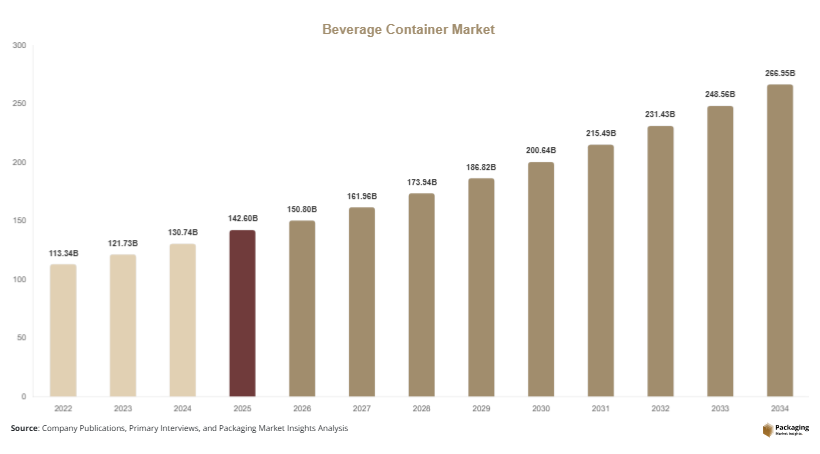
The beverage container market size is estimated at USD 142.6 billion in 2025 and is projected to reach USD 150.8 billion in 2026. By 2034, the market is forecast to grow to USD 268.5 billion, registering a CAGR of 7.4% during 2025–2034. This growth reflects strong demand across carbonated drinks, bottled water, dairy beverages, juices, and alcoholic beverages. The beverage container market is experiencing steady expansion driven by increasing global consumption of packaged beverages, rapid urbanization, and evolving consumer preferences toward convenience and sustainability.
One of the key growth factors in the beverage container market is the increasing consumption of ready-to-drink beverages globally. Rising disposable incomes, especially in emerging economies, are driving demand for packaged beverages, which directly increases the need for efficient and scalable container solutions. Another factor is the shift toward sustainable and recyclable packaging materials such as aluminum cans and glass bottles, which are gaining preference due to environmental concerns and regulatory pressure. Additionally, innovations in lightweight packaging and improved barrier properties are enabling manufacturers to reduce costs while maintaining product quality.
Key Highlights:
- The Beverage Container Market reached a market size of USD 142.6 billion in 2025, reflecting strong demand from global beverage consumption across categories such as bottled water, soft drinks, and functional beverages. The increasing shift toward packaged and ready-to-drink products continues to support steady market expansion.
- The market is projected to grow to USD 150.8 billion in 2026, driven by rising investments in advanced packaging technologies and expansion of beverage manufacturing capacities. Growth is further supported by increasing demand for convenient, lightweight, and durable container solutions.
- By 2034, the Beverage Container Market is expected to reach USD 268.5 billion, expanding at a CAGR of 7.4% during 2025–2034. This growth is fueled by urbanization, rising disposable income, and increasing preference for packaged beverages across emerging markets.
- There is a rising demand for packaged and ready-to-drink beverages, driven by changing consumer lifestyles and growing urban populations. This trend is significantly increasing the need for efficient and scalable beverage container solutions worldwide.
- The market is witnessing increasing adoption of recyclable and sustainable materials, such as aluminum, glass, and biodegradable plastics. This shift is influenced by environmental regulations and growing consumer awareness regarding sustainability.
- Additionally, there is strong growth in lightweight and high-performance container solutions, which help reduce transportation costs while maintaining product quality and durability. Manufacturers are focusing on innovative materials and designs to improve efficiency and sustainability.
Explore more data points, trends and opportunities Download Free Sample Report
Market Trends
Shift Toward Sustainable and Recyclable Packaging
A major trend shaping the beverage container market is the increasing shift toward sustainable and recyclable packaging materials. Governments and environmental organizations are promoting the use of eco-friendly containers to reduce plastic waste and carbon emissions. Beverage manufacturers are increasingly adopting aluminum cans, glass bottles, and biodegradable plastics to meet sustainability targets. This trend is particularly strong in Europe and North America, where regulatory frameworks encourage circular economy practices. Companies are investing in closed-loop recycling systems and lightweight packaging technologies to reduce environmental impact while maintaining product durability and shelf life.
Rising Demand for Convenience and On-the-Go Packaging
Another significant trend in the beverage container market is the growing demand for convenient, portable, and resealable packaging formats. Busy lifestyles and increasing urbanization are driving consumer preference for single-serve and easy-to-carry beverage containers. PET bottles, slim cans, and flexible pouches are gaining popularity due to their lightweight and user-friendly features. Manufacturers are also focusing on ergonomic designs and innovative closures to enhance consumer experience. This trend is further supported by the growth of online food delivery and retail channels, which require packaging solutions that ensure product safety during transportation.
Market Drivers
Growth in Global Beverage Consumption
The increasing consumption of beverages across the globe is a major driver of the beverage container market. Demand for bottled water, soft drinks, energy drinks, and functional beverages has been rising steadily due to changing lifestyles and dietary habits. Urbanization and population growth are further contributing to increased consumption of packaged beverages. This trend is particularly strong in emerging economies where rising middle-class populations are driving demand for convenience products. As beverage production increases, the need for efficient, durable, and scalable container solutions continues to grow, supporting market expansion.
Technological Advancements in Packaging Materials
Technological advancements in packaging materials and manufacturing processes are another key driver of the beverage container market. Innovations such as lightweight plastics, high-barrier coatings, and advanced molding techniques are enabling manufacturers to produce cost-effective and high-performance containers. These advancements help improve product shelf life, reduce transportation costs, and enhance sustainability. The development of smart packaging technologies, including QR codes and digital labeling, is also contributing to market growth by improving traceability and consumer engagement.
Market Restraint
Environmental Concerns and Plastic Waste Regulations
A major restraint affecting the beverage container market is the increasing concern over plastic waste and environmental impact. Governments worldwide are implementing strict regulations to limit the use of single-use plastics, which directly impacts the demand for traditional plastic beverage containers. Compliance with these regulations requires manufacturers to invest in alternative materials and recycling infrastructure, increasing production costs. For example, bans on certain plastic packaging formats in regions such as Europe have forced companies to shift toward more expensive materials like glass and aluminum. This transition can affect profit margins and limit the growth of smaller manufacturers.
Market Opportunities
Growth in Sustainable Packaging Innovations
The growing focus on sustainability presents a significant opportunity for the beverage container market. Manufacturers are developing innovative materials such as biodegradable plastics, plant-based polymers, and recyclable aluminum containers to meet environmental goals. These solutions not only reduce environmental impact but also appeal to environmentally conscious consumers. The increasing adoption of refillable and reusable packaging systems is further supporting market growth. Companies investing in sustainable technologies are likely to gain a competitive advantage in the evolving packaging landscape.
Expansion in Emerging Markets
Emerging markets in Asia Pacific, Latin America, and Africa offer substantial growth opportunities for the beverage container market. Rapid urbanization, increasing disposable incomes, and expanding retail infrastructure are driving demand for packaged beverages in these regions. The growing popularity of bottled water and ready-to-drink beverages is further boosting demand for beverage containers. Local manufacturing initiatives and investments in packaging infrastructure are supporting market expansion, making these regions key growth areas for industry players.
Report Scope
| Report Metric | Details |
|---|---|
| Market Size in 2025 | USD 142.6 Billion |
| Market Size in 2026 | USD 150.8 Billion |
| Market Size in 2034 | USD 268.5 Billion |
| CAGR | 7.4% (2026-2034) |
| Base Year for Estimation | 2025 |
| Historical Data | 2022-2024 |
| Forecast Period | 2026-2034 |
| Report Coverage | Revenue Forecast, Competitive Landscape, Supply Chain Disruption, Growth Factors, Environment & Regulatory Landscape and Trends |
| Geographies Covered | North America, Europe, APAC, Middle East and Africa, LATAM |
| Countries Covered | U.S., Canada, U.K., Germany, France, Spain, Italy, Russia, Nordic, Benelux, Rest of Europe, China, South Korea, Japan, India, Australia, Singapore, Taiwan, South East Asia, Rest of Asia-Pacific, UAE, Turky, Saudi Arabia, South Africa, Egypt, Nigeria, Rest of MEA, Brazil, Mexico, Argentina, Chile, Colombia, Rest of LATAM |
Explore more data points, trends and opportunities Download Free Sample Report
Segmental Analysis
By Material
Plastic dominates the beverage container market, accounting for approximately 46%–48% share in 2024, due to its lightweight nature, cost efficiency, and versatility across beverage categories. PET bottles are widely used in bottled water, carbonated drinks, juices, and sports beverages. Plastic containers offer excellent barrier properties, ease of molding into various shapes, and compatibility with high-speed production lines. Their durability and lower transportation costs further support their dominance across global markets.
The fastest-growing subsegment is biodegradable and recycled plastics, expected to grow at a CAGR of around 7%–8%. Growth is driven by increasing environmental concerns and regulatory pressure to reduce plastic waste. Companies are investing in recycled PET (rPET) and bio-based polymers to meet sustainability targets. These materials help reduce carbon footprint while maintaining performance, making them increasingly popular in developed markets.
By Product Type
Bottles and jars represent the dominant product segment, accounting for over 40%–44% share in 2024, due to their wide usage across multiple beverage categories including water, juices, dairy, and alcoholic beverages. Their ability to preserve freshness, prevent contamination, and provide convenience makes them the preferred packaging format. Both plastic and glass bottles are widely used, with PET bottles dominating mass-market beverages and glass bottles preferred for premium products.
The fastest-growing subsegment is cartons and pouches, projected to grow at a CAGR of around 6.5%–7.5%. Growth is driven by increasing demand for lightweight, eco-friendly, and easy-to-transport packaging formats. Cartons, made from renewable paperboard materials, are gaining traction in dairy and juice packaging, while flexible pouches are becoming popular for single-serve beverages.
By Application
Non-alcoholic beverages dominate the beverage container market, accounting for approximately 60%+ share in 2024, driven by high global consumption of bottled water, carbonated soft drinks, juices, and functional beverages. Increasing health awareness and demand for hydration products are supporting the growth of this segment. The rise of energy drinks, flavored water, and ready-to-drink tea is further boosting demand for diverse container formats.
The fastest-growing subsegment is functional and health beverages, projected to grow at a CAGR of 8%–9%. Growth is driven by rising consumer focus on wellness, immunity, and nutrition. These beverages often require specialized packaging with enhanced barrier properties and branding features. Innovative packaging formats, including slim cans and resealable bottles, are increasingly used in this segment to attract health-conscious consumers.
Beverage Container Market Segmentations
By Material
- Plastic
- Glass
- Metal
- Paperboard
By Product Type
- Bottles
- Cans
- Cartons
- Pouches
By Application
- Alcoholic Beverages
- Non-Alcoholic Beverages
- Dairy Beverages
- Functional Drinks
Regional Analysis
North America
North America accounts for approximately 32% market share in 2025 in the beverage container market, with a projected CAGR of 6.9% during 2025–2034. The region benefits from high consumption of packaged beverages, strong presence of major beverage brands, and increasing adoption of sustainable packaging solutions. Demand for aluminum cans and recyclable PET bottles is rising due to environmental regulations and consumer awareness. The region also shows strong innovation in lightweight packaging and smart labeling technologies.
The United States dominates the regional market due to its large-scale beverage production and advanced packaging infrastructure. A key growth factor is the increasing use of recyclable aluminum cans and closed-loop recycling systems, which support sustainability goals and reduce environmental impact. Canada is also contributing through increasing adoption of eco-friendly packaging materials and government-backed recycling initiatives.
Europe
Europe holds nearly 27% market share in 2025, with a projected CAGR of 6.8% in the beverage container market. Growth is strongly driven by strict environmental regulations, circular economy policies, and increasing adoption of recyclable packaging materials such as glass and aluminum. Countries across the region are focusing on reducing plastic waste, which is encouraging the shift toward alternative materials. Demand for premium beverage packaging formats is also rising in this region.
Germany leads the European market due to its strong manufacturing base and advanced recycling infrastructure. A unique growth factor is the widespread implementation of deposit return systems (DRS), which significantly improve recycling rates and encourage reuse of beverage containers. Other countries such as France and the UK are also expanding sustainable packaging adoption across beverage industries.
Asia Pacific
Asia Pacific holds the largest share of around 29% in 2025 and is expected to grow at the highest CAGR of 8.5% during 2025–2034 in the beverage container market. The region is driven by rapid urbanization, population growth, and increasing consumption of packaged beverages such as bottled water, soft drinks, and functional beverages. Expanding e-commerce and retail sectors further boost demand for durable and lightweight packaging solutions.
China dominates the regional market due to its large-scale beverage production and strong manufacturing ecosystem. A key growth factor is the expansion of mass production facilities for plastic and metal containers, which supports high-volume beverage packaging demand. India is also emerging as a fast-growing market due to rising disposable income and increasing consumption of ready-to-drink beverages.
Middle East & Africa
The Middle East & Africa region accounts for approximately 7% market share in 2025, with a projected CAGR of 7.2%. Growth in this region is supported by increasing consumption of bottled water and packaged beverages due to hot climatic conditions. Rising investments in food and beverage infrastructure and expanding retail sectors are also contributing to market expansion.
Saudi Arabia dominates the region due to high demand for bottled water and strong government initiatives to improve food security and packaging standards. A unique growth factor is the increasing adoption of high-durability plastic containers for long-distance storage and transport, especially in extreme temperature conditions. The UAE also supports growth through its expanding logistics and beverage import-export networks.
Latin America
Latin America accounts for around 5% market share in 2025, with a projected CAGR of 7.0% during 2025–2034. Growth is driven by rising demand for packaged beverages, expanding urban population, and increasing penetration of organized retail. The region is also witnessing gradual adoption of sustainable packaging materials due to regulatory pressure and consumer awareness.
Brazil dominates the Latin American market due to its strong beverage industry and growing export demand. A key growth factor is the increasing use of lightweight PET bottles for cost-efficient transportation, which supports large-scale beverage distribution across urban and rural areas. Mexico and Argentina are also contributing to regional growth through expanding beverage manufacturing activities.
Competitive Landscape
The beverage container market is highly competitive, with major players focusing on sustainability, innovation, and capacity expansion. Key companies include Ball Corporation, Crown Holdings Inc., Amcor plc, Ardagh Group, and Tetra Pak International.
Among these, Ball Corporation is a leading player due to its strong presence in aluminum packaging and commitment to sustainability. The company recently expanded its aluminum can production capacity to meet rising demand.
Key Players List
- Ball Corporation
- Crown Holdings Inc.
- Amcor plc
- Ardagh Group
- Tetra Pak International
- Owens-Illinois Inc.
- Berry Global Inc.
- Silgan Holdings Inc.
- CANPACK S.A.
- Plastipak Holdings Inc.
- Gerresheimer AG
- Vidrala S.A.
- ALPLA Group
- Krones AG
- Orora Limited