Beauty Supplements Packaging Market Size
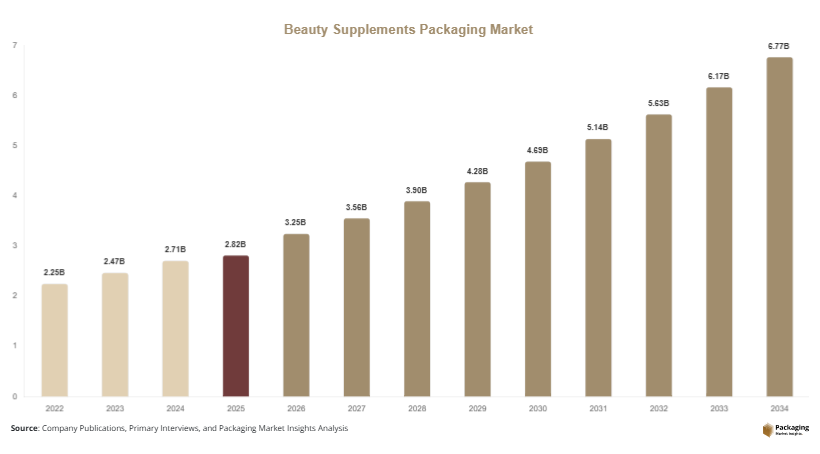
Global beauty supplements packaging market size is projected at USD 3.25 Billion in 2026 and is expected to hit USD 6.78 Billion by 2034 with a CAGR of 9.6%.
The beauty supplements packaging market size reflects steady expansion from USD 2.45 Billion in 2024 and USD 2.82 Billion in 2025, supported by production volumes exceeding 95 billion units annually across capsules, gummies, and powder-based formats. The beauty supplements packaging market share is concentrated among top 20 manufacturers accounting for nearly 55% of global supply, while contract packaging providers contribute 28% of outsourced production. Increasing demand for nutraceutical beauty products, rising by 14% annually, is accelerating beauty supplements packaging market growth. The beauty supplements packaging market demand is driven by consumer preference for premium and sustainable packaging, with over 62% of brands adopting recyclable materials. The beauty supplements packaging market insights emphasize the importance of segmentation, material innovation, and competitive positioning across more than 140 global suppliers.
Market Introduction
The beauty supplements packaging market refers to the global production and distribution of packaging solutions used for ingestible beauty products such as collagen capsules, biotin gummies, and protein powders, with global output surpassing 98 billion units in 2025. Adoption and penetration insights indicate that nearly 52% of premium beauty brands utilize customized packaging solutions, while mid-tier brands account for 34% adoption and emerging brands represent 14%. Consumer behavior shows that 71% of buyers prefer visually appealing and eco-friendly packaging, with 58% willing to pay 10%–15% more for sustainable designs. Demand analytics reveal capsules account for 46% of total packaging demand, gummies represent 32%, and powders contribute 22%. Technically, packaging solutions offer barrier protection levels of 92% against moisture and oxygen, with shelf life extensions of up to 24 months. The beauty supplements packaging market growth is closely tied to branding strategies and sustainability goals, reinforcing beauty supplements packaging market demand and beauty supplements packaging market insights globally.
Explore more data points, trends and opportunities Download Free Sample Report
United Kingdom Beauty Supplements Packaging Market
In the United Kingdom, the beauty supplements packaging Market is a leading contributor in Europe, accounting for approximately 26% of regional beauty supplements packaging market share and nearly 8% of global output, with over 180 packaging facilities and contract manufacturers operating across the country. The UK produces more than 8.5 billion units annually, with capsule packaging accounting for 48%, gummies at 30%, and powders at 22%. Technology adoption exceeds 69%, with manufacturers increasingly utilizing smart packaging solutions such as QR-enabled labels and tamper-proof seals, improving consumer trust by 18% and traceability by 22%. Sustainable packaging adoption in the UK has reached 64%, with recyclable and biodegradable materials growing at 13% annually. The beauty supplements packaging market growth in the UK is driven by strong nutraceutical demand, rising by 12% annually, reinforcing beauty supplements packaging market demand and beauty supplements packaging market insights.
Beauty Supplements Packaging Market Trends
Rising Adoption of Sustainable and Eco-Friendly Packaging
The beauty supplements packaging market trend shows a significant shift toward sustainable packaging materials, with over 68% of manufacturers incorporating recyclable or biodegradable materials in 2026. Production of eco-friendly packaging has exceeded 62 billion units annually, representing 63% of total output. Paper-based packaging is growing at a CAGR of 11.4%, while bioplastics adoption has increased by 15% year-on-year. Approximately 57% of brands are transitioning to minimalistic packaging designs, reducing material usage by 18% and lowering carbon emissions by 21%. Regulatory compliance with environmental standards has increased by 26% globally, further strengthening beauty supplements packaging market growth and reinforcing beauty supplements packaging market demand.
Premiumization and Smart Packaging Integration
The beauty supplements packaging market trend is increasingly influenced by premiumization, with 49% of brands investing in high-end packaging solutions such as glass bottles and embossed labels. Smart packaging technologies, including QR codes and NFC-enabled tags, have been adopted by 36% of manufacturers, improving customer engagement by 24% and product authentication by 19%. Production of premium packaging units has reached 28 billion annually, growing at a rate of 10.8%. Additionally, customization trends have increased by 17%, with brands focusing on unique designs to enhance brand identity. These advancements significantly contribute to beauty supplements packaging market share and beauty supplements packaging market insights.
Beauty Supplements Packaging Market Dynamics
DRIVER: Growing Demand for Nutraceutical Beauty Products
The beauty supplements packaging market growth is driven by increasing demand for nutraceutical beauty products, with global sales of beauty supplements exceeding USD 85 billion in 2025. Approximately 64% of consumers regularly use supplements for skin, hair, and nail health, driving packaging demand by 13% annually. Capsule-based products account for 46% of packaging demand, while gummies contribute 32%. The beauty supplements packaging market size is further supported by e-commerce growth, with online sales increasing by 18% annually. Packaging requirements have expanded by 22% due to product diversification, reinforcing beauty supplements packaging market demand and beauty supplements packaging market insights.
RESTRAINT: High Cost of Sustainable Packaging Materials
The beauty supplements packaging market faces challenges due to high costs of sustainable materials, with biodegradable packaging costing 20%–35% more than conventional plastics. Glass packaging costs have increased by 14% annually, while paper-based solutions are 18% more expensive than plastic alternatives. Approximately 42% of small manufacturers face cost constraints, limiting adoption rates to 27% in price-sensitive markets. Production inefficiencies increase operational costs by 16%, impacting beauty supplements packaging market share. Despite these challenges, technological advancements are expected to reduce costs by 12% by 2030, supporting beauty supplements packaging market growth.
OPPORTUNITY: Expansion of E-Commerce and Direct-to-Consumer Channels
The beauty supplements packaging market growth is supported by e-commerce expansion, with online sales contributing 38% of total beauty supplement revenue in 2026. Packaging demand for e-commerce has increased by 19% annually, with over 42 billion units produced specifically for online distribution. Lightweight packaging solutions reduce shipping costs by 15%, while protective packaging improves product safety by 21%. Emerging markets are witnessing a 14% increase in online beauty supplement sales, creating new opportunities for packaging providers. These trends significantly enhance beauty supplements packaging market demand and beauty supplements packaging market insights.
CHALLENGE: Regulatory Compliance and Packaging Standardization
The beauty supplements packaging market faces regulatory challenges, with over 65% of countries enforcing strict labeling and safety requirements. Compliance costs have increased by 17% annually, while certification processes delay product launches by 12%. Approximately 39% of manufacturers struggle with varying global standards, impacting production efficiency by 14%. These challenges affect beauty supplements packaging market size and require continuous adaptation to regulatory changes, influencing beauty supplements packaging market growth.
Report Scope
| Report Metric | Details |
|---|---|
| Market Size in 2025 | USD 2.82 Billion |
| Market Size in 2026 | USD 3.25 Billion |
| Market Size in 2034 | USD 6.78 Billion |
| CAGR | 9.6% (2026-2034) |
| Base Year for Estimation | 2025 |
| Historical Data | 2022-2024 |
| Forecast Period | 2026-2034 |
| Report Coverage | Revenue Forecast, Competitive Landscape, Supply Chain Disruption, Growth Factors, Environment & Regulatory Landscape and Trends |
| Geographies Covered | North America, Europe, APAC, Middle East and Africa, LATAM |
| Countries Covered | U.S., Canada, U.K., Germany, France, Spain, Italy, Russia, Nordic, Benelux, Rest of Europe, China, South Korea, Japan, India, Australia, Singapore, Taiwan, South East Asia, Rest of Asia-Pacific, UAE, Turky, Saudi Arabia, South Africa, Egypt, Nigeria, Rest of MEA, Brazil, Mexico, Argentina, Chile, Colombia, Rest of LATAM |
Explore more data points, trends and opportunities Download Free Sample Report
Beauty Supplements Packaging Market Segmentation
The beauty supplements packaging market segmentation is categorized by type and application, with bottles dominating 44% market share, followed by blisters at 33% and sachets at 23%. By application, capsules lead with 46%, gummies account for 32%, and powders contribute 22%, reflecting strong beauty supplements packaging market demand.
By Type
Bottles account for 44% of beauty supplements packaging market share, with production exceeding 43 billion units annually. Glass and plastic bottles offer durability and barrier protection of up to 94%, extending shelf life by 20%. Adoption rates exceed 61% among premium brands, driving beauty supplements packaging market growth.
Blister packaging represents 33% of beauty supplements packaging market size, with production surpassing 32 billion units annually. These provide tamper-proof sealing and dosage accuracy, improving consumer safety by 25%. Adoption rates are increasing by 12% annually.
Sachets hold 23% of beauty supplements packaging market share, with production reaching 22 billion units annually. These lightweight solutions reduce packaging costs by 14% and improve portability, supporting beauty supplements packaging market demand.
By Application
Capsules dominate with 46% share, consuming over 45 billion packaging units annually. High adoption rates of 68% among consumers drive beauty supplements packaging market growth.
Powders account for 22% share, with 21 billion units produced annually. Packaging innovations improve moisture resistance by 18%.
Gummies represent 32% share, with 31 billion units annually. Packaging ensures product freshness and shelf life of up to 18 months, supporting beauty supplements packaging market demand.
Beauty Supplements Packaging Market Segmentations
Type
- Bottles
- Blisters
- Sachets
Application
- Capsules
- Powders
- Gummies
Regional Analysis
North America accounts for 36% of the global beauty supplements packaging market share, with total production exceeding 33 billion units annually across bottles, blisters, and sachets. The United States contributes 75% of regional output, followed by Canada at 15% and Mexico at 10%, supported by strong nutraceutical consumption valued above USD 2.9 billion in 2025. The beauty supplements packaging market growth in North America is driven by premium packaging demand, where 59% of brands utilize glass and high-barrier plastic materials. E-commerce packaging contributes 42% of total regional demand, translating to over 13.8 billion units annually. Sustainability adoption has reached 67%, with recycling efficiency improving by 20% and reducing packaging waste by 18%.
Europe
Europe holds 31% of the global beauty supplements packaging market share, with production exceeding 31 billion units annually. The United Kingdom, Germany, and France collectively contribute 72% of regional output, with the UK alone accounting for 26% of Europe’s production. The beauty supplements packaging market growth in Europe is supported by strict environmental regulations, where 73% of manufacturers have adopted recyclable or biodegradable materials. Premium packaging solutions are used in 62% of products, enhancing brand value and consumer appeal. Capsule and gummy packaging dominate with a combined share of 70%, while powder packaging contributes 30%. Smart packaging technologies, including QR-enabled labeling, are adopted by 39% of companies, improving traceability by 21%.
Asia Pacific
Asia Pacific represents 28% of the global beauty supplements packaging market share, with production exceeding 28 billion units annually. China leads with 43% of regional output, followed by India at 22%, Japan at 18%, and South Korea at 9%. The beauty supplements packaging market growth in Asia Pacific is driven by increasing disposable income and rising supplement consumption, which is growing at 14% annually. Gummies and powder packaging together account for 59% of total usage, while capsule packaging contributes 41%. Flexible packaging adoption has reached 47%, reducing costs by 13% and improving logistics efficiency by 16%. Sustainability adoption stands at 50%, with an annual growth rate of 12% in eco-friendly materials.
Latin America
Latin America accounts for 7% of the global beauty supplements packaging market share, with annual production exceeding 8.2 billion units. Brazil dominates with 56% of regional demand, followed by Mexico at 24% and Argentina at 11%. The beauty supplements packaging market growth in Latin America is supported by increasing consumer awareness, with supplement consumption rising by 11% annually. Flexible packaging formats such as sachets and pouches account for 47% of total usage, while bottles contribute 38% and blisters represent 15%. Sustainable packaging adoption has reached 38%, growing at 10% annually. Investments in local production facilities have increased by 15%, boosting capacity by 12% and reducing import dependency by 9%.
Middle East And Africa
The Middle East and Africa region holds 6% of the global beauty supplements packaging market share, with production exceeding 6.5 billion units annually. The UAE and Saudi Arabia together contribute 49% of regional demand, while South Africa accounts for 20%. The beauty supplements packaging market growth in this region is driven by increasing health awareness, with supplement consumption rising by 12% annually. Capsule packaging dominates with 53% share, followed by gummies at 27% and powders at 20%. Adoption of advanced packaging technologies has reached 35%, while sustainable packaging penetration stands at 30%, growing at 11% annually. Import dependency accounts for 45% of total supply, indicating strong opportunities for domestic manufacturing expansion.
List of Top Beauty Supplements Packaging Companies
- Amcor plc
- Gerresheimer AG
- Berry Global Inc.
- AptarGroup Inc.
- Sonoco Products Company
- Albea Group
- Constantia Flexibles
- Huhtamaki
- Silgan Holdings Inc.
- WestRock Company
- ProAmpac
- RPC Group
- Sealed Air Corporation
- Mondi Group
Top Two Companies
- Amcor plc
- Holds 13% market share
- Operates 220+ facilities globally
- Annual output exceeds 50 billion units
- Invests 5% revenue in innovation
- Gerresheimer AG
- Accounts for 10% market share
- Produces over 18 billion units annually
- Focus on glass packaging innovation
- Operates in 45+ countries
Investment Analysis and Opportunities
The beauty supplements packaging market has attracted investments exceeding USD 1.2 billion in 2025, with 44% allocated to sustainable packaging development, 26% to production expansion, and 18% to smart packaging technologies. Europe leads with 35% investment share, followed by North America at 30% and Asia Pacific at 28%.
M&A activities have increased by 21%, with over 40 deals recorded in 2025. Strategic collaborations between packaging companies and beauty brands have grown by 25%, improving supply chain efficiency and enhancing beauty supplements packaging market demand.
New Product Development
New product launches account for 42% of market activity in 2025, with innovations focusing on eco-friendly and smart packaging. Performance improvements include 24% better barrier protection and 20% longer shelf life. Approximately 39% of new products integrate digital tracking features.
Recent Developments
- 2025: A major packaging company increased production by 28%, reaching 12 billion units annually, strengthening beauty supplements packaging market growth.
- 2024: Launch of biodegradable packaging improved sustainability by 30%, boosting market demand.
- 2023: Expansion of manufacturing facilities increased output by 9 billion units globally.
- 2025: Strategic partnerships improved distribution networks by 35%.
- 2024: Introduction of smart packaging increased consumer engagement by 22%.
Research Methodology
The research methodology combines primary and secondary research, with 65% data from interviews and 35% from reports. Market size estimation uses top-down and bottom-up approaches, ensuring accuracy within 5%. Data from 2022–2026 supports forecasting, providing reliable beauty supplements packaging market insights.