Battery Packaging Shell Market Size and Growth
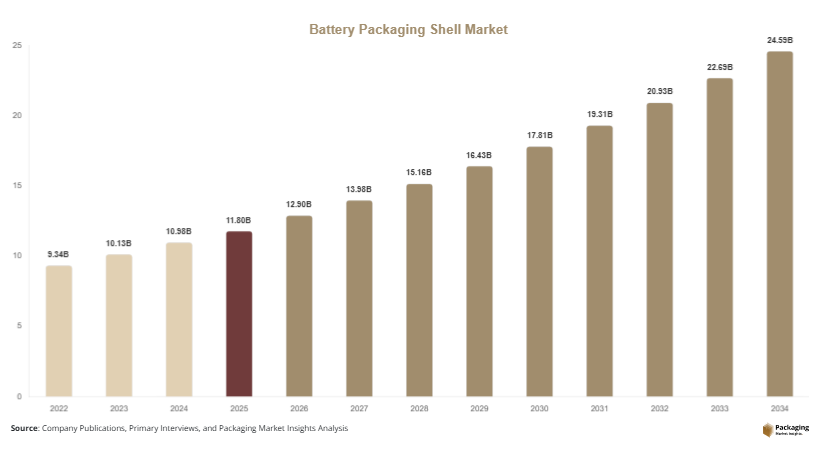
The global battery packaging shell market size is estimated at USD 11.8 billion in 2025, while the market is projected to reach USD 12.9 billion in 2026. By 2034, the market is forecasted to attain USD 26.7 billion, registering a CAGR of 8.4% during 2025–2034. The global battery packaging shell market is witnessing substantial growth due to the increasing adoption of electric vehicles, expansion of energy storage systems, and rising demand for portable electronic devices. Battery packaging shells are critical components designed to protect battery cells from external damage, thermal fluctuations, moisture, and mechanical stress. These shells are commonly manufactured using aluminum, steel, polymer composites, and advanced lightweight materials to ensure safety, durability, and thermal stability.
One of the major growth factors driving the market is the rapid increase in electric vehicle production across major automotive markets. Electric vehicle manufacturers require advanced battery shell packaging solutions capable of ensuring thermal protection and structural stability during vehicle operations. Another important growth factor is the growing investment in renewable energy storage infrastructure. Grid-scale battery storage systems require durable battery shell packaging to maintain safety and operational efficiency over long periods. In addition, the expansion of consumer electronics manufacturing is increasing demand for compact and lightweight battery packaging shells used in smartphones, laptops, wearable devices, and portable industrial equipment.
Key Highlights
- Asia Pacific dominated the market with a 47.2% share in 2025.
- Latin America is projected to grow at the fastest CAGR of 8.9%.
- Aluminum battery shells led the material segment with a 44.8% share.
- Electric vehicle battery applications dominated the application segment with a 52.6% share.
- Automotive manufacturers led the end-use segment with 55.9% share.
- The US remained the dominant country with a market size of USD 2.4 billion in 2025 and USD 2.6 billion in 2026.
Explore more data points, trends and opportunities Download Free Sample Report
Market Trends
Increasing Adoption of Lightweight and High-Strength Materials
The battery packaging shell market is increasingly shifting toward lightweight and high-strength materials to improve battery efficiency and safety performance. Manufacturers are replacing conventional steel battery shells with aluminum alloys and advanced composite materials that reduce overall battery weight without compromising structural integrity. Lightweight battery shells are particularly important in electric vehicles because they improve energy efficiency and driving range. In addition, advanced composite materials provide better corrosion resistance and thermal insulation, supporting longer battery life and enhanced operational safety. Manufacturers are also investing in material engineering technologies to improve impact resistance and optimize shell designs for next-generation battery systems used in automotive and industrial applications.
Integration of Thermal Management and Smart Safety Features
Thermal management integration is becoming a significant trend in the battery packaging shell market. Battery manufacturers are increasingly incorporating heat dissipation systems, insulation layers, and smart monitoring technologies into battery shell structures to prevent overheating and improve operational reliability. Electric vehicle battery systems generate substantial heat during charging and discharging cycles, creating strong demand for packaging shells with advanced thermal management capabilities. Smart sensors integrated into battery packaging systems are also enabling real-time monitoring of temperature, pressure, and battery performance. These technologies help reduce safety risks and improve battery lifespan across automotive, consumer electronics, and energy storage applications.
Market Drivers
Rapid Expansion of Electric Vehicle Manufacturing
The rapid expansion of electric vehicle manufacturing is one of the primary drivers supporting the battery packaging shell market. Governments worldwide are promoting electric mobility through subsidies, emission reduction targets, and investments in charging infrastructure. As electric vehicle production increases, demand for durable and lightweight battery shell packaging solutions continues to rise. Battery packaging shells play a critical role in protecting lithium-ion battery cells from thermal runaway, vibration, and external impacts during vehicle operation. Automotive manufacturers are increasingly investing in advanced battery packaging technologies to improve vehicle safety, battery efficiency, and driving performance. This trend is expected to support strong long-term market growth.
Growing Investment in Renewable Energy Storage Systems
The growing investment in renewable energy storage infrastructure is another major factor driving market expansion. Utility companies and industrial operators are increasingly deploying large-scale battery energy storage systems to support renewable power generation and grid stability. These storage systems require durable and thermally stable battery shell packaging capable of operating under varying environmental conditions. Governments are also supporting energy storage deployment through clean energy initiatives and infrastructure funding programs. As renewable energy adoption continues to increase globally, demand for industrial battery packaging shells is expected to rise steadily.
Market Restraint
High Manufacturing Costs and Raw Material Price Volatility
One of the major restraints affecting the battery packaging shell market is the high manufacturing cost associated with advanced materials and precision engineering processes. Aluminum alloys, composite materials, and thermal insulation components often involve higher production expenses compared to conventional battery packaging materials. In addition, fluctuations in raw material prices, particularly aluminum and specialty polymers, can significantly impact manufacturing costs and profit margins. Battery manufacturers are also under pressure to reduce battery costs while maintaining safety and performance standards. For example, some electric vehicle manufacturers may delay adoption of advanced composite battery shells because of cost concerns and limited large-scale production capacity. These financial pressures may limit adoption among smaller manufacturers and slow market expansion in cost-sensitive regions.
Market Opportunities
Expansion of Solid-State Battery Technology
The development of solid-state battery technology presents substantial opportunities for the battery packaging shell market. Solid-state batteries require specialized packaging systems capable of supporting improved thermal management and compact structural designs. These next-generation batteries are expected to offer higher energy density and enhanced safety compared to conventional lithium-ion batteries. Automotive manufacturers and battery developers are investing heavily in solid-state battery research and commercialization. This transition is expected to create demand for innovative battery shell materials and advanced packaging technologies optimized for next-generation energy storage systems.
Increasing Localization of Battery Manufacturing Facilities
The growing localization of battery manufacturing facilities across North America and Europe is creating another major opportunity for market participants. Governments and automotive companies are investing in domestic battery production to reduce supply chain dependence and strengthen regional manufacturing capabilities. New battery gigafactories require large-scale sourcing of battery shell packaging components and thermal management systems. This trend is encouraging packaging shell manufacturers to establish regional production facilities and expand partnerships with automotive and energy storage companies. Localized production is also improving supply chain efficiency and reducing transportation costs for battery manufacturers.
Report Scope
| Report Metric | Details |
|---|---|
| Market Size in 2025 | USD 11.8 Billion |
| Market Size in 2026 | USD 12.9 Billion |
| Market Size in 2034 | USD 26.7 Billion |
| CAGR | 8.4% (2026-2034) |
| Base Year for Estimation | 2025 |
| Historical Data | 2022-2024 |
| Forecast Period | 2026-2034 |
| Report Coverage | Revenue Forecast, Competitive Landscape, Supply Chain Disruption, Growth Factors, Environment & Regulatory Landscape and Trends |
| Geographies Covered | North America, Europe, APAC, Middle East and Africa, LATAM |
| Countries Covered | U.S., Canada, U.K., Germany, France, Spain, Italy, Russia, Nordic, Benelux, Rest of Europe, China, South Korea, Japan, India, Australia, Singapore, Taiwan, South East Asia, Rest of Asia-Pacific, UAE, Turky, Saudi Arabia, South Africa, Egypt, Nigeria, Rest of MEA, Brazil, Mexico, Argentina, Chile, Colombia, Rest of LATAM |
Explore more data points, trends and opportunities Download Free Sample Report
Segmental Analysis
By Material Type
Aluminum battery shells dominated the battery packaging shell market in 2024, accounting for approximately 44.8% of total market share. Aluminum is widely preferred because it offers an optimal balance between lightweight properties, corrosion resistance, and structural strength. Electric vehicle manufacturers increasingly use aluminum battery shells to reduce vehicle weight and improve energy efficiency. These shells also provide strong thermal conductivity, helping dissipate heat generated during battery operation. In addition, aluminum materials are highly recyclable, supporting sustainability objectives within automotive and energy storage industries. Rising production of electric vehicles and consumer electronics is continuing to strengthen demand for aluminum battery packaging solutions globally.
Composite material shells are expected to be the fastest-growing subsegment, registering a CAGR of 9.3% during the forecast period. Composite materials provide enhanced impact resistance, lightweight performance, and superior thermal insulation compared to traditional metals. Battery manufacturers are increasingly adopting advanced polymer composites and hybrid materials to improve battery safety and operational efficiency. These materials are especially valuable in high-performance electric vehicles and aerospace battery systems where weight reduction is critical. Continuous advancements in composite manufacturing technologies and material engineering are expected to support broader adoption across industrial and automotive battery applications.
By Application
Electric vehicle battery applications held the dominant position in the market in 2024 with a share of approximately 52.6%. The rapid growth of electric mobility and government incentives supporting zero-emission transportation are significantly increasing demand for advanced battery packaging shell solutions. Electric vehicle batteries require durable protective shells capable of managing thermal conditions, vibration, and impact during vehicle operation. Automotive manufacturers are focusing on lightweight battery systems to improve vehicle range and performance, which is increasing demand for advanced aluminum and composite battery packaging technologies. In addition, the growing production of commercial electric vehicles and battery-powered buses is supporting long-term growth in this segment.
Energy storage systems are projected to witness the fastest CAGR of 9.1% during the forecast period. Renewable energy projects increasingly rely on battery energy storage systems to stabilize power supply and improve grid reliability. These systems require durable and thermally stable packaging shells capable of supporting large-scale battery operations over extended periods. Governments and utility providers are investing heavily in renewable energy infrastructure, creating substantial demand for industrial battery packaging systems. In addition, increasing adoption of distributed energy storage systems in commercial and residential applications is supporting rapid segment growth.
By End-Use
Automotive manufacturers dominated the battery packaging shell market in 2024 and accounted for approximately 55.9% of total revenue share. Automotive companies require advanced battery shell solutions to support electric vehicle production and ensure compliance with strict safety standards. Increasing competition in the electric mobility industry is encouraging manufacturers to invest in lightweight and thermally efficient battery packaging systems that improve vehicle performance and operational safety. The expansion of electric vehicle production facilities and battery gigafactories is also strengthening demand for industrial-scale battery shell manufacturing capabilities.
Consumer electronics manufacturers are expected to record the fastest growth, with a projected CAGR of 8.7% during the forecast period. Smartphones, laptops, wearable devices, and portable industrial equipment require compact and lightweight battery packaging systems capable of ensuring product safety and thermal stability. The increasing adoption of high-performance batteries in advanced consumer electronics is encouraging manufacturers to invest in durable and miniaturized battery shell technologies. Rapid innovation in portable electronics and smart devices is expected to create long-term opportunities for battery shell manufacturers serving the consumer electronics industry.
Battery Packaging Shell Market Segmentations
By Material Type
- Aluminum Battery Shells
- Steel Battery Shells
- Composite Material Shells
- Plastic Battery Shells
By Application
- Electric Vehicle Batteries
- Consumer Electronics Batteries
- Energy Storage Systems
- Industrial Batteries
By End-User
- Automotive Manufacturers
- Consumer Electronics Manufacturers
- Energy & Utilities
- Industrial Equipment Manufacturers
Regional Analysis
North America
North America accounted for approximately 24.6% of the global battery packaging shell market share in 2025 and is projected to grow at a CAGR of 7.8% during the forecast period. The region benefits from increasing electric vehicle production, growing investment in battery manufacturing facilities, and rising deployment of energy storage systems. Government incentives supporting clean energy infrastructure and domestic battery supply chains are further contributing to regional market growth.
The United States dominates the North American market because of its expanding electric vehicle manufacturing industry and increasing investment in battery gigafactories. A unique growth factor is the rapid development of domestic lithium-ion battery production infrastructure. Automotive manufacturers and battery suppliers are increasing demand for lightweight and thermally stable battery shell packaging systems to support next-generation electric mobility solutions.
Europe
Europe held nearly 22.9% of the global market share in 2025 and is expected to register a CAGR of 7.9% through 2034. The regional market is supported by strict emission reduction regulations, strong electric vehicle adoption, and increasing renewable energy storage investments. Battery manufacturers across Europe are focusing on sustainable and recyclable packaging materials to align with regional environmental standards and circular economy objectives.
Germany remains the dominant country in the European market due to its advanced automotive manufacturing sector and expanding electric vehicle production capacity. A unique growth factor is the country’s strong focus on battery innovation and energy transition initiatives. Increasing investment in domestic battery manufacturing facilities is supporting demand for advanced battery packaging shell solutions throughout Germany.
Asia Pacific
Asia Pacific dominated the battery packaging shell market with a 47.2% share in 2025 and is projected to grow at a CAGR of 8.8% during the forecast period. Rapid expansion of battery manufacturing, increasing electric vehicle adoption, and strong consumer electronics production are major factors driving regional market growth. The region also benefits from large-scale investments in renewable energy storage projects and industrial battery manufacturing infrastructure.
China remains the dominant country in Asia Pacific because of its massive battery production capacity and strong electric vehicle manufacturing ecosystem. One unique growth factor is the country’s leadership in lithium-ion battery exports and battery material processing. Increasing production of electric vehicle batteries and energy storage systems is creating substantial demand for advanced battery packaging shell technologies across China.
Middle East & Africa
The Middle East & Africa region accounted for approximately 3.8% of the global market share in 2025 and is forecast to grow at a CAGR of 7.1%. Rising investments in renewable energy infrastructure and industrial battery applications are supporting regional market expansion. Governments are increasingly focusing on clean energy adoption and grid modernization projects, creating demand for advanced energy storage systems and battery packaging solutions.
Saudi Arabia dominates the regional market due to its growing investment in renewable energy projects and industrial diversification strategies. A unique growth factor is the country’s increasing focus on domestic electric mobility and energy storage infrastructure. These initiatives are supporting demand for industrial battery systems and advanced battery shell packaging technologies.
Latin America
Latin America represented around 4.5% of the global market share in 2025 and is projected to grow at the fastest CAGR of 8.9% during the forecast period. The region is benefiting from increasing renewable energy deployment, rising electric vehicle adoption, and growing investments in industrial battery storage applications. Improvements in manufacturing infrastructure and government support for clean energy projects are also contributing to market expansion.
Brazil leads the Latin American market due to its expanding renewable energy sector and increasing automotive electrification initiatives. A unique growth factor is the country’s investment in solar and wind energy storage infrastructure. This is creating higher demand for durable battery packaging shell solutions designed for industrial-scale energy storage systems.
Competitive Landscape
The global battery packaging shell market is moderately competitive, with major companies focusing on lightweight materials, thermal management technologies, and strategic partnerships with battery manufacturers and automotive companies. Market participants are investing in advanced aluminum processing technologies and composite material development to improve battery safety and operational efficiency. Companies are also expanding production facilities to meet increasing demand from electric vehicle and energy storage industries.
Novelis Inc. remains one of the leading companies in the market due to its strong expertise in aluminum material engineering and automotive battery packaging solutions. In 2024, the company introduced a high-strength lightweight aluminum battery enclosure solution designed for next-generation electric vehicle platforms. Other major participants include SGL Carbon, Constellium SE, Thyssenkrupp AG, and UACJ Corporation. These companies are emphasizing recyclable materials, lightweight structures, and advanced thermal protection technologies to strengthen market competitiveness.
Key Players List
- Novelis Inc.
- SGL Carbon
- Constellium SE
- Thyssenkrupp AG
- UACJ Corporation
- Norsk Hydro ASA
- POSCO Holdings Inc.
- Magna International Inc.
- ElringKlinger AG
- Nemak SAB de CV
- China Zhongwang Holdings Limited
- Henkel AG & Co. KGaA
- SABIC
- Covestro AG
- Dana Incorporated
- Alcoa Corporation