Battery Packaging Market Size and Growth
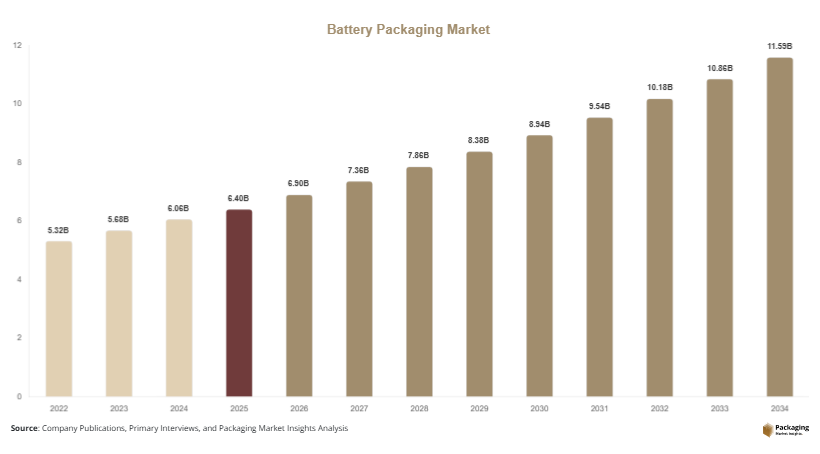
The global battery packaging market size was valued at approximately USD 6.4 billion in 2025 and is projected to reach USD 6.9 billion in 2026. Supported by strong adoption of lithium-ion batteries across automotive and industrial applications, the market is expected to reach USD 11.8 billion by 2034, growing at a CAGR of 6.7% during 2025–2034. The rising need for safe transportation, storage, and thermal protection of high-energy batteries continues to strengthen demand for specialized packaging solutions. The battery packaging market is witnessing steady expansion driven by rapid growth in electric mobility, renewable energy storage systems, and increasing demand for advanced battery safety solutions.
One of the primary growth factors is the accelerating adoption of electric vehicles (EVs) worldwide. As EV production increases, the requirement for secure battery handling and packaging solutions is expanding significantly. Another important factor is the rising deployment of energy storage systems (ESS) in renewable energy projects, particularly solar and wind power installations. These systems require robust packaging to ensure battery safety and performance stability during long-term use.
Key Market Highlights
- Asia Pacific dominated the market with a 38.6% share in 2025, while Latin America is projected to grow at the fastest CAGR of 6.8%.
- Lithium-ion battery packaging led the type segment with a 41.3% share, while solid-state battery packaging is expected to grow at a CAGR of 7.2%.
- Plastic-based protective packaging dominated with a 49.7% share, while composite fiber packaging is forecasted to grow at a CAGR of 6.9%.
- Automotive applications led the segment with 45.2% share, while energy storage systems are expected to grow at a CAGR of 7.0%.
- China remained the dominant country with a market size of USD 2.1 billion in 2025 and USD 2.3 billion in 2026.
Explore more data points, trends and opportunities Download Free Sample Report
Market Trends
Rising Adoption of Fire-Resistant and Thermally Stable Packaging Materials
The battery packaging market is increasingly influenced by the need for fire-resistant and thermally stable packaging materials. As lithium-ion batteries are widely used in electric vehicles and energy storage systems, the risk of overheating and thermal runaway has become a critical concern. Manufacturers are developing advanced packaging solutions that incorporate flame-retardant coatings, thermal insulation layers, and heat-dissipating structures. These innovations help reduce the risk of fire incidents during transportation and storage. Additionally, regulatory authorities are enforcing stricter safety standards for hazardous materials, pushing companies to adopt high-performance packaging materials. This trend is particularly strong in automotive and industrial applications, where battery safety is a top priority.
Growth of Smart and Sensor-Integrated Packaging Systems
Another key trend shaping the battery packaging market is the integration of smart technologies into packaging systems. Smart packaging solutions equipped with sensors are being developed to monitor temperature, humidity, shock, and pressure during battery transportation. These systems provide real-time data, allowing manufacturers and logistics providers to ensure safe handling conditions. The adoption of IoT-enabled tracking systems is improving supply chain visibility and reducing risks associated with battery damage. This trend is gaining traction in high-value applications such as electric vehicles and aerospace batteries, where precise monitoring is essential. The increasing focus on digitalization in supply chain management is expected to further drive adoption of smart packaging solutions.
Market Drivers
Expansion of Electric Vehicle Production and Adoption
The rapid expansion of the electric vehicle industry is a major driver of the battery packaging market. As global governments push for cleaner transportation alternatives, EV production is increasing at a significant pace. This growth directly impacts demand for battery packaging solutions that ensure safe handling, transportation, and storage of high-energy battery systems. Packaging plays a crucial role in protecting batteries from physical damage, temperature fluctuations, and environmental exposure. Automotive manufacturers are investing in advanced packaging systems that enhance safety and comply with international transport regulations. The continuous rise in EV adoption across both developed and emerging markets is expected to sustain strong demand for battery packaging solutions.
Increasing Deployment of Renewable Energy Storage Systems
The growing use of renewable energy sources such as solar and wind power is driving demand for large-scale energy storage systems. These systems rely heavily on advanced battery technologies, which require specialized packaging for safe installation and long-term operation. Battery packaging ensures structural stability, thermal management, and protection from external environmental factors. As governments invest in renewable energy infrastructure, the deployment of energy storage systems is increasing globally. This is creating new opportunities for packaging manufacturers to develop solutions tailored to stationary storage applications. The need for reliable energy storage is expected to remain a key driver of market growth.
Market Restraint
High Material Costs and Complex Manufacturing Requirements
One of the key challenges in the battery packaging market is the high cost associated with advanced packaging materials and manufacturing processes. Materials such as fire-resistant composites, reinforced polymers, and multi-layer insulation systems are expensive to produce. Additionally, manufacturing battery packaging requires precision engineering to ensure safety compliance and performance reliability. This increases production costs and limits adoption among small and medium-sized manufacturers. For example, specialized packaging for EV batteries requires extensive testing and certification, which further adds to costs. These financial barriers can slow market expansion, particularly in price-sensitive regions where cost efficiency is a major concern for manufacturers and logistics providers.
Market Opportunities
Expansion of Battery Recycling and Second-Life Applications
The increasing focus on battery recycling and second-life applications presents significant opportunities for the battery packaging market. As the number of used batteries grows, there is rising demand for safe packaging solutions for collection, transportation, and processing. Recycled batteries require secure containment systems to prevent leakage, contamination, or fire hazards. Packaging manufacturers are developing reusable and modular packaging systems designed specifically for reverse logistics. Additionally, second-life applications of EV batteries in stationary storage systems are creating new packaging requirements. This trend is expected to open new revenue streams for packaging companies specializing in sustainable and circular economy solutions.
Innovation in Lightweight and Sustainable Packaging Solutions
Sustainability is becoming an important growth area in the battery packaging market. Manufacturers are focusing on developing lightweight packaging solutions that reduce material usage while maintaining high safety standards. The use of biodegradable composites, recyclable plastics, and fiber-based materials is gaining traction. These innovations help reduce environmental impact and align with global sustainability goals. Lightweight packaging also reduces transportation costs and improves energy efficiency in logistics operations. Companies investing in eco-friendly packaging technologies are expected to benefit from increasing regulatory support and growing consumer awareness regarding environmental sustainability.
Report Scope
| Report Metric | Details |
|---|---|
| Market Size in 2025 | USD 6.4 Billion |
| Market Size in 2026 | USD 6.9 Billion |
| Market Size in 2034 | USD 11.8 Billion |
| CAGR | 6.7% (2026-2034) |
| Base Year for Estimation | 2025 |
| Historical Data | 2022-2024 |
| Forecast Period | 2026-2034 |
| Report Coverage | Revenue Forecast, Competitive Landscape, Supply Chain Disruption, Growth Factors, Environment & Regulatory Landscape and Trends |
| Geographies Covered | North America, Europe, APAC, Middle East and Africa, LATAM |
| Countries Covered | U.S., Canada, U.K., Germany, France, Spain, Italy, Russia, Nordic, Benelux, Rest of Europe, China, South Korea, Japan, India, Australia, Singapore, Taiwan, South East Asia, Rest of Asia-Pacific, UAE, Turky, Saudi Arabia, South Africa, Egypt, Nigeria, Rest of MEA, Brazil, Mexico, Argentina, Chile, Colombia, Rest of LATAM |
Explore more data points, trends and opportunities Download Free Sample Report
Segmental Analysis
By Battery Type
Lithium-ion battery packaging dominated the battery packaging market in 2024 with approximately 41.3% share. This dominance is driven by widespread use of lithium-ion batteries in electric vehicles, consumer electronics, and industrial systems. These batteries require advanced packaging to ensure safety, thermal stability, and structural protection. Packaging solutions include rigid containers, thermal insulation layers, and shock-resistant materials. The increasing production of lithium-ion batteries globally continues to reinforce demand for specialized packaging systems that can support high-energy density applications while maintaining safety standards.
Solid-state battery packaging is expected to grow at the fastest CAGR of 7.2% during the forecast period. This growth is driven by advancements in next-generation battery technologies that offer higher energy density and improved safety. Solid-state batteries require specialized packaging due to their unique structural properties and sensitivity to environmental conditions. Manufacturers are developing innovative packaging solutions that provide enhanced thermal management and mechanical protection. The increasing investment in solid-state battery research is expected to significantly drive demand for advanced packaging systems.
By Packaging Type
Plastic-based protective packaging dominated the market in 2024 with approximately 49.7% share. This segment is widely used due to its flexibility, cost-effectiveness, and ability to provide shock resistance. Plastic packaging solutions are commonly used in battery transportation and storage applications. They offer strong protection against physical damage and environmental exposure. The growing demand for EV batteries and portable energy storage systems continues to support this segment’s dominance in the market.
Composite fiber packaging is expected to grow at the fastest CAGR of 6.9% during the forecast period. This growth is driven by increasing demand for lightweight and high-strength packaging materials. Composite fiber solutions offer superior thermal resistance and durability compared to traditional materials. They are increasingly used in high-value applications such as automotive and aerospace batteries. The focus on sustainability and weight reduction is further driving adoption of composite fiber packaging solutions.
By Application
The automotive application segment dominated the battery packaging market in 2024 with approximately 45.2% share. The rapid growth of electric vehicles is the primary driver of this segment. Automotive batteries require robust packaging systems to ensure safety during transportation and usage. Packaging plays a critical role in protecting battery modules from vibration, impact, and thermal stress. The increasing production of EVs globally continues to drive demand in this segment.
Energy storage systems are expected to grow at the fastest CAGR of 7.0%. This growth is driven by increasing investments in renewable energy infrastructure. Battery packaging for energy storage systems must ensure long-term stability and safety. The expansion of solar and wind energy projects is significantly contributing to demand. These systems require durable packaging solutions capable of supporting large-scale energy storage applications.
Battery Packaging Market Segmentations
By Battery Type
- Lithium-ion Batteries
- Solid-state Batteries
- Lead-acid Batteries
- Others
By Packaging Type
- Plastic Packaging
- Composite Fiber Packaging
- Metal Packaging
- Paper-based Packaging
By Application
- Automotive
- Consumer Electronics
- Energy Storage Systems
- Industrial
Regional Analysis
North America
North America accounted for approximately 23.4% of the battery packaging market share in 2025 and is expected to grow at a CAGR of 6.2%. The region benefits from strong electric vehicle adoption and advanced energy storage infrastructure. Increasing investments in clean energy projects and EV manufacturing are driving demand for high-performance battery packaging solutions. Regulatory standards for battery safety are also encouraging innovation in packaging technologies.
The United States dominates the regional market due to its large EV manufacturing base and strong research ecosystem. A key growth factor is the rapid expansion of battery gigafactories across the country. These facilities require advanced packaging systems to support large-scale production and logistics operations.
Europe
Europe held a 21.8% market share in 2025 and is projected to grow at a CAGR of 6.5%. The region is driven by strict environmental regulations and strong EV adoption policies. Battery packaging demand is increasing due to rising production of electric vehicles and renewable energy storage systems.
Germany leads the European market due to its strong automotive industry. A key growth factor is the increasing investment in domestic battery production facilities supported by government incentives.
Asia Pacific
Asia Pacific dominated the battery packaging market with a 38.6% share in 2025 and is expected to grow at a CAGR of 7.1%. The region benefits from large-scale battery manufacturing, EV production, and strong supply chain networks. Rapid industrialization and government support for clean energy technologies are boosting demand.
China is the dominant country due to its leadership in battery manufacturing and EV production. A key growth factor is the expansion of lithium-ion battery production capacity supported by major industrial investments.
Middle East & Africa
The Middle East & Africa region accounted for 7.5% of the market share in 2025 and is expected to grow at a CAGR of 6.4%. Growth is supported by increasing investments in renewable energy projects and energy storage systems. The region is gradually adopting advanced battery technologies for industrial applications.
Saudi Arabia leads the regional market due to its renewable energy expansion programs. A key growth factor is the development of large-scale solar energy projects requiring battery storage solutions.
Latin America
Latin America held a 8.7% market share in 2025 and is projected to grow at the fastest CAGR of 6.8%. The region is experiencing growing adoption of electric mobility and renewable energy systems. Government initiatives supporting clean energy are driving demand for battery technologies.
Brazil dominates the market due to increasing EV adoption and renewable energy investments. A key growth factor is the expansion of local energy storage projects supporting grid stability.
Competitive Landscape
The battery packaging market is moderately competitive, with several global players focusing on innovation, sustainability, and material advancement. Companies such as Amcor plc, 3M Company, and DS Smith are leading the market through continuous product development and strategic partnerships. These companies are investing in advanced materials such as fire-resistant composites and smart packaging systems.
Amcor plc remains a key leader due to its strong global presence and diversified packaging portfolio. The company has recently introduced advanced protective packaging solutions designed specifically for EV battery transportation, enhancing safety and efficiency across supply chains.
Key Players List
- Amcor plc
- 3M Company
- DS Smith plc
- Smurfit Kappa Group
- Sonoco Products Company
- Sealed Air Corporation
- Huhtamaki Group
- Nefab Group
- Greif Inc.
- International Paper Company
- Pregis LLC
- Ranpak Holdings Corp.
- Mondi Group
- Cascades Inc.
- Stora Enso Oyj