Barrier Tube Packaging Market Size
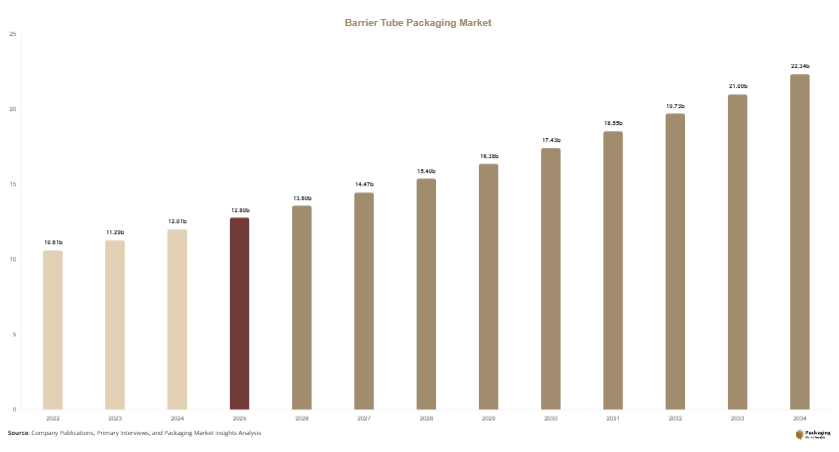
Barrier Tube Packaging market size is projected at USD 13.6 billion in 2026 and is expected to hit USD 22.4 billion by 2034 with a CAGR of 6.4%. Increasing demand for high-barrier packaging solutions, extended product shelf life, and premium packaging formats is accelerating market expansion. The report provides detailed analysis of material types, application segments, production capacity, competitive landscape, technological advancements, and regional market performance.
Barrier tube packaging refers to advanced tube-based packaging solutions designed with multi-layer structures to protect sensitive products from oxygen, moisture, UV exposure, and contamination. Global production exceeded 48 billion barrier tubes in 2025, with plastic barrier tubes accounting for approximately 52%, laminated tubes contributing 34%, and aluminum tubes representing nearly 14% of total production. More than 68% of premium personal care brands utilize barrier tube packaging due to improved product protection and consumer convenience, reinforcing the Barrier Tube Packaging Market.
Explore more data points, trends and opportunities Download Free Sample Report
Barrier Tube Packaging Market Trends
Increasing Adoption of Sustainable Barrier Tube Solutions
Manufacturers are shifting toward recyclable plastics, mono-material tubes, bio-based polymers, and lightweight packaging formats. Sustainable barrier tubes accounted for nearly 36% of newly launched products in 2025, while recycled polymer usage increased by approximately 22%. More than 17 billion sustainable barrier tubes entered global supply chains, strengthening the Barrier Tube Packaging Market.
Advanced extrusion technologies, improved barrier coatings, and reduced material consumption are transforming tube manufacturing. Approximately 59% of cosmetic packaging companies are investing in sustainable tube solutions, while lightweight barrier tube adoption increased by 18% across major markets. These developments continue supporting the Barrier Tube Packaging Market.
Growing Demand for Premium Cosmetic and Pharmaceutical Tubes
Premium skincare, pharmaceutical creams, ointments, and specialty formulations are increasing demand for advanced barrier protection. More than 25 billion cosmetic and pharmaceutical tubes were produced globally in 2025, while demand for air-tight and contamination-resistant packaging increased by 16%. These sector-specific requirements continue accelerating the Barrier Tube Packaging Market.
Barrier Tube Packaging Market Drivers
Rising Demand for Shelf-Life Extension Packaging
Manufacturers across cosmetics, pharmaceuticals, and food industries are adopting barrier tubes to improve product stability and reduce wastage. Approximately 72% of sensitive formulations require enhanced barrier protection, while global demand for extended shelf-life packaging increased by 14% annually. More than 30 billion high-barrier tubes are used for sensitive products each year, supporting the Barrier Tube Packaging Market.
Barrier Tube Packaging Market Restraints
High Manufacturing Costs of Multi-Layer Structures
Advanced barrier tubes require specialized materials, multilayer extrusion technologies, and complex production processes. Manufacturing costs are approximately 20–35% higher compared with conventional tubes, while raw material prices increased by nearly 13% during recent years. These cost factors continue limiting adoption among price-sensitive manufacturers and affecting the Barrier Tube Packaging Market.
Barrier Tube Packaging Market Opportunities
Expansion of Sustainable and Recyclable Packaging
Increasing environmental regulations and brand sustainability goals create significant opportunities for recyclable barrier tubes. Sustainable packaging investments increased by nearly 25%, while demand for mono-material tubes expanded by 19% during 2025. More than 10 billion recyclable barrier tubes are expected to be produced annually by 2030, creating new opportunities within the Barrier Tube Packaging Market.
Report Scope
| Report Metric | Details |
|---|---|
| Market Size in 2025 | USD 12.8 billion |
| Market Size in 2026 | USD 13.6 billion |
| Market Size in 2034 | USD 22.4 billion |
| CAGR | 6.4% (2026-2034) |
| Base Year for Estimation | 2025 |
| Historical Data | 2022-2024 |
| Forecast Period | 2026-2034 |
| Report Coverage | Revenue Forecast, Competitive Landscape, Supply Chain Disruption, Growth Factors, Environment & Regulatory Landscape and Trends |
| Geographies Covered | North America, Europe, APAC, Middle East and Africa, LATAM |
| Countries Covered | U.S., Canada, U.K., Germany, France, Spain, Italy, Russia, Nordic, Benelux, Rest of Europe, China, South Korea, Japan, India, Australia, Singapore, Taiwan, South East Asia, Rest of Asia-Pacific, UAE, Turky, Saudi Arabia, South Africa, Egypt, Nigeria, Rest of MEA, Brazil, Mexico, Argentina, Chile, Colombia, Rest of LATAM |
Explore more data points, trends and opportunities Download Free Sample Report
Challenges in Barrier Tube Packaging Market
Complex Recycling of Multi-Layer Tube Structures
Although barrier tubes provide excellent protection, multilayer structures create recycling challenges. Approximately 28% of existing tube packaging contains multiple material layers that require specialized processing. Recycling infrastructure limitations and separation difficulties continue influencing manufacturers to develop simplified structures within the Barrier Tube Packaging Market.
Barrier Tube Packaging Market Segmentation
The Barrier Tube Packaging Market is segmented based on material and application. Plastic barrier tubes dominate with approximately 52% market share due to lightweight properties and cost advantages, while personal care and cosmetics applications account for nearly 56% of total consumption.
By Material
Plastic Barrier Tubes
Plastic barrier tubes represent approximately 52% of market revenue, with annual production exceeding 25 billion units. These tubes provide lightweight construction, chemical resistance, excellent printability, and compatibility with PE, PP, and advanced polymer materials.
Aluminum Barrier Tubes
Aluminum barrier tubes contribute nearly 14% of market demand, with production exceeding 6 billion units annually. They offer complete oxygen and moisture protection, high recyclability, premium appearance, and strong compatibility with pharmaceutical ointments and specialty products.
Laminated Barrier Tubes
Laminated barrier tubes account for approximately 34% of industry revenue. Production exceeds 16 billion units annually, offering multilayer protection, customized barrier properties, lightweight structures, and improved product preservation.
By Application
Personal Care & Cosmetics
Personal care and cosmetics dominate with approximately 56% market share, consuming more than 27 billion barrier tubes annually. Skincare creams, toothpaste, gels, lotions, and premium beauty products require attractive designs, product protection, and controlled dispensing.
Pharmaceuticals
Pharmaceutical applications represent approximately 29% of market demand. More than 14 billion tubes are manufactured annually for ointments, gels, topical treatments, and medical formulations requiring contamination protection and stability.
Food & Beverages
Food and beverage applications contribute nearly 15% of consumption. Sauces, spreads, condiments, and specialty food products utilize more than 7 billion barrier tubes annually for freshness preservation and convenient usage.
Barrier Tube Packaging Market Segmentations
Material Type
- Plastic Barrier Tubes
- Aluminum Barrier Tubes
- Laminated Barrier Tubes
Application
- Personal Care & Cosmetics
- Pharmaceuticals
- Food & Beverages
Distribution Channel
- Direct Sales
- Packaging Distributors
- Online Sales
- OEM & Contract Packaging
- Specialty Packaging Suppliers
Barrier Tube Packaging Regional Outlook
North America
North America accounts for approximately 30% of global market revenue. The United States contributes nearly 82% of regional demand, supported by strong pharmaceutical production, premium cosmetics consumption, and advanced packaging infrastructure.
Europe
Europe represents approximately 29% of the market. Germany, France, Italy, and the United Kingdom collectively contribute more than 76% of regional consumption due to strong sustainability regulations and luxury cosmetics manufacturing.
Asia-Pacific
Asia-Pacific holds approximately 33% market share and remains the fastest-growing region. China, India, Japan, and South Korea collectively produce more than 18 billion barrier tubes annually, supported by expanding cosmetics, pharmaceutical, and food industries.
Latin America
Latin America contributes nearly 5% of global demand. Brazil and Mexico account for approximately 68% of regional consumption, driven by personal care manufacturing growth and increasing pharmaceutical packaging demand.
Middle East & Africa
The Middle East & Africa represent approximately 3% of global revenue. Saudi Arabia, UAE, and South Africa continue investing in healthcare and personal care industries, supporting barrier tube adoption.
Top players in Barrier Tube Packaging Market
- Amcor plc
- Albéa Group
- Essel Propack Limited
- Berry Global Inc.
- Huhtamaki Oyj
- Montebello Packaging Inc.
- HCP Packaging
- Alltub Group
- Sonoco Products Company
- LINHARDT Group
- PackGlobal
- IntraPac International LLC
Amcor plc
-
Estimated market share of approximately 15%, supported by global manufacturing capabilities and advanced sustainable packaging solutions.
-
The company focuses on recyclable barrier tubes, lightweight packaging designs, and innovative multilayer structures for cosmetics, pharmaceutical, and food applications. Strong customer relationships, global production facilities, and continuous investment in sustainable technologies strengthen its leadership position within the Barrier Tube Packaging Market.
Albéa Group
-
Estimated market share of approximately 12%, with strong specialization in cosmetic and personal care tube packaging.
-
Albéa emphasizes eco-designed tubes, recycled materials, advanced decoration technologies, and customized packaging solutions. Its extensive global presence and partnerships with leading beauty brands position the company as a major competitor in the Barrier Tube Packaging Market.