Barrier Coatings For Flexible Packaging Market Size and Growth
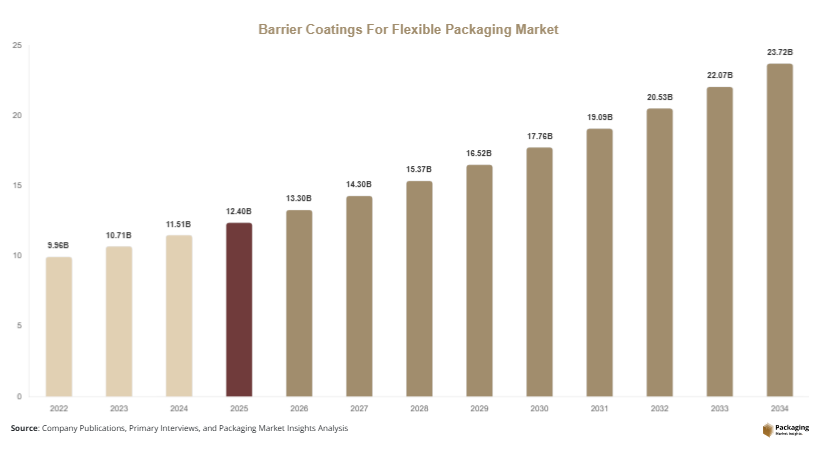
The global barrier coatings for flexible packaging Market size is estimated to reach USD 12.4 billion in 2025, rising to USD 13.3 billion in 2026. The industry is projected to expand significantly over the coming decade, reaching approximately USD 23.8 billion by 2034. This reflects a compound annual growth rate (CAGR) of 7.5% between 2025 and 2034. The market is gaining traction due to the growing adoption of lightweight packaging materials and increasing demand for packaged foods across emerging economies.
The barrier coatings for flexible packaging Market has experienced steady expansion as manufacturers focus on improving product shelf life, reducing food waste, and supporting sustainable packaging solutions. Barrier coatings are thin functional layers applied to flexible packaging materials such as paper, films, and laminates. These coatings help protect products from moisture, oxygen, light, grease, and other environmental factors. They are widely used in food packaging, pharmaceuticals, personal care, and industrial applications where product integrity is essential.
Key Highlights
- Market size estimated at USD 12.4 billion in 2025
- Expected to reach USD 23.8 billion by 2034
- Forecast CAGR of 7.5% from 2025 to 2034
- Increasing adoption of sustainable flexible packaging solutions
- Strong demand from food, pharmaceutical, and consumer goods industries
Explore more data points, trends and opportunities Download Free Sample Report
Market Trends
Rising Adoption of Sustainable Barrier Coatings
Sustainability has become a central trend in the barrier coatings for flexible packaging Market. Governments, packaging companies, and consumer brands are focusing on reducing plastic waste and improving recyclability. As a result, manufacturers are developing water-based barrier coatings and bio-based solutions that can replace traditional multilayer laminates containing aluminum or non-recyclable plastics.
Paper-based flexible packaging coated with advanced barrier layers is gaining strong traction in food and beverage applications. These coatings provide resistance against oxygen, grease, and moisture while allowing the packaging material to remain recyclable in existing paper recycling streams. Many packaging converters are also investing in compostable coatings that support circular economy initiatives. This trend is expected to accelerate as consumer awareness regarding environmentally responsible packaging continues to increase.
Integration of Advanced Nano-Barrier Technologies
Another emerging trend in the market is the adoption of nano-barrier coating technologies. These coatings incorporate nanoparticles or ultra-thin functional layers that significantly enhance protection against oxygen and water vapor while maintaining material flexibility. Nano-barrier solutions allow packaging manufacturers to achieve high barrier performance without adding thickness or additional plastic layers.
These advanced coatings are particularly beneficial in high-value packaging applications such as pharmaceuticals, medical products, and specialty foods. They provide excellent transparency and maintain the visual appeal of packaging materials. As research in material science progresses, companies are expected to introduce new nano-structured coatings that combine barrier performance with antimicrobial properties and improved durability.
Market Drivers
Expanding Demand for Packaged and Processed Foods
The rapid growth of the global food processing industry is one of the main drivers of the barrier coatings for flexible packaging Market. Urbanization and changing consumer lifestyles have increased the consumption of packaged meals, frozen foods, and convenience snacks. These products require protective packaging solutions that prevent contamination and maintain freshness during storage and distribution.
Barrier coatings help prevent oxygen penetration and moisture absorption, both of which can degrade food quality. By enhancing shelf life and reducing spoilage, these coatings allow manufacturers to distribute products across longer supply chains. As supermarkets and online grocery platforms expand in emerging markets, the need for advanced flexible packaging with strong barrier properties continues to grow.
Growth of Pharmaceutical and Healthcare Packaging
The pharmaceutical sector also contributes significantly to market growth. Many pharmaceutical products are sensitive to moisture, oxygen, and light exposure. Flexible packaging solutions coated with specialized barrier layers help protect medicines, medical devices, and diagnostic kits from environmental damage.
Barrier-coated packaging is widely used in blister packs, sachets, and pouches for drug formulations. With the global pharmaceutical industry expanding due to aging populations and increasing healthcare spending, the demand for protective packaging materials continues to rise. Additionally, strict regulatory requirements regarding drug stability encourage pharmaceutical manufacturers to adopt high-performance barrier coating technologies.
Market Restraint
High Production Costs and Technical Complexity
Despite steady growth prospects, the barrier coatings for flexible packaging Market faces certain challenges related to production costs and technical complexity. High-performance barrier coatings often require advanced raw materials, specialized equipment, and precise manufacturing processes. These factors increase production costs compared to conventional packaging materials.
For small and medium-sized packaging converters, investing in advanced coating technologies may require significant capital expenditure. Additionally, some high-barrier coatings require multiple coating layers or curing processes, which can slow down production speeds and increase operational costs.
Another challenge involves compatibility with recycling systems. While many new barrier coatings aim to support recyclable packaging, not all formulations are easily integrated into existing recycling streams. Manufacturers must carefully balance barrier performance with recyclability and cost efficiency.
For example, multilayer structures that combine different polymers can provide excellent barrier properties but may complicate recycling. As environmental regulations become stricter, packaging companies may face pressure to redesign materials, which can increase research and development costs.
These technical and financial barriers may limit adoption among smaller manufacturers. However, ongoing innovation in water-based and single-material coatings is expected to gradually address these challenges over time.
Market Opportunities
Growing Demand for Paper-Based Flexible Packaging
A major opportunity in the barrier coatings for flexible packaging Market lies in the increasing demand for paper-based flexible packaging solutions. Brands and retailers are actively seeking alternatives to plastic packaging due to environmental concerns and regulatory pressure. Barrier-coated paper materials offer a promising solution by combining sustainability with protective performance.
Advanced coatings can provide resistance against grease, oxygen, and moisture, making paper packaging suitable for snacks, bakery products, and ready-to-eat foods. As retailers commit to sustainability targets and plastic reduction strategies, demand for barrier-coated paper packaging is expected to grow significantly across global markets.
Rapid Growth of E-commerce Packaging Solutions
The expansion of global e-commerce is creating new opportunities for barrier coating manufacturers. Online retail requires packaging that can protect products during long shipping routes, temperature fluctuations, and repeated handling. Flexible packaging with strong barrier coatings helps ensure product quality during transit.
Food delivery services, meal kit providers, and online grocery platforms also require packaging materials that maintain freshness for extended periods. Barrier-coated films and laminates provide lightweight protection while reducing shipping costs. As e-commerce penetration continues to increase worldwide, demand for durable flexible packaging solutions is expected to create new growth avenues for coating technology providers.
Report Scope
| Report Metric | Details |
|---|---|
| Market Size in 2025 | USD 12.4 Billion |
| Market Size in 2026 | USD 13.3 Billion |
| Market Size in 2034 | USD 23.8 Billion |
| CAGR | 7.5% (2026-2034) |
| Base Year for Estimation | 2025 |
| Historical Data | 2022-2024 |
| Forecast Period | 2026-2034 |
| Report Coverage | Revenue Forecast, Competitive Landscape, Supply Chain Disruption, Growth Factors, Environment & Regulatory Landscape and Trends |
| Geographies Covered | North America, Europe, APAC, Middle East and Africa, LATAM |
| Countries Covered | U.S., Canada, U.K., Germany, France, Spain, Italy, Russia, Nordic, Benelux, Rest of Europe, China, South Korea, Japan, India, Australia, Singapore, Taiwan, South East Asia, Rest of Asia-Pacific, UAE, Turky, Saudi Arabia, South Africa, Egypt, Nigeria, Rest of MEA, Brazil, Mexico, Argentina, Chile, Colombia, Rest of LATAM |
Explore more data points, trends and opportunities Download Free Sample Report
Segmental Analysis
By Type
The polymer-based barrier coatings segment dominated the market in 2024, accounting for approximately 48% of the total market share. These coatings provide strong protection against oxygen and moisture while maintaining flexibility and transparency. Polymer coatings are widely used in food packaging applications such as snack wrappers, pouches, and laminated films. Their compatibility with existing coating equipment and cost efficiency make them a preferred choice for packaging manufacturers.
Polymer coatings are also used extensively in pharmaceutical and personal care packaging. Their versatility allows them to be applied to various substrates including plastic films, paper, and aluminum laminates. As packaging manufacturers continue to seek materials that combine durability with barrier performance, polymer-based coatings are expected to maintain strong demand across multiple industries.
The bio-based barrier coatings segment is projected to be the fastest-growing, with an estimated CAGR of around 9.2% between 2025 and 2034. Growing environmental concerns and regulatory restrictions on plastic waste are driving interest in renewable and biodegradable coating materials. Bio-based coatings derived from natural polymers such as starch, cellulose, and proteins offer promising alternatives to conventional synthetic coatings.
These coatings are gaining popularity in paper-based packaging applications, particularly in food and beverage sectors. Many consumer brands are adopting sustainable packaging strategies that emphasize biodegradable materials. As research and development in bio-based polymers advances, manufacturers are expected to introduce new coating formulations with improved barrier properties and commercial scalability.
By Application
The moisture barrier coatings segment held the largest share in 2024, representing nearly 42% of the overall market. Moisture protection is critical for a wide range of products including dry foods, snacks, pharmaceuticals, and powdered goods. Flexible packaging coated with moisture-resistant layers helps prevent spoilage and maintains product texture during storage.
Moisture barrier coatings are particularly important in humid climates where packaging materials are exposed to high levels of environmental moisture. By preventing water vapor transmission, these coatings extend product shelf life and reduce food waste. Packaging manufacturers continue to focus on improving moisture resistance without compromising recyclability or transparency.
The oxygen barrier coatings segment is expected to register the fastest growth, with a forecast CAGR of approximately 8.7% during the study period. Oxygen exposure can cause oxidation, flavor degradation, and nutrient loss in many food products. Oxygen barrier coatings help preserve product freshness and maintain nutritional value.
These coatings are widely used in packaging for dairy products, processed meats, and ready-to-eat meals. As consumer demand for high-quality packaged foods increases, manufacturers are investing in advanced oxygen barrier technologies to improve packaging performance.
By End-Use Industry
The food and beverage industry dominated the market in 2024, accounting for nearly 55% of total demand. Flexible packaging solutions with barrier coatings are widely used in snack packaging, frozen foods, dairy products, and ready-to-eat meals. These coatings provide protection against moisture, oxygen, and grease, helping maintain product quality throughout the supply chain.
The growth of convenience foods and packaged snacks continues to drive demand for barrier-coated packaging materials. Food manufacturers rely on these coatings to ensure consistent product freshness while reducing packaging weight and transportation costs.
The pharmaceutical industry is projected to be the fastest-growing end-use segment, with an estimated CAGR of around 8.4% between 2025 and 2034. Pharmaceutical products often require strict protection from environmental factors such as humidity and oxygen exposure.
Barrier-coated flexible packaging solutions help maintain drug stability and comply with regulatory requirements. With the global pharmaceutical sector expanding and new drug formulations entering the market, the demand for high-performance barrier coatings is expected to increase steadily.
Barrier Coatings For Flexible Packaging Market Segmentations
Type
- Polymer-Based Barrier Coatings
- Bio-Based Barrier Coatings
- Wax-Based Barrier Coatings
- Aluminum-Based Barrier Coatings
Application
- Moisture Barrier
- Oxygen Barrier
- Aroma Barrier
- Grease Barrier
End-Use Industry
- Food & Beverage
- Pharmaceuticals
- Personal Care
- Industrial Goods
Regional Analysis
North America
North America accounted for approximately 28% of the global barrier coatings for flexible packaging Market share in 2025. The region is expected to grow at a CAGR of around 6.8% during the forecast period. Growth is supported by strong demand from food processing, pharmaceuticals, and consumer packaged goods industries. Packaging manufacturers in the region are actively investing in sustainable materials and recyclable coating technologies to comply with environmental regulations.
The United States dominates the North American market due to its large food processing industry and advanced packaging infrastructure. One unique growth factor in the country is the rapid expansion of online grocery services. These services require durable packaging materials that maintain food quality during delivery, increasing demand for high-performance barrier coatings.
Europe
Europe represented nearly 25% of the global market share in 2025 and is expected to grow at a CAGR of about 7.1% through 2034. The region has strong regulatory frameworks aimed at reducing plastic waste and promoting recyclable packaging materials. As a result, manufacturers are increasingly adopting water-based and bio-based barrier coatings.
Germany leads the European market due to its advanced packaging technology sector and strong industrial base. A key growth factor in the country is the expansion of sustainable packaging initiatives supported by government policies and environmental standards. These initiatives encourage manufacturers to develop recyclable flexible packaging solutions.
Asia Pacific
Asia Pacific held the largest share of around 34% in 2025 and is projected to grow at the fastest CAGR of approximately 8.5% during the forecast period. Rapid industrialization, population growth, and rising disposable incomes contribute to strong demand for packaged food and consumer goods across the region.
China dominates the regional market due to its large manufacturing sector and expanding food processing industry. A unique growth factor is the rapid growth of domestic e-commerce platforms, which require protective flexible packaging solutions for large-scale product distribution.
Middle East & Africa
The Middle East & Africa accounted for nearly 7% of the global market in 2025 and is projected to grow at a CAGR of around 6.5% during the forecast period. Increasing urbanization and rising demand for packaged food products support market expansion in the region.
The United Arab Emirates leads the regional market due to its strong logistics infrastructure and growing retail sector. One unique growth factor is the expansion of modern supermarket chains and food distribution networks, which require reliable packaging solutions to maintain product quality.
Latin America
Latin America represented approximately 6% of the global market share in 2025 and is expected to grow at a CAGR of around 6.9% over the forecast period. The region’s packaging industry is expanding as food processing and retail sectors continue to develop.
Brazil dominates the Latin American market due to its large agricultural and food processing industries. A key growth factor in the country is the increasing export of packaged food products, which require protective flexible packaging to ensure quality during international transportation.
Competitive Landscape
The barrier coatings for flexible packaging Market is moderately competitive, with several global chemical and packaging material manufacturers actively investing in product innovation and strategic partnerships. Leading companies focus on developing high-performance coatings that combine strong barrier properties with sustainability and recyclability.
One of the leading companies in the market is BASF SE, which has developed advanced water-based barrier coatings designed for recyclable paper and flexible packaging materials. The company continues to invest in research to improve oxygen and moisture barrier performance while maintaining environmental compatibility.
Other major companies in the market include Dow Inc., AkzoNobel N.V., Michelman Inc., and Arkema S.A. These companies are expanding their product portfolios through new coating formulations and collaborations with packaging converters. Many firms are also focusing on bio-based and solvent-free coatings to meet sustainability targets set by consumer brands and regulatory bodies.
Recent industry developments include investments in advanced coating technologies and the expansion of production facilities to meet rising demand from food and pharmaceutical packaging sectors.
Key Players List
- BASF SE
- Dow Inc.
- AkzoNobel N.V.
- Arkema S.A.
- Michelman Inc.
- Solvay S.A.
- Henkel AG & Co. KGaA
- DuPont de Nemours Inc.
- Ashland Global Holdings Inc.
- Covestro AG
- Eastman Chemical Company
- Kuraray Co. Ltd.
- Mitsui Chemicals Inc.
- Toray Industries Inc.
- Clariant AG