Bagging Machines Market Size and Growth
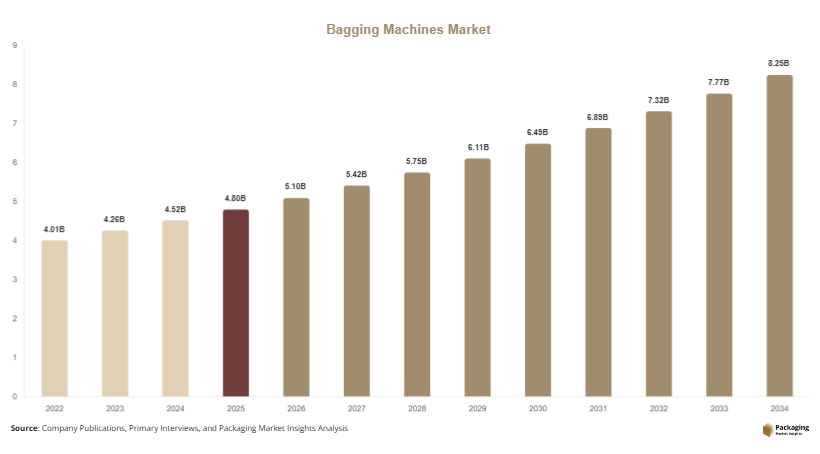
The global bagging machines market size is estimated at USD 4.8 billion in 2025 and is projected to reach USD 5.1 billion in 2026. Over the forecast period from 2025 to 2034, the market is expected to grow at a CAGR of 6.2%, reaching approximately USD 8.7 billion by 2034. This growth reflects increasing demand for efficient, high-speed packaging systems that improve productivity and reduce labor dependency in manufacturing and processing environments. The bagging machines market is witnessing steady expansion as automation continues to transform packaging operations across multiple industries.
A key growth factor is the rising adoption of automation in packaging processes. Industries such as food and beverage, agriculture, chemicals, and construction materials are investing in automated bagging systems to enhance operational efficiency. Bagging machines offer consistent filling, sealing, and weighing, reducing product wastage and ensuring uniform packaging quality. This makes them essential in large-scale production settings.
Key Highlights
- Asia Pacific dominated the market with a 36.8% share in 2025, while Latin America is projected to grow at the fastest CAGR of 6.7%.
- Automatic bagging machines led the type segment with a 48.9% share, while semi-automatic machines are expected to grow at a CAGR of 6.5%.
- Plastic packaging dominated with a 50.6% share, while paper-based packaging is forecasted to grow at a CAGR of 6.3%.
- Food & beverage applications led the segment with 41.7% share, while chemicals applications are expected to grow at a CAGR of 6.6%.
- China remained the dominant country with a market size of USD 1.2 billion in 2025 and USD 1.3 billion in 2026.
Explore more data points, trends and opportunities Download Free Sample Report
Market Trends
Increasing adoption of automation and smart packaging technologies
The bagging machines market is evolving with the rapid integration of automation and digital technologies. Manufacturers are increasingly adopting fully automated bagging systems equipped with programmable logic controllers, sensors, and real-time monitoring features. These systems enhance production efficiency by reducing manual intervention and minimizing operational errors. Smart bagging machines can adjust filling speeds, detect defects, and optimize packaging processes based on product characteristics. Integration with IoT platforms allows operators to monitor performance remotely, improving maintenance planning and reducing downtime. As industries aim to improve productivity and reduce costs, the demand for technologically advanced bagging machines continues to rise, shaping the overall market landscape.
Rising demand for flexible and sustainable packaging solutions
Another notable trend in the bagging machines market is the growing demand for machines capable of handling diverse packaging materials and formats. Industries are shifting toward sustainable packaging options such as paper and biodegradable materials, requiring bagging machines that can adapt to different material properties. Flexible bagging systems that support multiple bag sizes and types are becoming increasingly important. This trend is particularly evident in food and agricultural sectors, where packaging requirements vary significantly. Manufacturers are developing machines with modular designs and adjustable configurations to meet these needs. As sustainability becomes a key focus, the ability to handle eco-friendly materials is expected to influence purchasing decisions and drive innovation in bagging technologies.
Market Drivers
Expansion of industrial automation across manufacturing sectors
The widespread adoption of automation in manufacturing processes is a major factor driving the bagging machines market. Industries are increasingly investing in automated systems to improve efficiency, reduce labor costs, and enhance product quality. Bagging machines play a critical role in automating packaging operations, ensuring consistent filling, sealing, and labeling. The ability to handle high production volumes with minimal human intervention makes these machines essential for modern manufacturing facilities. As labor shortages and wage pressures continue to impact industries, the demand for automated bagging solutions is expected to increase. This trend is particularly strong in sectors such as food processing, chemicals, and construction materials.
Growth of bulk packaging and logistics operations
The expansion of global trade and logistics networks is contributing to the growth of the bagging machines market. Bulk packaging is widely used for transporting and storing products such as grains, fertilizers, cement, and chemicals. Bagging machines enable efficient packaging of these materials, ensuring durability and ease of handling. The rise of organized retail and e-commerce has further increased the need for reliable packaging solutions. Efficient bagging systems help streamline supply chain operations, reduce packaging time, and improve product protection. As industries continue to scale their operations, the demand for high-capacity bagging machines is expected to grow, supporting overall market expansion.
Market Restraint
High initial investment and maintenance costs
One of the key challenges in the bagging machines market is the high initial investment required for advanced equipment. Automated bagging systems with integrated technologies often involve significant capital expenditure, which can be a barrier for small and medium-sized enterprises. In addition to the purchase cost, ongoing maintenance and operational expenses can add to the financial burden. Companies may also need to invest in skilled personnel to operate and maintain these machines. For example, a small agricultural processing unit may find it difficult to justify the cost of a fully automated bagging system, opting instead for manual or semi-automatic solutions. This restraint can limit market penetration, particularly in developing regions where cost sensitivity is high. However, as technology becomes more accessible and cost-effective, this challenge is expected to gradually decrease.
Market Opportunities
Increasing demand in emerging economies
Emerging markets present significant growth opportunities for the bagging machines market. Regions such as Asia Pacific, Latin America, and Africa are experiencing rapid industrialization and agricultural expansion. Governments in these regions are investing in infrastructure development and modernizing manufacturing processes, creating demand for automated packaging solutions. The growth of small and medium enterprises is also contributing to the adoption of bagging machines. As these economies continue to develop, the need for efficient and cost-effective packaging solutions is expected to rise. Companies that offer scalable and affordable bagging systems are likely to benefit from this trend.
Advancements in machine design and customization
Technological innovation is creating new opportunities in the bagging machines market. Manufacturers are developing machines with modular designs, allowing customization based on specific industry requirements. These machines can handle a wide range of products, from powders and granules to liquids and solids. Features such as automated weighing, sealing, and labeling enhance efficiency and accuracy. The integration of digital technologies enables real-time monitoring and predictive maintenance, reducing downtime and improving productivity. As industries seek tailored solutions to meet their packaging needs, the demand for advanced and customizable bagging machines is expected to grow, driving market expansion.
Report Scope
| Report Metric | Details |
|---|---|
| Market Size in 2025 | USD 4.8 Billion |
| Market Size in 2026 | USD 5.1 Billion |
| Market Size in 2034 | USD 8.7 Billion |
| CAGR | 6.2% (2026-2034) |
| Base Year for Estimation | 2025 |
| Historical Data | 2022-2024 |
| Forecast Period | 2026-2034 |
| Report Coverage | Revenue Forecast, Competitive Landscape, Supply Chain Disruption, Growth Factors, Environment & Regulatory Landscape and Trends |
| Geographies Covered | North America, Europe, APAC, Middle East and Africa, LATAM |
| Countries Covered | U.S., Canada, U.K., Germany, France, Spain, Italy, Russia, Nordic, Benelux, Rest of Europe, China, South Korea, Japan, India, Australia, Singapore, Taiwan, South East Asia, Rest of Asia-Pacific, UAE, Turky, Saudi Arabia, South Africa, Egypt, Nigeria, Rest of MEA, Brazil, Mexico, Argentina, Chile, Colombia, Rest of LATAM |
Explore more data points, trends and opportunities Download Free Sample Report
Segmental Analysis
By Type
Automatic bagging machines dominated the bagging machines market in 2024, accounting for approximately 48.9% of the total share. These machines are widely used in large-scale production environments due to their ability to perform filling, weighing, and sealing operations with minimal human intervention. Their high efficiency and accuracy make them suitable for industries that require consistent packaging quality.
Semi-automatic bagging machines are expected to grow at a CAGR of 6.5% during the forecast period. These machines offer a balance between automation and cost, making them suitable for small and medium-sized enterprises. Their flexibility and ease of operation are key factors driving their adoption.
By Packaging Material
Plastic-based packaging dominated the market in 2024, accounting for 50.6% of the total share. These materials are widely used due to their durability and versatility. Bagging machines designed for plastic packaging offer high efficiency and compatibility with various product types.
Paper-based packaging is expected to grow at a CAGR of 6.3%. The increasing demand for sustainable packaging solutions is driving the adoption of paper materials. Bagging machines capable of handling paper bags are gaining popularity, particularly in regions with strict environmental regulations.
By Application
Food and beverage applications accounted for the largest share of the bagging machines market in 2024, holding 41.7% of the total market. The need for hygienic and efficient packaging solutions drives demand in this segment. Bagging machines ensure product safety and compliance with regulatory standards.
Chemical applications are expected to grow at a CAGR of 6.6% during the forecast period. The demand for safe and efficient packaging of hazardous materials is driving the adoption of advanced bagging machines in this segment.
Bagging Machines Market Segmentations
By Product Type
- Automatic Bagging Machines
- Semi-Automatic Bagging Machines
- Manual Bagging Machines
By Application
- Food & Beverage
- Chemicals
- Agriculture
- Construction
By Packaging Material
- Plastic
- Paper
- Others
Regional Analysis
North America
North America accounted for approximately 22.4% of the bagging machines market share in 2025 and is projected to grow at a CAGR of 5.4% during the forecast period. The region benefits from advanced manufacturing infrastructure and high adoption of automation technologies. Industries such as food processing, chemicals, and construction materials are major contributors to market demand.
The United States dominates the regional market due to its strong industrial base and technological advancements. A unique growth factor is the increasing focus on operational efficiency and labor cost reduction, which is driving the adoption of automated bagging systems across various industries.
Europe
Europe held a 20.1% share of the bagging machines market in 2025 and is expected to grow at a CAGR of 5.7%. The region is characterized by strict regulatory standards and a strong emphasis on sustainability. These factors are encouraging the adoption of advanced bagging technologies that support eco-friendly packaging.
Germany leads the European market, supported by its well-established manufacturing sector. A unique growth factor is the region’s focus on Industry 4.0, which promotes the integration of digital technologies into manufacturing processes, including packaging operations.
Asia Pacific
Asia Pacific dominated the bagging machines market with a 36.8% share in 2025 and is projected to grow at a CAGR of 6.8%. The region’s growth is driven by rapid industrialization and increasing demand for packaged goods. The expansion of agriculture and food processing industries further supports market growth.
China remains the dominant country in this region due to its large manufacturing base and high production capacity. Government initiatives aimed at industrial modernization are a key growth factor, driving the adoption of advanced bagging machines.
Middle East & Africa
The Middle East & Africa region accounted for 9.7% of the bagging machines market share in 2025 and is expected to grow at a CAGR of 6.0%. Growth is supported by increasing investments in infrastructure and industrial development. The demand for efficient packaging solutions is rising across various sectors.
Saudi Arabia leads the regional market, driven by its focus on economic diversification and industrial expansion. A unique growth factor is the development of large-scale construction projects, which require efficient packaging solutions for materials such as cement and chemicals.
Latin America
Latin America held an 11.0% share of the bagging machines market in 2025 and is projected to grow at the fastest CAGR of 6.7%. The region’s growth is driven by expanding agricultural and industrial activities. The demand for efficient packaging solutions is increasing as industries scale their operations.
Brazil dominates the regional market due to its strong agricultural sector. A unique growth factor is the increasing adoption of modern farming and processing techniques, which require efficient bagging systems for bulk products.
Competitive Landscape
The bagging machines market is moderately competitive, with several global players focusing on innovation and technological advancement. Companies are investing in research and development to enhance machine performance and meet evolving industry requirements. Strategic partnerships and mergers are common as firms aim to expand their market presence.
Premier Tech is recognized as a leading player in the market, known for its advanced bagging solutions. The company recently introduced a new automated system with enhanced efficiency and digital integration features. Other companies are focusing on customization and expanding their product portfolios to cater to diverse industry needs.
Key Players List
- Premier Tech
- Haver & Boecker
- Bosch Packaging Technology
- All-Fill Inc.
- IMA Group
- Barry-Wehmiller Companies
- Viking Masek
- Fuji Machinery Co., Ltd.
- Syntegon Technology
- Concetti S.p.A.
- PT Chronos
- PAYPER S.A.
- Nichrome India Ltd.
- STATEC BINDER GmbH
- Pakona Engineers Pvt. Ltd.