Automotive Parts Packaging Market Size and Growth
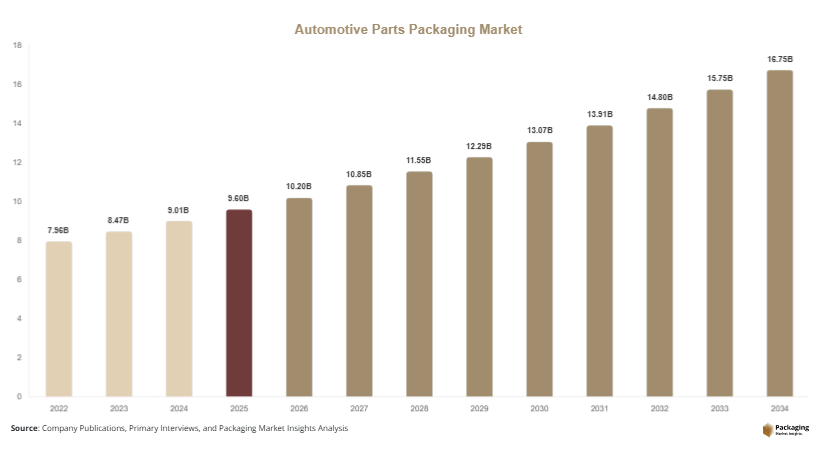
The global automotive parts packaging market size is estimated at USD 9.6 billion in 2025, while the market is projected to reach USD 10.2 billion in 2026. By 2034, the market is forecasted to attain USD 17.8 billion, registering a CAGR of 6.4% during 2025–2034. The automotive parts packaging market is experiencing significant growth due to increasing vehicle production, expansion of automotive aftermarket services, and rising international trade of automotive components. Automotive parts packaging solutions are designed to protect components such as engines, batteries, electronic systems, filters, and body parts during storage and transportation. These packaging systems include corrugated boxes, returnable containers, pallets, trays, protective wraps, and customized industrial packaging products.
One of the major growth factors supporting the market is the steady increase in global automotive production. Vehicle manufacturers require advanced packaging systems to ensure safe handling and transportation of automotive components across supply chains. Another important factor is the rapid expansion of electric vehicle manufacturing, which is increasing demand for specialized packaging solutions for lithium-ion batteries, electronic modules, and lightweight vehicle parts. In addition, growth in automotive aftermarket services and replacement part distribution is contributing to rising demand for durable and cost-efficient packaging products.
Key Highlights
- Asia Pacific dominated the market with a 42.1% share in 2025.
- Latin America is projected to grow at the fastest CAGR of 6.9%.
- Corrugated packaging led the material segment with a 39.8% share.
- Protective packaging applications dominated the application segment with a 36.4% share.
- OEMs led the end-use segment with 58.7% share.
- The US remained the dominant country with a market size of USD 2.1 billion in 2025 and USD 2.2 billion in 2026.
Explore more data points, trends and opportunities Download Free Sample Report
Market Trends
Rising Adoption of Sustainable and Reusable Packaging Solutions
Sustainability is becoming a major trend in the automotive parts packaging market as manufacturers focus on reducing packaging waste and improving supply chain efficiency. Automotive companies are increasingly using reusable plastic containers, foldable crates, and recyclable corrugated packaging to minimize environmental impact and reduce long-term operational costs. Reusable packaging systems improve material handling efficiency and lower packaging replacement expenses across manufacturing and logistics operations. Governments and environmental agencies are also encouraging industries to adopt sustainable packaging practices through stricter waste management regulations. In addition, automotive manufacturers are integrating circular economy strategies into supply chains, further increasing demand for durable and recyclable packaging solutions designed for repeated use in transportation and warehousing applications.
Increasing Integration of Smart Packaging and Tracking Technologies
The integration of smart packaging technologies is another important trend shaping the automotive parts packaging market. Manufacturers and logistics providers are increasingly using RFID tags, barcode systems, and IoT-enabled sensors to improve tracking and inventory management. Smart packaging solutions help companies monitor shipment conditions, reduce inventory losses, and improve supply chain transparency. Automotive manufacturers handling high-value components such as batteries and electronic modules are particularly investing in intelligent packaging systems to ensure product safety during transportation. The growing adoption of warehouse automation and digital logistics platforms is further encouraging the implementation of connected packaging technologies across global automotive supply chains.
Market Drivers
Expansion of Global Automotive Production
The continuous expansion of global automotive production is one of the primary drivers supporting the automotive parts packaging market. Vehicle manufacturers require efficient packaging systems to transport automotive components safely across assembly plants, suppliers, and distribution centers. Increasing production of passenger vehicles, commercial vehicles, and electric vehicles is generating strong demand for protective packaging solutions. Automotive supply chains involve large-scale transportation of engines, transmission systems, batteries, and electronic parts, all of which require secure and durable packaging. Emerging economies are also witnessing growing investments in automotive manufacturing infrastructure, further supporting packaging demand across domestic and international supply chains.
Growth of Automotive Aftermarket and Spare Parts Distribution
The expansion of automotive aftermarket services and spare parts distribution is another major factor driving market growth. Vehicle owners are increasingly purchasing replacement parts, accessories, and maintenance components through dealerships and online retail platforms. This trend has increased demand for efficient packaging systems capable of protecting products during storage and shipping. E-commerce growth in automotive spare parts sales is also contributing to higher consumption of lightweight and protective packaging materials. Logistics providers are investing in customized packaging solutions to reduce product damage and improve delivery efficiency across aftermarket distribution networks.
Market Restraint
Fluctuating Raw Material Prices and Packaging Cost Pressures
One of the major restraints affecting the automotive parts packaging market is the fluctuation in raw material prices, particularly plastics, corrugated paper, and metal-based packaging materials. Volatility in petroleum and commodity prices can increase production costs for packaging manufacturers and reduce profit margins. Automotive manufacturers are also under pressure to reduce logistics and operational expenses, which limits the adoption of premium packaging solutions in some markets. In addition, sustainable and reusable packaging systems often require higher initial investments compared to traditional disposable packaging materials. For example, smaller automotive suppliers may continue using low-cost corrugated packaging rather than investing in reusable industrial containers because of budget limitations. These pricing pressures can restrict market growth and influence purchasing decisions across automotive supply chains.
Market Opportunities
Increasing Demand for Electric Vehicle Battery Packaging
The rapid growth of electric vehicle production is creating substantial opportunities for the automotive parts packaging market. Lithium-ion batteries and electronic components require specialized packaging systems that provide shock resistance, thermal insulation, and safe transportation conditions. Automotive manufacturers and battery suppliers are investing in advanced packaging solutions to comply with safety standards and reduce transportation risks. The increasing adoption of electric mobility across North America, Europe, and Asia Pacific is expected to drive long-term demand for battery packaging systems. Manufacturers focusing on lightweight and reusable battery packaging solutions are likely to benefit from growing investments in electric vehicle supply chains.
Expansion of Cross-Border Automotive Trade
The expansion of cross-border automotive trade is creating another important opportunity for market participants. Automotive manufacturers increasingly rely on global supply chains to source components from multiple countries. This has increased demand for durable export packaging solutions capable of protecting parts during long-distance transportation. Export-oriented automotive manufacturing hubs in Asia Pacific and Latin America are particularly contributing to rising demand for industrial packaging products. In addition, increasing investments in global logistics infrastructure and free trade agreements are encouraging higher international movement of automotive components, creating favorable growth conditions for packaging suppliers.
Report Scope
| Report Metric | Details |
|---|---|
| Market Size in 2025 | USD 9.6 Billion |
| Market Size in 2026 | USD 10.2 Billion |
| Market Size in 2034 | USD 17.8 Billion |
| CAGR | 6.4% (2026-2034) |
| Base Year for Estimation | 2025 |
| Historical Data | 2022-2024 |
| Forecast Period | 2026-2034 |
| Report Coverage | Revenue Forecast, Competitive Landscape, Supply Chain Disruption, Growth Factors, Environment & Regulatory Landscape and Trends |
| Geographies Covered | North America, Europe, APAC, Middle East and Africa, LATAM |
| Countries Covered | U.S., Canada, U.K., Germany, France, Spain, Italy, Russia, Nordic, Benelux, Rest of Europe, China, South Korea, Japan, India, Australia, Singapore, Taiwan, South East Asia, Rest of Asia-Pacific, UAE, Turky, Saudi Arabia, South Africa, Egypt, Nigeria, Rest of MEA, Brazil, Mexico, Argentina, Chile, Colombia, Rest of LATAM |
Explore more data points, trends and opportunities Download Free Sample Report
Segmental Analysis
By Material Type
Corrugated packaging dominated the automotive parts packaging market in 2024, accounting for approximately 39.8% of total market share. Corrugated materials are widely used because they provide lightweight, cost-effective, and customizable packaging solutions for automotive components. Automotive manufacturers and suppliers rely on corrugated boxes and protective inserts to transport spare parts, filters, electronic systems, and lightweight vehicle components. These materials are also recyclable and compatible with sustainable packaging initiatives, making them highly preferred across automotive supply chains. The growth of e-commerce-based spare parts distribution and increasing export activities have further strengthened demand for corrugated automotive packaging solutions globally.
Reusable plastic packaging is expected to be the fastest-growing subsegment, registering a CAGR of 7.1% during the forecast period. Automotive manufacturers are increasingly adopting reusable plastic containers, pallets, and foldable crates to improve operational efficiency and reduce long-term packaging costs. These packaging systems offer better durability, moisture resistance, and product protection compared to disposable alternatives. The rising emphasis on sustainability and circular economy practices is also encouraging wider adoption of reusable packaging solutions. In addition, increasing automation in automotive warehouses and logistics centers is supporting demand for standardized reusable containers designed for efficient handling and transportation.
By Application
Protective packaging applications held the dominant position in the market in 2024 with a share of approximately 36.4%. Protective packaging solutions are essential for preventing damage to automotive components during transportation and storage. Automotive parts such as electronic modules, engines, transmission systems, and lighting components require specialized cushioning and shock-resistant materials to maintain product quality. Increasing global trade in automotive components has strengthened demand for durable protective packaging systems capable of handling long-distance transportation requirements. In addition, vehicle manufacturers are focusing on reducing product returns and logistics losses, which is encouraging higher investment in advanced protective packaging technologies.
Battery packaging applications are projected to witness the fastest CAGR of 7.3% during the forecast period. The rapid growth of electric vehicle manufacturing is driving demand for safe and specialized packaging systems for lithium-ion batteries and energy storage modules. Battery packaging solutions must provide thermal protection, vibration resistance, and compliance with transportation safety regulations. Automotive manufacturers and battery suppliers are increasingly investing in lightweight and reusable battery packaging systems to improve logistics efficiency and reduce environmental impact. Rising global investment in electric mobility infrastructure is expected to support long-term growth in this segment.
By End-Use
OEMs dominated the automotive parts packaging market in 2024 and accounted for approximately 58.7% of total revenue share. Original equipment manufacturers require large-scale packaging operations to transport components between suppliers, assembly plants, and distribution facilities. The increasing complexity of automotive supply chains and rising vehicle production volumes are supporting demand for standardized industrial packaging systems. OEMs are also investing in reusable and smart packaging technologies to improve inventory management and reduce operational costs. The growing adoption of automation in manufacturing and warehousing operations has further strengthened demand for machine-compatible automotive packaging solutions across OEM supply chains.
Automotive aftermarket packaging is expected to record the fastest growth, with a projected CAGR of 6.8% during the forecast period. Rising vehicle ownership and increasing demand for replacement parts are supporting expansion of aftermarket distribution networks. E-commerce growth in automotive spare parts sales is also contributing to higher demand for lightweight and protective packaging materials. Logistics providers and retailers are focusing on customized packaging solutions that improve shipping efficiency and reduce product damage during last-mile delivery operations. The expansion of digital automotive retail platforms is expected to create additional growth opportunities for aftermarket packaging suppliers.
Automotive Parts Packaging Market Segmentations
By Material Type
- Corrugated Packaging
- Plastic Packaging
- Metal Packaging
- Foam Packaging
- Others
By Application
- Protective Packaging
- Battery Packaging
- Bulk Component Packaging
- Export Packaging
By End-User
- OEMs
- Automotive Aftermarket
Regional Analysis
North America
North America accounted for approximately 25.8% of the global automotive parts packaging market share in 2025 and is projected to grow at a CAGR of 5.7% during the forecast period. The region benefits from advanced automotive manufacturing infrastructure, strong aftermarket distribution networks, and high adoption of reusable industrial packaging systems. Increasing production of electric vehicles and rising investment in automotive logistics operations continue to support regional market growth.
The United States dominates the North American market because of its large automotive manufacturing and aftermarket industries. A unique growth factor is the increasing investment in electric vehicle battery manufacturing facilities across the country. The growing transportation of lithium-ion batteries and electronic vehicle components is driving demand for specialized automotive packaging solutions with enhanced safety and durability.
Europe
Europe held nearly 23.5% of the global market share in 2025 and is expected to register a CAGR of 5.8% through 2034. The regional market is supported by strong automotive production capabilities and increasing emphasis on sustainable industrial packaging. Automotive manufacturers are increasingly adopting reusable packaging systems to reduce waste and improve supply chain efficiency. The region also benefits from advanced logistics infrastructure and strict packaging sustainability regulations.
Germany remains the dominant country in the European market due to its strong automotive manufacturing base and export-oriented vehicle production industry. A unique growth factor is the country’s focus on electric mobility and advanced automotive engineering. Increasing production of electric vehicles and automotive electronics is supporting demand for customized and protective packaging systems across German automotive supply chains.
Asia Pacific
Asia Pacific dominated the automotive parts packaging market with a 42.1% share in 2025 and is projected to grow at a CAGR of 6.9% during the forecast period. Rapid industrialization, expanding automotive production, and increasing international trade activities are major factors supporting regional market growth. The region is also witnessing increasing adoption of reusable packaging systems and automated logistics technologies across automotive supply chains.
China remains the dominant country in Asia Pacific due to its large automotive manufacturing industry and strong export operations. One unique growth factor is the rapid expansion of domestic electric vehicle production and battery manufacturing. Increasing exports of automotive components and EV batteries are creating substantial demand for advanced industrial packaging solutions across the country.
Middle East & Africa
The Middle East & Africa region accounted for approximately 3.9% of the global market share in 2025 and is forecast to grow at a CAGR of 5.9%. Rising investments in industrial manufacturing and automotive assembly operations are supporting market development across the region. Governments are also improving transportation infrastructure and logistics capabilities, creating favorable conditions for automotive component trade and packaging demand.
Saudi Arabia dominates the regional market due to its growing industrial diversification initiatives and investments in automotive manufacturing projects. A unique growth factor is the expansion of local automotive assembly operations under industrial development programs. This is increasing demand for transportation and protective packaging solutions for imported and locally manufactured automotive components.
Latin America
Latin America represented around 4.7% of the global market share in 2025 and is projected to grow at the fastest CAGR of 6.9% during the forecast period. The region is benefiting from increasing automotive production, rising spare parts demand, and expansion of export-oriented manufacturing operations. Growth in logistics infrastructure and industrial warehousing is also contributing to market expansion.
Brazil leads the Latin American market due to its large automotive manufacturing and aftermarket sectors. A unique growth factor is the increasing export of automotive components to North America and Europe. This is encouraging higher adoption of durable industrial packaging systems capable of supporting long-distance transportation and reducing product damage during shipping.
Competitive Landscape
The global automotive parts packaging market is moderately competitive, with leading companies focusing on sustainable materials, reusable packaging technologies, and logistics optimization solutions. Market participants are investing in lightweight industrial packaging systems and smart tracking technologies to improve supply chain efficiency and reduce transportation costs. Strategic collaborations with automotive manufacturers and logistics companies are also helping packaging suppliers strengthen market presence.
DS Smith Plc remains one of the leading companies in the market due to its strong focus on sustainable corrugated packaging solutions and industrial packaging innovation. In 2024, the company introduced a reusable automotive packaging system designed for electric vehicle battery transportation and export logistics operations. Other major players include Schoeller Allibert, Nefab Group, Smurfit Kappa Group, and ORBIS Corporation. These companies are emphasizing recyclable materials, returnable packaging systems, and advanced logistics solutions to address evolving automotive industry requirements.
Key Players List
- DS Smith Plc
- Schoeller Allibert
- Nefab Group
- Smurfit Kappa Group
- ORBIS Corporation
- Sealed Air Corporation
- Sonoco Products Company
- Mondi Group
- Menasha Corporation
- WestRock Company
- Packaging Corporation of America
- Signode Industrial Group
- Primex Design & Fabrication
- Myers Industries Inc.
- Knauf Industries
- Reusable Transport Packaging Ltd.