Automatic Labeling Machine Market Size and Growth
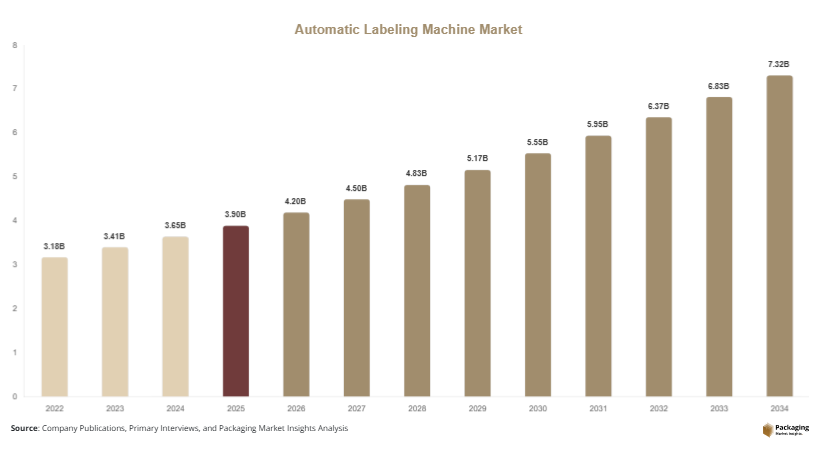
The automatic labeling machine market is experiencing consistent growth driven by increasing automation across manufacturing industries and the rising need for accurate, high-speed labeling solutions. Automatic labeling machines are widely used in industries such as food and beverages, pharmaceuticals, cosmetics, and consumer goods to enhance operational efficiency and ensure compliance with labeling regulations. The market size was valued at approximately USD 3.9 billion in 2025 and is projected to reach USD 4.2 billion in 2026. By 2034, the market is expected to reach USD 7.8 billion, registering a CAGR of 7.2% during the forecast period (2025–2034).
One of the primary growth factors is the increasing demand for automation in production lines. Manufacturers are focusing on reducing labor costs and improving operational efficiency by adopting automated labeling solutions. Automatic labeling machines offer high-speed operations, accuracy, and consistency, making them essential for modern manufacturing environments. Another important growth factor is the growing emphasis on product traceability and compliance. Regulatory requirements in industries such as pharmaceuticals and food processing necessitate accurate labeling, driving the adoption of advanced labeling machines.
Key Highlights:
- Market size is projected to grow from USD 3.9 billion in 2025 to USD 7.8 billion by 2034, indicating steady expansion in industrial labeling technologies. This growth reflects increasing demand across manufacturing and packaging sectors.
- The market is expected to register a CAGR of 7.2% during the forecast period from 2025 to 2034. This consistent growth is supported by advancements in automation and rising efficiency requirements in production lines.
- Rising adoption of automation in manufacturing industries is a key growth driver. Companies are focusing on improving productivity, reducing labor dependency, and ensuring consistent labeling accuracy.
- Increasing demand for accurate and efficient labeling solutions is further boosting market growth. Industries such as food, pharmaceuticals, and consumer goods require precise labeling to meet regulatory and quality standards.
Explore more data points, trends and opportunities Download Free Sample Report
Market Trends
Integration of Smart Technologies in Labeling Machines
The integration of smart technologies is a key trend shaping the automatic labeling machine market. Manufacturers are incorporating advanced features such as sensors, machine vision systems, and IoT connectivity into labeling machines. These technologies enable real-time monitoring, predictive maintenance, and improved accuracy in labeling processes. Smart labeling machines can detect errors and adjust operations automatically, reducing downtime and waste. Additionally, integration with enterprise resource planning systems allows better coordination across production lines. As industries move toward smart manufacturing, the demand for intelligent labeling solutions is expected to increase significantly.
Growing Demand for Flexible and Multi-Functional Machines
The demand for flexible and multi-functional labeling machines is increasing across industries. Manufacturers require equipment that can handle different product shapes, sizes, and labeling requirements. Automatic labeling machines with adjustable configurations and quick changeover capabilities are gaining popularity. These machines allow companies to adapt to changing production needs without significant downtime. The trend toward product diversification and customization is driving the adoption of versatile labeling solutions. As businesses focus on efficiency and cost optimization, the demand for flexible labeling machines is expected to grow.
Market Drivers
Increasing Automation in Manufacturing Processes
The growing adoption of automation in manufacturing processes is a major driver of the automatic labeling machine market. Industries are increasingly investing in automated solutions to improve productivity and reduce labor costs. Automatic labeling machines play a crucial role in automated production lines by ensuring consistent and accurate labeling. These machines can operate at high speeds, enabling manufacturers to meet increasing production demands. Additionally, automation helps reduce human error and improve overall efficiency. As industries continue to embrace automation, the demand for labeling machines is expected to rise.
Stringent Regulatory Requirements for Labeling
Stringent regulatory requirements for product labeling are driving the adoption of automatic labeling machines. Industries such as pharmaceuticals and food processing must comply with strict labeling standards to ensure product safety and traceability. Accurate labeling is essential for providing information such as ingredients, expiration dates, and batch numbers. Automatic labeling machines help manufacturers meet these requirements by ensuring precision and consistency. Failure to comply with labeling regulations can result in penalties and product recalls, making reliable labeling solutions essential.
Market Restraint
High Initial Investment and Maintenance Costs
The high initial investment required for automatic labeling machines is a key restraint in the market. These machines involve significant costs related to equipment, installation, and integration with existing production lines. Small and medium-sized enterprises may find it challenging to invest in advanced labeling solutions due to budget constraints. Additionally, maintenance and operational costs can further increase the total cost of ownership. For example, regular servicing and replacement of components are necessary to ensure optimal performance. These cost factors can limit the adoption of automatic labeling machines, particularly in developing regions.
Market Opportunities
Expansion of Packaging Industry in Emerging Markets
The expansion of the packaging industry in emerging markets presents significant opportunities for the automatic labeling machine market. Countries in Asia Pacific, Latin America, and Africa are experiencing rapid industrialization and growth in manufacturing sectors. The increasing demand for packaged goods is driving the need for efficient labeling solutions. As companies expand their production capacities, the adoption of automatic labeling machines is expected to increase. This trend is supported by improving infrastructure and growing investments in manufacturing industries.
Development of Advanced and Energy-Efficient Machines
The development of advanced and energy-efficient labeling machines is creating new opportunities in the market. Manufacturers are focusing on designing machines that consume less energy while maintaining high performance. Energy-efficient machines help reduce operational costs and support sustainability goals. Additionally, innovations such as modular designs and digital interfaces are enhancing machine functionality. These advancements are attracting customers looking for cost-effective and environmentally friendly solutions. As technology continues to evolve, the demand for advanced labeling machines is expected to grow.
Report Scope
| Report Metric | Details |
|---|---|
| Market Size in 2025 | USD 3.9 Billion |
| Market Size in 2026 | USD 4.2 Billion |
| Market Size in 2034 | USD 7.8 Billion |
| CAGR | 7.2% (2026-2034) |
| Base Year for Estimation | 2025 |
| Historical Data | 2022-2024 |
| Forecast Period | 2026-2034 |
| Report Coverage | Revenue Forecast, Competitive Landscape, Supply Chain Disruption, Growth Factors, Environment & Regulatory Landscape and Trends |
| Geographies Covered | North America, Europe, APAC, Middle East and Africa, LATAM |
| Countries Covered | U.S., Canada, U.K., Germany, France, Spain, Italy, Russia, Nordic, Benelux, Rest of Europe, China, South Korea, Japan, India, Australia, Singapore, Taiwan, South East Asia, Rest of Asia-Pacific, UAE, Turky, Saudi Arabia, South Africa, Egypt, Nigeria, Rest of MEA, Brazil, Mexico, Argentina, Chile, Colombia, Rest of LATAM |
Explore more data points, trends and opportunities Download Free Sample Report
Segmental Analysis
By Type
The pressure-sensitive labeling machines segment dominated the automatic labeling machine market in 2024, accounting for approximately 46% of the market share. These machines are widely used due to their versatility and ease of use. They can handle various label types and are suitable for different industries. Pressure-sensitive labeling machines provide high accuracy and efficiency, making them a preferred choice for manufacturers.
The shrink sleeve labeling machines segment is expected to be the fastest-growing, with a CAGR of 7.8% during the forecast period. These machines are gaining popularity due to their ability to provide 360-degree labeling. The growing demand for visually appealing packaging is driving the adoption of shrink sleeve labeling machines.
By Application
The food and beverages segment held the largest share of the automatic labeling machine market in 2024, accounting for approximately 52% of the market. The demand for labeling machines in this segment is driven by the need for accurate labeling and compliance with regulations. Additionally, the increasing consumption of packaged food and beverages is supporting market growth.
The pharmaceuticals segment is projected to be the fastest-growing, with a CAGR of 7.9% during the forecast period. The need for precise labeling and traceability in pharmaceutical products is driving the adoption of labeling machines.
By End-Use
The manufacturing sector dominated the automatic labeling machine market in 2024, accounting for approximately 55% of the market share. This sector relies heavily on labeling machines for product identification and compliance. The increasing adoption of automation is driving the demand for labeling machines.
The e-commerce sector is expected to be the fastest-growing, with a CAGR of 8.0% during the forecast period. The rapid growth of online retail is driving demand for efficient packaging and labeling solutions.
Automatic Labeling Machine Market Segmentations
By Type
- Pressure-Sensitive Labeling Machines
- Shrink Sleeve Labeling Machines
- Glue-Based Labeling Machines
By Application
- Food & Beverages
- Pharmaceuticals
- Personal Care & Cosmetics
- Others
By End-Use
- Manufacturing
- E-Commerce
- Retail
- Others
Regional Analysis
North America
North America accounted for approximately 28% of the automatic labeling machine market share in 2025 and is expected to grow at a CAGR of 6.8% during the forecast period. The region benefits from a well-developed manufacturing sector and early adoption of automation technologies. The demand for labeling machines is driven by industries such as pharmaceuticals, food and beverages, and consumer goods. Additionally, regulatory requirements for labeling are supporting market growth.
The United States dominates the North American market due to its advanced industrial infrastructure. A unique growth factor in the region is the increasing adoption of smart manufacturing technologies. Companies are investing in automated systems to improve efficiency and reduce costs, driving demand for labeling machines.
Europe
Europe held a market share of approximately 26% in 2025 and is projected to grow at a CAGR of 6.6% through 2034. The region’s growth is driven by strict regulatory standards and strong manufacturing capabilities. The demand for labeling machines is increasing across industries such as food processing and pharmaceuticals.
Germany is a key market in Europe, supported by its robust industrial base. A unique growth factor in the region is the focus on precision engineering and quality standards. This is encouraging the adoption of advanced labeling machines.
Asia Pacific
Asia Pacific is the fastest-growing region, accounting for approximately 32% of the global market share in 2025 and projected to grow at a CAGR of 8.5%. The region’s growth is driven by rapid industrialization and increasing demand for packaged goods.
China dominates the Asia Pacific market due to its large manufacturing sector. A unique growth factor is the expansion of production facilities, which is driving demand for automated labeling solutions.
Middle East & Africa
The Middle East & Africa region accounted for approximately 7% of the market share in 2025 and is expected to grow at a CAGR of 7.0%. The market is driven by increasing investments in manufacturing and packaging industries.
Saudi Arabia is a leading market in the region, supported by industrial development initiatives. A unique growth factor is the growing demand for packaged consumer goods, which is driving the adoption of labeling machines.
Latin America
Latin America held around 7% of the market share in 2025 and is projected to grow at a CAGR of 7.3% during the forecast period. The region’s growth is driven by expanding manufacturing industries and increasing demand for packaged products.
Brazil dominates the Latin American market due to its large industrial base. A unique growth factor is the increasing adoption of automation technologies in manufacturing, which is supporting market growth.
Competitive Landscape
The automatic labeling machine market is characterized by the presence of several global and regional players focusing on innovation and technological advancements. Companies are investing in research and development to introduce advanced labeling machines with improved efficiency and accuracy. Strategic collaborations and product launches are common strategies adopted by market players.
HERMA GmbH is a leading player in the market, known for its advanced labeling solutions. The company recently introduced a new generation of labeling machines with enhanced automation features. Other major players are also focusing on expanding their product portfolios to meet evolving market demands.
Key Players List
- HERMA GmbH
- Krones AG
- SACMI Group
- Fuji Seal International Inc.
- ProMach Inc.
- Marchesini Group S.p.A.
- Accutek Packaging Equipment Companies, Inc.
- Pack Leader Machinery Inc.
- Quadrel Labeling Systems
- Barry-Wehmiller Companies
- Sidel Group
- IMA Group
- Arca Etichette S.p.A.
- Label-Aire Inc.
- Nita Labeling Equipment