Automated e-commerce Packaging Market Size and Growth
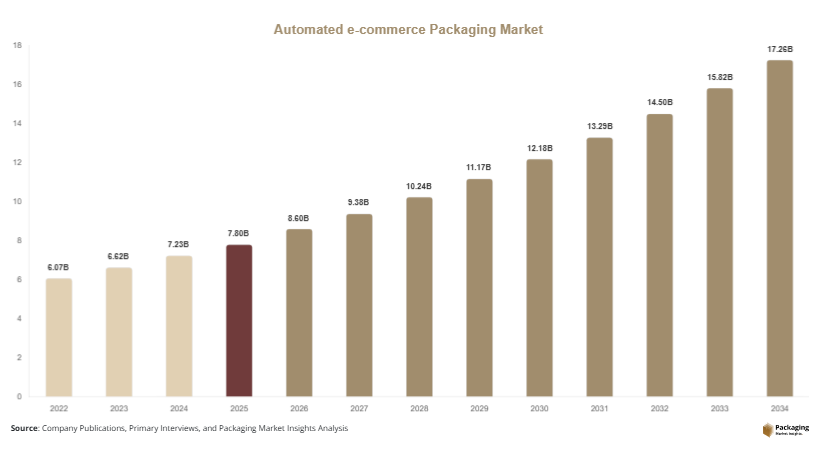
The automated e-commerce packaging market size is estimated at USD 7.8 billion in 2025 and is projected to reach USD 8.6 billion in 2026. Over the forecast period, the market is expected to grow significantly and reach approximately USD 18.9 billion by 2034, registering a CAGR of 9.1% from 2025 to 2034. This growth reflects the increasing demand for high-speed packaging systems, reduced labor dependency, and improved order accuracy in e-commerce operations. The automated e-commerce packaging market is experiencing strong growth as online retail continues to expand globally and fulfillment centers adopt automation to improve efficiency and scalability.
One of the primary growth factors is the rapid expansion of e-commerce platforms, which has significantly increased the volume of parcel shipments. Automated packaging solutions, including carton erectors, auto-bagging systems, and robotic packaging lines, are helping companies manage high order volumes while maintaining consistency and speed. These systems reduce manual errors and improve operational efficiency, making them essential for large-scale fulfillment centers.
Key Highlights
- Asia Pacific dominated the market with a 38.2% share in 2025, while Latin America is projected to grow at the fastest CAGR of 9.5%.
- Automated bagging systems led the type segment with a 33.4% share, while robotic packaging systems are expected to grow at a CAGR of 10.2%.
- Corrugated packaging dominated with a 55.6% share, while sustainable packaging is forecasted to grow at a CAGR of 9.8%.
- Retail e-commerce applications led the segment with 47.3% share, while food delivery packaging is expected to grow at a CAGR of 9.6%.
- China remained the dominant country with a market size of USD 2.1 billion in 2025 and USD 2.3 billion in 2026.
Explore more data points, trends and opportunities Download Free Sample Report
Market Trends
Increasing adoption of robotics and AI-driven packaging systems
The automated e-commerce packaging market is witnessing a growing integration of robotics and artificial intelligence technologies across packaging operations. Robotic arms, automated sorters, and AI-enabled systems are being deployed to enhance speed, accuracy, and flexibility in packaging processes. These systems can identify products, determine optimal packaging configurations, and execute packaging tasks with minimal human intervention. The use of machine learning algorithms enables continuous improvement in efficiency by analyzing operational data. This trend is particularly significant in large fulfillment centers that handle high volumes of orders, as it helps reduce errors, improve throughput, and optimize resource utilization.
Rising focus on right-sized and sustainable packaging solutions
There is a noticeable shift toward right-sized packaging solutions in the automated e-commerce packaging market. Companies are adopting automated systems that create packaging tailored to the dimensions of each product, reducing the need for excess materials and void fillers. This approach not only lowers packaging costs but also minimizes environmental impact. Sustainability is becoming a key priority for e-commerce companies, leading to increased use of recyclable materials and energy-efficient packaging systems. Automated solutions are playing a crucial role in achieving these goals by enabling precise material usage and reducing waste throughout the packaging process.
Market Drivers
Rapid expansion of global e-commerce industry
The growth of the global e-commerce sector is a major factor driving the automated e-commerce packaging market. Increasing internet penetration, smartphone usage, and changing consumer preferences are contributing to the rise in online shopping. This has led to a surge in order volumes, creating a need for efficient and scalable packaging solutions. Automated packaging systems enable companies to process large volumes of orders quickly and accurately, reducing lead times and improving customer satisfaction. As e-commerce continues to grow, the demand for automated packaging solutions is expected to increase significantly.
Increasing need for operational efficiency and cost reduction
Companies in the e-commerce and logistics sectors are focusing on improving operational efficiency and reducing costs. Automated packaging systems help achieve these objectives by minimizing labor requirements, reducing errors, and optimizing material usage. These systems can operate continuously, increasing productivity and reducing downtime. In addition, automation improves consistency in packaging quality, which is important for maintaining brand reputation. The ability to scale operations without a proportional increase in labor costs is a key advantage driving the adoption of automated packaging solutions.
Market Restraint
High initial investment and integration complexity
The adoption of automated packaging systems requires significant capital investment, which can be a barrier for small and medium-sized enterprises. The cost of purchasing, installing, and maintaining advanced equipment such as robotic systems and automated conveyors can be substantial. In addition, integrating these systems with existing warehouse management and logistics systems can be complex and time-consuming. Companies may face challenges related to system compatibility, workforce training, and operational disruptions during the implementation phase. These factors can slow down the adoption of automation, particularly in regions with limited financial resources or technical expertise.
Market Opportunities
Growth of fulfillment centers and warehouse automation
The expansion of fulfillment centers and distribution networks presents significant opportunities for the automated e-commerce packaging market. Companies are investing in large-scale automated warehouses to meet the growing demand for fast and efficient order fulfillment. Automated packaging systems are a critical component of these facilities, enabling high-speed operations and reducing manual intervention. The increasing adoption of warehouse automation technologies is expected to drive demand for integrated packaging solutions that can seamlessly connect with other automated systems.
Increasing demand for customized and branded packaging
The growing importance of customer experience in e-commerce is creating opportunities for customized and branded packaging solutions. Automated systems are enabling companies to produce personalized packaging with unique designs and branding elements. This enhances the unboxing experience and helps build brand loyalty. The ability to customize packaging at scale is particularly valuable for companies operating in competitive markets. As consumer expectations continue to evolve, the demand for automated systems that support customization and flexibility is expected to increase.
Report Scope
| Report Metric | Details |
|---|---|
| Market Size in 2025 | USD 7.8 Billion |
| Market Size in 2026 | USD 8.6 Billion |
| Market Size in 2034 | USD 18.9 Billion |
| CAGR | 9.1% (2026-2034) |
| Base Year for Estimation | 2025 |
| Historical Data | 2022-2024 |
| Forecast Period | 2026-2034 |
| Report Coverage | Revenue Forecast, Competitive Landscape, Supply Chain Disruption, Growth Factors, Environment & Regulatory Landscape and Trends |
| Geographies Covered | North America, Europe, APAC, Middle East and Africa, LATAM |
| Countries Covered | U.S., Canada, U.K., Germany, France, Spain, Italy, Russia, Nordic, Benelux, Rest of Europe, China, South Korea, Japan, India, Australia, Singapore, Taiwan, South East Asia, Rest of Asia-Pacific, UAE, Turky, Saudi Arabia, South Africa, Egypt, Nigeria, Rest of MEA, Brazil, Mexico, Argentina, Chile, Colombia, Rest of LATAM |
Explore more data points, trends and opportunities Download Free Sample Report
Segmental Analysis
By Type
Automated bagging systems dominated the market in 2024, accounting for approximately 33.4% of the share. These systems are widely used in e-commerce packaging due to their speed, efficiency, and ability to handle a wide range of products. Automated bagging systems are particularly suitable for small and lightweight items, making them ideal for industries such as apparel and electronics. The increasing demand for high-speed packaging solutions is driving the adoption of these systems.
Robotic packaging systems are expected to grow at the fastest CAGR of 10.2% during the forecast period. These systems offer advanced capabilities such as product recognition, sorting, and packaging, enabling greater flexibility and efficiency. The integration of AI and machine learning technologies is enhancing the performance of robotic systems. The growing need for automation in high-volume operations is supporting the growth of this segment.
By Material
Corrugated packaging dominated the market in 2024, accounting for 55.6% of the share. Corrugated materials are widely used due to their strength, durability, and recyclability. They provide effective protection for products during transportation and are suitable for a wide range of applications. The increasing demand for sustainable packaging solutions is supporting the growth of this segment.
Sustainable packaging is expected to grow at the fastest CAGR of 9.8%. Companies are adopting eco-friendly materials and packaging solutions to reduce environmental impact. Automated systems are enabling efficient use of materials, reducing waste and improving sustainability. This trend is expected to drive growth in the sustainable packaging segment.
By Application
Retail e-commerce applications held the largest share of 47.3% in 2024 due to the high volume of online orders. Automated packaging systems are widely used in retail e-commerce to improve efficiency and reduce processing time. The growing demand for fast delivery is driving the adoption of automated solutions.
Food delivery packaging is expected to grow at the fastest CAGR of 9.6%. The increasing popularity of online food delivery services is driving demand for efficient and hygienic packaging solutions. Automated systems help ensure consistency and speed in packaging, supporting the growth of this segment.
Automated e-commerce Packaging Market Segmentations
By Type
- Automated Bagging Systems
- Carton Erectors
- Robotic Packaging Systems
- Automated Conveyors
By Material
- Corrugated
- Plastic
- Sustainable Materials
By Application
- Retail E-commerce
- Food Delivery
- Electronics
- Apparel
Regional Analysis
North America
North America accounted for a market share of 30.6% in 2025 and is expected to grow at a CAGR of 8.5% during the forecast period. The region benefits from a well-developed e-commerce ecosystem and advanced logistics infrastructure. The presence of major technology providers and early adoption of automation technologies support market growth. Increasing demand for efficient packaging solutions is driving the adoption of automated systems.
The United States dominates the regional market due to its large e-commerce industry and high investment in automation technologies. A key growth factor is the increasing adoption of robotics in fulfillment centers, which enhances operational efficiency and reduces labor costs. The focus on sustainability is also influencing packaging strategies.
Europe
Europe held a market share of 24.8% in 2025 and is projected to grow at a CAGR of 8.2%. The region is characterized by strong regulatory frameworks and a focus on sustainability. Companies are adopting automated packaging solutions to improve efficiency and reduce environmental impact. The presence of established logistics networks supports market growth.
Germany is the leading market in Europe due to its advanced manufacturing and automation capabilities. A unique growth factor is the increasing adoption of Industry 4.0 technologies, which integrate automation and data exchange in packaging operations. This is driving innovation and improving efficiency.
Asia Pacific
Asia Pacific dominated the market with a 38.2% share in 2025 and is projected to grow at the fastest CAGR of 9.4%. Rapid growth in e-commerce, increasing urbanization, and rising disposable incomes are driving demand for automated packaging solutions. The expansion of logistics and warehousing infrastructure further supports market growth.
China is the dominant country in the region due to its large e-commerce market and manufacturing base. A key growth factor is the government’s support for automation and digitalization, which is encouraging companies to adopt advanced packaging technologies.
Middle East & Africa
The Middle East and Africa region held a market share of 3.9% in 2025 and is expected to grow at a CAGR of 8.7%. The region is experiencing gradual growth due to increasing investments in logistics and e-commerce infrastructure. The demand for efficient packaging solutions is supporting market expansion.
The United Arab Emirates is a leading market in the region due to its focus on technological advancement and logistics development. A unique growth factor is the growth of cross-border e-commerce, which is driving demand for automated packaging solutions.
Latin America
Latin America accounted for 2.5% of the market share in 2025 and is projected to grow at a CAGR of 9.5%. The region is witnessing growth due to increasing internet penetration and expansion of online retail. The demand for cost-effective packaging solutions is supporting market growth.
Brazil dominates the Latin American market due to its large population and growing e-commerce sector. A key growth factor is the increasing investment in logistics infrastructure, which is driving the adoption of automated packaging systems.
Competitive Landscape
The automated e-commerce packaging market is moderately competitive, with several global players focusing on innovation and expansion strategies. Companies are investing in advanced technologies such as robotics and AI to enhance their product offerings. Sealed Air Corporation is recognized as a leading player due to its strong portfolio of automated packaging solutions and focus on innovation. The company has recently introduced new automated systems designed to improve efficiency and sustainability in e-commerce packaging.
Other major players include WestRock Company, Smurfit Kappa Group, Mondi Group, and DS Smith Plc. These companies are focusing on strategic partnerships, acquisitions, and product launches to strengthen their market position. The competitive landscape is characterized by continuous innovation and a focus on meeting the evolving needs of e-commerce companies.
Key Players List
- Sealed Air Corporation
- WestRock Company
- Smurfit Kappa Group
- Mondi Group
- DS Smith Plc
- Amcor plc
- Ranpak Holdings Corp.
- Pregis LLC
- ProMach Inc.
- Automated Packaging Systems Inc.
- ULMA Packaging
- BEUMER Group
- Körber AG
- Daifuku Co., Ltd.
- Murata Machinery Ltd.