Aseptic Processing And Packaging Market Size and Growth
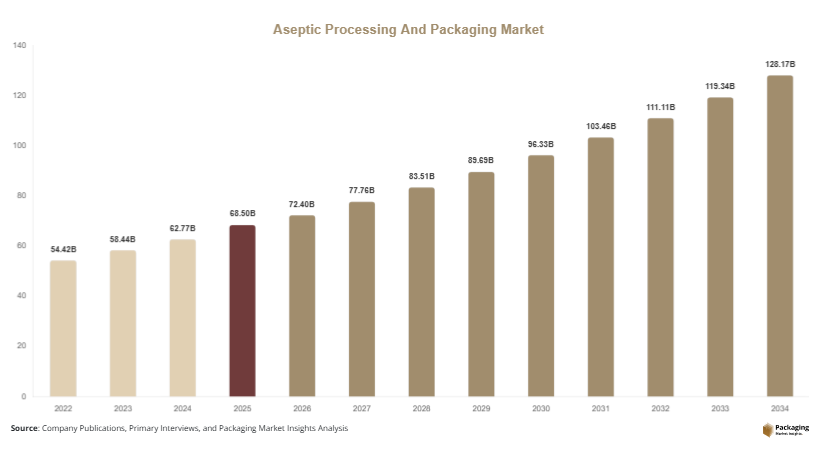
The global aseptic processing and packaging market size is estimated at USD 68.5 billion in 2025 and is projected to reach USD 72.4 billion in 2026. Driven by rising demand for packaged food, beverages, and pharmaceutical products, the market is forecasted to reach USD 128.9 billion by 2034, registering a CAGR of 7.4% during the forecast period (2025–2034). Aseptic processing and packaging involve sterilizing both the product and packaging separately before combining them in a sterile environment, ensuring longer shelf life without refrigeration. The aseptic processing and packaging market is experiencing steady expansion as industries focus on extending product shelf life while maintaining safety and quality.
Several factors are contributing to the growth of the aseptic processing and packaging market. One key driver is the increasing demand for convenience food and ready-to-drink beverages, particularly in urban areas where consumers seek longer shelf-life products. Another growth factor is the expansion of the pharmaceutical sector, which requires sterile packaging solutions to maintain drug safety and efficacy. Additionally, the rising focus on reducing food waste is encouraging the adoption of aseptic packaging, as it helps preserve product quality for extended periods.
Key Highlights:
- Asia Pacific dominated the market with a 41.2% share in 2025, while Latin America is projected to grow at the fastest CAGR of 7.9%.
- Carton packaging led the type segment with a 36.5% share, while plastic-based aseptic packaging is expected to grow at a CAGR of 7.6%.
- Food & beverage applications dominated with a 58.3% share, while pharmaceutical applications are forecasted to grow at a CAGR of 7.8%.
- Liquid products led the product segment with 62.7% share, while semi-liquid products are expected to grow at a CAGR of 7.5%.
- China remained the dominant country with a market size of USD 14.6 billion in 2025 and USD 15.5 billion in 2026.
Explore more data points, trends and opportunities Download Free Sample Report
Market Trends
Increasing adoption of sustainable and recyclable aseptic packaging solutions
Sustainability is becoming a key trend in the aseptic processing and packaging market. Manufacturers are focusing on developing eco-friendly packaging materials that reduce environmental impact while maintaining product integrity. Lightweight cartons, recyclable plastics, and bio-based materials are gaining traction as companies aim to meet regulatory requirements and consumer expectations. The shift toward sustainable packaging is also driven by the need to reduce carbon emissions and improve resource efficiency. Companies are investing in research and development to create innovative materials that offer both performance and sustainability, which is expected to shape the future of the market.
Integration of advanced automation and digital technologies in processing systems
The adoption of automation and digital technologies is transforming aseptic processing and packaging operations. Advanced filling machines, robotics, and real-time monitoring systems are improving efficiency and reducing the risk of contamination. Digital technologies such as data analytics and IoT are enabling manufacturers to optimize production processes and ensure consistent product quality. These innovations are particularly important in the pharmaceutical and food industries, where strict quality standards must be maintained. The integration of such technologies is expected to enhance productivity and drive market growth.
Market Drivers
Growing demand for extended shelf-life food and beverage products
The increasing demand for products with longer shelf life is a major driver of the aseptic processing and packaging market. Consumers are seeking convenient food and beverage options that can be stored for extended periods without refrigeration. Aseptic packaging provides an effective solution by preserving product freshness and nutritional value. This is particularly important in regions with limited cold chain infrastructure. The growing popularity of ready-to-drink beverages, dairy products, and packaged foods is expected to continue driving demand for aseptic packaging solutions.
Expansion of the pharmaceutical and healthcare industries
The rapid growth of the pharmaceutical and healthcare sectors is significantly contributing to market expansion. Aseptic processing and packaging are essential for maintaining the sterility and safety of pharmaceutical products, including vaccines, injectables, and biologics. The increasing prevalence of chronic diseases and the rising demand for advanced medical treatments are driving the need for sterile packaging solutions. This driver is expected to remain strong as healthcare infrastructure continues to develop globally.
Market Restraint
High initial investment and operational complexity
One of the major challenges in the aseptic processing and packaging market is the high initial investment required for setting up aseptic processing facilities. The equipment and technologies involved are complex and require significant capital expenditure. Additionally, maintaining sterile conditions during production involves stringent quality control measures, which can increase operational costs. For example, small and medium-sized enterprises may find it difficult to invest in advanced aseptic systems, limiting their market participation. This restraint can slow down market growth, particularly in developing regions.
Market Opportunities
Development of innovative packaging formats for diverse applications
The development of new packaging formats presents significant opportunities for market growth. Manufacturers are introducing innovative designs such as flexible pouches, bag-in-box systems, and single-serve containers to cater to changing consumer preferences. These formats offer convenience, portability, and improved product protection. The ability to customize packaging solutions for different applications is expected to drive demand across various industries.
Expansion in emerging markets with growing consumer demand
Emerging markets offer substantial growth opportunities for the aseptic processing and packaging market. Rapid urbanization, increasing disposable incomes, and changing lifestyles are driving demand for packaged products in these regions. The expansion of retail and distribution networks is further supporting market growth. Companies are focusing on expanding their presence in emerging markets to capitalize on these opportunities.
Report Scope
| Report Metric | Details |
|---|---|
| Market Size in 2025 | USD 68.5 Billion |
| Market Size in 2026 | USD 72.4 Billion |
| Market Size in 2034 | USD 128.9 Billion |
| CAGR | 7.4% (2026-2034) |
| Base Year for Estimation | 2025 |
| Historical Data | 2022-2024 |
| Forecast Period | 2026-2034 |
| Report Coverage | Revenue Forecast, Competitive Landscape, Supply Chain Disruption, Growth Factors, Environment & Regulatory Landscape and Trends |
| Geographies Covered | North America, Europe, APAC, Middle East and Africa, LATAM |
| Countries Covered | U.S., Canada, U.K., Germany, France, Spain, Italy, Russia, Nordic, Benelux, Rest of Europe, China, South Korea, Japan, India, Australia, Singapore, Taiwan, South East Asia, Rest of Asia-Pacific, UAE, Turky, Saudi Arabia, South Africa, Egypt, Nigeria, Rest of MEA, Brazil, Mexico, Argentina, Chile, Colombia, Rest of LATAM |
Explore more data points, trends and opportunities Download Free Sample Report
Segmental Analysis
By Packaging Type
Carton packaging dominated the market in 2024, accounting for 36.5% of the total share. These cartons are widely used for packaging beverages such as milk and juices due to their excellent barrier properties and sustainability advantages. They are lightweight and easy to transport.
Plastic-based aseptic packaging is expected to grow at a CAGR of 7.6% during the forecast period. This growth is driven by its flexibility and durability, making it suitable for a wide range of applications.
By Application
Food & beverage applications held the largest share of 58.3% in 2024. Aseptic packaging is widely used for products such as dairy, juices, and ready-to-eat meals. The demand for convenient and long-lasting food products is driving this segment.
Pharmaceutical applications are expected to grow at a CAGR of 7.8% during the forecast period. This growth is driven by the increasing demand for sterile packaging solutions in the healthcare sector.
By Product Type
Liquid products dominated the market in 2024, accounting for 62.7% of the total share. These products include beverages, dairy, and liquid pharmaceuticals. Aseptic packaging ensures their safety and quality.
Semi-liquid products are expected to grow at a CAGR of 7.5% during the forecast period. This growth is driven by the increasing demand for products such as sauces and creams.
Aseptic Processing And Packaging Market Segmentations
By Packaging Type
- Carton Packaging
- Plastic Packaging
By Application
- Food & Beverage
- Pharmaceutical
By Product Type
- Liquid Products
- Semi-Liquid Products
Regional Analysis
North America
North America accounted for 23.4% of the aseptic processing and packaging market share in 2025 and is expected to grow at a CAGR of 6.8% during the forecast period. The region benefits from a well-established food and pharmaceutical industry, which drives demand for aseptic solutions. The presence of advanced manufacturing infrastructure supports market growth.
The United States dominates the regional market due to its large consumer base. A unique growth factor is the high demand for ready-to-eat and ready-to-drink products, which require aseptic packaging to ensure safety and shelf life.
Europe
Europe held a market share of 25.1% in 2025 and is projected to grow at a CAGR of 7.0%. The region is characterized by strict food safety regulations and a strong focus on sustainability. The adoption of recyclable aseptic packaging materials is increasing.
Germany is the dominant country in the European market, driven by its advanced manufacturing capabilities. A unique growth factor is the implementation of stringent quality standards, which encourage the use of aseptic processing technologies.
Asia Pacific
Asia Pacific dominated the market with a 41.2% share in 2025 and is expected to grow at a CAGR of 7.9%. The region’s growth is driven by rapid urbanization and increasing consumption of packaged food and beverages. The expansion of retail and e-commerce sectors is further supporting market growth.
China remains the leading country in the region due to its large manufacturing base. A unique growth factor is the increasing demand for affordable and long-lasting packaged products.
Middle East & Africa
The Middle East & Africa region accounted for 5.8% of the market share in 2025 and is projected to grow at a CAGR of 7.2%. Growth is supported by increasing urbanization and rising demand for packaged food products. The development of retail infrastructure is also contributing to market expansion.
South Africa is a key market in the region, supported by its growing consumer goods industry. A unique growth factor is the increasing adoption of modern packaging technologies.
Latin America
Latin America held a 4.5% share in 2025 and is expected to grow at the fastest CAGR of 7.9%. The region’s growth is driven by increasing consumer demand and expanding retail networks. The adoption of aseptic packaging is also gaining momentum.
Brazil dominates the regional market due to its large population. A unique growth factor is the rising demand for dairy and beverage products that require extended shelf life.
Competitive Landscape
The aseptic processing and packaging market is moderately competitive, with several global players focusing on innovation and expansion. Companies are investing in advanced technologies to improve efficiency and reduce costs. Strategic partnerships and product launches are common strategies.
Tetra Pak International S.A. is a leading player in the market, known for its innovative aseptic packaging solutions. The company recently introduced sustainable packaging materials to reduce environmental impact. Other players are also focusing on expanding their product portfolios.
Key Players List
- Tetra Pak International S.A.
- SIG Combibloc Group AG
- Amcor plc
- Sealed Air Corporation
- Schott AG
- DS Smith Plc
- Elopak AS
- Greatview Aseptic Packaging Co., Ltd.
- Uflex Ltd.
- Ecolean AB
- Bemis Company, Inc.
- Reynolds Group Holdings Limited
- Printpack Inc.
- Coesia S.p.A.
- IMA Group