Aseptic Paper Packaging Market Size and Growth
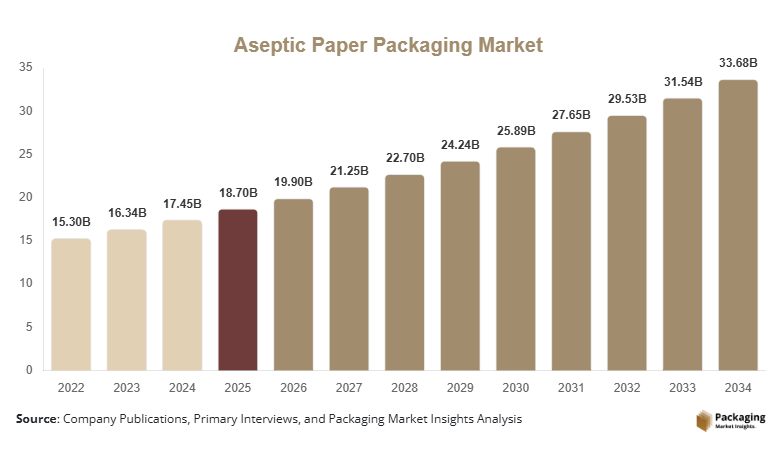
The global aseptic paper packaging market size is estimated at USD 18.7 billion in 2026, while the market is projected to reach approximately USD 19.9 billion in 2026. By 2034, the market is forecasted to attain nearly USD 33.8 billion, registering a CAGR of 6.8% during 2025–2034. The aseptic paper packaging market is experiencing significant growth due to increasing demand for safe, shelf-stable, and sustainable packaging solutions across food and beverage industries. Aseptic paper packaging is widely used for packaging dairy products, juices, soups, plant-based beverages, pharmaceuticals, and liquid foods without the need for refrigeration during storage and transportation. These packaging systems use sterilized paperboard combined with protective barrier layers to maintain product freshness and extend shelf life while reducing contamination risks. The growing preference for convenient and preservative-free packaged food products is supporting the expansion of the aseptic paper packaging industry worldwide.
One of the major growth factors driving the market is the increasing consumption of packaged beverages and ready-to-drink products. Consumers are increasingly seeking convenient and long-lasting food products that maintain nutritional value and freshness. Another important growth factor is the rising demand for sustainable packaging materials. Paper-based aseptic cartons are gaining popularity because they reduce plastic usage and support recycling initiatives across multiple regions. In addition, the expansion of dairy and plant-based beverage industries is creating strong demand for aseptic paper packaging solutions capable of preserving product quality without refrigeration.
Key Highlights
- Asia Pacific dominated the market with a 41.2% share in 2025.
- Latin America is projected to grow at the fastest CAGR of 7.2%.
- Carton packaging led the product segment with a 53.6% share.
- Paperboard materials dominated with a 58.1% share.
- Food & beverage applications led the market with a 76.4% share.
- The US remained the dominant country with a market size of USD 3.1 billion in 2025 and USD 3.3 billion in 2026.
Explore more data points, trends and opportunities Download Free Sample Report
Market Trends
Rising Adoption of Sustainable and Recyclable Aseptic Packaging
Sustainability has become a major trend in the aseptic paper packaging market as food and beverage companies increasingly focus on reducing environmental impact. Manufacturers are investing in recyclable paperboard cartons, plant-based barrier materials, and renewable packaging components to align with environmental regulations and consumer preferences. Retailers and beverage producers are also promoting eco-friendly packaging as part of their sustainability strategies. Technological advancements in fiber-based barrier coatings are helping companies reduce aluminum and plastic content in aseptic cartons while maintaining product protection and shelf stability. This trend is encouraging innovation in lightweight and recyclable packaging solutions across dairy, beverage, and liquid food applications.
Growing Demand for On-the-Go Beverage Packaging Formats
The increasing demand for convenient and portable beverage products is driving the popularity of compact aseptic paper packaging formats. Consumers are increasingly purchasing ready-to-drink coffee, flavored milk, plant-based beverages, juices, and nutritional drinks packaged in lightweight cartons and paper pouches. Urbanization and changing consumer lifestyles are supporting growth in single-serve packaging solutions suitable for transportation and outdoor consumption. In addition, foodservice providers and retail chains are adopting easy-to-store aseptic paper containers that improve logistics efficiency and product shelf life. Packaging manufacturers are therefore introducing innovative carton shapes, resealable caps, and ergonomic designs to improve consumer convenience and brand differentiation.
Market Drivers
Increasing Consumption of Packaged Food and Beverages
The rapid growth in packaged food and beverage consumption is one of the primary drivers supporting the aseptic paper packaging market. Consumers are increasingly choosing shelf-stable products that provide convenience, extended freshness, and easy transportation. Aseptic paper packaging allows manufacturers to preserve liquid food products without refrigeration or preservatives, making it highly suitable for dairy beverages, juices, soups, and nutritional drinks. Rising urban populations, busy lifestyles, and expanding retail distribution networks are contributing to higher demand for packaged food products globally. In addition, increasing awareness regarding food safety and hygienic packaging is encouraging manufacturers to adopt advanced aseptic packaging technologies.
Expansion of Dairy and Plant-Based Beverage Industries
The growing dairy and plant-based beverage industries are significantly contributing to the expansion of the aseptic paper packaging market. Products such as milk, yogurt drinks, almond milk, oat beverages, and soy-based nutritional drinks require packaging solutions capable of maintaining freshness and preventing microbial contamination. Aseptic paper packaging provides long shelf life while reducing transportation and storage costs associated with refrigeration. In addition, rising consumer interest in plant-based nutrition and functional beverages is supporting demand for innovative packaging formats. Beverage manufacturers are increasingly adopting aseptic cartons and pouches to improve product safety, sustainability, and supply chain efficiency.
Market Restraint
Complex Recycling Processes for Multilayer Packaging Materials
One of the key restraints affecting the aseptic paper packaging market is the complexity associated with recycling multilayer packaging structures. Aseptic paper cartons often contain layers of paperboard, plastic, and aluminum that provide moisture and oxygen protection for liquid food products. Separating these materials during recycling requires specialized infrastructure and advanced processing technologies, which are not widely available in all regions. As a result, recycling rates for aseptic packaging can remain limited in developing economies. For example, municipalities lacking dedicated carton recycling systems may send used aseptic packages to landfills despite their recyclable components. This challenge can affect consumer perception regarding sustainability and increase regulatory pressure on packaging manufacturers. Companies are therefore investing in recyclable barrier technologies and simplified material structures, although these innovations may increase production costs and require significant research investment.
Market Opportunities
Development of Fully Renewable Aseptic Packaging Solutions
The increasing demand for environmentally responsible packaging is creating strong opportunities for fully renewable aseptic paper packaging products. Packaging manufacturers are focusing on renewable paper fibers, plant-based polymers, and recyclable barrier coatings to reduce dependence on fossil-fuel-based materials. Beverage companies are also seeking low-carbon packaging alternatives to support sustainability commitments and improve brand positioning. Innovations in bio-based cap materials and fiber-based oxygen barriers are expected to improve recyclability while maintaining packaging performance. As governments continue encouraging circular economy practices, companies investing in renewable aseptic packaging technologies are likely to gain competitive advantages across global markets.
Expansion of Shelf-Stable Pharmaceutical Liquid Packaging
The pharmaceutical industry is generating new opportunities for aseptic paper packaging through the growing demand for sterile liquid packaging solutions. Nutritional supplements, oral medicines, and pediatric healthcare products increasingly require shelf-stable packaging systems that maintain sterility and product quality during transportation and storage. Aseptic paper packaging offers lightweight handling, improved logistics efficiency, and reduced contamination risks for pharmaceutical liquid products. In addition, increasing healthcare access in emerging economies is supporting demand for cost-effective sterile packaging systems suitable for long-distance distribution. Manufacturers developing pharmaceutical-grade aseptic paper packaging solutions are expected to benefit from expanding healthcare infrastructure and rising medical exports.
Report Scope
| Report Metric | Details |
|---|---|
| Market Size in 2025 | USD 18.7 Billion |
| Market Size in 2026 | USD 19.9 Billion |
| Market Size in 2034 | USD 33.8 Billion |
| CAGR | 6.8% (2026-2034) |
| Base Year for Estimation | 2025 |
| Historical Data | 2022-2024 |
| Forecast Period | 2026-2034 |
| Report Coverage | Revenue Forecast, Competitive Landscape, Supply Chain Disruption, Growth Factors, Environment & Regulatory Landscape and Trends |
| Geographies Covered | North America, Europe, APAC, Middle East and Africa, LATAM |
| Countries Covered | U.S., Canada, U.K., Germany, France, Spain, Italy, Russia, Nordic, Benelux, Rest of Europe, China, South Korea, Japan, India, Australia, Singapore, Taiwan, South East Asia, Rest of Asia-Pacific, UAE, Turky, Saudi Arabia, South Africa, Egypt, Nigeria, Rest of MEA, Brazil, Mexico, Argentina, Chile, Colombia, Rest of LATAM |
Explore more data points, trends and opportunities Download Free Sample Report
Segmental Analysis
By Product Type
Carton packaging dominated the aseptic paper packaging market in 2024, accounting for approximately 53.6% of the total market share. Aseptic cartons are widely used for dairy products, juices, soups, and nutritional beverages because they provide strong barrier protection, lightweight transportation, and long shelf life without refrigeration. These cartons also support efficient storage and large-scale distribution across retail supply chains. Increasing consumer demand for convenient beverage packaging and sustainable alternatives to plastic containers is significantly supporting market expansion. In addition, manufacturers are developing resealable carton designs and improved paperboard structures that enhance consumer convenience and packaging durability during transportation and handling operations.
Aseptic paper pouches are projected to be the fastest-growing subsegment, expanding at a CAGR of 7.4% during the forecast period. The growing popularity of portable beverage products and single-serve food packaging is driving demand for lightweight pouch formats. Aseptic paper pouches are increasingly used for baby food, flavored milk, smoothies, and nutritional drinks due to their flexibility and reduced material usage. Manufacturers are introducing advanced pouch designs with enhanced barrier protection and easy-opening features to improve product usability. In addition, rising demand for compact packaging suitable for e-commerce distribution and outdoor consumption is further supporting market growth.
By Material
Paperboard materials dominated the market in 2024 with a share of approximately 58.1%. Paperboard is widely used in aseptic packaging because it offers structural strength, printability, lightweight performance, and compatibility with recycling systems. Beverage manufacturers prefer paperboard cartons because they provide efficient transportation and storage benefits while reducing environmental impact compared to rigid plastic packaging. The increasing use of certified renewable paper fibers is also supporting sustainability initiatives across food and beverage industries. In addition, advancements in multilayer barrier coatings are improving the protective performance of paperboard packaging against oxygen, moisture, and microbial contamination.
Recyclable multilayer materials are expected to witness the fastest growth, registering a CAGR of 7.1% during the forecast period. Packaging manufacturers are increasingly developing advanced multilayer structures that improve recyclability while maintaining high barrier performance for liquid food products. These materials help extend product shelf life while reducing environmental concerns associated with traditional composite packaging. Growing regulatory pressure regarding packaging waste management is encouraging companies to adopt recyclable barrier technologies and renewable polymers. In addition, investments in fiber-based coatings and aluminum-free aseptic structures are expected to support long-term market growth.
By Application
Food & beverage applications accounted for the dominant market share of approximately 76.4% in 2024 within the aseptic paper packaging market. Dairy products, fruit juices, plant-based beverages, soups, and ready-to-drink nutritional products are major applications driving packaging demand. Aseptic paper packaging helps preserve freshness, nutritional quality, and product safety without requiring refrigeration during transportation and storage. Increasing urbanization, rising packaged food consumption, and growth in organized retail distribution are significantly contributing to market expansion. Beverage manufacturers are also adopting innovative carton packaging formats and lightweight materials to improve sustainability and consumer convenience.
Pharmaceutical liquid packaging is expected to register the fastest CAGR of 6.9% during the forecast period. The increasing distribution of oral medicines, healthcare beverages, and nutritional supplements is supporting demand for sterile aseptic packaging systems. Pharmaceutical companies require packaging solutions capable of maintaining product integrity and contamination control throughout global supply chains. Aseptic paper packaging offers lightweight handling, extended shelf life, and reduced transportation costs for liquid healthcare products. In addition, growing healthcare access and pharmaceutical exports in emerging economies are creating new growth opportunities for sterile paper-based packaging solutions.
Aseptic Paper Packaging Market Segmentations
By Product Type
- Carton Packaging
- Aseptic Paper Pouches
- Cups & Containers
- Sachets
- Other Aseptic Paper Packaging
By Material
- Paperboard
- Plastic Layers
- Aluminum Layers
- Recyclable Multilayer Materials
- Bio-Based Barrier Materials
By Application
- Food & Beverage
- Dairy Products
- Plant-Based Beverages
- Pharmaceutical Liquid Packaging
- Nutritional Products
Regional Analysis
North America
North America accounted for approximately 26.8% of the global aseptic paper packaging market share in 2025 and is projected to grow at a CAGR of 6.0% during the forecast period. The region benefits from strong packaged beverage consumption, advanced food processing industries, and increasing demand for sustainable packaging materials. Food and beverage companies across North America are increasingly adopting recyclable aseptic cartons to reduce plastic packaging usage and improve shelf stability. In addition, growth in ready-to-drink nutritional beverages and dairy alternatives is supporting higher demand for aseptic paper packaging products.
The United States dominates the North American market due to its extensive beverage manufacturing industry and strong retail distribution infrastructure. One unique growth factor is the rapid expansion of plant-based beverage consumption requiring shelf-stable and sustainable carton packaging solutions. Beverage manufacturers in the country are increasingly adopting renewable paperboard materials and recyclable caps to align with changing consumer preferences and sustainability regulations.
Europe
Europe represented nearly 24.4% of the global market share in 2025 and is expected to expand at a CAGR of 5.8% during the forecast period. Strict environmental regulations and strong consumer awareness regarding sustainable packaging are supporting market growth across the region. European food manufacturers are increasingly replacing traditional plastic containers with fiber-based aseptic cartons and recyclable paper packaging systems. Growth in dairy exports and functional beverage consumption is also driving demand for long-shelf-life packaging solutions across regional markets.
Germany remains the dominant country in the European market because of its advanced food processing sector and strong packaging recycling infrastructure. A unique growth factor is the increasing adoption of renewable packaging materials supported by circular economy policies. German packaging companies are investing in lightweight aseptic carton structures and low-carbon manufacturing technologies to improve sustainability performance and meet regulatory requirements.
Asia Pacific
Asia Pacific dominated the aseptic paper packaging market with a 41.2% share in 2025 and is projected to register a CAGR of 7.1% during the forecast period. Rapid urbanization, rising packaged food consumption, and expanding dairy industries are major drivers supporting regional growth. Countries such as China, India, Japan, and Indonesia are witnessing increasing demand for convenient beverage products and shelf-stable liquid foods. In addition, rising middle-class populations and growth in modern retail channels are contributing to higher adoption of aseptic paper packaging solutions.
China dominates the regional market due to its extensive beverage manufacturing industry and rapidly growing dairy consumption. One unique growth factor is the expansion of shelf-stable milk and nutritional beverage production for rural distribution networks where refrigeration infrastructure remains limited. Chinese manufacturers are increasingly investing in high-speed aseptic filling systems and recyclable carton packaging technologies to improve production efficiency and food safety standards.
Middle East & Africa
The Middle East & Africa region accounted for approximately 3.9% of the global market share in 2025 and is projected to grow at a CAGR of 6.4% during the forecast period. Rising demand for long-shelf-life food products and increasing investments in food processing infrastructure are supporting regional market growth. Aseptic paper packaging is becoming increasingly important for beverage transportation and storage in regions with high temperatures and limited refrigeration access. In addition, growth in imported dairy and juice products is contributing to higher demand for protective packaging systems.
Saudi Arabia leads the regional market due to growing packaged beverage consumption and expanding retail food distribution networks. One unique growth factor is the increasing demand for shelf-stable dairy products suitable for hot climatic conditions and long transportation distances. Food manufacturers are investing in aseptic packaging technologies that improve product durability while reducing refrigeration requirements across regional supply chains.
Latin America
Latin America represented nearly 3.7% of the global aseptic paper packaging market share in 2025 and is expected to grow at the fastest CAGR of 7.2% during the forecast period. Rising urbanization, increasing packaged juice consumption, and expanding dairy industries are supporting market development across the region. Food and beverage companies are increasingly adopting aseptic cartons to improve product shelf life and reduce transportation costs. In addition, growing retail modernization and consumer demand for convenient packaged products are contributing to higher packaging consumption.
Brazil dominates the Latin American market because of its large dairy processing industry and growing beverage export activities. A unique growth factor is the increasing demand for affordable shelf-stable nutritional drinks distributed through expanding retail and school nutrition programs. Regional packaging manufacturers are investing in lightweight aseptic carton production to support food security initiatives and improve logistics efficiency.
Competitive Landscape
The aseptic paper packaging market is moderately competitive, with leading companies focusing on recyclable packaging innovation, renewable material development, and advanced aseptic filling technologies. Market participants are investing in sustainable paperboard materials, lightweight carton structures, and barrier coating technologies to improve environmental performance and product shelf life. Strategic collaborations with beverage manufacturers and food processing companies are also supporting global market expansion.
Tetra Pak remains one of the leading companies in the market due to its broad aseptic carton portfolio and strong international distribution network. In 2024, the company introduced a fiber-based aseptic carton with increased renewable material content designed for dairy and beverage applications. Other major participants include SIG Group AG, Elopak ASA, Greatview Aseptic Packaging Co., Ltd., and Nippon Paper Industries Co., Ltd. These companies are focusing on sustainable packaging innovation, production capacity expansion, and recyclable barrier technologies to strengthen their market position.
Key Players List
- Tetra Pak
- SIG Group AG
- Elopak ASA
- Greatview Aseptic Packaging Co., Ltd.
- Nippon Paper Industries Co., Ltd.
- Amcor plc
- Mondi Group
- Uflex Ltd.
- DS Smith Plc
- Ecolean AB
- Refresco Group
- International Paper Company
- Smurfit Kappa Group
- WestRock Company
- Billerud AB