Aseptic Packaging In Food Market Size and Growth
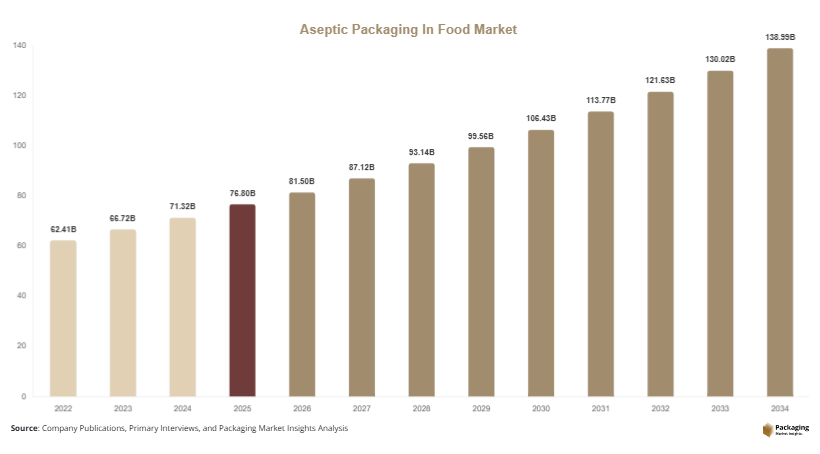
The global aseptic packaging in food market was valued at approximately USD 76.8 billion in 2025 and is projected to reach nearly USD 81.5 billion in 2026. By 2034, the market is forecast to reach around USD 138.9 billion, registering a CAGR of 6.9% during 2025–2034. The aseptic packaging in food market is witnessing strong growth due to increasing demand for extended shelf-life food products, rising consumption of packaged beverages, and growing preference for preservative-free food solutions. Aseptic packaging technology enables food and beverage manufacturers to maintain product freshness and nutritional quality without refrigeration during storage and transportation.
One of the key growth factors driving the market is the rapid increase in demand for ready-to-consume and convenience food products. Urbanization, busy lifestyles, and rising disposable incomes are encouraging consumers to purchase packaged dairy products, soups, juices, sauces, and liquid foods with longer shelf life. Aseptic packaging supports this demand by preserving food quality while reducing the need for chemical preservatives. Another major growth factor is the expansion of global food distribution networks. Food manufacturers increasingly require advanced packaging solutions that ensure product safety during long-distance transportation and export operations.
Key Highlights
- Asia Pacific dominated the market with a 39.3% share in 2025.
- Latin America is projected to grow at the fastest CAGR of 7.3%.
- Carton packaging led the type segment with a 46.7% share.
- Paperboard materials dominated with a 49.2% share.
- Dairy food applications led the segment with 42.8% share.
- The US remained the dominant country with a market size of USD 14.6 billion in 2025 and USD 15.4 billion in 2026.
Explore more data points, trends and opportunities Download Free Sample Report
Market Trends
Increasing Adoption of Sustainable Aseptic Packaging Solutions
Sustainability is becoming a major trend in the aseptic packaging in food market as food manufacturers and retailers focus on reducing environmental impact. Companies are increasingly introducing recyclable paperboard cartons, bio-based polymers, and lightweight multilayer packaging structures to meet sustainability targets. Food brands are also reducing packaging thickness and increasing the use of renewable raw materials to minimize carbon emissions. For example, several dairy and juice manufacturers in Europe are adopting plant-based aseptic cartons with certified renewable materials. Consumers are showing greater preference for environmentally responsible food packaging, encouraging manufacturers to improve recycling compatibility. Over the forecast period, sustainable aseptic packaging technologies are expected to gain significant adoption across dairy, beverage, and liquid food applications globally.
Rising Demand for Shelf-Stable Functional and Plant-Based Foods
The growing popularity of plant-based and functional food products is strongly influencing packaging demand in the aseptic packaging in food market. Consumers increasingly prefer shelf-stable nutritional beverages, dairy alternatives, protein drinks, and organic soups that offer convenience and extended freshness without preservatives. Food manufacturers are adopting aseptic packaging because it helps preserve nutrients, flavor, and texture while ensuring product safety. For instance, plant-based milk producers are expanding aseptic carton packaging for almond, soy, and oat beverages due to rising retail demand. This trend is expected to accelerate future investments in high-barrier packaging systems, advanced sterile filling technologies, and portable food packaging formats suitable for on-the-go consumption patterns.
Market Drivers
Rising Demand for Long Shelf-Life Packaged Food Products
The increasing demand for packaged food products with extended shelf life is one of the major drivers supporting the aseptic packaging in food market. Consumers prefer food products that remain fresh for longer periods without refrigeration, particularly in urban areas and regions with developing cold chain infrastructure. Aseptic packaging technology enables manufacturers to distribute products efficiently while maintaining food safety and quality. Dairy products, fruit juices, sauces, soups, and ready-to-drink beverages are increasingly packaged using sterile filling systems and multilayer barrier materials. For example, food manufacturers in Asia Pacific are adopting aseptic cartons for milk and nutritional beverages to support expanding retail distribution networks. The growing global demand for convenience foods is expected to continue driving market growth over the forecast period.
Expansion of Organized Retail and Food Distribution Networks
The rapid expansion of supermarkets, convenience stores, and e-commerce grocery platforms is significantly supporting demand for aseptic food packaging solutions. Retailers require food products with longer shelf life and efficient inventory management capabilities to reduce food waste and improve supply chain efficiency. Aseptic packaging allows packaged foods to remain stable during transportation and extended shelf display periods without refrigeration. Food manufacturers are increasingly using aseptic pouches, cartons, and bottles to improve logistics performance and reduce distribution costs. For instance, several global beverage companies have expanded aseptic beverage packaging production to meet growing online grocery demand. The development of cross-border food trade and export-oriented packaged food manufacturing is expected to further strengthen market demand.
Market Restraint
High Initial Investment and Complex Packaging Infrastructure Requirements
One of the major restraints affecting the aseptic packaging in food market is the high capital investment required for sterile filling systems, advanced processing equipment, and specialized packaging materials. Aseptic packaging operations require strict sterilization procedures and sophisticated manufacturing infrastructure to maintain food safety standards. Small and medium-sized food manufacturers often face challenges in adopting aseptic packaging technologies due to high equipment costs and operational complexity. Additionally, multilayer aseptic packaging materials can involve complex recycling processes, creating environmental concerns in certain regions. For example, some developing economies still lack sufficient recycling infrastructure for multilayer cartons and composite packaging materials. Compliance with food safety regulations and quality assurance standards can also increase production expenses for packaging manufacturers. These factors may limit market penetration among smaller food producers and cost-sensitive regions despite increasing demand for long shelf-life packaged food products.
Market Opportunities
Growth in Plant-Based and Organic Food Packaging
The increasing popularity of plant-based and organic food products presents major opportunities for aseptic packaging manufacturers. Consumers are increasingly demanding shelf-stable plant-based milk, dairy alternatives, nutritional beverages, and organic soups that maintain freshness without preservatives. Aseptic packaging provides excellent barrier protection and supports clean-label food positioning, making it suitable for organic and natural food applications. Food companies are investing in advanced aseptic cartons and pouches to support product differentiation and sustainability goals. Future opportunities are expected to expand further as plant-based diets become more common across North America, Europe, and Asia Pacific markets.
Expansion of Food Processing Industries in Emerging Economies
Emerging economies are creating strong opportunities for the aseptic packaging in food market due to rapid industrialization and increasing packaged food consumption. Countries such as India, Brazil, Indonesia, and Vietnam are investing heavily in dairy processing, beverage manufacturing, and packaged food production facilities. Aseptic packaging helps manufacturers improve food distribution efficiency while reducing refrigeration dependency. Governments in several developing countries are also supporting food processing investments and export-oriented manufacturing activities. Future growth opportunities are expected in nutritional beverages, ready-to-eat meals, and liquid food packaging applications across rapidly urbanizing economies.
Report Scope
| Report Metric | Details |
|---|---|
| Market Size in 2025 | USD 76.8 Billion |
| Market Size in 2026 | USD 81.5 Billion |
| Market Size in 2034 | USD 138.9 Billion |
| CAGR | 6.9% (2026-2034) |
| Base Year for Estimation | 2025 |
| Historical Data | 2022-2024 |
| Forecast Period | 2026-2034 |
| Report Coverage | Revenue Forecast, Competitive Landscape, Supply Chain Disruption, Growth Factors, Environment & Regulatory Landscape and Trends |
| Geographies Covered | North America, Europe, APAC, Middle East and Africa, LATAM |
| Countries Covered | U.S., Canada, U.K., Germany, France, Spain, Italy, Russia, Nordic, Benelux, Rest of Europe, China, South Korea, Japan, India, Australia, Singapore, Taiwan, South East Asia, Rest of Asia-Pacific, UAE, Turky, Saudi Arabia, South Africa, Egypt, Nigeria, Rest of MEA, Brazil, Mexico, Argentina, Chile, Colombia, Rest of LATAM |
Explore more data points, trends and opportunities Download Free Sample Report
Segmental Analysis
By Type
Carton packaging dominated the aseptic packaging in food market in 2024, accounting for approximately 46.7% of the global market share. Cartons are widely used for dairy beverages, juices, soups, and liquid food products due to their lightweight structure, excellent barrier protection, and transportation efficiency. Food manufacturers prefer carton packaging because it supports extended shelf life while reducing refrigeration requirements. Multilayer carton structures effectively protect food products from oxygen, light, and microbial contamination, helping maintain nutritional quality and freshness. Several beverage companies are also adopting resealable carton designs and digital printing technologies to improve consumer convenience and branding opportunities. The segment’s dominance is further supported by rising demand for sustainable paperboard-based packaging solutions across retail food industries worldwide.
Pouch packaging is expected to emerge as the fastest-growing subsegment, registering a CAGR of 7.5% during the forecast period. Flexible aseptic pouches are increasingly used for sauces, soups, baby food, dairy products, and nutritional beverages due to their lightweight and portable characteristics. Food manufacturers are adopting pouch packaging because it reduces material consumption and transportation costs while improving shelf visibility. Several companies are introducing spouted and stand-up pouch designs to support convenience-oriented consumption trends. Rising demand for single-serve food products and on-the-go meal solutions is expected to accelerate future segment growth. Packaging innovations involving recyclable films and bio-based flexible materials are also likely to strengthen market expansion over the forecast period.
By Material
Paperboard materials accounted for the dominant market share of 49.2% in 2024 due to their strong sustainability profile and widespread use in aseptic carton packaging applications. Paperboard-based aseptic packaging provides effective barrier protection while supporting lightweight transportation and recyclability objectives. Dairy product manufacturers, juice producers, and nutritional beverage companies extensively use multilayer paperboard cartons because they maintain product freshness and improve shelf stability. Increasing consumer preference for renewable and recyclable packaging materials is further supporting segment growth. Food manufacturers are also integrating certified renewable paper fibers and plant-based coatings into aseptic packaging systems to reduce environmental impact. The segment continues benefiting from strong adoption across supermarkets, convenience stores, and export-oriented food distribution networks.
Bio-based materials are projected to be the fastest-growing segment, expanding at a CAGR of 7.6% through 2034. Rising environmental concerns and stricter packaging sustainability regulations are encouraging food companies to adopt renewable packaging materials for aseptic applications. Bio-based polymers and renewable barrier coatings are increasingly used in cartons, bottles, and flexible pouches to reduce dependence on fossil-based plastics. Several beverage manufacturers are introducing aseptic packaging made with sugarcane-derived polymers and compostable material blends to strengthen sustainability positioning. Future growth is expected to accelerate as governments implement stricter waste reduction policies and consumers increasingly prefer eco-friendly food packaging solutions. Technological advancements in biodegradable barrier materials are also expected to support long-term market development.
By End-Use
Dairy food applications dominated the aseptic packaging in food market in 2024, accounting for approximately 42.8% of total market revenue. Milk, flavored dairy beverages, cream products, yogurt drinks, and nutritional dairy products are widely packaged using aseptic cartons and bottles due to their sensitivity to microbial contamination. Aseptic packaging enables dairy manufacturers to extend product shelf life without refrigeration while maintaining nutritional quality and flavor stability. Increasing demand for packaged milk products in urban areas and export-oriented dairy distribution is further supporting market growth. Dairy producers are also investing in lightweight packaging formats and resealable cartons to improve consumer convenience and reduce logistics costs. The segment continues benefiting from rising global consumption of ready-to-drink dairy beverages and fortified nutritional products.
Plant-based food packaging is anticipated to grow at the fastest CAGR of 7.8% during the forecast period. Consumers increasingly prefer plant-based milk alternatives, protein beverages, vegan soups, and nutritional drinks due to rising health awareness and changing dietary habits. Aseptic packaging is highly suitable for these products because it preserves nutritional integrity and enables long shelf life without preservatives. Beverage companies are introducing advanced aseptic cartons and flexible pouches for oat milk, soy beverages, almond milk, and plant protein drinks. Future market growth is expected to be supported by increasing vegan product launches, sustainable food packaging trends, and expanding retail availability of plant-based nutritional products worldwide.
Aseptic Packaging In Food Market Segmentations
By Type
- Carton Packaging
- Pouch Packaging
- Bottles & Containers
- Bags & Sachets
- Cans
By Material
- Paperboard
- Plastic
- Glass
- Metal
- Bio-Based Materials
By End-User
- Dairy Foods
- Beverages
- Ready-to-Eat Foods
- Plant-Based Foods
- Sauces & Soups
By Distribution Channel
- Supermarkets & Hypermarkets
- Convenience Stores
- Online Retail
- Foodservice Channels
- Specialty Food Stores
Regional Analysis
North America
North America accounted for approximately 28.6% of the global aseptic packaging in food market share in 2025 and is projected to grow at a CAGR of 6.1% during the forecast period. The region benefits from strong packaged food consumption, advanced food processing infrastructure, and increasing demand for shelf-stable dairy and beverage products. Consumers in the United States and Canada increasingly prefer convenient food products that offer extended freshness and reduced preservative usage. Food manufacturers are investing in sustainable aseptic cartons, bottles, and pouch packaging formats to improve logistics efficiency and reduce refrigeration costs. Growth in online grocery retail and premium nutritional beverage consumption is also contributing to higher demand for aseptic food packaging solutions across the region.
The United States dominates the North American market due to its large food processing industry and strong retail distribution network. One unique growth driver is the increasing demand for protein beverages and functional nutrition products among health-conscious consumers. Beverage manufacturers are expanding aseptic packaging production for meal replacement drinks, dairy alternatives, and nutritional shakes. Several U.S.-based companies are also investing in recyclable aseptic carton technologies and renewable material sourcing to improve sustainability performance. The growth of direct-to-consumer food delivery services is expected to further support packaging demand across the country.
Europe
Europe represented nearly 24.7% of the global aseptic packaging in food market share in 2025 and is forecast to expand at a CAGR of 5.9% through 2034. The region’s market growth is supported by rising demand for organic food products, strong environmental regulations, and increasing consumption of packaged dairy beverages. Countries such as Germany, France, Italy, and the United Kingdom are investing in recyclable and renewable aseptic packaging materials to support circular economy objectives. Demand for shelf-stable soups, sauces, dairy products, and plant-based beverages remains high across supermarkets and foodservice industries. In addition, advanced food safety standards are encouraging manufacturers to adopt sterile packaging technologies for export-oriented food production.
Germany remains the dominant country in the European market due to its advanced dairy processing and packaged food manufacturing sectors. A unique growth factor is the strong adoption of sustainable food packaging initiatives supported by government recycling regulations. German food manufacturers increasingly use paperboard-based aseptic cartons with renewable coatings and lightweight packaging structures. The country is also witnessing rising demand for organic milk and plant-based beverages packaged in recyclable aseptic containers. Investments in automated sterile filling systems and energy-efficient packaging technologies are expected to support long-term market growth.
Asia Pacific
Asia Pacific dominated the global aseptic packaging in food market with a 39.3% share in 2025 and is expected to register a CAGR of 7.5% during the forecast period. Rapid urbanization, rising disposable incomes, and increasing packaged food consumption are major contributors to regional market expansion. China, India, Japan, and Indonesia are witnessing strong demand for shelf-stable dairy products, fruit juices, ready-to-drink tea, and nutritional beverages. Food manufacturers are investing in aseptic cartons and pouch packaging technologies to improve food safety and transportation efficiency. The expansion of organized retail chains and e-commerce grocery platforms is also accelerating demand for long shelf-life packaged food products across the region.
China dominates the Asia Pacific market due to its extensive food processing industry and rapidly growing packaged beverage sector. One unique growth driver is the increasing consumption of ready-to-drink dairy beverages and nutritional drinks among urban populations. Chinese beverage companies are investing in advanced aseptic filling lines and lightweight packaging materials to support large-scale production and export operations. The country is also witnessing growing adoption of sustainable food packaging solutions as environmental regulations become stricter. Rising investment in cold chain alternatives and food distribution infrastructure is expected to strengthen market growth further.
Middle East & Africa
The Middle East & Africa accounted for approximately 4.5% of the global aseptic packaging in food market share in 2025 and is projected to grow at a CAGR of 6.8% during the forecast period. Rising urban populations, increasing packaged food imports, and growing demand for shelf-stable dairy products are supporting regional market growth. Countries such as Saudi Arabia, the UAE, and South Africa are witnessing increasing consumption of packaged juices, flavored milk, and ready-to-eat food products. Food manufacturers are increasingly adopting aseptic packaging solutions to improve product stability in high-temperature environments. Investments in retail infrastructure and tourism-driven foodservice industries are also contributing to packaging demand across the region.
The United Arab Emirates leads the regional market due to its strong retail sector and expanding food import industry. A unique growth factor is the increasing demand for premium packaged beverages and nutritional dairy products within hospitality and tourism sectors. Beverage suppliers in the UAE are increasingly adopting aseptic cartons and bottle packaging to maintain product quality during long-distance transportation and storage. The country is also investing in food security initiatives and local food processing capabilities, creating additional opportunities for aseptic packaging suppliers.
Latin America
Latin America held approximately 2.9% of the global aseptic packaging in food market share in 2025 and is anticipated to grow at the fastest CAGR of 7.3% during the forecast period. Rising packaged food consumption, expanding supermarket chains, and increasing investments in beverage manufacturing are supporting regional market growth. Brazil, Mexico, and Argentina are experiencing strong demand for packaged dairy drinks, fruit juices, and nutritional beverages. Food manufacturers are investing in cost-effective aseptic pouch and carton packaging systems to improve product shelf life and reduce refrigeration dependency. The rapid expansion of convenience retail channels is also supporting higher consumption of shelf-stable packaged food products across urban populations.
Brazil dominates the Latin American market due to its large dairy and beverage manufacturing industries. One unique growth driver is the increasing consumption of tropical fruit beverages and shelf-stable nutritional drinks among younger consumers. Beverage companies in Brazil are expanding aseptic carton production and investing in lightweight packaging materials to improve transportation efficiency and sustainability performance. Rising exports of packaged beverages and improving food retail infrastructure are expected to strengthen long-term demand for aseptic packaging solutions across the country.
Competitive Landscape
The aseptic packaging in food market is highly competitive, with companies focusing on sustainable packaging technologies, sterile filling innovations, and regional manufacturing expansion to strengthen market presence. Tetra Pak International remains one of the leading companies due to its extensive aseptic carton packaging portfolio and strong global food packaging infrastructure. The company recently introduced renewable material-based aseptic cartons designed for dairy and beverage applications.
Other major market participants include SIG Group AG, Amcor plc, Elopak ASA, and Greatview Aseptic Packaging Co. Ltd. These companies are investing in recyclable packaging materials, lightweight multilayer structures, and advanced aseptic filling systems to improve packaging performance and sustainability. Strategic collaborations with dairy processors and beverage manufacturers remain key competitive strategies across the industry. Companies are also expanding production capacities in Asia Pacific and Latin America to support rising packaged food demand. Increasing focus on renewable packaging materials and flexible aseptic pouch innovations is expected to intensify market competition over the forecast period.
Key Players List
- Tetra Pak International
- SIG Group AG
- Amcor plc
- Elopak ASA
- Greatview Aseptic Packaging Co. Ltd.
- Mondi Group
- DS Smith Plc
- Ecolean AB
- Scholle IPN
- Smurfit Kappa Group
- UFlex Limited
- Sealed Air Corporation
- Liquibox Corporation
- IPI Srl
- Reynolds Group Holdings
- Nippon Paper Industries Co. Ltd.
- Stora Enso Oyj
- Billerud AB