Aseptic Packaging For The Pharmaceutical Market Size and Growth
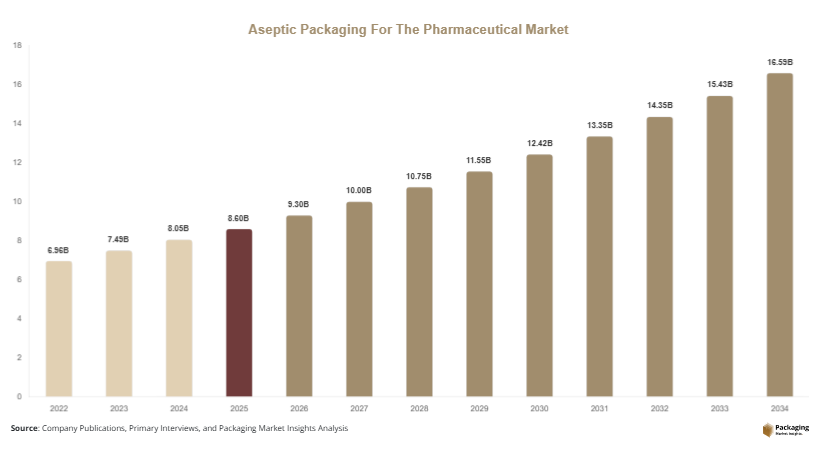
The aseptic packaging for the pharmaceutical market is experiencing steady expansion, supported by the growing demand for sterile drug delivery systems and the rising prevalence of chronic diseases. In 2025, the global market size is estimated to reach USD 8.6 billion, and it is projected to grow to approximately USD 9.3 billion in 2026. By 2034, the market is forecasted to achieve a value of nearly USD 17.8 billion, expanding at a compound annual growth rate (CAGR) of 7.5% from 2025 to 2034.
Aseptic packaging plays a critical role in maintaining the sterility and integrity of pharmaceutical products, particularly biologics, injectables, and vaccines. The increasing complexity of drug formulations and the need for contamination-free storage and transportation have elevated the importance of aseptic solutions across the pharmaceutical supply chain. Furthermore, stringent regulatory frameworks regarding drug safety and packaging standards are encouraging manufacturers to adopt advanced aseptic technologies.
Key Highlights:
- Market size valued at USD 8.6 billion in 2025
- Expected to reach USD 17.8 billion by 2034
- CAGR of 7.5% during 2025–2034
- Rising demand for biologics and vaccines driving adoption
- Increasing regulatory focus on sterile packaging solutions
Explore more data points, trends and opportunities Download Free Sample Report
Market Trends
Increasing Adoption of Prefilled Syringes and Ready-to-Use Packaging
The market is witnessing a significant shift toward prefilled syringes and ready-to-use aseptic packaging formats. These solutions reduce the risk of contamination and improve dosing accuracy, making them highly suitable for injectable drugs and biologics. Pharmaceutical companies are increasingly adopting these formats to streamline production processes and minimize human intervention. Prefilled syringes also enhance patient convenience, especially for self-administration therapies, which is becoming more common in chronic disease management.
In addition, ready-to-use packaging eliminates the need for in-house sterilization, reducing operational complexity and cost. This trend is particularly prominent in developed markets where automation and efficiency are key priorities. As drug manufacturers focus on reducing turnaround time and improving product safety, the demand for such advanced packaging formats is expected to grow steadily.
Integration of Advanced Materials and Smart Packaging Technologies
Another notable trend is the integration of advanced materials and smart packaging technologies in aseptic pharmaceutical packaging. Manufacturers are developing high-barrier materials that offer superior protection against moisture, oxygen, and microbial contamination. These materials help extend the shelf life of sensitive drugs and maintain their efficacy throughout the distribution process.
Furthermore, the incorporation of smart packaging features such as track-and-trace systems, tamper-evident seals, and digital labeling is gaining traction. These technologies enhance supply chain transparency and ensure product authenticity, which is critical in preventing counterfeit drugs. As regulatory bodies emphasize traceability and safety, the adoption of intelligent packaging solutions is expected to increase across the pharmaceutical industry.
Market Drivers
Growing Demand for Biologics and Injectable Drugs
The rising demand for biologics and injectable therapies is a major driver of the aseptic packaging for the pharmaceutical market. Biologics are highly sensitive to environmental conditions and require strict sterile packaging to maintain their stability and effectiveness. As the pipeline of biologic drugs continues to expand, pharmaceutical companies are investing in advanced aseptic packaging solutions to meet these requirements.
Additionally, the increasing prevalence of chronic diseases such as diabetes, cancer, and autoimmune disorders is driving the demand for injectable treatments. These therapies often require precise dosing and contamination-free packaging, further boosting the need for aseptic solutions. The growth of personalized medicine is also contributing to this trend, as customized treatments often rely on sterile packaging formats.
Stringent Regulatory Requirements for Drug Safety
Regulatory authorities across the globe are implementing strict guidelines to ensure the safety and quality of pharmaceutical products. These regulations mandate the use of aseptic packaging for sterile drugs, particularly injectables and vaccines. Compliance with these standards is essential for market approval and commercialization, prompting manufacturers to adopt high-quality aseptic packaging solutions.
Moreover, regulatory agencies are increasingly focusing on preventing contamination and ensuring product integrity throughout the supply chain. This has led to the adoption of advanced sterilization techniques and packaging technologies. As compliance becomes more critical, pharmaceutical companies are prioritizing investments in aseptic packaging to meet regulatory expectations and maintain their competitive position in the market.
Market Restraint
High Cost of Aseptic Packaging Technologies
One of the primary restraints affecting the growth of the aseptic packaging for the pharmaceutical market is the high cost associated with advanced aseptic packaging technologies. The implementation of aseptic systems requires significant capital investment in specialized equipment, cleanroom facilities, and skilled labor. These costs can be a barrier for small and medium-sized pharmaceutical companies, limiting their ability to adopt such solutions.
In addition, the maintenance and validation of aseptic packaging systems involve ongoing expenses, including quality assurance processes and regulatory compliance checks. This increases the overall operational cost for manufacturers. For example, setting up a fully automated aseptic filling line can require substantial investment, making it less feasible for companies with limited budgets. As a result, cost considerations may hinder the widespread adoption of aseptic packaging, particularly in developing regions.
Market Opportunities
Expansion in Emerging Markets
Emerging economies present significant growth opportunities for the aseptic packaging market. Countries in Asia Pacific, Latin America, and the Middle East are investing in healthcare infrastructure and pharmaceutical manufacturing capabilities. This expansion is driving the demand for advanced packaging solutions that ensure product safety and compliance with international standards.
Furthermore, governments in these regions are promoting local drug production to reduce dependency on imports. This has led to increased investments in manufacturing facilities, creating a favorable environment for aseptic packaging providers. As pharmaceutical companies expand their operations in these markets, the demand for sterile packaging solutions is expected to rise substantially.
Growth of Contract Manufacturing Organizations (CMOs)
The increasing reliance on contract manufacturing organizations (CMOs) is another key opportunity in the market. Pharmaceutical companies are outsourcing their production processes to CMOs to reduce costs and focus on core competencies. These organizations require advanced aseptic packaging solutions to meet the stringent quality standards of their clients.
CMOs are investing in state-of-the-art facilities and technologies to offer comprehensive services, including aseptic filling and packaging. This trend is creating new opportunities for packaging solution providers to collaborate with CMOs and expand their market presence. As outsourcing continues to grow, the demand for reliable and efficient aseptic packaging solutions is expected to increase.
Report Scope
| Report Metric | Details |
|---|---|
| Market Size in 2025 | USD 8.6 Billion |
| Market Size in 2026 | USD 9.3 Billion |
| Market Size in 2034 | USD 17.8 Billion |
| CAGR | 7.5% (2026-2034) |
| Base Year for Estimation | 2025 |
| Historical Data | 2022-2024 |
| Forecast Period | 2026-2034 |
| Report Coverage | Revenue Forecast, Competitive Landscape, Supply Chain Disruption, Growth Factors, Environment & Regulatory Landscape and Trends |
| Geographies Covered | North America, Europe, APAC, Middle East and Africa, LATAM |
| Countries Covered | U.S., Canada, U.K., Germany, France, Spain, Italy, Russia, Nordic, Benelux, Rest of Europe, China, South Korea, Japan, India, Australia, Singapore, Taiwan, South East Asia, Rest of Asia-Pacific, UAE, Turky, Saudi Arabia, South Africa, Egypt, Nigeria, Rest of MEA, Brazil, Mexico, Argentina, Chile, Colombia, Rest of LATAM |
Explore more data points, trends and opportunities Download Free Sample Report
Segmental Analysis
By Type
The vials segment dominated the market in 2024, accounting for approximately 38% of the total share. Vials are widely used for storing injectable drugs and vaccines due to their ability to maintain sterility and prevent contamination. Their compatibility with automated filling systems and ease of handling make them a preferred choice among pharmaceutical manufacturers. Additionally, the increasing production of vaccines and biologics has significantly boosted the demand for vials, reinforcing their leading position in the market.
Prefilled syringes are expected to be the fastest-growing subsegment, with a projected CAGR of 8.9% during the forecast period. The growth is driven by the rising demand for self-administration therapies and the need for accurate dosing. Prefilled syringes reduce the risk of contamination and improve patient convenience, making them increasingly popular in chronic disease management. The shift toward patient-centric healthcare is further supporting the adoption of this packaging format.
By Application
The injectables segment held the largest share in 2024, accounting for around 45% of the market. Injectable drugs require strict aseptic conditions to ensure safety and efficacy. The increasing prevalence of chronic diseases and the growing demand for biologics are driving the use of aseptic packaging in this segment. Additionally, advancements in drug delivery systems are further boosting the demand for sterile packaging solutions.
Vaccines represent the fastest-growing application segment, with a CAGR of 9.5%. The expansion of global immunization programs and the development of new vaccines are key growth factors. Aseptic packaging is essential for maintaining the stability and effectiveness of vaccines, particularly during storage and transportation. The increasing focus on pandemic preparedness is also contributing to the growth of this segment.
By End-Use
Pharmaceutical companies accounted for the largest share in 2024, representing approximately 60% of the market. These companies rely on aseptic packaging to ensure the safety and quality of their products. The growing demand for advanced drug formulations and the need for regulatory compliance are driving the adoption of aseptic packaging solutions in this segment.
Contract manufacturing organizations (CMOs) are the fastest-growing end-use segment, with a CAGR of 8.7%. The increasing trend of outsourcing pharmaceutical manufacturing is a major growth factor. CMOs require advanced aseptic packaging technologies to meet the quality standards of their clients. As outsourcing continues to expand, the demand for aseptic packaging solutions in this segment is expected to rise significantly.
Aseptic Packaging For The Pharmaceutical Market Segmentations
Type
- Vials
- Ampoules
- Prefilled Syringes
- Bags & Pouches
Application
- Injectables
- Vaccines
- Ophthalmic Solutions
- Others
End-Use
- Pharmaceutical Companies
- Contract Manufacturing Organizations
- Research Laboratories
Regional Analysis
North America
North America accounted for a significant share of the aseptic packaging for the pharmaceutical market in 2025, with approximately 35% of the global market. The region is expected to maintain steady growth, with a projected CAGR of 6.8% during the forecast period. The presence of a well-established pharmaceutical industry and advanced healthcare infrastructure supports market expansion. Additionally, strong regulatory frameworks ensure the adoption of high-quality aseptic packaging solutions.
The United States dominates the regional market due to its extensive pharmaceutical manufacturing capabilities and high demand for biologics. A key growth factor is the increasing investment in research and development activities, which drives the need for innovative packaging solutions. The focus on personalized medicine and advanced drug delivery systems further supports the adoption of aseptic packaging technologies.
Europe
Europe held around 28% of the market share in 2025 and is expected to grow at a CAGR of 6.5% through 2034. The region benefits from stringent regulatory standards and a strong emphasis on product safety. Pharmaceutical companies in Europe are adopting advanced aseptic packaging solutions to comply with these regulations and maintain product integrity.
Germany is a leading country in the European market, driven by its robust pharmaceutical manufacturing sector. A unique growth factor is the increasing focus on sustainable packaging solutions. Companies are developing eco-friendly aseptic packaging materials to reduce environmental impact while maintaining sterility and product safety.
Asia Pacific
Asia Pacific is the fastest-growing region, with a CAGR of 9.2% during the forecast period and a market share of approximately 22% in 2025. Rapid industrialization and increasing healthcare investments are driving market growth. The expansion of pharmaceutical manufacturing facilities in countries such as China and India is further boosting demand for aseptic packaging solutions.
China dominates the regional market due to its large-scale pharmaceutical production and growing healthcare sector. A key growth factor is government support for domestic drug manufacturing, which encourages the adoption of advanced packaging technologies. The increasing demand for vaccines and generic drugs also contributes to market expansion.
Middle East & Africa
The Middle East & Africa region accounted for around 8% of the market share in 2025 and is projected to grow at a CAGR of 7.0%. The region is witnessing gradual improvements in healthcare infrastructure and pharmaceutical manufacturing capabilities, which are supporting market growth.
Saudi Arabia leads the regional market, driven by government initiatives to develop the healthcare sector. A unique growth factor is the increasing focus on local drug production, which reduces reliance on imports. This trend is creating opportunities for aseptic packaging providers to establish a presence in the region.
Latin America
Latin America held approximately 7% of the market share in 2025 and is expected to grow at a CAGR of 7.3%. The region is experiencing steady growth due to rising healthcare expenditures and increasing demand for pharmaceutical products. Investments in manufacturing infrastructure are also contributing to market expansion.
Brazil dominates the Latin American market, supported by its large pharmaceutical industry. A key growth factor is the growing demand for generic drugs, which require cost-effective yet reliable packaging solutions. This is driving the adoption of aseptic packaging technologies in the region.
Competitive Landscape
The aseptic packaging for the pharmaceutical market is moderately consolidated, with several key players focusing on innovation and strategic collaborations. Leading companies are investing in advanced technologies to enhance product quality and meet regulatory requirements. The competitive environment is characterized by product launches, partnerships, and capacity expansions.
A prominent leader in the market is Amcor plc, known for its extensive portfolio of high-performance packaging solutions. The company has recently expanded its aseptic packaging capabilities by introducing advanced barrier materials designed for pharmaceutical applications. Other major players are also focusing on automation and digitalization to improve efficiency and reduce contamination risks. As competition intensifies, companies are prioritizing innovation and sustainability to strengthen their market position.
Key Players List
- Amcor plc
- Gerresheimer AG
- Schott AG
- West Pharmaceutical Services, Inc.
- Becton, Dickinson and Company
- AptarGroup, Inc.
- Nipro Corporation
- SGD Pharma
- Stevanato Group
- Catalent, Inc.
- Berry Global Inc.
- Uflex Ltd.
- Piramal Glass Pvt. Ltd.
- Sealed Air Corporation
- DuPont de Nemours, Inc.