Aseptic Flex Bag Market Size and Growth
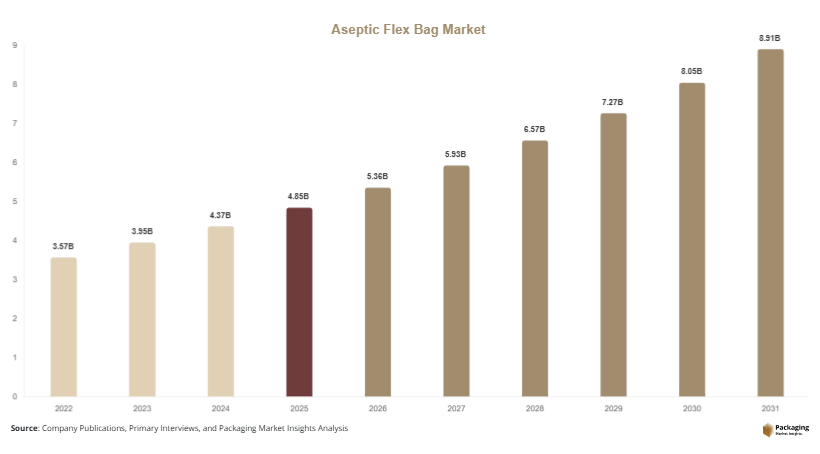
The global Aseptic Flex Bag Market size was valued at USD 4.85 billion in 2025 and is projected to reach USD 8.92 billion by 2030, expanding at a CAGR of 10.7% during 2025–2031. The market is experiencing steady expansion due to the rising demand for sterile, lightweight, and cost-efficient bulk packaging solutions across the food, pharmaceutical, and chemical industries.
One of the primary global factors supporting market growth is the increasing demand for extended shelf-life products without preservatives. Aseptic flex bags enable safe storage and transportation of liquids such as dairy products, fruit concentrates, pharmaceuticals, and industrial chemicals. Their compatibility with bulk handling systems and reduced contamination risks make them an ideal choice in modern supply chains.
From a broader industry perspective, the Pharmaceutical Packaging Equipment Market continues to influence aseptic packaging innovations, as manufacturers increasingly integrate advanced sterilization and filling technologies into flex bag systems.
Key Highlights:
- North America dominated the market with 34.2% share in 2025, while Asia Pacific is expected to grow at the fastest CAGR of 12.8%
- By capacity, 100–1000 liters segment led with 41.5% share, while >1000 liters is projected to grow at a CAGR of 11.9%
- By application, food & beverages dominated, whereas pharmaceuticals is the fastest-growing segment at 12.3% CAGR
- The U.S. market was valued at USD 1.21 billion in 2025 and is expected to reach USD 1.32 billion in 2026
Explore more data points, trends and opportunities Download Free Sample Report
Market Trends
Shift Toward Sustainable Flexible Packaging
Sustainability has emerged as a defining trend in the Aseptic Flex Bag Market. Manufacturers are increasingly developing recyclable and bio-based multilayer films to reduce environmental impact. This aligns with global sustainability goals and regulatory pressures to minimize plastic waste. Companies are also optimizing material usage by reducing film thickness while maintaining barrier properties, which lowers transportation costs and carbon emissions. The influence of sustainability practices from the Pharmaceutical Packaging Equipment Market is accelerating innovation in eco-friendly aseptic systems.
Integration of Smart Packaging Technologies
Another key trend is the integration of smart packaging features such as RFID tags, temperature indicators, and traceability solutions. These technologies enhance supply chain visibility and product safety, especially for sensitive applications like pharmaceuticals and dairy products. Real-time monitoring ensures compliance with strict quality standards, reducing spoilage and product recalls. As digitalization increases across industries, aseptic flex bags are evolving into intelligent packaging solutions, offering value beyond containment.
Market Drivers
Rising Demand for Bulk Liquid Transportation
The growing need for efficient bulk transportation of liquids is a major driver of the Aseptic Flex Bag Market. Industries such as food processing, chemicals, and pharmaceuticals require safe and cost-effective solutions for storing and transporting large volumes. Aseptic flex bags offer advantages such as reduced contamination risk, easy handling, and compatibility with intermediate bulk containers (IBCs). These benefits are driving adoption across global supply chains.
Growth of Processed Food and Beverage Industry
The expansion of the processed food and beverage sector is significantly boosting market demand. Products such as fruit purees, sauces, and dairy require aseptic packaging to maintain freshness and quality over extended periods. Urbanization, changing consumer lifestyles, and increasing demand for convenience foods are fueling this growth. Additionally, technological advancements influenced by the Pharmaceutical Packaging Equipment Market are improving sterilization efficiency, further enhancing the appeal of aseptic flex bags.
Market Restraint
High Initial Setup and Equipment Costs
One of the major restraints in the Aseptic Flex Bag Market is the high initial investment required for aseptic processing and packaging equipment. The integration of sterilization units, filling systems, and specialized storage infrastructure increases capital expenditure for manufacturers. Small and medium enterprises often face challenges in adopting these technologies due to budget constraints.
Moreover, maintaining aseptic conditions requires strict compliance with regulatory standards, which adds to operational costs. Equipment maintenance, skilled labor requirements, and quality assurance processes further increase expenses. While the long-term benefits of aseptic packaging are substantial, the upfront costs can limit market penetration, particularly in developing regions.
Market Opportunities
Expansion in Emerging Markets
Emerging economies in the Asia Pacific, Latin America, and Africa present significant growth opportunities for the Aseptic Flex Bag Market. Rapid industrialization, increasing food processing activities, and improving healthcare infrastructure are driving demand for aseptic packaging solutions. Governments in these regions are also promoting investments in food safety and pharmaceutical manufacturing, creating a favourable environment for market expansion.
Increasing Pharmaceutical Applications
The growing use of aseptic flex bags in pharmaceutical applications offers a promising opportunity. These bags are widely used for storing sterile liquids, biopharmaceuticals, and injectable solutions. As the Pharmaceutical Packaging Equipment Market continues to evolve, the demand for advanced aseptic packaging solutions is expected to rise. Innovations in barrier materials and sterilization techniques will further enhance product safety and efficiency.
Report Scope
| Report Metric | Details |
|---|---|
| Market Size in 2025 | USD 4.85 Billion |
| Market Size in 2026 | USD 5.36 Billion |
| Market Size in 2031 | USD 9.18 Billion |
| CAGR | 10.7% (2026-2031) |
| Base Year for Estimation | 2025 |
| Historical Data | 2022-2024 |
| Forecast Period | 2026-2031 |
| Report Coverage | Revenue Forecast, Competitive Landscape, Supply Chain Disruption, Growth Factors, Environment & Regulatory Landscape and Trends |
| Geographies Covered | North America, Europe, APAC, Middle East and Africa, LATAM |
| Countries Covered | U.S., Canada, U.K., Germany, France, Spain, Italy, Russia, Nordic, Benelux, Rest of Europe, China, South Korea, Japan, India, Australia, Singapore, Taiwan, South East Asia, Rest of Asia-Pacific, UAE, Turky, Saudi Arabia, South Africa, Egypt, Nigeria, Rest of MEA, Brazil, Mexico, Argentina, Chile, Colombia, Rest of LATAM |
Explore more data points, trends and opportunities Download Free Sample Report
Segmental Analysis
By Capacity
The 100–1000 liters segment dominated the market with a 41.5% share in 2024, driven by its versatility and suitability for a wide range of applications. These bags are widely used in food and beverage industries for transporting liquids such as juices and dairy products.
The >1000 liters segment will grow at a CAGR of 11.9%, supported by increasing demand for bulk transportation solutions. Large-capacity bags will gain traction in industrial and pharmaceutical applications due to their efficiency and cost advantages.
By Material Type
Polyethylene-based materials held the dominant share of 46.3% in 2024, owing to their excellent barrier properties and cost-effectiveness. These materials are widely used in aseptic packaging for maintaining product integrity.
Biodegradable materials will grow at a CAGR of 12.5%, driven by increasing environmental concerns and regulatory pressures. Innovations in sustainable materials will enhance their adoption across industries.
By Application
The food & beverage segment dominated with a 52.7% share in 2024, supported by high demand for aseptic packaging in processed foods. The need for extended shelf life and reduced preservatives drives this segment.
The pharmaceutical segment will grow at a CAGR of 12.3%, fueled by increasing demand for sterile packaging solutions. Advances in the Pharmaceutical Packaging Equipment Market will further support this growth.
By End-Use Industry
The food processing industry led with a 48.9% share in 2024, driven by large-scale production and export of processed foods. Aseptic flex bags provide efficient storage and transportation solutions.
The healthcare industry will grow at a CAGR of 11.8%, supported by increasing demand for sterile packaging in pharmaceutical applications.
Aseptic Flex Bag Market Segmentations
By Capacity
- Less than 100 liters
- 100–1000 liters
- More than 1000 liters
By Material Type
- Polyethylene
- Polypropylene
- Aluminum Laminates
- Biodegradable Materials
- By Application
- Food & Beverages
- Pharmaceuticals
- Chemicals
- Others
By End-Use Industry
- Food Processing
- Healthcare
- Industrial
- Others
Regional Analysis
North America
North America accounted for 34.2% of the Aseptic Flex Bag Market share in 2025 and will grow at a CAGR of 9.8% during 2025–2033. The region’s growth is driven by advanced food processing industries and strong adoption of aseptic packaging technologies. The presence of established manufacturers and high demand for convenience foods contribute to market expansion.
The United States dominated the regional market due to its robust pharmaceutical and food industries. The increasing demand for sterile packaging solutions, supported by advancements in the Pharmaceutical Packaging Equipment Market, has strengthened market growth. Continuous innovation and investment in packaging technologies further support the country’s leadership.
Europe
Europe held 27.5% market share in 2025 and is expected to grow at a CAGR of 9.2%. The region benefits from strict food safety regulations and high adoption of sustainable packaging solutions. European manufacturers are focusing on eco-friendly materials and advanced aseptic technologies.
Germany emerged as the dominant country due to its strong industrial base and technological expertise. The country’s focus on sustainable packaging and efficient supply chains has boosted demand for aseptic flex bags. Increasing exports of processed food products further support market growth.
Asia Pacific
Asia Pacific represented 23.8% share in 2025 and will grow at the fastest CAGR of 12.8%. Rapid urbanization, population growth, and rising disposable income are key factors driving demand for aseptic packaging solutions.
China led the regional market due to its expanding food processing and pharmaceutical sectors. Government initiatives to improve food safety standards and increase domestic production have accelerated market growth. The influence of the Pharmaceutical Packaging Equipment Market is also evident in the adoption of advanced aseptic technologies.
Middle East & Africa
The Middle East & Africa accounted for 7.1% share in 2025 and will grow at a CAGR of 8.5%. The region’s growth is supported by increasing investments in food processing and healthcare infrastructure.
Saudi Arabia dominated the market due to its focus on food security and industrial diversification. The adoption of aseptic packaging solutions is increasing as companies aim to reduce food waste and improve supply chain efficiency.
Latin America
Latin America held 7.4% share in 2025 and is expected to grow at a CAGR of 9.0%. The region’s growth is driven by expanding agricultural and food processing industries.
Brazil led the market due to its large agricultural output and increasing exports of processed food products. The demand for cost-effective and reliable packaging solutions has boosted the adoption of aseptic flex bags.
Competitive Landscape
The Aseptic Flex Bag Market is moderately fragmented, with key players focusing on innovation, strategic partnerships, and capacity expansion. Companies are investing in advanced materials and smart packaging technologies to gain a competitive edge.
Scholle IPN is a leading player in the market, known for its extensive product portfolio and global presence. The company recently introduced a new range of recyclable aseptic flex bags, strengthening its sustainability initiatives.
Other notable players include Amcor plc, Smurfit Kappa Group, DS Smith Plc, and Liqui-Box Corporation. These companies are focusing on expanding their production capacities and enhancing product offerings to meet growing demand.
Key Players in the Aseptic Flex Bag Market
- Scholle IPN
- Amcor plc
- Smurfit Kappa Group
- DS Smith Plc
- Liqui-Box Corporation
- Optopack Ltd.
- CDF Corporation
- TPS Rental Systems Ltd.
- Arlington Packaging
- Nittel GmbH
- Parish Manufacturing Inc.
- Bag-in-Box Solutions
- Accurate Box Company
- Vine Valley Ventures
- Glenroy Inc.