Aseptic Bag In Box Market Size and Growth
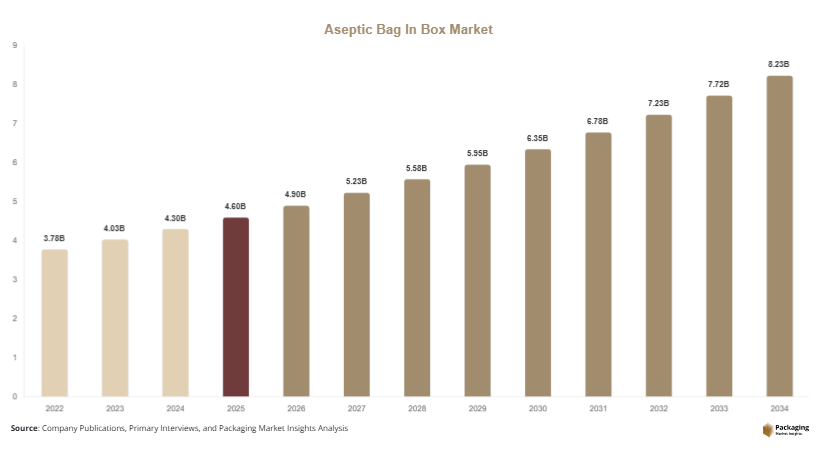
The global aseptic bag in box market size was valued at approximately USD 4.6 billion in 2025 and is projected to reach USD 4.9 billion in 2026. Over the forecast period, the market is expected to grow to USD 8.7 billion by 2034, registering a compound annual growth rate (CAGR) of 6.7% from 2025 to 2034. This growth is supported by the rising need for aseptic packaging that preserves product quality without refrigeration. The global aseptic bag in box market is witnessing consistent expansion driven by increasing demand for safe, extended shelf-life liquid packaging solutions across food, beverage, and industrial applications.
Aseptic bag-in-box systems consist of flexible bags placed inside corrugated boxes, designed to store and transport liquid products such as juices, dairy, wine, sauces, and liquid eggs. These systems prevent contamination and extend shelf life, making them suitable for both industrial and retail distribution. The increasing consumption of processed and packaged food products is a key factor contributing to market expansion.
Market Insights:
- Asia Pacific dominated the market with a 38.6% share in 2025, while Latin America is projected to grow at the fastest CAGR of 7.2%.
- Multi-layer aseptic bags led the type segment with a 51.4% share, while high-barrier films are expected to grow at a CAGR of 7.3%.
- Plastic-based packaging dominated with a 52.3% share, while recyclable paperboard boxes are forecasted to grow at a CAGR of 6.8%.
- Food & beverage applications led the segment with 49.7% share, while industrial liquids are expected to grow at a CAGR of 6.9%.
- China remained the dominant country with a market size of USD 1.3 billion in 2025 and USD 1.4 billion in 2026.
Explore more data points, trends and opportunities Download Free Sample Report
Market Trends
Increasing Demand for Sustainable and Lightweight Packaging
The aseptic bag in box market is increasingly influenced by the shift toward sustainable and lightweight packaging solutions. Manufacturers are focusing on reducing packaging material usage while maintaining product protection and performance. Bag-in-box systems are gaining popularity because they use less plastic compared to rigid containers and incorporate recyclable corrugated outer boxes. This helps companies meet sustainability targets and reduce environmental impact.
Additionally, the lightweight nature of these systems reduces transportation costs and carbon emissions, making them attractive for global supply chains. The food and beverage industry is particularly adopting these solutions to align with regulatory requirements and consumer expectations. As sustainability becomes a key consideration in packaging decisions, the demand for aseptic bag-in-box systems is expected to rise steadily.
Growing Adoption in E-Commerce and Foodservice Channels
Another important trend in the aseptic bag in box market is the increasing use of these packaging solutions in e-commerce and foodservice applications. The rise of online grocery shopping and food delivery services is driving demand for packaging that ensures product safety and convenience during transportation. Aseptic bag-in-box systems provide leak-proof and durable packaging, making them suitable for long-distance distribution.
In the foodservice sector, these systems are widely used for dispensing beverages, sauces, and dairy products in bulk. Their ease of handling and reduced waste make them a preferred choice for restaurants, hotels, and catering services. As the foodservice industry continues to expand and e-commerce penetration increases, the adoption of aseptic bag-in-box packaging is expected to grow.
Market Drivers
Rising Demand for Extended Shelf-Life Packaging Solutions
The increasing need for packaging solutions that extend product shelf life is a key driver of the aseptic bag in box market. Aseptic packaging eliminates the need for preservatives and refrigeration by maintaining a sterile environment, which helps preserve product quality over extended periods. This is particularly important for perishable products such as dairy, juices, and liquid foods.
The growing demand for packaged food and beverages, especially in urban areas, is driving the adoption of aseptic bag-in-box systems. Consumers are seeking convenient and long-lasting products, which is encouraging manufacturers to invest in advanced packaging technologies. As the demand for shelf-stable products continues to increase, the market is expected to grow.
Expansion of Food and Beverage Processing Industry
The expansion of the global food and beverage processing industry is another major driver of the aseptic bag in box market. The increasing production of processed foods and beverages is creating a need for efficient and reliable packaging solutions. Aseptic bag-in-box systems are widely used in this industry due to their ability to handle large volumes and maintain product quality.
Additionally, the growth of the beverage industry, including juices, wine, and liquid dairy products, is supporting market expansion. The convenience and cost-effectiveness of these systems make them suitable for both manufacturers and distributors. As the food and beverage industry continues to grow, the demand for aseptic bag-in-box packaging is expected to increase.
Market Restraint
Limited Recycling Infrastructure and Material Complexity
One of the key challenges facing the aseptic bag in box market is the limited recycling infrastructure for multi-layer packaging materials. Aseptic bags are typically made from multiple layers of plastic and barrier materials, which can be difficult to separate and recycle. This complexity poses challenges for waste management systems and can limit the adoption of these packaging solutions in regions with strict environmental regulations.
For example, in certain European markets, regulations require higher recyclability standards, which can restrict the use of multi-layer packaging. Additionally, the lack of awareness and infrastructure in developing regions further complicates recycling efforts. These factors can impact the overall growth of the market. However, ongoing research and development efforts are focused on creating more recyclable and eco-friendly materials, which may help address this challenge in the future.
Market Opportunities
Development of Recyclable and Bio-Based Materials
The development of recyclable and bio-based materials presents significant opportunities for the aseptic bag in box market. Manufacturers are investing in innovative materials that reduce environmental impact while maintaining performance. Bio-based plastics and recyclable barrier films are gaining attention as sustainable alternatives to traditional materials.
These innovations are helping companies comply with environmental regulations and meet consumer demand for sustainable packaging. The ability to offer eco-friendly solutions without compromising product quality is a key competitive advantage. As research and development efforts continue, the adoption of sustainable materials is expected to drive market growth.
Expansion in Emerging Markets and Industrial Applications
Emerging markets offer substantial growth opportunities for the aseptic bag in box market. Rapid urbanization, increasing disposable incomes, and changing consumption patterns are driving demand for packaged food and beverages. These factors are encouraging manufacturers to adopt advanced packaging solutions.
In addition to food and beverage applications, industrial uses such as chemicals, lubricants, and liquid fertilizers are creating new opportunities for market expansion. The ability of aseptic bag-in-box systems to handle large volumes and ensure product safety makes them suitable for these applications. As industrialization continues in emerging regions, the demand for these systems is expected to grow.
Report Scope
| Report Metric | Details |
|---|---|
| Market Size in 2025 | USD 4.6 Billion |
| Market Size in 2026 | USD 4.9 Billion |
| Market Size in 2034 | USD 8.7 Billion |
| CAGR | 6.7% (2026-2034) |
| Base Year for Estimation | 2025 |
| Historical Data | 2022-2024 |
| Forecast Period | 2026-2034 |
| Report Coverage | Revenue Forecast, Competitive Landscape, Supply Chain Disruption, Growth Factors, Environment & Regulatory Landscape and Trends |
| Geographies Covered | North America, Europe, APAC, Middle East and Africa, LATAM |
| Countries Covered | U.S., Canada, U.K., Germany, France, Spain, Italy, Russia, Nordic, Benelux, Rest of Europe, China, South Korea, Japan, India, Australia, Singapore, Taiwan, South East Asia, Rest of Asia-Pacific, UAE, Turky, Saudi Arabia, South Africa, Egypt, Nigeria, Rest of MEA, Brazil, Mexico, Argentina, Chile, Colombia, Rest of LATAM |
Explore more data points, trends and opportunities Download Free Sample Report
Segmental Analysis
By Type
Multi-layer aseptic bags dominated the aseptic bag in box market in 2024, accounting for approximately 51.4% of total revenue. These bags offer superior barrier properties, protecting products from oxygen, moisture, and contaminants. They are widely used in food and beverage applications due to their ability to extend shelf life and maintain product quality. The growing demand for high-performance packaging solutions is supporting the dominance of this segment.
High-barrier films are expected to grow at the fastest CAGR of 7.3% during the forecast period. This growth is driven by increasing demand for advanced packaging materials that provide enhanced protection and durability. These films are particularly suitable for applications requiring extended shelf life, such as dairy and pharmaceutical products. As industries continue to prioritize product safety and quality, the demand for high-barrier films is expected to increase.
By Application
The food and beverage segment dominated the market in 2024, accounting for 49.7% of total revenue. Aseptic bag-in-box systems are widely used for packaging juices, dairy products, sauces, and wine. The increasing consumption of packaged food products is driving demand in this segment. Additionally, the convenience and cost-effectiveness of these systems are making them a preferred choice for manufacturers and distributors.
The industrial liquids segment is expected to grow at a CAGR of 6.9%. The use of aseptic bag-in-box systems for packaging chemicals, lubricants, and liquid fertilizers is increasing due to their ability to handle large volumes and ensure product safety. The expansion of industrial applications is creating new growth opportunities for this segment.
By End-Use
The food processing industry dominated the aseptic bag in box market in 2024, accounting for a significant share of total revenue. The use of aseptic packaging solutions in food processing helps maintain product quality and extend shelf life. The increasing demand for processed food products is driving growth in this segment.
The foodservice industry is expected to grow at a CAGR of 6.8%. The use of bag-in-box systems for dispensing beverages and sauces in restaurants and catering services is increasing. These systems offer convenience, reduce waste, and improve efficiency, making them suitable for foodservice applications.
Aseptic Bag In Box Market Segmentations
By Product Type
- Multi-Layer Aseptic Bags
- High-Barrier Films
By Application
- Food & Beverage
- Industrial Liquids
- Pharmaceutical
- Others
By Distribution Channel
- Direct Sales (B2B)
- Distributors & Wholesalers
- Online Procurement Platforms
- Specialty Packaging Suppliers
- Industrial Supply Networks
Regional Analysis
North America
North America accounted for approximately 23.5% of the aseptic bag in box market share in 2025 and is projected to grow at a CAGR of 6.2% during the forecast period. The region benefits from a well-established food processing industry and high adoption of advanced packaging technologies. Increasing demand for convenience foods and beverages is driving market growth.
The United States dominates the regional market due to its large-scale food and beverage production. A key growth factor is the rising demand for bulk packaging solutions in the foodservice industry, which is supporting the adoption of aseptic bag-in-box systems.
Europe
Europe held a share of approximately 26.1% in 2025 and is expected to grow at a CAGR of 6.4%. The region is characterized by strong environmental regulations and a focus on sustainable packaging solutions. These factors are encouraging the adoption of innovative packaging technologies.
Germany is a leading market in Europe, supported by its advanced manufacturing sector. A unique growth factor is the increasing use of bag-in-box packaging for wine and beverages, which is driving demand in the region.
Asia Pacific
Asia Pacific dominated the aseptic bag in box market with a share of 38.6% in 2025 and is projected to grow at a CAGR of 7.2%. Rapid urbanization and increasing consumption of packaged food products are driving market growth in the region.
China leads the regional market due to its large population and expanding food processing industry. A key growth factor is the increasing demand for cost-effective packaging solutions, which is supporting the adoption of aseptic bag-in-box systems.
Middle East & Africa
The Middle East & Africa region accounted for approximately 5.4% of the market in 2025 and is expected to grow at a CAGR of 6.0%. The region’s growth is supported by increasing urbanization and rising demand for packaged goods.
The United Arab Emirates is a key market in the region. A unique growth factor is the expansion of the hospitality and foodservice sectors, which is driving demand for bulk packaging solutions.
Latin America
Latin America held a share of approximately 6.4% in 2025 and is projected to grow at the fastest CAGR of 7.2%. The region’s growth is driven by increasing demand for processed food and beverages.
Brazil dominates the market in Latin America. A key growth factor is the expansion of the beverage industry, which is increasing demand for aseptic packaging solutions.
Competitive Landscape
The aseptic bag in box market is moderately competitive, with key players focusing on product innovation and expansion strategies. Companies are investing in advanced materials and technologies to improve the performance and sustainability of their products. Strategic partnerships and mergers are also common in the market.
Smurfit Kappa Group is a leading player in the market, known for its innovative packaging solutions. The company has recently introduced new bag-in-box systems with improved barrier properties and sustainability features. Other companies are focusing on expanding their product portfolios and strengthening their global presence.
Key Players List
- Smurfit Kappa Group
- DS Smith Plc
- Liquibox Corporation
- Scholle IPN
- Amcor plc
- CDF Corporation
- Optopack Ltd.
- Parish Manufacturing Inc.
- TPS Rental Systems Ltd.
- Vine Valley Ventures LLC
- Arlington Packaging Ltd.
- BiB Packaging Ltd.
- Accurate Box Company
- Glenroy, Inc.
- Hedwin Division of Zacros America