Artificial Intelligence In The Packaging Design Market Size and Growth
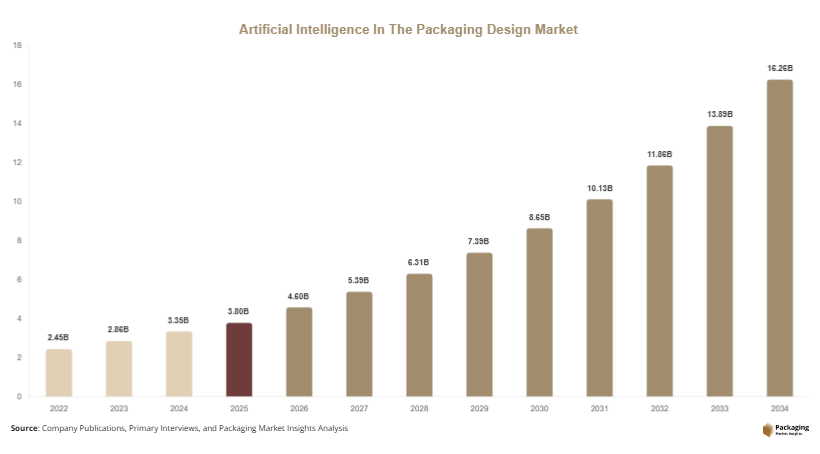
In 2025, the artificial intelligence in the packaging design market size is estimated at USD 3.8 billion, and it is projected to grow to approximately USD 4.6 billion in 2026. With continuous innovation and broader adoption across industries, the market is forecast to reach USD 18.9 billion by 2034, registering a CAGR of 17.1% during the forecast period (2025–2034). The artificial intelligence in the packaging design market is gaining momentum as companies increasingly adopt advanced digital tools to enhance efficiency, creativity, and cost optimization in packaging processes.
Artificial intelligence is transforming packaging design by enabling automation, predictive analytics, and real-time customization. AI-driven tools assist in optimizing material usage, improving structural design, and enhancing visual aesthetics. These capabilities are particularly valuable in industries such as food and beverage, pharmaceuticals, personal care, and e-commerce, where packaging plays a critical role in branding and product safety.
Key Highlights:
- The market size is projected to reach USD 18.9 billion by 2034, reflecting strong expansion driven by digital transformation in packaging design. Increasing adoption of AI tools across industries is supporting this long-term growth trajectory.
- The market is expected to register a CAGR of 17.1% from 2025 to 2034, indicating rapid adoption of advanced technologies. Continuous innovation and automation in design processes are contributing to this growth rate.
- There is a rising demand for personalized and efficient packaging design solutions across industries. Companies are leveraging AI to create customized designs that enhance brand appeal and improve customer engagement.
- The growing integration of AI with sustainable and smart packaging technologies is shaping the market landscape. Businesses are focusing on eco-friendly designs and intelligent packaging features to meet regulatory standards and consumer expectations.
Explore more data points, trends and opportunities Download Free Sample Report
Market Trends
Integration of Generative AI in Packaging Design
The artificial intelligence in the packaging design market is witnessing a growing adoption of generative AI tools that enable automated creation of packaging concepts. These tools use algorithms to generate multiple design variations based on predefined inputs such as brand guidelines, material constraints, and consumer preferences. This trend is helping companies reduce design cycles and accelerate product launches. Generative AI also enhances creativity by offering innovative design options that may not be easily conceived through traditional methods. As brands seek to differentiate themselves in competitive markets, the use of generative AI is becoming a critical component of packaging design strategies.
Adoption of AI for Sustainable Packaging Optimization
Another notable trend is the use of AI to optimize packaging for sustainability. Companies are leveraging machine learning algorithms to analyze material usage, recyclability, and environmental impact. AI tools can simulate different design scenarios to identify the most efficient and eco-friendly options. This trend is particularly important as regulatory requirements and consumer expectations for sustainable packaging continue to rise. By integrating AI into the design process, companies can achieve a balance between performance, cost, and environmental responsibility. This approach is driving innovation and shaping the future of packaging design.
Market Drivers
Increasing Demand for Personalized Packaging Solutions
The demand for personalized packaging is a major driver of the artificial intelligence in the packaging design market. Consumers are increasingly seeking products that reflect their preferences and lifestyles, prompting companies to adopt AI-driven design tools. These tools enable the creation of customized packaging designs based on data insights, enhancing brand engagement and customer satisfaction. The ability to quickly adapt designs to changing trends provides a competitive advantage. As personalization becomes a key differentiator, the adoption of AI in packaging design is expected to grow significantly.
Need for Cost Reduction and Operational Efficiency
Businesses are under constant pressure to reduce costs while maintaining quality. AI-driven packaging design solutions help achieve this by optimizing material usage and minimizing waste. These tools enable virtual prototyping, reducing the need for physical samples and lowering production costs. Additionally, AI improves workflow efficiency by automating repetitive tasks and streamlining the design process. As companies focus on improving profitability, the adoption of AI technologies in packaging design is becoming increasingly important.
Market Restraint
High Implementation Costs and Technical Complexity
The high cost of implementing AI technologies is a significant restraint in the artificial intelligence in the packaging design market. Small and medium-sized enterprises often face challenges in adopting these solutions due to limited budgets and lack of technical expertise. The integration of AI systems requires substantial investment in software, infrastructure, and skilled personnel. Additionally, the complexity of AI algorithms can create barriers for organizations that lack advanced technical capabilities. For example, a mid-sized packaging company may struggle to implement AI-driven design tools due to high initial costs and the need for specialized training. These challenges can slow down market adoption and limit growth, particularly in developing regions.
Market Opportunities
Expansion of AI in Smart and Connected Packaging
The integration of AI with smart packaging technologies presents significant growth opportunities. AI can enhance features such as QR codes, sensors, and interactive elements, enabling real-time tracking and consumer engagement. This capability is particularly valuable in industries such as pharmaceuticals and food, where product safety and traceability are critical. The growing demand for connected packaging solutions is expected to drive the adoption of AI technologies. Companies that invest in this area can create innovative packaging solutions that offer added value to consumers.
Growth in Emerging Markets and Digital Transformation
Emerging markets offer substantial opportunities for the artificial intelligence in the packaging design market. Rapid industrialization, increasing digital adoption, and rising consumer demand for innovative packaging are driving growth in these regions. Companies are investing in AI technologies to enhance their competitiveness and meet evolving market needs. Additionally, government initiatives promoting digital transformation are supporting the adoption of AI in packaging design. As infrastructure improves and awareness increases, emerging markets are expected to play a significant role in the expansion of the market.
Report Scope
| Report Metric | Details |
|---|---|
| Market Size in 2025 | USD 3.8 Billion |
| Market Size in 2026 | USD 4.6 Billion |
| Market Size in 2034 | USD 18.9 Billion |
| CAGR | 17.1% (2026-2034) |
| Base Year for Estimation | 2025 |
| Historical Data | 2022-2024 |
| Forecast Period | 2026-2034 |
| Report Coverage | Revenue Forecast, Competitive Landscape, Supply Chain Disruption, Growth Factors, Environment & Regulatory Landscape and Trends |
| Geographies Covered | North America, Europe, APAC, Middle East and Africa, LATAM |
| Countries Covered | U.S., Canada, U.K., Germany, France, Spain, Italy, Russia, Nordic, Benelux, Rest of Europe, China, South Korea, Japan, India, Australia, Singapore, Taiwan, South East Asia, Rest of Asia-Pacific, UAE, Turky, Saudi Arabia, South Africa, Egypt, Nigeria, Rest of MEA, Brazil, Mexico, Argentina, Chile, Colombia, Rest of LATAM |
Explore more data points, trends and opportunities Download Free Sample Report
Segmental Analysis
By Component
Software solutions dominated the artificial intelligence in the packaging design market in 2024, accounting for approximately 61% of the total market share. These solutions include design automation tools, simulation platforms, and predictive analytics software that enable companies to optimize packaging design processes. The increasing adoption of cloud-based platforms is further supporting the growth of this segment. Software solutions offer scalability, flexibility, and cost efficiency, making them a preferred choice for businesses. The growing need for data-driven decision-making in packaging design is also contributing to the dominance of this segment.
Services are expected to be the fastest-growing segment, with a CAGR of around 18.5% during the forecast period. The growth of this segment is driven by the increasing demand for consulting, implementation, and support services. Companies are seeking expert guidance to integrate AI technologies into their existing workflows. The complexity of AI systems and the need for customization are further driving the demand for services. As adoption increases, the services segment is expected to witness significant growth.
By Application
Design optimization emerged as the dominant application segment in 2024, holding nearly 44% of the market share. AI-driven design optimization tools enable companies to improve packaging performance, reduce material usage, and enhance visual appeal. These tools use advanced algorithms to analyze various design parameters and identify the most efficient solutions. The increasing focus on cost reduction and sustainability is driving the adoption of design optimization solutions.
Quality control and inspection are projected to be the fastest-growing application segment, with a CAGR of 19.2%. AI technologies are being used to detect defects and ensure consistency in packaging design. The ability to perform real-time analysis and improve accuracy is driving the adoption of these solutions. As quality standards become more stringent, the demand for AI-driven quality control systems is expected to increase.
By End-Use Industry
The food and beverage industry dominated the market in 2024, accounting for approximately 39% of total demand. AI-driven packaging design solutions are widely used in this industry to enhance product appeal and ensure safety. The increasing demand for packaged food and beverages is driving the adoption of AI technologies. Additionally, the need for innovative and sustainable packaging solutions is supporting the growth of this segment.
The pharmaceutical industry is expected to be the fastest-growing end-use segment, with a CAGR of 19.5%. The growth is driven by the increasing need for safe and efficient packaging solutions. AI technologies enable companies to design packaging that meets regulatory requirements and ensures product integrity. The expansion of the healthcare sector is further contributing to the growth of this segment.
Artificial Intelligence In The Packaging Design Market Segmentations
By Component
- Software
- Services
By Application
- Design Optimization
- Quality Control & Inspection
- Prototyping & Simulation
- Supply Chain Optimization
By End-Use Industry
- Food & Beverage
- Pharmaceutical
- Personal Care & Cosmetics
- E-commerce
Regional Analysis
North America
North America accounted for approximately 36% of the global artificial intelligence in the packaging design market share in 2025 and is projected to grow at a CAGR of 16.2% during the forecast period. The region benefits from advanced technological infrastructure and high adoption of AI solutions across industries. The presence of leading technology companies and strong investment in research and development are key factors driving market growth.
The United States dominates the regional market due to its well-established technology ecosystem and strong focus on innovation. A unique growth factor is the increasing collaboration between packaging companies and AI startups to develop advanced design solutions. This collaborative approach is accelerating the adoption of AI technologies and driving market expansion.
Europe
Europe held around 25% of the global market share in 2025 and is expected to grow at a CAGR of 15.8%. The region’s growth is supported by strong regulatory frameworks and a focus on sustainability. Companies are adopting AI technologies to design eco-friendly packaging solutions that comply with environmental standards.
Germany leads the European market due to its advanced manufacturing sector and emphasis on digital transformation. A unique growth factor is the integration of AI with Industry 4.0 initiatives, which enhances efficiency and innovation in packaging design processes. This trend is contributing to the steady growth of the market in the region.
Asia Pacific
Asia Pacific is the fastest-growing region, accounting for approximately 28% of the market share in 2025 and expected to grow at a CAGR of 18.9%. Rapid industrialization, increasing digital adoption, and rising consumer demand for innovative packaging are driving growth in this region. The expansion of e-commerce and retail sectors further supports market development.
China dominates the Asia Pacific market due to its large manufacturing base and growing technology sector. A unique growth factor is the increasing investment in AI-driven design tools to improve production efficiency and reduce costs. This focus on technological advancement is driving the adoption of AI in packaging design.
Middle East & Africa
The Middle East & Africa region accounted for around 6% of the global market share in 2025 and is projected to grow at a CAGR of 16.5%. The market is driven by increasing digital transformation and investment in advanced technologies. The growing demand for innovative packaging solutions is also supporting market growth.
The United Arab Emirates is a key contributor to the regional market. A unique growth factor is the government’s focus on smart technologies and innovation, which is encouraging the adoption of AI in packaging design. This initiative is creating new opportunities for market expansion.
Latin America
Latin America held approximately 5% of the global market share in 2025 and is expected to grow at a CAGR of 17.0%. The region’s growth is supported by increasing industrialization and rising demand for advanced packaging solutions. The adoption of AI technologies is gradually increasing as companies seek to improve efficiency and competitiveness.
Brazil leads the Latin American market due to its large industrial base and growing technology adoption. A unique growth factor is the increasing investment in digital infrastructure, which is enabling the adoption of AI-driven design tools. This trend is contributing to the growth of the market in the region.
Competitive Landscape
The artificial intelligence in the packaging design market is characterized by a mix of technology providers and packaging companies. Key players are focusing on innovation, strategic partnerships, and product development to strengthen their market position. The competitive landscape is evolving as companies invest in advanced AI technologies to enhance their offerings.
Autodesk Inc. is recognized as a leading player in the market due to its strong portfolio of design and simulation software. The company recently introduced AI-powered features in its design tools to improve efficiency and creativity. Other major players are also investing in research and development to expand their capabilities and meet the growing demand for AI-driven packaging solutions.
Key Players List
- Autodesk Inc.
- Adobe Inc.
- Dassault Systèmes
- Siemens AG
- IBM Corporation
- Microsoft Corporation
- Google LLC
- Amazon Web Services Inc.
- SAP SE
- NVIDIA Corporation
- Oracle Corporation
- Accenture plc
- Tetra Pak International S.A.
- WestRock Company
- Amcor Plc