Artificial Intelligence In Packaging Market Size and Growth
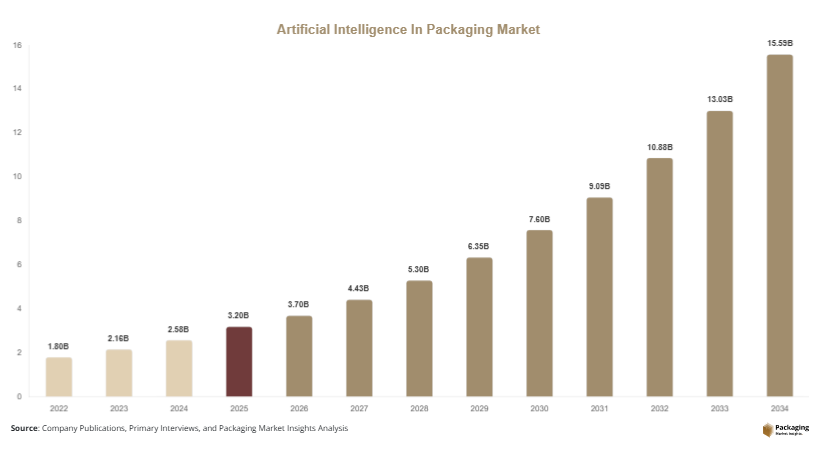
The global artificial intelligence in packaging market size was estimated at USD 3.2 billion in 2025 and is projected to reach approximately USD 3.7 billion in 2026. With increasing adoption of smart manufacturing technologies, the market is expected to expand significantly and reach nearly USD 15.6 billion by 2034, registering a compound annual growth rate (CAGR) of around 19.7% from 2025 to 2034. The integration of AI with industrial automation platforms is transforming traditional packaging processes into data-driven operations that can respond to changing demand and quality requirements.
The artificial intelligence in packaging market is gaining attention as manufacturers and consumer goods companies adopt digital technologies to improve efficiency, quality control, and supply chain visibility. Artificial intelligence (AI) in packaging refers to the use of machine learning algorithms, computer vision systems, and predictive analytics to automate packaging operations, optimize material usage, detect defects, and enhance product traceability. These solutions are widely used in industries such as food and beverage, pharmaceuticals, personal care, and e-commerce logistics.
Key Highlights
- Market size estimated at USD 3.2 billion in 2025
- Expected to reach USD 15.6 billion by 2034
- CAGR of 19.7% from 2025 to 2034
- Rising automation in manufacturing and logistics is supporting adoption
- Growing use of AI-based inspection and predictive analytics in packaging operations
Explore more data points, trends and opportunities Download Free Sample Report
Market Trends
Integration of Computer Vision for Real-Time Packaging Inspection
A prominent trend in the artificial intelligence in packaging market is the growing integration of computer vision systems for automated inspection. Packaging manufacturers are increasingly deploying AI-enabled cameras and deep learning algorithms to monitor packaging lines in real time. These systems analyze thousands of images per minute to identify defects such as misaligned labels, damaged containers, incorrect seals, or incomplete packaging.
Computer vision technology also helps manufacturers maintain consistent product quality across large production volumes. Unlike traditional inspection methods that rely on manual labor, AI-based systems provide higher accuracy and faster detection speeds. The technology is widely used in food, beverage, and pharmaceutical packaging operations where quality standards are strict. As imaging sensors and machine learning models continue to improve, the adoption of computer vision in packaging environments is expected to expand significantly.
AI-Driven Predictive Maintenance in Packaging Machinery
Another trend shaping the artificial intelligence in packaging market is the use of predictive maintenance technologies in packaging machinery. AI platforms analyze operational data from sensors embedded in packaging equipment to identify early signs of mechanical failure. This approach helps manufacturers schedule maintenance activities before unexpected breakdowns occur.
Predictive maintenance reduces downtime, lowers maintenance costs, and improves overall equipment effectiveness. Packaging lines often operate continuously in high-volume manufacturing environments, making equipment reliability essential. AI-based analytics systems process data related to vibration, temperature, motor performance, and operating cycles to forecast potential issues. As industrial IoT infrastructure becomes more common in manufacturing facilities, predictive maintenance solutions are expected to play an important role in improving packaging productivity and reducing operational disruptions.
Market Drivers
Rising Demand for Automated Packaging in Manufacturing
The increasing demand for automated packaging systems is a key driver supporting the growth of the artificial intelligence in packaging market. Manufacturers across sectors are seeking ways to improve productivity while minimizing labor costs. AI-enabled automation allows packaging lines to operate with minimal human intervention while maintaining accuracy and efficiency.
Artificial intelligence enhances traditional automation systems by enabling adaptive decision-making. For example, machine learning algorithms can adjust packaging parameters based on product size, shape, or material characteristics. This capability is particularly useful for manufacturers producing multiple product variants on the same packaging line. AI solutions also support dynamic quality control processes that automatically detect anomalies and prevent defective packages from reaching the market.
Expansion of E-Commerce and Logistics Packaging
The rapid growth of e-commerce platforms is creating strong demand for advanced packaging technologies. Online retail requires large-scale packaging operations capable of processing high order volumes while ensuring product protection and delivery efficiency. AI-based packaging systems are being adopted in fulfillment centers to optimize box selection, automate packing processes, and improve shipment accuracy.
Artificial intelligence algorithms analyze order data and product dimensions to determine the most efficient packaging configuration. This approach reduces material waste and shipping costs while improving operational speed. Logistics companies are also using AI-driven robotic packaging systems to manage peak demand periods. As global e-commerce sales continue to increase, the demand for intelligent packaging automation is expected to expand significantly.
Market Restraint
High Implementation Costs and Integration Complexity
One of the main restraints affecting the artificial intelligence in packaging market is the high cost associated with implementing AI-based packaging solutions. Deploying advanced AI systems requires significant investments in hardware infrastructure, sensors, machine vision equipment, and data analytics platforms. For small and medium-sized packaging companies, these costs can be difficult to justify, particularly when traditional packaging processes are still functional.
Integration challenges also limit the adoption of AI technologies in existing packaging facilities. Many manufacturing plants operate legacy packaging machinery that may not be compatible with modern AI-enabled automation systems. Retrofitting these machines with sensors, cameras, and connectivity solutions often requires additional investment and technical expertise. For example, installing computer vision inspection systems in older packaging lines may require redesigning conveyor layouts or modifying production workflows.
Furthermore, implementing AI solutions requires specialized skills in data science, machine learning, and industrial automation. Packaging companies may need to train employees or collaborate with external technology providers to deploy these systems successfully. These technical and financial barriers can slow adoption rates, particularly in emerging markets where digital infrastructure is still developing. Despite these challenges, ongoing advancements in cloud-based AI platforms and modular automation systems are gradually reducing implementation barriers.
Market Opportunities
Adoption of Smart and Connected Packaging
The development of smart and connected packaging solutions presents a significant opportunity in the artificial intelligence in packaging market. Smart packaging technologies incorporate sensors, RFID tags, and data tracking systems that enable real-time monitoring of product conditions throughout the supply chain. Artificial intelligence plays a crucial role in analyzing the large volumes of data generated by these connected packaging systems.
AI algorithms can process sensor data to detect temperature fluctuations, humidity changes, or physical damage during transportation. This information helps companies maintain product quality and improve supply chain transparency. The technology is particularly valuable in pharmaceutical and food industries where product safety and regulatory compliance are critical. As supply chains become more digitized, smart packaging solutions supported by AI analytics are expected to create new revenue opportunities for packaging technology providers.
AI Integration with Sustainable Packaging Initiatives
Sustainability initiatives are creating new growth opportunities in the artificial intelligence in packaging market. Governments and corporations are introducing environmental regulations and sustainability goals aimed at reducing packaging waste and improving material efficiency. Artificial intelligence can help packaging manufacturers optimize material usage and design more efficient packaging structures.
AI-driven analytics tools analyze packaging design parameters, product dimensions, and transportation requirements to identify opportunities for material reduction. These systems help companies minimize packaging weight while maintaining product protection. In addition, AI solutions can optimize recycling processes by identifying packaging materials through computer vision systems. As global sustainability initiatives continue to expand, AI-based packaging optimization technologies are expected to gain increasing adoption across multiple industries.
Report Scope
| Report Metric | Details |
|---|---|
| Market Size in 2025 | USD 3.2 Billion |
| Market Size in 2026 | USD 3.7 Billion |
| Market Size in 2034 | USD 15.6 Billion |
| CAGR | 19.7% (2026-2034) |
| Base Year for Estimation | 2025 |
| Historical Data | 2022-2024 |
| Forecast Period | 2026-2034 |
| Report Coverage | Revenue Forecast, Competitive Landscape, Supply Chain Disruption, Growth Factors, Environment & Regulatory Landscape and Trends |
| Geographies Covered | North America, Europe, APAC, Middle East and Africa, LATAM |
| Countries Covered | U.S., Canada, U.K., Germany, France, Spain, Italy, Russia, Nordic, Benelux, Rest of Europe, China, South Korea, Japan, India, Australia, Singapore, Taiwan, South East Asia, Rest of Asia-Pacific, UAE, Turky, Saudi Arabia, South Africa, Egypt, Nigeria, Rest of MEA, Brazil, Mexico, Argentina, Chile, Colombia, Rest of LATAM |
Explore more data points, trends and opportunities Download Free Sample Report
Segmental Analysis
By Technology
The computer vision segment dominated the artificial intelligence in packaging market in 2024, accounting for approximately 38% of the total market share. Computer vision systems are widely used for automated quality inspection in packaging lines. These systems analyze images captured by high-speed cameras to identify defects such as incorrect labeling, damaged containers, or incomplete seals. Manufacturers rely on these solutions to ensure product consistency and compliance with regulatory standards. The technology also helps reduce manual inspection tasks and improves production efficiency. Industries such as food processing and pharmaceuticals have adopted computer vision extensively due to strict quality control requirements. As packaging volumes continue to increase, automated visual inspection solutions remain a key component of AI-driven packaging systems.
The machine learning analytics segment is expected to register the fastest growth with a CAGR of approximately 22.3% during the forecast period. Machine learning algorithms process operational data from packaging equipment, sensors, and supply chain systems to generate actionable insights. These insights help manufacturers optimize packaging parameters, predict equipment failures, and improve inventory management. Growth in this segment is largely driven by the increasing availability of industrial data generated by connected manufacturing systems. Companies are integrating machine learning platforms with enterprise resource planning software to enhance decision-making across packaging operations. As digital transformation initiatives expand globally, demand for data-driven packaging optimization solutions is expected to increase rapidly.
By Application
The quality inspection and defect detection segment held the largest share of the artificial intelligence in packaging market in 2024, representing nearly 36% of total revenue. Quality control is a critical component of packaging operations, particularly in industries that handle sensitive or regulated products. AI-based inspection systems enable manufacturers to detect packaging errors quickly and prevent defective products from entering the supply chain. These systems use deep learning algorithms to analyze images and identify irregularities that may not be visible through traditional inspection methods. The technology improves accuracy while reducing the need for manual quality checks. Companies in food, beverage, and pharmaceutical industries rely heavily on AI-driven inspection tools to maintain compliance with safety regulations.
The predictive maintenance application segment is expected to grow at the fastest rate with a CAGR of about 21.8% through 2034. Predictive maintenance solutions analyze data from sensors embedded in packaging equipment to forecast potential failures. By identifying performance anomalies early, these systems allow companies to schedule maintenance activities proactively. This approach reduces unexpected downtime and extends the lifespan of packaging machinery. Growth in this segment is supported by the expansion of industrial IoT infrastructure and the increasing availability of sensor-enabled packaging equipment. As companies seek to improve operational efficiency and reduce maintenance costs, predictive analytics solutions are becoming an essential component of modern packaging facilities.
By End-Use Industry
The food and beverage industry dominated the artificial intelligence in packaging market in 2024, accounting for approximately 41% of total market share. Food manufacturers require efficient packaging systems to manage high production volumes while maintaining strict hygiene and safety standards. AI-based inspection and automation technologies help detect packaging defects, monitor product conditions, and ensure labeling accuracy. These systems also support supply chain transparency by tracking product batches and monitoring storage conditions. With increasing global demand for packaged foods, manufacturers are investing in intelligent packaging solutions that improve production efficiency and minimize waste.
The pharmaceutical industry is projected to be the fastest-growing end-use segment, expanding at a CAGR of around 22.1% during the forecast period. Pharmaceutical packaging requires high levels of precision and regulatory compliance. AI technologies help companies verify labeling accuracy, detect counterfeit products, and monitor packaging integrity. The technology also supports serialization and track-and-trace systems that are essential for maintaining supply chain security. As pharmaceutical production continues to expand globally, companies are adopting advanced AI-based packaging solutions to meet regulatory requirements and ensure product safety.
Artificial Intelligence In Packaging Market Segmentations
Technology
- Computer Vision
- Machine Learning Analytics
- Natural Language Processing
- Predictive Analytics
Application
- Quality Inspection and Defect Detection
- Predictive Maintenance
- Packaging Design Optimization
- Supply Chain Monitoring
End-Use Industry
- Food and Beverage
- Pharmaceuticals
- Consumer Goods
- Logistics and E-Commerce
Regional Analysis
North America
North America accounted for approximately 34% of the global artificial intelligence in packaging market share in 2025, making it one of the leading regional markets. The region is expected to register a CAGR of around 18.9% during the forecast period due to strong adoption of advanced manufacturing technologies. Companies in the United States and Canada are investing heavily in industrial automation, robotics, and artificial intelligence solutions to enhance operational efficiency across packaging operations.
The United States represents the dominant country within the North American market. A key growth factor is the strong presence of large food processing, pharmaceutical, and consumer goods companies that require advanced packaging automation. These industries are integrating AI-based inspection systems and predictive analytics platforms to improve product quality and reduce operational downtime.
Europe
Europe held nearly 27% of the global artificial intelligence in packaging market share in 2025 and is expected to grow at a CAGR of around 18.1% during the forecast period. The region benefits from strong industrial automation infrastructure and a well-established packaging manufacturing sector. Countries across the European Union are increasingly adopting AI technologies to modernize production facilities and improve supply chain transparency.
Germany is the leading country in the European market due to its advanced manufacturing ecosystem and focus on Industry 4.0 initiatives. A key growth factor is the widespread adoption of smart factory technologies in the country’s packaging machinery industry. German manufacturers are integrating AI analytics, robotics, and IoT connectivity into packaging equipment to enhance efficiency and reduce production errors.
Asia Pacific
Asia Pacific represented approximately 25% of the global artificial intelligence in packaging market share in 2025 and is projected to experience the fastest CAGR of about 21.5% over the forecast period. Rapid industrialization and the expansion of manufacturing sectors in emerging economies are creating strong demand for intelligent packaging solutions. Governments in the region are promoting digital transformation initiatives that encourage companies to adopt AI-driven automation technologies.
China is the dominant country in the Asia Pacific market. One unique growth factor is the rapid expansion of the country’s e-commerce sector, which requires highly efficient packaging and logistics operations. Chinese fulfillment centers are increasingly deploying AI-based robotic packaging systems to manage large volumes of online retail shipments.
Middle East & Africa
The Middle East & Africa region accounted for around 7% of the global artificial intelligence in packaging market share in 2025 and is expected to grow at a CAGR of approximately 17.4% through 2034. Although the market is relatively smaller compared to other regions, increasing investments in industrial automation and logistics infrastructure are supporting market development.
United Arab Emirates is emerging as a key country within the region. A major growth factor is the expansion of advanced logistics and distribution hubs supporting international trade. Companies operating in these hubs are adopting AI-enabled packaging and sorting systems to manage high shipment volumes efficiently.
Latin America
Latin America captured nearly 7% of the artificial intelligence in packaging market share in 2025 and is projected to grow at a CAGR of around 17.8% during the forecast period. Growing demand for packaged food products and consumer goods is encouraging manufacturers to modernize their packaging infrastructure. AI-based automation solutions are gradually being introduced to improve productivity in packaging facilities.
Brazil represents the leading country in the Latin American market. A key growth factor is the expansion of the country’s food processing and agricultural export industries. These sectors require reliable packaging operations capable of meeting international quality standards, which is driving interest in AI-based inspection and automation technologies.
Competitive Landscape
The artificial intelligence in packaging market is moderately competitive and includes global technology providers, industrial automation companies, and specialized AI software developers. Key players focus on product innovation, partnerships, and technology integration to strengthen their market positions.
Among the leading companies, IBM is considered a major market participant due to its advanced AI analytics platforms and industrial automation solutions. The company provides machine learning tools that support predictive maintenance and operational optimization in packaging environments. Another important player is Microsoft, which offers cloud-based AI services used by packaging manufacturers for data analytics and automation integration.
Companies such as Siemens, ABB, and Rockwell Automation also play significant roles in the market by providing AI-enabled industrial automation solutions for packaging lines. These organizations integrate robotics, machine vision, and predictive analytics into packaging equipment to improve manufacturing efficiency.
A recent development in the market involves Siemens, which expanded its AI-driven manufacturing analytics platform to support packaging operations in smart factory environments. Such developments demonstrate the increasing focus on digital transformation across the packaging industry.