Anti Static Packaging Market Size and Growth
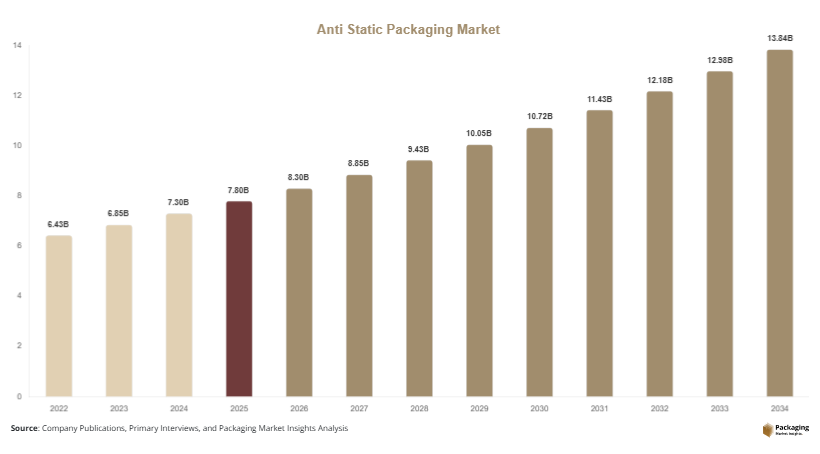
The anti static packaging market size was valued at approximately USD 7.8 billion in 2025 and is projected to reach USD 8.3 billion in 2026, with expectations to grow to nearly USD 13.9 billion by 2034, registering a compound annual growth rate (CAGR) of 6.6% from 2025 to 2034. Anti static packaging solutions are designed to prevent electrostatic discharge (ESD), which can damage sensitive electronic components during handling, storage, and transportation. The anti static packaging market is experiencing consistent expansion driven by the rapid growth of the electronics, semiconductor, and automotive industries.
One of the primary growth factors driving the anti static packaging market is the increasing demand for consumer electronics such as smartphones, laptops, and wearable devices. These products contain delicate electronic components that require protection against static electricity. As production volumes continue to rise globally, manufacturers are investing in advanced packaging solutions to ensure product integrity and reduce losses.
Key Highlights:
- Asia Pacific dominated the market with a 39.2% share in 2025, while Latin America is projected to grow at the fastest CAGR of 7.0%.
- Bags and pouches led the type segment with a 34.8% share, while conductive containers are expected to grow at a CAGR of 6.9%.
- Plastic materials dominated with a 57.6% share, while eco-friendly materials are forecasted to grow at a CAGR of 6.7%.
- Electronics applications led the segment with 49.3% share, while automotive electronics are expected to grow at a CAGR of 6.8%.
- China remained the dominant country with a market size of USD 1.6 billion in 2025 and USD 1.7 billion in 2026.
Explore more data points, trends and opportunities Download Free Sample Report
Market Trends
Increasing Adoption of Sustainable Anti Static Packaging Solutions
The anti static packaging market is witnessing a growing shift toward sustainable materials and environmentally friendly solutions. Manufacturers are focusing on developing packaging made from recyclable and biodegradable materials to meet regulatory requirements and consumer expectations. Traditional plastic-based anti static packaging is being gradually replaced with eco-friendly alternatives that maintain the required electrostatic discharge protection while reducing environmental impact. Companies are also investing in research and development to improve the performance of sustainable materials. This trend is expected to gain momentum as industries aim to reduce their carbon footprint and adopt circular economy practices.
Integration of Advanced Materials and Nanotechnology
Another important trend shaping the market is the integration of advanced materials and nanotechnology in anti static packaging. These innovations enhance the effectiveness of packaging solutions by improving conductivity and durability. Nanotechnology-based coatings and additives are being used to create packaging materials with superior electrostatic discharge protection. This is particularly beneficial for high-value electronic components that require precise handling. The use of advanced materials also enables manufacturers to develop lightweight and cost-effective packaging solutions. As technology continues to evolve, the adoption of these advanced materials is expected to increase, driving innovation in the market.
Market Drivers
Growth of Electronics and Semiconductor Industries
The rapid growth of the electronics and semiconductor industries is a major driver of the anti static packaging market. The increasing production of electronic devices such as smartphones, tablets, and computers is creating demand for reliable packaging solutions. Anti static packaging is essential for protecting sensitive components from electrostatic discharge, which can cause damage and reduce product quality. The expansion of semiconductor manufacturing, driven by advancements in technology, is further supporting this trend. As the demand for electronic products continues to rise, the need for anti static packaging is expected to increase.
Rising Demand from Automotive Electronics Sector
The automotive industry is undergoing significant transformation with the adoption of electric vehicles and advanced electronic systems. This has led to increased demand for anti static packaging solutions to protect electronic components used in vehicles. These components are highly sensitive to electrostatic discharge and require specialized packaging during transportation and storage. The growing integration of electronics in vehicles is driving the demand for anti static packaging. This trend is expected to continue as the automotive industry evolves and adopts new technologies.
Market Restraint
High Cost of Advanced Anti Static Materials
One of the key challenges faced by the anti static packaging market is the high cost associated with advanced materials used in packaging solutions. Materials such as conductive polymers and specialized coatings can be expensive, increasing the overall cost of packaging. This can be a barrier for small and medium-sized enterprises, which may have limited budgets. Additionally, the cost of maintaining consistent quality and performance in anti static packaging can add to operational expenses. For example, companies manufacturing low-cost electronic components may opt for basic packaging solutions to reduce costs, limiting the adoption of advanced anti static packaging. This restraint can impact market growth, particularly in price-sensitive regions.
Market Opportunities
Expansion of E-Commerce and Global Supply Chains
The growth of e-commerce and global supply chains is creating new opportunities for the anti static packaging market. The transportation of electronic components across long distances requires reliable packaging solutions to prevent damage. Anti static packaging provides the necessary protection, ensuring that products reach their destination in optimal condition. As e-commerce continues to expand, the demand for efficient packaging solutions is expected to increase. This presents significant growth opportunities for market players.
Increasing Demand for Miniaturized Electronic Components
The trend toward miniaturization in electronic devices is driving demand for advanced anti static packaging solutions. Smaller components are more sensitive to electrostatic discharge and require specialized packaging to ensure protection. This is particularly relevant in industries such as consumer electronics and healthcare, where precision is critical. Manufacturers are developing innovative packaging solutions to meet these requirements. As the demand for miniaturized components continues to grow, the need for advanced anti static packaging is expected to increase.
Report Scope
| Report Metric | Details |
|---|---|
| Market Size in 2025 | USD 7.8 Billion |
| Market Size in 2026 | USD 8.3 Billion |
| Market Size in 2034 | USD 13.9 Billion |
| CAGR | 6.6% (2026-2034) |
| Base Year for Estimation | 2025 |
| Historical Data | 2022-2024 |
| Forecast Period | 2026-2034 |
| Report Coverage | Revenue Forecast, Competitive Landscape, Supply Chain Disruption, Growth Factors, Environment & Regulatory Landscape and Trends |
| Geographies Covered | North America, Europe, APAC, Middle East and Africa, LATAM |
| Countries Covered | U.S., Canada, U.K., Germany, France, Spain, Italy, Russia, Nordic, Benelux, Rest of Europe, China, South Korea, Japan, India, Australia, Singapore, Taiwan, South East Asia, Rest of Asia-Pacific, UAE, Turky, Saudi Arabia, South Africa, Egypt, Nigeria, Rest of MEA, Brazil, Mexico, Argentina, Chile, Colombia, Rest of LATAM |
Explore more data points, trends and opportunities Download Free Sample Report
Segmental Analysis
By Type
Bags and pouches dominated the anti static packaging market in 2024, accounting for approximately 34.8% of the total market share. These packaging solutions are widely used due to their flexibility, cost-effectiveness, and ease of handling. They provide effective protection against electrostatic discharge and are commonly used for packaging electronic components such as circuit boards and semiconductors. The increasing demand for lightweight and convenient packaging solutions is supporting the growth of this segment. Additionally, advancements in material technology are improving the performance and durability of bags and pouches, making them a preferred choice for manufacturers.
Conductive containers are expected to be the fastest-growing subsegment, with a projected CAGR of 6.9% during the forecast period. These containers are designed to provide enhanced protection for high-value electronic components. They are widely used in industries where precision and reliability are critical. The growing demand for advanced packaging solutions in semiconductor manufacturing is driving the adoption of conductive containers. As industries continue to adopt more sophisticated technologies, the demand for these containers is expected to increase.
By Material
Plastic materials accounted for the largest share of the anti static packaging market in 2024, at approximately 57.6%. Plastic-based packaging solutions are widely used due to their versatility, durability, and cost-effectiveness. They provide excellent protection against electrostatic discharge and are suitable for a wide range of applications. The widespread use of plastic materials in the electronics industry is supporting the growth of this segment. Additionally, advancements in polymer technology are enhancing the performance of plastic-based anti static packaging solutions.
Eco-friendly materials are projected to grow at the fastest CAGR of 6.7% during the forecast period. The increasing focus on sustainability and environmental regulations is driving the adoption of biodegradable and recyclable materials. Manufacturers are developing innovative solutions that combine environmental benefits with effective electrostatic discharge protection. As consumer awareness about sustainability continues to grow, the demand for eco-friendly materials is expected to increase.
By End-Use Industry
The electronics industry dominated the anti static packaging market in 2024 with a share of approximately 49.3%. The need to protect sensitive electronic components from electrostatic discharge is driving demand in this segment. Anti static packaging solutions are widely used in the manufacturing and transportation of electronic devices. The growth of the electronics industry is further supporting this trend. Additionally, the increasing adoption of advanced technologies is driving demand for reliable packaging solutions.
The automotive electronics segment is expected to grow at the fastest CAGR of 6.8% during the forecast period. The increasing integration of electronic systems in vehicles is driving demand for anti static packaging solutions. These systems require protection during manufacturing and transportation. As the automotive industry continues to evolve, the demand for anti static packaging is expected to increase.
Anti Static Packaging Market Segmentations
By Type
- Bags and Pouches
- Conductive Containers
- Trays
- Foam Packaging
By Material
- Plastic
- Metal
- Paper & Paperboard
- Eco-Friendly Materials
By End-Use Industry
- Electronics
- Automotive Electronics
- Healthcare
- Industrial
Regional Analysis
North America
North America accounted for approximately 23.6% of the global anti static packaging market share in 2025 and is projected to grow at a CAGR of 6.2% during the forecast period. The region benefits from a strong electronics manufacturing base and advanced technological infrastructure. The increasing demand for consumer electronics and semiconductor devices is driving the adoption of anti static packaging solutions in the region.
The United States dominates the regional market due to its large electronics industry and strong focus on innovation. A unique growth factor is the increasing investment in semiconductor manufacturing, which is driving demand for advanced packaging solutions. This trend is expected to support market growth in the region.
Europe
Europe held a market share of around 21.8% in 2025 and is expected to grow at a CAGR of 6.1%. The region is characterized by strict environmental regulations and a strong focus on sustainability. These factors are driving the adoption of eco-friendly anti static packaging solutions.
Germany leads the European market due to its strong industrial and automotive sectors. A unique growth factor is the increasing adoption of electric vehicles, which is driving demand for anti static packaging to protect electronic components. This trend is expected to boost market growth.
Asia Pacific
Asia Pacific dominated the market with a 39.2% share in 2025 and is expected to grow at the highest CAGR of 7.0%. Rapid industrialization, expanding electronics manufacturing, and increasing consumer demand are key factors driving market growth in this region.
China is the leading country in the region, supported by its large manufacturing base. A unique growth factor is the rapid expansion of the electronics industry, which is driving demand for anti static packaging solutions. This is significantly boosting market growth.
Middle East & Africa
The Middle East & Africa region accounted for approximately 7.4% of the market share in 2025 and is projected to grow at a CAGR of 6.0%. The growth is supported by increasing investments in industrial and electronics sectors.
Saudi Arabia is a key contributor to the regional market, driven by its focus on industrial development. A unique growth factor is the increasing demand for electronic products, which is driving the adoption of anti static packaging solutions in the region.
Latin America
Latin America held a market share of around 8.0% in 2025 and is expected to grow at the fastest CAGR of 7.0%. The region is witnessing growth in electronics manufacturing and retail sectors.
Brazil dominates the regional market due to its expanding electronics industry. A unique growth factor is the increasing penetration of consumer electronics, which is driving demand for anti static packaging solutions. This trend is expected to support market growth.
Competitive Landscape
The anti static packaging market is moderately competitive, with several global and regional players focusing on product innovation and technological advancements. Companies are investing in research and development to improve the performance and sustainability of their packaging solutions. The market is characterized by the presence of both established manufacturers and emerging players offering specialized products.
Sealed Air Corporation is recognized as a leading player in the market due to its strong product portfolio and global presence. The company recently introduced a new range of sustainable anti static packaging solutions, highlighting its focus on environmental responsibility. Other key players are also adopting similar strategies to strengthen their market position. Strategic collaborations and product innovations are expected to shape the competitive landscape in the coming years.
Key Players List
- Sealed Air Corporation
- Smurfit Kappa Group
- DS Smith Plc
- 3M Company
- BASF SE
- Dow Inc.
- Pregis LLC
- Teknis Limited
- Desco Industries Inc.
- Elcom Ltd.
- Botron Company Inc.
- Polyplus Packaging
- Protective Packaging Corporation
- Conductive Containers Inc.
- Miller Supply Inc.