Anti Counterfeit Cosmetic Packaging Market Size and Growth
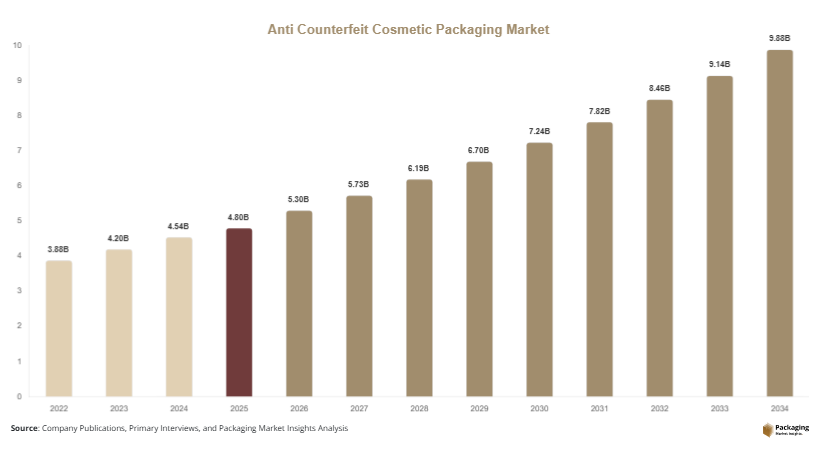
The global anti counterfeit cosmetic packaging market size was valued at approximately USD 4.8 billion in 2025 and is expected to reach nearly USD 5.3 billion in 2026. The market is forecasted to achieve around USD 10.7 billion by 2034, expanding at a CAGR of 8.1% during 2025–2034. The increasing penetration of online beauty retail platforms has intensified the risk of counterfeit cosmetic distribution, encouraging brands to invest in advanced authentication packaging systems.
One of the major growth factors is the rapid expansion of luxury skincare and premium beauty products, where brand protection has become essential. Another key factor is the increasing implementation of track-and-trace technologies in cosmetic packaging. Beauty brands are integrating digital authentication solutions that allow consumers to verify products using smartphones and cloud-based platforms. Additionally, growing government regulations regarding consumer safety and packaging transparency are supporting adoption across developed and emerging markets.
Key Highlights:
- Asia Pacific dominated the market with a 36.9% share in 2025.
- Latin America is projected to grow at the fastest CAGR of 8.8%.
- Holographic security packaging led the type segment with a 31.4% share.
- Plastic-based packaging dominated with a 48.7% share.
- Skincare applications led the end-use segment with 42.6% share.
- The US remained the dominant country with a market size of USD 1.3 billion in 2025 and USD 1.4 billion in 2026.
Explore more data points, trends and opportunities Download Free Sample Report
Market Trends
Integration of Smart Authentication Technologies
The anti counterfeit cosmetic packaging market is witnessing strong adoption of smart authentication technologies such as QR-enabled verification systems, NFC chips, and blockchain-supported product traceability. Cosmetic companies are increasingly embedding digital verification features into packaging to improve supply chain visibility and consumer trust. For example, premium skincare brands are integrating QR codes that allow customers to verify product authenticity through mobile applications before purchase. This trend is particularly visible in online cosmetic retail channels where counterfeit risks are higher. Smart packaging also helps brands collect consumer engagement data and monitor product movement across distribution channels. In the future, AI-integrated authentication systems and cloud-connected packaging platforms are expected to improve real-time counterfeit detection and strengthen brand protection capabilities.
Rising Adoption of Sustainable Anti-Counterfeit Packaging
Sustainability is becoming a key trend in the anti counterfeit cosmetic packaging market as cosmetic brands seek environmentally responsible security packaging solutions. Manufacturers are developing recyclable holographic labels, biodegradable tamper seals, and eco-friendly security inks to align with sustainability targets. For example, luxury cosmetic brands in Europe are adopting paper-based packaging with embedded authentication features to reduce plastic waste while maintaining product security. Regulatory pressure regarding sustainable packaging is also encouraging innovation in low-carbon security materials. Future market growth is expected to be influenced by the development of compostable authentication labels and reusable smart packaging systems. The combination of sustainability and security is likely to become a major competitive differentiator in premium cosmetic packaging.
Market Drivers
Growth of E-commerce Beauty Retail
The rapid expansion of e-commerce beauty retail is a major driver for the anti counterfeit cosmetic packaging market. Online cosmetic sales have increased significantly due to convenience, product variety, and social media-driven purchasing behavior. However, this growth has also increased counterfeit product circulation across digital marketplaces. As a result, cosmetic companies are investing heavily in authentication packaging technologies to protect consumers and maintain brand credibility. For example, international beauty brands now use serialized QR labels that allow customers to validate products instantly using smartphones. This shift toward digital authentication is improving supply chain transparency and reducing counterfeit penetration. The continued expansion of online beauty retail platforms is expected to create sustained demand for advanced anti-counterfeit cosmetic packaging solutions.
Increasing Consumer Awareness Regarding Product Safety
Consumer awareness regarding cosmetic safety and authenticity is growing rapidly, especially in premium skincare and dermatological beauty products. Counterfeit cosmetics often contain harmful chemicals, creating significant health risks for consumers. This has encouraged cosmetic manufacturers to implement tamper-evident seals, holographic authentication systems, and forensic printing technologies. For example, luxury fragrance brands are increasingly using multi-layer security labels to ensure authenticity and improve consumer confidence. Regulatory agencies are also increasing product monitoring standards, particularly in North America and Europe. As consumer preference shifts toward transparent and traceable beauty products, anti-counterfeit cosmetic packaging adoption is expected to increase across multiple product categories.
Market Restraint
One of the major restraints in the anti counterfeit cosmetic packaging market is the high implementation cost associated with advanced authentication technologies. Small and medium-sized cosmetic manufacturers often face financial challenges when integrating RFID systems, blockchain tracking platforms, and serialized packaging infrastructure into existing production lines. The cost of specialized inks, holographic materials, and smart labels can significantly increase overall packaging expenses, particularly for low-margin cosmetic products. For example, independent beauty brands operating in emerging markets may struggle to implement high-end authentication technologies due to limited capital investment capacity. Additionally, complex integration requirements and the need for digital supply chain coordination can slow adoption. Counterfeiters are also becoming increasingly sophisticated, forcing brands to continuously upgrade packaging security systems, which further raises operational costs and technological complexity across the industry.
Market Opportunities
Expansion of Blockchain-Based Traceability Solutions
Blockchain-enabled packaging traceability presents a major growth opportunity in the anti counterfeit cosmetic packaging market. Blockchain technology allows cosmetic companies to create transparent and tamper-resistant product authentication systems across the supply chain. Consumers can verify product origin, manufacturing details, and distribution records through digital scanning systems. For example, premium skincare brands are piloting blockchain-connected packaging solutions to improve customer trust and reduce counterfeit risk in international trade. Future applications may include real-time logistics monitoring and AI-driven counterfeit alerts. As supply chains become increasingly digitalized, blockchain-based packaging authentication is expected to gain strong adoption across premium and luxury cosmetic segments.
Growth of Premium and Luxury Beauty Packaging
The expansion of premium and luxury cosmetic products is creating significant opportunities for advanced anti-counterfeit packaging solutions. Luxury beauty brands prioritize exclusivity, product integrity, and consumer trust, making secure packaging essential. Companies are investing in premium holographic seals, NFC-enabled packaging, and smart authentication labels to differentiate products and protect brand value. For example, prestige fragrance manufacturers are introducing connected packaging systems that provide digital authentication and personalized customer experiences. Future market demand is expected to rise further as affluent consumers increasingly prefer traceable and premium-packaged cosmetic products across global retail and online channels.
Report Scope
| Report Metric | Details |
|---|---|
| Market Size in 2025 | USD 4.8 Billion |
| Market Size in 2026 | USD 5.3 Billion |
| Market Size in 2034 | USD 10.7 Billion |
| CAGR | 8.1% (2026-2034) |
| Base Year for Estimation | 2025 |
| Historical Data | 2022-2024 |
| Forecast Period | 2026-2034 |
| Report Coverage | Revenue Forecast, Competitive Landscape, Supply Chain Disruption, Growth Factors, Environment & Regulatory Landscape and Trends |
| Geographies Covered | North America, Europe, APAC, Middle East and Africa, LATAM |
| Countries Covered | U.S., Canada, U.K., Germany, France, Spain, Italy, Russia, Nordic, Benelux, Rest of Europe, China, South Korea, Japan, India, Australia, Singapore, Taiwan, South East Asia, Rest of Asia-Pacific, UAE, Turky, Saudi Arabia, South Africa, Egypt, Nigeria, Rest of MEA, Brazil, Mexico, Argentina, Chile, Colombia, Rest of LATAM |
Explore more data points, trends and opportunities Download Free Sample Report
Segmental Analysis
Type Segment
Holographic security packaging dominated the type segment with approximately 31.4% market share in 2024. Holograms remain widely adopted because they provide visible and difficult-to-replicate authentication features while maintaining cost efficiency for large-scale cosmetic packaging applications. Cosmetic manufacturers use holographic labels, seals, and shrink sleeves to improve product security and brand differentiation. For example, premium skincare and fragrance brands frequently integrate multi-dimensional holographic labels into outer packaging to reduce counterfeit risks across retail channels. The dominance of this segment is also supported by ease of integration into existing packaging production lines. Holographic solutions are particularly common in luxury beauty products where visual security features improve consumer trust. The growing use of customized holographic printing and forensic holography is expected to maintain strong demand across global cosmetic packaging markets.
RFID-enabled packaging is projected to be the fastest-growing subsegment, expanding at a CAGR of 9.2% during 2025–2034. Growth is driven by increasing adoption of smart packaging technologies and rising demand for real-time supply chain visibility. RFID solutions help cosmetic companies track product movement across distribution channels while improving inventory management and authentication efficiency. For example, premium cosmetic retailers are using RFID-integrated packaging to prevent unauthorized distribution and improve customer verification experiences. The future outlook for this segment remains strong due to declining RFID implementation costs and increasing digitalization of cosmetic supply chains. Integration of RFID with AI-supported analytics and cloud-based monitoring platforms is expected to further accelerate adoption in premium and luxury cosmetic packaging applications.
Material Segment
Plastic-based packaging accounted for the dominant material segment with approximately 48.7% share in 2024. Plastic materials continue to lead because they provide durability, flexibility, lightweight performance, and compatibility with advanced authentication technologies such as tamper-evident seals and RFID integration. Polyethylene terephthalate and polypropylene are widely used in cosmetic bottles, caps, and protective packaging structures. For example, anti-counterfeit cosmetic labels and smart authentication tags are commonly integrated into plastic containers due to their design flexibility and cost efficiency. The dominance of plastic packaging is also linked to high-volume production requirements across skincare, fragrance, and haircare products. Despite increasing sustainability concerns, plastic remains highly preferred because of its protective performance and compatibility with digital authentication systems.
Paper-based sustainable packaging is anticipated to register the fastest CAGR of 8.5% through 2034. Growth is driven by increasing environmental regulations, rising demand for recyclable packaging, and growing consumer preference for eco-conscious beauty products. Cosmetic brands are increasingly introducing paper cartons with embedded security features such as QR verification codes and biodegradable tamper seals. For example, luxury skincare brands in Europe are adopting recyclable paperboard packaging integrated with invisible authentication inks. Future developments in coated paper materials and recyclable smart labels are expected to expand the application scope of sustainable anti-counterfeit cosmetic packaging. Companies are also investing in low-carbon authentication materials to align with corporate sustainability targets and circular economy initiatives.
End-Use Segment
Skincare applications dominated the end-use segment with nearly 42.6% market share in 2024. The skincare category experiences high counterfeit risk because of strong global demand for premium creams, serums, anti-aging products, and dermatological formulations. Consumers purchasing high-value skincare products increasingly prioritize authenticity and product safety, encouraging cosmetic companies to adopt advanced packaging security systems. For example, luxury skincare brands are integrating serialized QR codes and tamper-evident packaging into product lines distributed through e-commerce channels. The dominance of the skincare segment is also supported by the rapid expansion of premium beauty retail and growing demand for clinically tested formulations. Rising counterfeit circulation in online marketplaces further strengthens the need for authentication packaging in skincare applications.
Premium cosmetics are expected to emerge as the fastest-growing end-use subsegment, expanding at a CAGR of 9.1% during the forecast period. Growth is driven by increasing consumer spending on luxury beauty products and rising preference for personalized cosmetic experiences. Premium makeup and fragrance brands are investing in smart packaging technologies such as NFC-enabled containers and blockchain-supported authentication systems. For instance, luxury fragrance manufacturers are using connected packaging solutions that allow consumers to verify authenticity and access exclusive digital content. Future demand is expected to increase significantly as affluent consumers prioritize traceable and secure cosmetic packaging. Packaging innovation combined with premium branding strategies will continue supporting rapid growth across this segment.
Anti Counterfeit Cosmetic Packaging Market Segmentations
By Type
- Holographic Security Packaging
- RFID-Enabled Packaging
- Tamper-Evident Packaging
- QR Code Authentication Packaging
- Forensic Ink Packaging
By Material
- Plastic-Based Packaging
- Paper & Paperboard Packaging
- Glass Packaging
- Metal Packaging
- Sustainable Composite Materials
By End-User
- Skincare
- Haircare
- Fragrances
- Makeup & Color Cosmetics
- Premium Cosmetics
Regional Analysis
North America
North America accounted for approximately 24.6% of the anti counterfeit cosmetic packaging market share in 2025 and is projected to expand at a CAGR of 7.8% during 2025–2034. The region benefits from high cosmetic consumption, advanced retail infrastructure, and strict consumer safety regulations. Demand for anti-counterfeit cosmetic packaging is increasing due to the rapid growth of online beauty retail and premium skincare products. Cosmetic companies in the region are heavily investing in smart authentication technologies, including serialized QR codes and NFC-enabled packaging systems. Rising consumer awareness regarding counterfeit cosmetics and product traceability is further strengthening market demand. The growing adoption of connected packaging technologies is also supporting innovation across the regional beauty packaging industry.
The United States dominates the North American market due to its large luxury beauty sector and strong technology adoption. A unique growth driver in the country is the rising integration of AI-supported authentication systems into premium cosmetic packaging. For example, several skincare and fragrance companies are introducing cloud-connected packaging that allows real-time verification through smartphone applications. Canada is also witnessing rising demand for sustainable authentication packaging, particularly in clean beauty and organic cosmetic segments. Retailers across the region are increasingly prioritizing secure and traceable cosmetic packaging to improve brand trust and reduce counterfeit distribution through online marketplaces.
Europe
Europe represented nearly 22.1% share of the market in 2025 and is expected to grow at a CAGR of 8.0% during the forecast period. The region is characterized by strict regulatory standards regarding cosmetic safety, sustainability, and packaging transparency. Anti-counterfeit cosmetic packaging demand is increasing due to the strong presence of luxury beauty brands and high consumer preference for premium products. European cosmetic manufacturers are investing heavily in sustainable authentication technologies, including recyclable holographic labels and eco-friendly tamper-evident packaging materials. Growing demand for clean-label beauty products is also encouraging companies to improve product traceability and digital authentication capabilities.
France leads the European market due to its strong luxury fragrance and skincare industry. A key growth driver is the increasing adoption of sustainable premium packaging integrated with authentication technologies. For example, French cosmetic brands are introducing paper-based packaging with embedded QR authentication systems to align with environmental regulations and luxury branding strategies. Germany also contributes significantly due to its advanced packaging manufacturing sector and strong demand for secure pharmaceutical-cosmetic hybrid products. The region is expected to maintain strong growth as cosmetic companies continue integrating smart packaging technologies into premium product lines.
Asia Pacific
Asia Pacific dominated the anti counterfeit cosmetic packaging market with a 36.9% share in 2025 and is projected to register a CAGR of 8.7% through 2034. The region benefits from strong cosmetics manufacturing activity, rapid urbanization, and expanding e-commerce ecosystems. Countries such as China, South Korea, Japan, and India are major contributors due to rising demand for skincare, beauty, and personal care products. Counterfeit cosmetic circulation is relatively high in online marketplaces across several Asian economies, creating significant demand for authentication packaging solutions. Rising disposable income and increasing preference for branded cosmetics are also supporting market growth.
China remains the dominant country in the region due to its large cosmetics manufacturing base and rapidly growing online beauty market. A major growth driver is the increasing adoption of digital traceability systems by cosmetic exporters targeting international markets. For example, Chinese beauty brands are integrating serialized QR codes and blockchain-supported verification systems to improve export compliance and brand protection. South Korea is another key contributor due to strong demand for premium skincare packaging and advanced beauty technology innovation. India is also witnessing rapid growth due to rising cosmetic consumption and increasing awareness regarding counterfeit beauty products in urban retail channels.
Middle East & Africa
The Middle East & Africa region accounted for approximately 8.7% market share in 2025 and is forecasted to expand at a CAGR of 7.2% during the forecast period. Market growth is supported by rising luxury beauty consumption, increasing retail modernization, and growing awareness regarding counterfeit personal care products. Premium fragrance and skincare demand is particularly strong in Gulf countries, where consumers prioritize branded and imported beauty products. Cosmetic companies operating in the region are increasingly adopting tamper-evident packaging and holographic authentication labels to maintain product integrity. The expansion of organized retail chains and online beauty platforms is also strengthening demand for secure cosmetic packaging solutions.
Saudi Arabia dominates the regional market due to strong luxury cosmetic consumption and increasing beauty retail investments. A unique growth driver is the growing demand for imported premium fragrances that require advanced authentication packaging to prevent counterfeit distribution. For example, fragrance retailers in Riyadh and Dubai are adopting serialized packaging systems and premium holographic seals to improve product security and customer confidence. South Africa also contributes to regional growth through rising adoption of authentication packaging in dermatological and premium skincare products. Future demand is expected to rise steadily with increasing cross-border cosmetic trade.
Latin America
Latin America held around 7.7% market share in 2025 and is projected to grow at the fastest CAGR of 8.8% during 2025–2034. The market is driven by increasing beauty product consumption, growing e-commerce penetration, and rising awareness regarding counterfeit cosmetics. Countries across the region are experiencing rapid growth in online beauty retail, increasing the need for secure and traceable packaging systems. Cosmetic manufacturers are also focusing on affordable authentication technologies suitable for mass-market beauty products. Demand for tamper-evident labels and serialized packaging solutions is rising steadily among local and international beauty brands.
Brazil dominates the Latin American market due to its large cosmetics industry and strong domestic beauty product demand. A key growth driver is the increasing investment in digital packaging verification systems for online cosmetic sales. For example, Brazilian cosmetic companies are introducing QR-based authentication labels to reduce counterfeit penetration in direct-to-consumer beauty channels. Mexico is also witnessing strong demand for anti-counterfeit packaging due to expanding retail infrastructure and rising imports of premium skincare products. Future growth in the region is expected to be supported by increasing smartphone penetration and digital consumer engagement.
Competitive Landscape
The anti counterfeit cosmetic packaging market is moderately competitive, with global packaging companies and authentication technology providers competing through innovation, strategic partnerships, and product development. Major companies are focusing on smart packaging technologies, sustainable security materials, and digital authentication platforms to strengthen market presence. Leading players are increasingly collaborating with cosmetic manufacturers to provide customized anti-counterfeit packaging solutions across skincare, fragrance, and premium beauty product categories.
Avery Dennison Corporation remains one of the leading market participants due to its strong expertise in intelligent labels, RFID technologies, and smart packaging systems. The company continues expanding its digital authentication capabilities for luxury beauty packaging applications. CCL Industries is focusing on holographic security labels and tamper-evident packaging technologies to strengthen its position in cosmetic brand protection. SICPA Holding SA is investing in forensic authentication inks and traceability systems for premium packaging applications.
Other major companies are emphasizing sustainable anti-counterfeit solutions to align with evolving cosmetic packaging regulations. Investments in blockchain-enabled verification systems, cloud-connected authentication platforms, and recyclable security labels are increasing rapidly. The competitive landscape is expected to intensify as counterfeit risks rise across global online beauty retail channels.
Key Players List
- Avery Dennison Corporation
- CCL Industries Inc.
- SICPA Holding SA
- Authentix Inc.
- AlpVision SA
- Zebra Technologies Corporation
- SML Group Limited
- 3M Company
- DuPont de Nemours, Inc.
- Honeywell International Inc.
- Uflex Limited
- NanoMatriX Technologies Limited
- Brady Corporation
- Toppan Inc.
- OpSec Security Group plc