Ampoules Packaging Market Size and Growth
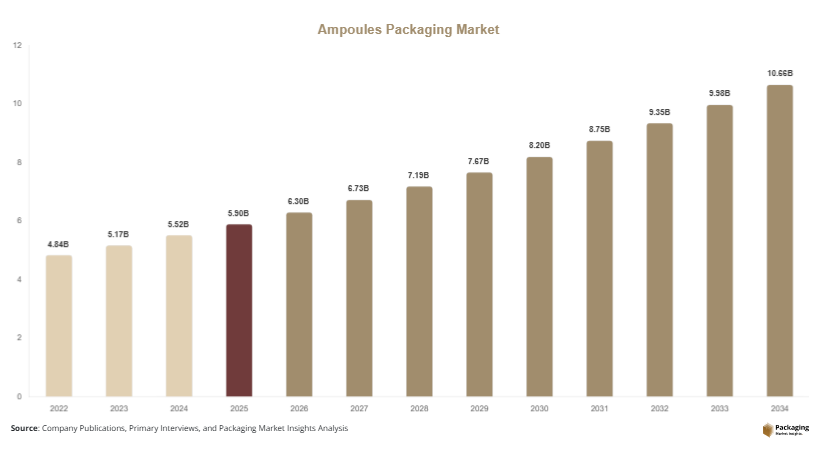
The global ampoules packaging market size is estimated to reach USD 5.9 billion in 2025, supported by growing pharmaceutical manufacturing capacity and rising demand for sterile drug packaging. The market is projected to grow to USD 6.3 billion in 2026, reflecting ongoing investments in pharmaceutical production and healthcare infrastructure. Over the long term, the market is expected to reach approximately USD 10.8 billion by 2034, expanding at a compound annual growth rate (CAGR) of 6.8% from 2025 to 2034.
The ampoules packaging market is experiencing steady expansion as pharmaceutical and biotechnology industries continue to demand sterile and contamination-resistant packaging solutions. Ampoules are sealed glass or plastic containers designed for single-dose pharmaceutical products, ensuring product stability, safety, and tamper resistance. Their use is common in injectable medicines, vaccines, and specialty drugs. Increasing healthcare spending, rising biologics production, and the expansion of vaccination programs are shaping the global market landscape.
Key Highlights
- Global ampoules packaging market size reached USD 5.9 billion in 2025
- Market expected to reach USD 10.8 billion by 2034
- CAGR of 6.8% during 2025–2034
- Rising demand for injectable pharmaceuticals driving market growth
- Pharmaceutical manufacturing expansion supporting packaging demand
Explore more data points, trends and opportunities Download Free Sample Report
Market Trends
Growing Adoption of Polymer-Based Ampoules
The pharmaceutical packaging industry is witnessing a gradual shift toward polymer-based ampoules as manufacturers explore alternatives to traditional glass containers. Polymer ampoules are typically produced using blow-fill-seal technology, which integrates container formation, filling, and sealing into a single automated process. This method improves production efficiency and reduces contamination risk.
Polymer ampoules also offer advantages such as lightweight structure, improved break resistance, and easier transportation compared with glass alternatives. These features make them suitable for large-scale vaccine distribution and pharmaceutical logistics. As healthcare systems continue to expand and supply chains become more complex, manufacturers are increasingly evaluating polymer ampoules as a viable packaging option. Although glass remains dominant, polymer formats are expected to gain gradual market share during the forecast period.
Automation and Precision Manufacturing in Ampoule Production
Automation technologies are increasingly transforming the ampoules packaging industry. Pharmaceutical packaging manufacturers are investing in advanced forming equipment, robotic handling systems, and digital monitoring tools to improve efficiency and quality control. These technologies allow companies to produce ampoules with high dimensional accuracy and consistent sealing performance.
Automated inspection systems are also becoming more common. These systems use sensors and imaging technology to detect cracks, contamination, and filling inconsistencies before products reach the market. Automation supports higher production capacity while maintaining strict regulatory compliance. As pharmaceutical demand increases globally, automation is expected to remain an important trend that helps manufacturers scale production while ensuring reliability and product integrity.
Market Drivers
Increasing Demand for Injectable Drug Delivery
The growing use of injectable drug delivery systems is a significant factor supporting the ampoules packaging market. Many pharmaceutical treatments, including vaccines, biologics, and emergency medicines, require direct injection into the bloodstream or muscle tissue. These medications must be packaged in sterile containers that prevent contamination and preserve drug stability.
Ampoules are widely used for these applications because they provide airtight sealing and protection against environmental exposure. Pharmaceutical companies prefer ampoules for single-dose medicines because they eliminate the need for preservatives that are sometimes required in multi-dose containers. As healthcare providers continue to prioritize safe and precise drug administration, the demand for ampoule packaging is expected to grow across hospitals, clinics, and vaccination programs.
Expansion of Global Pharmaceutical Manufacturing
Another key driver of the market is the increasing scale of pharmaceutical production worldwide. Governments and private investors are establishing new drug manufacturing facilities to meet rising healthcare demand. Emerging economies in particular are investing heavily in pharmaceutical infrastructure to improve domestic drug supply and export capacity.
As pharmaceutical production increases, the need for reliable packaging solutions also grows. Ampoules are widely used in manufacturing injectable medications and sterile solutions, making them an essential component of pharmaceutical supply chains. Packaging manufacturers are responding by expanding production capacity and adopting advanced manufacturing technologies to support large-scale drug manufacturing operations.
Market Restraint
High Fragility and Handling Challenges of Glass Ampoules
Despite their widespread use, glass ampoules present certain limitations that can restrict market growth. Glass is inherently fragile, making ampoules susceptible to breakage during transportation, storage, and handling. This issue can lead to product loss, contamination risks, and increased packaging waste.
Pharmaceutical distributors must implement careful packaging and logistics procedures to minimize breakage during shipping. These additional handling requirements can increase operational costs for pharmaceutical companies. Hospitals and healthcare providers may also face challenges when opening glass ampoules, as improper handling can lead to glass particle contamination or injury.
For example, in large-scale vaccine distribution programs, fragile packaging formats can create logistical complexities when products must be transported across long distances. As a result, some pharmaceutical manufacturers are exploring alternative packaging formats such as polymer ampoules and prefilled syringes. While glass ampoules remain widely used due to their chemical stability, fragility concerns continue to influence packaging innovation and material selection across the pharmaceutical industry.
Market Opportunities
Growth of Biopharmaceutical Products
The expansion of biopharmaceutical research and production presents significant opportunities for the ampoules packaging market. Biopharmaceutical products such as monoclonal antibodies, recombinant proteins, and cell-based therapies require sterile and stable packaging solutions. Many of these medicines are administered through injection, making ampoules a suitable packaging format.
Biopharmaceutical companies require packaging that maintains product integrity and prevents contamination. Ampoules provide airtight sealing and protection against environmental exposure, which helps preserve sensitive formulations. As the number of approved biologic drugs continues to increase, demand for reliable sterile packaging solutions is expected to grow. Packaging manufacturers that develop specialized ampoules for temperature-sensitive and high-value biologics may benefit from expanding pharmaceutical pipelines.
Expansion of Healthcare Infrastructure in Emerging Markets
Healthcare infrastructure development across emerging economies is creating new opportunities for pharmaceutical packaging companies. Governments in regions such as Asia Pacific, Latin America, and the Middle East are investing in hospitals, research facilities, and pharmaceutical manufacturing plants to meet growing healthcare needs.
As healthcare services expand, the demand for injectable medicines and sterile pharmaceutical packaging also increases. Ampoules are commonly used in hospitals for emergency medications, anesthetics, and injectable therapies. Expanding healthcare access means more patients receiving injectable treatments, which drives higher demand for ampoule packaging. Packaging manufacturers that establish production facilities or partnerships in emerging markets may gain access to growing pharmaceutical supply chains and expanding healthcare systems.
Report Scope
| Report Metric | Details |
|---|---|
| Market Size in 2025 | USD 5.9 Billion |
| Market Size in 2026 | USD 6.3 Billion |
| Market Size in 2034 | USD 10.8 Billion |
| CAGR | 6.8% (2026-2034) |
| Base Year for Estimation | 2025 |
| Historical Data | 2022-2024 |
| Forecast Period | 2026-2034 |
| Report Coverage | Revenue Forecast, Competitive Landscape, Supply Chain Disruption, Growth Factors, Environment & Regulatory Landscape and Trends |
| Geographies Covered | North America, Europe, APAC, Middle East and Africa, LATAM |
| Countries Covered | U.S., Canada, U.K., Germany, France, Spain, Italy, Russia, Nordic, Benelux, Rest of Europe, China, South Korea, Japan, India, Australia, Singapore, Taiwan, South East Asia, Rest of Asia-Pacific, UAE, Turky, Saudi Arabia, South Africa, Egypt, Nigeria, Rest of MEA, Brazil, Mexico, Argentina, Chile, Colombia, Rest of LATAM |
Explore more data points, trends and opportunities Download Free Sample Report
Segmental Analysis
By Material Type
Glass ampoules represented the dominant subsegment in 2024 with approximately 72% market share. Glass has long been the preferred material for pharmaceutical ampoules because it offers excellent chemical stability and resistance to drug interactions. Borosilicate glass in particular is widely used for injectable medicines because it maintains product purity and provides strong resistance to temperature changes. Pharmaceutical manufacturers rely on glass ampoules for sensitive drugs, vaccines, and specialty injectables where packaging integrity is critical. The established manufacturing infrastructure for glass ampoules also contributes to their widespread use across pharmaceutical supply chains.
Polymer ampoules represent the fastest-growing subsegment with an expected CAGR of around 8.4% during the forecast period. Advances in polymer technology and blow-fill-seal manufacturing processes are supporting increased adoption of plastic-based packaging formats. Polymer ampoules offer advantages such as improved durability, reduced breakage risk, and lighter weight compared with glass containers. These characteristics make them attractive for pharmaceutical logistics and large-scale distribution programs. As pharmaceutical companies seek more flexible and cost-efficient packaging solutions, polymer ampoules are expected to gain increasing adoption across emerging markets and high-volume pharmaceutical manufacturing environments.
By Application
Injectable drugs accounted for the largest share of the market in 2024, representing nearly 64% of total demand. Ampoules are widely used for injectable formulations because they provide sterile single-dose packaging that prevents contamination and preserves drug stability. Hospitals and clinics frequently use ampoules for emergency medicines, anesthetics, and vaccines. The continued growth of injectable biologics and specialty therapies further supports demand for ampoule packaging across pharmaceutical supply chains. As more treatments are delivered through injection rather than oral dosage forms, injectable drug applications remain the dominant driver of ampoule packaging demand.
Vaccines are projected to be the fastest-growing application segment, with a CAGR of approximately 8.1% through 2034. Global vaccination programs and increased investment in vaccine research are contributing to higher demand for sterile packaging solutions. Ampoules are often used for vaccine packaging because they maintain product sterility and support single-dose administration. During large-scale vaccination campaigns, pharmaceutical companies require packaging that can be produced efficiently while maintaining strict quality standards. As governments and health organizations continue to prioritize immunization programs, demand for ampoule packaging within vaccine applications is expected to expand.
By End-Use
Pharmaceutical companies represented the largest end-use segment in 2024, accounting for nearly 58% of total market share. These companies rely on ampoules to package injectable medicines, anesthetics, antibiotics, and specialty therapies. Pharmaceutical manufacturers require packaging solutions that comply with strict regulatory requirements and ensure drug stability during storage and transportation. Ampoules provide sealed sterile packaging that supports safe drug delivery in healthcare environments. As pharmaceutical pipelines expand and more injectable therapies enter the market, pharmaceutical companies remain the primary consumers of ampoule packaging.
Biotechnology companies represent the fastest-growing end-use segment, projected to grow at a CAGR of 8.6% through 2034. Biotechnology firms are increasingly developing biologic drugs that require sterile injection-based administration. These treatments often involve sensitive formulations that require reliable packaging to maintain product integrity. Ampoules provide protection against contamination and environmental exposure, making them suitable for biologic drug packaging. As biotechnology innovation accelerates and more biologic therapies enter clinical trials and commercial production, demand for ampoule packaging within this sector is expected to grow steadily.
Ampoules Packaging Market Segmentations
Material Type
- Glass Ampoules
- Polymer Ampoules
Application
- Injectable Drugs
- Vaccines
- Diagnostic Solutions
End-Use
- Pharmaceutical Companies
- Biotechnology Companies
- Research Laboratories
Regional Analysis
North America
North America accounted for approximately 32% of the global ampoules packaging market share in 2025, reflecting the region’s advanced pharmaceutical manufacturing sector and well-established healthcare infrastructure. The region is expected to grow at a CAGR of 5.9% through 2034, supported by ongoing investment in biologics development and sterile drug manufacturing. Pharmaceutical companies in the region rely on high-quality packaging solutions to maintain regulatory compliance and product safety.
The United States represents the dominant country within the region due to its large pharmaceutical industry and extensive research ecosystem. One important growth factor is the strong presence of biotechnology firms developing injectable biologic therapies. As these therapies expand across oncology, immunology, and rare disease treatments, demand for sterile packaging formats such as ampoules continues to increase.
Europe
Europe held approximately 28% market share in 2025 and is expected to register a CAGR of around 6.1% during the forecast period. The region benefits from a strong pharmaceutical manufacturing base and strict regulatory standards related to drug packaging and safety. These regulations encourage the use of sterile and reliable packaging solutions, supporting consistent demand for ampoules across pharmaceutical production facilities.
Germany remains the dominant country in the European market due to its large pharmaceutical and chemical industries. One important growth factor is the country’s focus on advanced manufacturing technologies and pharmaceutical innovation. German pharmaceutical companies invest heavily in automated packaging lines and precision manufacturing processes, which increases demand for high-quality ampoule packaging.
Asia Pacific
Asia Pacific accounted for approximately 24% of the global market share in 2025 and is projected to grow at a CAGR of 8.2% through 2034, making it one of the fastest expanding regions. Rapid growth in pharmaceutical production, increasing healthcare expenditure, and expanding population base are key factors driving demand for sterile pharmaceutical packaging solutions across the region.
China represents the dominant country in the region due to its large pharmaceutical manufacturing sector. One significant growth factor is the country’s expanding vaccine production capacity. Large-scale vaccine manufacturing requires sterile packaging formats such as ampoules, which are widely used for injectable formulations and global distribution programs.
Middle East & Africa
The Middle East & Africa region accounted for nearly 8% of the global market share in 2025 and is expected to grow at a CAGR of 6.4% during the forecast period. Growth is supported by improving healthcare infrastructure and increasing investment in pharmaceutical production facilities. Governments across the region are working to strengthen domestic drug manufacturing capabilities.
Saudi Arabia plays a central role in the regional market. A unique growth factor is the government’s healthcare development initiatives aimed at expanding pharmaceutical production and reducing reliance on imports. These initiatives encourage local manufacturing of injectable medicines, which increases demand for sterile packaging formats including ampoules.
Latin America
Latin America represented approximately 8% of the ampoules packaging market share in 2025 and is expected to grow at a CAGR of 6.7% through 2034. Rising healthcare spending and expanding pharmaceutical production facilities are supporting market growth in the region. Pharmaceutical companies are increasing production capacity to meet domestic demand and regional export opportunities.
Brazil remains the dominant country in the region due to its large healthcare system and growing pharmaceutical manufacturing sector. One key growth factor is the increasing demand for vaccines and injectable medicines within national healthcare programs. Government vaccination initiatives require reliable sterile packaging, which supports steady demand for ampoules.
Competitive Landscape
The ampoules packaging market is moderately competitive, with several global and regional manufacturers operating across pharmaceutical packaging supply chains. Companies compete based on manufacturing capacity, product quality, technological capabilities, and regulatory compliance. Many manufacturers are investing in automation technologies and advanced materials to improve production efficiency and meet the increasing demand for sterile pharmaceutical packaging.
One of the prominent companies in the industry is Schott AG, which maintains a strong presence in pharmaceutical glass packaging. The company focuses on high-quality borosilicate glass solutions designed for injectable medicines and biologic drugs. Other significant participants include Gerresheimer AG, Nipro Corporation, Stevanato Group, and Amcor plc.
Manufacturers are increasingly investing in research and development to improve packaging durability, reduce contamination risk, and support pharmaceutical innovation. For instance, several companies have recently introduced improved ampoule designs that enhance break resistance and manufacturing efficiency. Strategic collaborations with pharmaceutical manufacturers are also becoming more common as packaging suppliers work closely with drug developers to meet evolving industry requirements.
Key Players List
- Schott AG
- Gerresheimer AG
- Nipro Corporation
- Stevanato Group
- Amcor plc
- West Pharmaceutical Services
- SGD Pharma
- AptarGroup Inc.
- Bormioli Pharma
- Piramal Glass
- Nipro PharmaPackaging
- Adelphi Healthcare Packaging
- DWK Life Sciences
- Arab Pharmaceutical Glass Company
- Shandong Pharmaceutical Glass Co., Ltd.