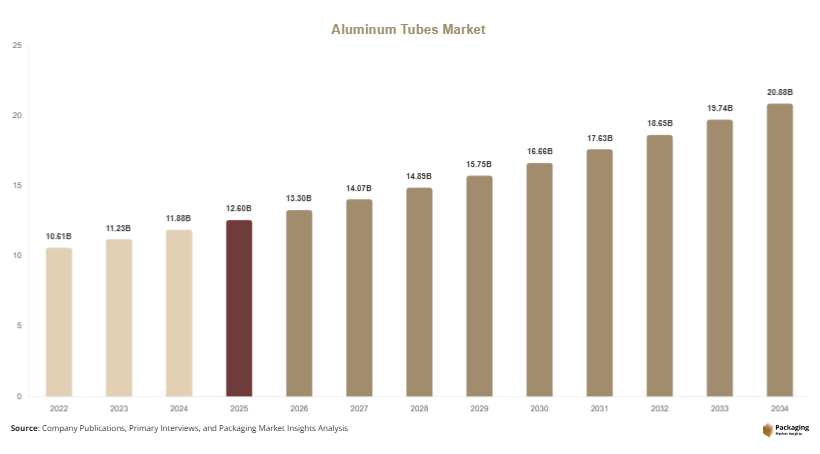
Aluminum Tubes Market Size and Growth
The aluminum tubes market size was valued at approximately USD 12.6 billion in 2025 and is projected to reach USD 13.3 billion in 2026, further expanding to USD 20.9 billion by 2034, growing at a CAGR of 5.8% during 2025–2034. Aluminum tubes are widely used for packaging products such as creams, ointments, adhesives, and food items due to their barrier properties, durability, and recyclability. The aluminum tubes market is witnessing steady expansion due to its widespread applications across packaging, pharmaceuticals, personal care, and industrial sectors.
One of the primary growth factors is the increasing demand from the pharmaceutical and healthcare industries, where aluminum tubes are preferred for their ability to protect sensitive formulations from contamination and light exposure. The growing global healthcare expenditure and rising demand for topical medications are driving this segment significantly. Another key factor is the expansion of the personal care and cosmetics sector, where aluminum tubes are widely used for packaging creams, gels, and lotions. Brands prefer aluminum packaging due to its premium appearance and recyclability.
Key Market Insights:
- Asia Pacific dominated the market with a 39.2% share in 2025, while Latin America is projected to grow at the fastest CAGR of 6.3%.
- Collapsible aluminum tubes led the type segment with a 41.7% share, while laminated aluminum tubes are expected to grow at a CAGR of 6.4%.
- Pharmaceutical-grade aluminum tubes dominated with a 48.6% share, while cosmetic-grade tubes are forecasted to grow at a CAGR of 6.1%.
- Healthcare applications led the segment with 44.3% share, while personal care is expected to grow at a CAGR of 6.2%.
- China remained the dominant country with a market size of USD 3.2 billion in 2025 and USD 3.4 billion in 2026.
Explore more data points, trends and opportunities Download Free Sample Report
Market Trends
Increasing Adoption of Sustainable and Recyclable Packaging
The shift toward sustainable packaging solutions is significantly influencing the aluminum tubes market. Aluminum is widely recognized for its recyclability and ability to retain its properties even after multiple recycling cycles. This makes it a preferred choice for manufacturers aiming to reduce environmental impact. Companies are increasingly replacing plastic packaging with aluminum tubes to meet regulatory requirements and consumer expectations. The trend is particularly evident in the cosmetics and pharmaceutical industries, where sustainability is becoming a key purchasing factor. Additionally, advancements in recycling infrastructure are supporting the widespread adoption of aluminum packaging.
Rising Demand for Premium and Customizable Packaging Solutions
The demand for premium and visually appealing packaging is growing across industries, especially in personal care and cosmetics. Aluminum tubes offer a sleek and high-quality appearance, making them suitable for premium products. Manufacturers are investing in advanced printing technologies and innovative designs to enhance product differentiation. Customization options such as embossing, unique shapes, and high-quality finishes are gaining popularity. This trend is driving the adoption of aluminum tubes in high-end product segments, where packaging plays a crucial role in influencing consumer perception.
Market Drivers
Growth of Pharmaceutical and Healthcare Industry
The pharmaceutical and healthcare industry is a major driver of the aluminum tubes market. Aluminum tubes are widely used for packaging ointments, creams, and gels due to their excellent barrier properties. They protect products from contamination, moisture, and light, ensuring product stability and effectiveness. The increasing prevalence of chronic diseases and rising healthcare expenditure are driving demand for pharmaceutical products, which in turn boosts the demand for aluminum tubes. Additionally, regulatory requirements for safe and secure packaging further support the adoption of aluminum tubes in this sector.
Expansion of Personal Care and Cosmetics Industry
The rapid growth of the personal care and cosmetics industry is another key driver of the aluminum tubes market. Aluminum tubes are commonly used for packaging skincare and haircare products due to their durability and premium appearance. The rising demand for organic and natural cosmetics is also contributing to market growth, as aluminum packaging aligns with sustainability goals. Furthermore, the increasing influence of branding and product differentiation is encouraging manufacturers to adopt aluminum tubes for their packaging needs.
Market Restraint
Fluctuating Raw Material Prices and Production Costs
One of the major challenges facing the aluminum tubes market is the fluctuation in raw material prices. Aluminum prices are influenced by factors such as supply-demand dynamics, energy costs, and geopolitical conditions. These fluctuations can impact production costs and profit margins for manufacturers. For example, a sudden increase in aluminum prices can lead to higher packaging costs for end-use industries, which may affect demand. Additionally, the energy-intensive nature of aluminum production adds to operational costs. These factors can limit market growth, particularly in price-sensitive regions.
Market Opportunities
Increasing Demand in Emerging Economies
Emerging economies present significant growth opportunities for the aluminum tubes market. Rapid urbanization, rising disposable incomes, and expanding healthcare infrastructure are driving demand for packaged products. Countries in Asia Pacific and Latin America are witnessing increased consumption of pharmaceuticals and personal care products, which supports the adoption of aluminum tubes. Additionally, the growth of local manufacturing industries is creating new opportunities for market expansion.
Technological Advancements in Manufacturing Processes
Advancements in manufacturing technologies are opening new opportunities for the aluminum tubes market. Innovations in extrusion, coating, and printing processes are improving product quality and enabling greater customization. These technologies allow manufacturers to produce lightweight and high-performance aluminum tubes with enhanced barrier properties. Additionally, automation and digitalization are improving production efficiency and reducing costs, making aluminum tubes more competitive compared to alternative packaging materials.
Report Scope
| Report Metric | Details |
|---|---|
| Market Size in 2025 | USD 12.6 Billion |
| Market Size in 2026 | USD 13.3 Billion |
| Market Size in 2034 | USD 20.9 Billion |
| CAGR | 5.8% (2026-2034) |
| Base Year for Estimation | 2025 |
| Historical Data | 2022-2024 |
| Forecast Period | 2026-2034 |
| Report Coverage | Revenue Forecast, Competitive Landscape, Supply Chain Disruption, Growth Factors, Environment & Regulatory Landscape and Trends |
| Geographies Covered | North America, Europe, APAC, Middle East and Africa, LATAM |
| Countries Covered | U.S., Canada, U.K., Germany, France, Spain, Italy, Russia, Nordic, Benelux, Rest of Europe, China, South Korea, Japan, India, Australia, Singapore, Taiwan, South East Asia, Rest of Asia-Pacific, UAE, Turky, Saudi Arabia, South Africa, Egypt, Nigeria, Rest of MEA, Brazil, Mexico, Argentina, Chile, Colombia, Rest of LATAM |
Explore more data points, trends and opportunities Download Free Sample Report
Segmental Analysis
By Type
Collapsible aluminum tubes dominated the market in 2024, accounting for approximately 41.7% of the total share. These tubes are widely used in pharmaceutical and personal care applications due to their flexibility and ease of use. They allow controlled dispensing of products and provide excellent barrier properties. Additionally, collapsible tubes are cost-effective and widely available, making them a preferred choice for manufacturers.
Laminated aluminum tubes are expected to grow at the fastest CAGR of 6.4% during the forecast period. These tubes combine the benefits of aluminum and plastic layers, offering enhanced durability and barrier properties. The increasing demand for high-performance packaging solutions in cosmetics and pharmaceuticals is driving growth in this segment.
By Application
Healthcare applications dominated the market in 2024, holding a share of 44.3%. Aluminum tubes are widely used for packaging ointments, creams, and gels, ensuring product safety and stability. The increasing prevalence of chronic diseases and rising healthcare expenditure are driving demand in this segment.
Personal care applications are expected to grow at a CAGR of 6.2%. The increasing demand for skincare and haircare products is driving growth in this segment. Aluminum tubes are preferred for their premium appearance and sustainability, making them suitable for high-end cosmetic products.
By End-Use
The pharmaceutical industry accounted for the largest share of 46.8% in 2024. Aluminum tubes are widely used in this sector due to their ability to protect sensitive formulations. The growing demand for pharmaceutical products is supporting market growth.
The cosmetics industry is projected to grow at a CAGR of 6.3%. The increasing demand for premium and sustainable packaging solutions is driving growth in this segment. Aluminum tubes provide an attractive and eco-friendly packaging option for cosmetic products.
Aluminum Tubes Market Segmentations
By Product Type
- Collapsible Aluminum Tubes
- Laminated Aluminum Tubes
- Rigid Aluminum Tubes
- Coated Aluminum Tubes
By Application
- Healthcare
- Personal Care
- Industrial
- Food
By Distribution Channel
- Direct Sales
- Distributors & Wholesalers
- Online B2B Platforms
- Retail Supply Chains
Regional Analysis
North America
North America accounted for approximately 24.1% of the global aluminum tubes market share in 2025 and is expected to grow at a CAGR of 5.3% during the forecast period. The region’s growth is driven by strong demand from pharmaceutical and personal care industries. The presence of advanced manufacturing facilities and established packaging companies further supports market development. Additionally, increasing focus on sustainable packaging is encouraging the adoption of aluminum tubes.
The United States dominates the North American market due to its large healthcare and cosmetics industries. A unique growth factor in this region is the increasing demand for eco-friendly packaging solutions, driven by regulatory initiatives and consumer awareness.
Europe
Europe held a market share of approximately 22.7% in 2025 and is projected to grow at a CAGR of 5.2%. The region is characterized by stringent environmental regulations and a strong emphasis on sustainability. Aluminum tubes are widely used in pharmaceutical and cosmetic applications due to their recyclability and barrier properties. Technological advancements in packaging design are also contributing to market growth.
Germany is the leading country in Europe, supported by its strong industrial base and focus on innovation. A key growth factor is the increasing adoption of sustainable packaging solutions to comply with environmental regulations.
Asia Pacific
Asia Pacific dominated the market in 2025 with a share of 39.2% and is expected to grow at a CAGR of 6.1%. The region’s growth is driven by rapid industrialization, urbanization, and expansion of healthcare and personal care industries. Increasing disposable incomes and changing consumer preferences are also contributing to market growth.
China is the dominant country in Asia Pacific, supported by its large manufacturing base and growing domestic demand. A unique growth factor is the increasing demand for pharmaceutical products, which drives the need for aluminum tube packaging.
Middle East & Africa
The Middle East & Africa region accounted for approximately 6.4% of the global market share in 2025 and is projected to grow at a CAGR of 5.6%. The market is driven by increasing healthcare investments and expanding retail sectors. Demand for aluminum tubes is rising due to growth in pharmaceutical and personal care industries.
The United Arab Emirates is a leading market in this region, supported by strong economic growth and infrastructure development. A unique growth factor is the increasing demand for high-quality packaging solutions in the cosmetics sector.
Latin America
Latin America held a market share of approximately 7.6% in 2025 and is expected to grow at the fastest CAGR of 6.3%. The region’s growth is driven by rising demand for packaged products and expanding healthcare infrastructure. The increasing focus on sustainable packaging is also supporting market development.
Brazil is the dominant country in Latin America, driven by its large consumer base and growing industrial activities. A key growth factor is the increasing demand for affordable and sustainable packaging solutions.
Competitive Landscape
The aluminum tubes market is moderately competitive, with several global and regional players focusing on innovation and sustainability. Companies are investing in advanced manufacturing technologies and expanding production capacities to meet growing demand. Strategic partnerships and product innovations are common strategies adopted by market participants.
Amcor Plc is a leading player in the market, known for its extensive product portfolio and global presence. The company recently introduced sustainable aluminum tube packaging solutions to meet increasing demand for eco-friendly packaging. Other key players are also focusing on developing high-quality and customizable products to strengthen their market position.
Key Players List
- Amcor Plc
- Albea Group
- Essel Propack Ltd.
- Montebello Packaging
- Alltub Group
- Hoffmann Neopac AG
- Tubex GmbH
- Linhardt GmbH & Co. KG
- Andpak Inc.
- Aluminium Werke Wutöschingen AG
- Unette Corporation
- Trivium Packaging
- Ball Corporation
- Euro Asia Packaging
- Perfektüp Ambalaj