Aluminum Foil Packaging Market Size and Growth
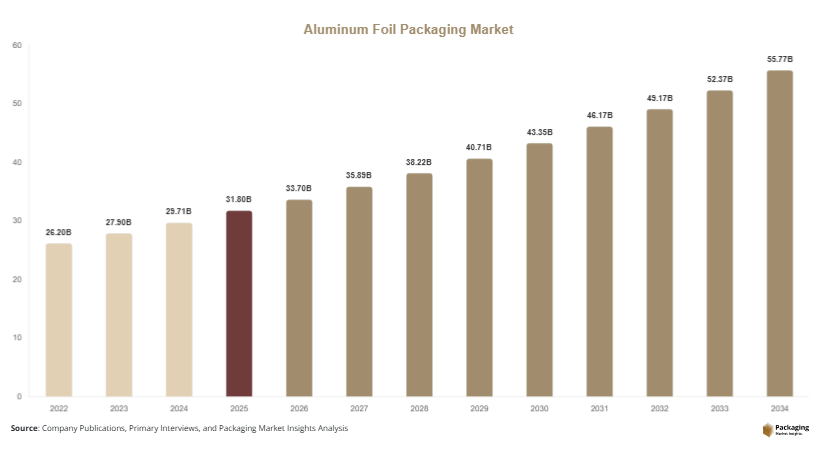
The global aluminum foil packaging market size was valued at approximately USD 31.8 billion in 2025 and is expected to reach USD 33.7 billion in 2026. The market is projected to achieve nearly USD 55.9 billion by 2034, expanding at a CAGR of 6.5% during 2025–2034. The aluminum foil packaging market is witnessing stable growth due to increasing demand for lightweight, durable, and high-barrier packaging solutions across food & beverage, pharmaceutical, personal care, and industrial sectors. Aluminum foil packaging is widely used because of its superior barrier properties against moisture, oxygen, light, and contaminants. The material helps preserve product freshness, extend shelf life, and maintain product quality during storage and transportation. Aluminum foil packaging products include wraps, pouches, blister packs, lids, sachets, and laminated containers used in flexible and rigid packaging applications.
One of the major growth factors supporting market expansion is the rising consumption of packaged and convenience food products. Consumers increasingly prefer ready-to-eat meals, frozen foods, dairy products, and takeaway foods that require reliable barrier packaging. Another key factor is the growth of the pharmaceutical industry, where aluminum foil is widely used in blister packaging for medicines and healthcare products due to its protective and tamper-resistant properties. Additionally, increasing demand for sustainable and recyclable packaging materials is encouraging manufacturers to use aluminum foil because of its high recyclability and circular economy advantages.
Key Highlights
- Asia Pacific dominated the market with a 41.2% share in 2025.
- Latin America is projected to grow at the fastest CAGR of 6.9%.
- Flexible foil packaging led the product type segment with a 47.5% share.
- Aluminum laminated materials dominated the market with a 53.6% share.
- Food & beverage applications accounted for 58.4% market share.
- The US remained the dominant country with a market size of USD 7.1 billion in 2025 and USD 7.5 billion in 2026.
Explore more data points, trends and opportunities Download Free Sample Report
Market Trends
Increasing Adoption of Sustainable and Recyclable Foil Packaging
Sustainability has become a major trend influencing the aluminum foil packaging market as companies focus on reducing environmental impact and improving recyclability. Aluminum foil is gaining preference because it can be recycled multiple times without significant quality loss. Food manufacturers and pharmaceutical companies are increasingly adopting recyclable foil laminates and lightweight aluminum packaging structures to meet sustainability targets and regulatory requirements. Packaging producers are also investing in thinner foil technologies that reduce raw material consumption while maintaining barrier performance. Consumers are showing stronger preference for eco-friendly packaging solutions, encouraging brands to shift toward recyclable aluminum-based materials for flexible and rigid packaging applications.
Growth of High-Barrier Flexible Packaging Solutions
The market is witnessing rising demand for high-barrier flexible packaging formats that combine convenience with product protection. Aluminum foil pouches, sachets, and wraps are increasingly used for snacks, dairy products, coffee, pharmaceuticals, and pet food because they offer superior protection against oxygen, moisture, and light exposure. Manufacturers are developing multilayer foil laminates with improved sealability, puncture resistance, and heat resistance to support evolving packaging requirements. Flexible foil packaging also reduces storage and transportation costs compared to rigid alternatives. Growth in e-commerce food delivery and retail-ready packaging is further accelerating adoption of high-barrier aluminum foil packaging solutions globally.
Market Drivers
Rising Demand for Packaged Food Products
The increasing consumption of packaged and processed foods is a major factor driving the aluminum foil packaging market. Urbanization, changing lifestyles, and rising disposable incomes are encouraging consumers to purchase ready-to-eat meals, frozen foods, snacks, and convenience beverages. Aluminum foil packaging helps maintain freshness, aroma, and nutritional quality by preventing exposure to moisture and oxygen. Food manufacturers prefer foil packaging because it extends shelf life and reduces product spoilage during transportation and storage. Supermarkets and retail chains are also demanding lightweight and durable packaging materials that improve logistics efficiency and support long-distance distribution of food products.
Expanding Pharmaceutical Packaging Applications
The pharmaceutical industry is another major driver supporting market growth. Aluminum foil is widely used in blister packs, strip packaging, sachets, and medical pouches because it offers strong barrier protection and tamper resistance. Rising healthcare expenditure, increasing pharmaceutical production, and growing demand for over-the-counter medicines are contributing to higher consumption of aluminum foil packaging products. Pharmaceutical manufacturers rely on foil packaging to protect medicines from humidity, contamination, and light exposure. In addition, stricter drug safety regulations and growth in temperature-sensitive pharmaceutical products are increasing the importance of advanced barrier packaging solutions across global healthcare markets.
Market Restraint
Fluctuating Aluminum Prices and Energy-Intensive Production
One of the major restraints affecting the aluminum foil packaging market is the fluctuation in aluminum raw material prices and the high energy consumption associated with aluminum production. Changes in mining costs, energy prices, and global supply chain conditions can significantly impact manufacturing expenses for packaging producers. For example, sudden increases in aluminum prices can reduce profit margins for flexible packaging companies supplying food and pharmaceutical sectors. In addition, aluminum foil manufacturing requires substantial energy consumption during smelting and rolling processes, creating operational cost challenges and environmental concerns. Smaller manufacturers may struggle to maintain competitive pricing when raw material costs increase rapidly. Although recycling can reduce some production costs, limited recycling infrastructure in certain regions continues to affect sustainable supply chain development and material recovery efficiency.
Market Opportunities
Expansion of Recyclable Flexible Packaging Solutions
The increasing demand for sustainable packaging solutions is creating significant opportunities for recyclable aluminum foil packaging products. Food brands, beverage manufacturers, and pharmaceutical companies are adopting recyclable foil laminates and mono-material flexible packaging structures to improve environmental performance. Aluminum foil’s ability to maintain barrier protection while supporting recycling initiatives makes it attractive for long-term packaging applications. Packaging companies are investing in advanced separation and recycling technologies that improve material recovery rates. Rising government regulations supporting recyclable packaging and circular economy strategies are expected to further strengthen market opportunities for aluminum foil packaging manufacturers globally.
Growth of Pharmaceutical Blister Packaging
The expansion of pharmaceutical manufacturing and healthcare distribution is creating strong growth opportunities for aluminum foil blister packaging products. Blister packaging remains widely used for tablets, capsules, and medical products because it provides dosage protection, tamper evidence, and extended shelf life. Increasing demand for healthcare products in emerging markets and growth in aging populations are contributing to higher pharmaceutical packaging consumption. Technological advancements in child-resistant and moisture-resistant blister packs are also supporting market development. As pharmaceutical regulations continue to prioritize product safety and traceability, demand for high-quality foil blister packaging is expected to increase steadily.
Report Scope
| Report Metric | Details |
|---|---|
| Market Size in 2025 | USD 31.8 Billion |
| Market Size in 2026 | USD 33.7 Billion |
| Market Size in 2034 | USD 55.9 Billion |
| CAGR | 6.5% (2026-2034) |
| Base Year for Estimation | 2025 |
| Historical Data | 2022-2024 |
| Forecast Period | 2026-2034 |
| Report Coverage | Revenue Forecast, Competitive Landscape, Supply Chain Disruption, Growth Factors, Environment & Regulatory Landscape and Trends |
| Geographies Covered | North America, Europe, APAC, Middle East and Africa, LATAM |
| Countries Covered | U.S., Canada, U.K., Germany, France, Spain, Italy, Russia, Nordic, Benelux, Rest of Europe, China, South Korea, Japan, India, Australia, Singapore, Taiwan, South East Asia, Rest of Asia-Pacific, UAE, Turky, Saudi Arabia, South Africa, Egypt, Nigeria, Rest of MEA, Brazil, Mexico, Argentina, Chile, Colombia, Rest of LATAM |
Explore more data points, trends and opportunities Download Free Sample Report
Segmental Analysis
By Product Type
Flexible foil packaging dominated the aluminum foil packaging market in 2024 and accounted for approximately 47.5% of total market share. Flexible foil packaging products such as pouches, sachets, wraps, and lids are widely used because they offer lightweight performance, superior barrier protection, and cost efficiency. Food manufacturers prefer flexible foil packaging for snacks, dairy products, confectionery, and ready-to-eat meals due to its ability to preserve freshness and prevent contamination. Pharmaceutical companies also use flexible foil structures for medical sachets and strip packaging applications. In addition, flexible packaging formats reduce transportation costs and improve storage efficiency compared to rigid packaging alternatives.
Recyclable laminated foils are projected to register the fastest CAGR of 7.3% during the forecast period. Increasing environmental awareness and stricter packaging regulations are encouraging manufacturers to develop recyclable foil laminates with improved sustainability performance. Food and beverage companies are adopting recyclable multilayer foil structures to align with circular economy initiatives and consumer sustainability expectations. Technological advancements in material separation and lightweight foil technologies are improving recyclability without reducing barrier properties. Rising investment in sustainable packaging innovation is expected to further support segment growth across global markets.
By Material Type
Aluminum laminated materials accounted for the largest market share of 53.6% in 2024 because of their strong barrier protection, flexibility, and compatibility with multiple packaging formats. Laminated aluminum structures are widely used in food packaging, pharmaceutical blister packs, and beverage applications because they provide excellent moisture and oxygen resistance. Manufacturers prefer laminated materials because they improve sealing performance and extend product shelf life while supporting lightweight packaging designs. In addition, aluminum laminates are increasingly integrated with recyclable flexible packaging technologies to support sustainability goals and regulatory compliance.
Ultra-thin foil packaging is expected to witness the fastest CAGR of 7.1% during the forecast period. Packaging manufacturers are increasingly developing thinner foil structures to reduce raw material consumption and lower production costs while maintaining barrier performance. Ultra-thin aluminum foils are gaining popularity in flexible food packaging, beverage lids, and pharmaceutical applications because they reduce packaging weight and improve transportation efficiency. Technological advancements in rolling and coating processes are improving durability and puncture resistance in thin foil products. This trend is expected to accelerate as companies focus on cost optimization and environmental sustainability.
By Application
Food & beverage applications dominated the aluminum foil packaging market in 2024 and accounted for approximately 58.4% of the overall market share. Aluminum foil packaging is widely used in snacks, dairy products, frozen foods, confectionery, and beverage applications because it offers strong barrier protection and product preservation capabilities. Consumers increasingly prefer convenient packaged foods with extended shelf life, encouraging manufacturers to adopt advanced foil packaging solutions. Food service operators and retail chains are also using foil packaging for takeaway meals and ready-to-cook products. Growth in organized retail and e-commerce grocery delivery is further strengthening demand for aluminum foil packaging across food applications.
Pharmaceutical packaging is projected to register the fastest CAGR of 7.0% during the forecast period. Aluminum foil blister packs and strip packaging solutions are increasingly used for medicines and healthcare products because they provide protection against humidity, contamination, and tampering. Rising pharmaceutical production and growing healthcare expenditure are contributing to increased demand for advanced foil packaging products. Pharmaceutical companies are also investing in child-resistant and moisture-resistant blister packaging technologies to improve patient safety and regulatory compliance. Expansion of healthcare infrastructure in emerging economies is expected to support future segment growth.
Aluminum Foil Packaging Market Segmentations
By Product Type
- Flexible Foil Packaging
- Foil Wraps
- Foil Containers
- Blister Packs
- Laminated Foil Packaging
By Material Type
- Aluminum Laminates
- Ultra-Thin Foils
- Coated Aluminum Foils
- Printed Aluminum Foils
By Application
- Food & Beverage
- Pharmaceutical Packaging
- Personal Care Packaging
- Industrial Packaging
- Household Applications
Regional Analysis
North America
North America accounted for approximately 27.9% of the global aluminum foil packaging market share in 2025 and is projected to grow at a CAGR of 6.1% during the forecast period. Rising demand for packaged foods, pharmaceutical products, and flexible packaging solutions is supporting regional market expansion. Food manufacturers are increasingly using aluminum foil packaging for ready-to-eat meals, dairy products, and beverage applications due to its strong barrier performance. Sustainability initiatives and rising adoption of recyclable packaging materials are also contributing to market growth across the region.
The United States dominates the North American market because of its large food processing and pharmaceutical industries. A unique growth factor in the country is the growing demand for convenience meal packaging and microwaveable food trays. Consumers increasingly prefer packaged meal solutions that offer longer shelf life and improved product freshness, encouraging manufacturers to expand aluminum foil packaging production capacity.
Europe
Europe held approximately 25.4% of the global market share in 2025 and is expected to expand at a CAGR of 6.3% through 2034. Strong sustainability regulations and rising demand for recyclable packaging solutions are influencing regional market growth. Food and beverage companies are increasingly replacing conventional plastic packaging with aluminum foil laminates that offer improved recyclability and barrier performance. Pharmaceutical production and healthcare packaging demand are also contributing to market expansion across European countries.
Germany dominates the European market because of its advanced manufacturing sector and strong pharmaceutical industry. A unique growth factor is the country’s increasing investment in sustainable flexible packaging technologies. Packaging manufacturers are focusing on lightweight foil laminates and recyclable multilayer structures to comply with environmental regulations and improve circular economy performance.
Asia Pacific
Asia Pacific represented approximately 41.2% of the global aluminum foil packaging market share in 2025 and is projected to register the fastest regional growth over the forecast period. Rapid urbanization, rising disposable incomes, and increasing packaged food consumption are major factors driving regional demand. Expanding pharmaceutical manufacturing and growth in organized retail are also contributing to higher adoption of aluminum foil packaging solutions. Packaging companies are investing heavily in production expansion to meet rising domestic and export demand across the region.
China dominates the Asia Pacific market due to its extensive food processing and flexible packaging manufacturing industries. A unique growth factor is the rapid growth of e-commerce grocery delivery and online pharmaceutical distribution channels. Manufacturers are increasingly using aluminum foil pouches and sachets to improve product protection and transportation efficiency for digitally distributed consumer goods.
Middle East & Africa
The Middle East & Africa region accounted for approximately 5.1% of the global aluminum foil packaging market share in 2025 and is expected to grow at a CAGR of 5.7% during the forecast period. Rising food imports, expanding healthcare infrastructure, and increasing packaged food consumption are supporting market growth across the region. Demand for flexible packaging products is increasing steadily in retail food distribution and pharmaceutical applications. Growth in tourism and hospitality sectors is also contributing to higher packaging consumption.
Saudi Arabia dominates the regional market because of its expanding food processing and pharmaceutical sectors. A unique growth factor is the growing requirement for temperature-resistant packaging solutions suitable for hot climatic conditions. Aluminum foil packaging helps maintain product stability and shelf life during transportation and storage in challenging environmental conditions.
Latin America
Latin America accounted for nearly 6.4% of the global market share in 2025 and is projected to grow at a CAGR of 6.9% during the forecast period. Increasing urbanization, rising demand for packaged food products, and expansion of retail infrastructure are supporting regional market development. Flexible packaging adoption is increasing among local food manufacturers seeking lightweight and cost-efficient packaging solutions. Growth in healthcare spending is also driving demand for pharmaceutical foil packaging products.
Brazil dominates the Latin American market due to its large food and beverage industry. A unique growth factor is the increasing export of processed agricultural and meat products that require moisture-resistant and oxygen-protective packaging materials. Aluminum foil packaging is increasingly used to maintain freshness and comply with international food safety standards during export transportation.
Competitive Landscape
The aluminum foil packaging market is highly competitive, with major companies focusing on sustainable packaging development, lightweight foil technologies, and production capacity expansion to strengthen market presence. Manufacturers are investing in recyclable multilayer laminates and advanced barrier packaging solutions to meet changing customer and regulatory requirements. Strategic partnerships with food processing and pharmaceutical companies are also supporting long-term business growth.
Amcor plc remains one of the leading companies in the market because of its strong flexible packaging portfolio and global manufacturing network. In 2024, the company introduced recyclable aluminum-based flexible packaging solutions designed for food and pharmaceutical applications. Other major players include Constantia Flexibles, Novelis Inc., UFlex Ltd., and Hindalco Industries Ltd. These companies are focusing on product innovation, lightweight packaging technologies, and sustainable material development to improve competitiveness. Investment in high-performance foil laminates and recyclable barrier packaging is expected to remain a key strategic focus across the industry.
Key Players List
- Amcor plc
- Constantia Flexibles
- Novelis Inc.
- UFlex Ltd.
- Hindalco Industries Ltd.
- Aluflexpack AG
- Pactiv Evergreen Inc.
- Reynolds Consumer Products
- Huhtamaki Oyj
- Mondi Group
- Ess Dee Aluminium Ltd.
- Flexifoil Packaging Pvt. Ltd.
- Sealed Air Corporation
- Nicholl Food Packaging
- Toyo Aluminium K.K.