Aluminium Cans Market Size and Growth
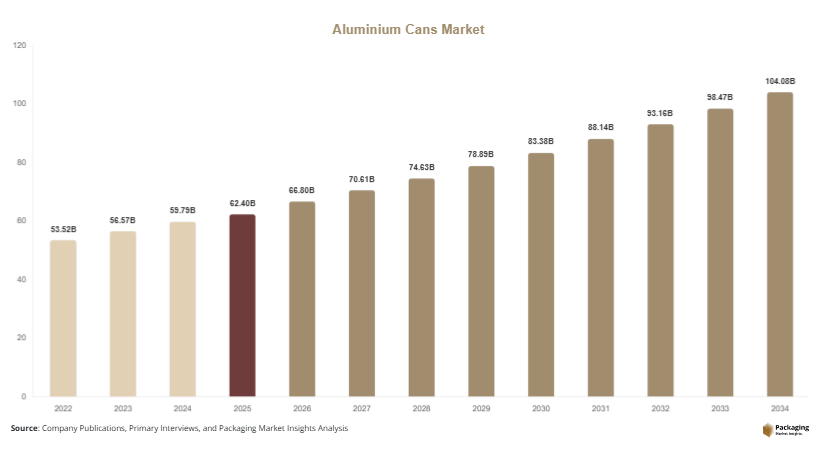
The aluminium cans market size is experiencing steady expansion as packaging manufacturers and beverage producers increasingly adopt lightweight, recyclable materials. Aluminium cans are widely used for beverages such as carbonated drinks, beer, energy drinks, and ready-to-drink products due to their durability, recyclability, and ability to preserve product freshness. In 2025, the global aluminium cans market size is estimated at USD 62.4 billion, and it is projected to reach USD 66.8 billion in 2026. The market is forecast to grow significantly and reach approximately USD 104.3 billion by 2034, registering a compound annual growth rate (CAGR) of 5.7% from 2025 to 2034.
Growing environmental awareness and regulations encouraging recyclable packaging are major contributors to market expansion. Aluminium cans are considered one of the most sustainable packaging options because they can be recycled multiple times without losing quality. Governments and environmental organizations worldwide are promoting circular economy initiatives that encourage the use of recyclable materials, which continues to support the demand for aluminium cans across multiple industries.
Key Highlights
- The aluminium cans market reached USD 62.4 billion in 2025 and is projected to reach USD 104.3 billion by 2034, growing at a CAGR of 5.7% (2025–2034).
- The beverage segment dominates demand, driven by increasing consumption of carbonated drinks, energy drinks, and ready-to-drink beverages.
- Sustainability regulations and high recyclability of aluminium are accelerating the adoption of aluminium cans across the global packaging industry.
Explore more data points, trends and opportunities Download Free Sample Report
Market Trends
Rising Demand for Sustainable Packaging Solutions
One of the major trends shaping the aluminium cans market is the rising demand for environmentally responsible packaging solutions. Consumers and regulatory bodies increasingly prioritize materials that reduce environmental impact. Aluminium cans have a high recycling rate compared with plastic or glass packaging. In many regions, aluminium recycling systems are well established, allowing manufacturers to reuse materials efficiently. Beverage companies are integrating sustainability strategies into their operations and shifting toward aluminium packaging to reduce carbon footprints. Additionally, retailers and brand owners are promoting recyclable packaging labels, which increases consumer preference for aluminium cans.
Expansion of Ready-to-Drink Beverage Categories
Another notable trend in the aluminium cans market is the rapid expansion of ready-to-drink (RTD) beverage categories. Products such as canned coffee, alcoholic seltzers, functional beverages, and flavored sparkling water are gaining popularity among younger consumers. These beverages often use aluminium cans due to their portability and ability to maintain product quality. Beverage startups and established brands are launching new products in slim and sleek can formats to enhance brand appeal and shelf visibility. As consumer demand for convenient beverage packaging grows globally, aluminium cans continue to emerge as a practical and widely adopted solution.
Market Drivers
Increasing Global Beverage Consumption
The steady increase in beverage consumption is a primary driver of the aluminium cans market. Urbanization, rising disposable income, and changing consumer lifestyles are driving higher demand for packaged drinks. Carbonated beverages, energy drinks, and beer continue to dominate global beverage markets, and aluminium cans remain one of the preferred packaging formats for these products. Beverage producers favor aluminium cans because they offer efficient storage, long shelf life, and strong resistance to contamination. Additionally, cans provide excellent protection against light and oxygen, helping maintain beverage flavor and carbonation.
Growth of Recycling Infrastructure
The development of recycling infrastructure is another important factor driving the aluminium cans market. Many governments are implementing waste management policies that encourage recycling and discourage single-use plastics. Aluminium cans are particularly suited to circular economy initiatives because they can be recycled repeatedly without degradation. Recycling aluminum requires significantly less energy compared with producing primary aluminium from raw materials. As recycling programs expand and consumer awareness grows, manufacturers are increasingly choosing aluminium cans to meet sustainability targets and comply with environmental regulations.
Market Restraint
Volatility in Raw Material Prices
One of the primary restraints affecting the aluminium cans market is the volatility in aluminium raw material prices. Aluminium production depends heavily on mining, refining, and energy-intensive processes, which makes it sensitive to fluctuations in global commodity markets. Changes in bauxite supply, energy costs, or geopolitical factors can significantly influence aluminium pricing. When raw material costs increase, can manufacturers may face higher production expenses, which can reduce profit margins or lead to increased product prices.
The impact of price volatility is particularly significant for beverage companies that operate on high-volume production models. Sudden cost increases can disrupt supply contracts and affect packaging procurement strategies. In some cases, companies may consider alternative packaging materials such as plastic or glass if aluminium prices rise significantly. For example, small beverage startups may find it challenging to maintain stable pricing when aluminium costs fluctuate. As a result, raw material instability remains a critical factor that manufacturers must manage through long-term supplier agreements, recycling initiatives, and operational efficiency improvements.
Market Opportunities
Expansion of Craft Beverage Industry
The growth of the craft beverage industry presents a major opportunity for the aluminium cans market. Craft beer producers, specialty soda manufacturers, and small beverage startups increasingly prefer aluminium cans due to their affordability and branding flexibility. Unlike glass bottles, aluminium cans are lighter and easier to transport, which helps reduce logistics costs for small-scale producers. Modern printing technologies allow beverage brands to create customized designs directly on cans, improving product visibility in retail stores. As the craft beverage sector continues to expand globally, aluminium cans are expected to remain a popular packaging option for emerging beverage brands.
Development of Innovative Can Designs
Another opportunity within the aluminium cans market lies in the development of innovative can designs and formats. Manufacturers are introducing slim cans, resealable lids, and embossed surfaces to improve product functionality and visual appeal. These innovations help beverage brands differentiate their products in competitive retail environments. Slim cans, for example, are widely used for energy drinks and premium beverages because they provide a modern aesthetic and convenient grip for consumers. Additionally, advancements in digital printing technology enable short production runs, which allows brands to launch limited-edition packaging campaigns. These innovations are likely to support future growth in the aluminium cans industry.
Report Scope
| Report Metric | Details |
|---|---|
| Market Size in 2025 | USD 62.4 Billion |
| Market Size in 2026 | USD 66.8 Billion |
| Market Size in 2034 | USD 104.3 Billion |
| CAGR | 5.7% (2026-2034) |
| Base Year for Estimation | 2025 |
| Historical Data | 2022-2024 |
| Forecast Period | 2026-2034 |
| Report Coverage | Revenue Forecast, Competitive Landscape, Supply Chain Disruption, Growth Factors, Environment & Regulatory Landscape and Trends |
| Geographies Covered | North America, Europe, APAC, Middle East and Africa, LATAM |
| Countries Covered | U.S., Canada, U.K., Germany, France, Spain, Italy, Russia, Nordic, Benelux, Rest of Europe, China, South Korea, Japan, India, Australia, Singapore, Taiwan, South East Asia, Rest of Asia-Pacific, UAE, Turky, Saudi Arabia, South Africa, Egypt, Nigeria, Rest of MEA, Brazil, Mexico, Argentina, Chile, Colombia, Rest of LATAM |
Explore more data points, trends and opportunities Download Free Sample Report
Segmental Analysis
By Type
The two-piece aluminium cans segment dominated the aluminium cans market in 2024, accounting for approximately 72% of the global market share. These cans are widely used in beverage packaging because they offer superior durability and efficient production processes. Two-piece cans are manufactured using a single aluminium sheet that forms both the body and base, reducing the need for additional materials. This design lowers manufacturing costs and improves structural integrity. Beverage companies prefer two-piece cans because they can withstand high carbonation pressure while maintaining product freshness. In addition, the design allows for smooth exterior surfaces that are suitable for high-quality printing and branding.
The three-piece aluminium cans segment is projected to grow at the fastest rate during the forecast period, registering a CAGR of approximately 5.9%. Three-piece cans consist of a separate body, base, and lid, which allows for greater flexibility in can sizes and shapes. This format is commonly used in food packaging and specialty beverage products. Manufacturers are increasingly exploring three-piece cans for niche product categories such as premium beverages and specialty canned foods. The ability to customize can dimensions and incorporate unique design features is expected to support growth in this segment.
By Application
The beverages segment held the largest share of the aluminium cans market in 2024, representing nearly 80% of global demand. Aluminium cans are widely used for packaging soft drinks, beer, energy drinks, and sparkling water. Beverage manufacturers favor aluminium cans because they protect products from light and oxygen exposure, which helps maintain taste and carbonation. Additionally, cans chill faster than glass bottles, improving the consumer experience. The convenience of aluminium cans for transportation and storage also makes them a preferred packaging format for large-scale beverage distribution.
The food packaging segment is expected to grow at the fastest pace during the forecast period with a CAGR of about 6.1%. Increasing demand for ready-to-eat meals, canned fruits, and packaged seafood is driving growth in this segment. Aluminium cans provide excellent protection against contamination and moisture, making them suitable for long shelf-life food products. As consumers increasingly seek convenient meal solutions and packaged food options, the use of aluminium cans in food applications is expected to expand significantly.
By End-Use Industry
The beverage manufacturing industry dominated the aluminium cans market in 2024 with a market share of approximately 78%. Large beverage producers rely heavily on aluminium cans for packaging carbonated drinks, beer, and ready-to-drink beverages. The lightweight nature of aluminium reduces transportation costs, which is particularly beneficial for companies distributing products across large geographic regions. Furthermore, beverage brands often prefer aluminium cans because they offer greater design flexibility, allowing companies to print vibrant graphics directly on the packaging.
The food processing industry is projected to grow at the fastest rate, registering a CAGR of around 6.2% during the forecast period. The increasing demand for packaged food products, especially in urban areas, is contributing to this growth. Aluminium cans offer strong protection against environmental contamination and provide extended shelf life for food products. As global food supply chains continue to expand and consumers demand convenient meal options, the food processing sector is expected to increase its adoption of aluminium can packaging.
Aluminium Cans Market Segmentations
Type
- Two-Piece Aluminium Cans
- Three-Piece Aluminium Cans
Application
- Beverages
- Food Packaging
End-Use Industry
- Beverage Manufacturing
- Food Processing
Regional Analysis
North America
North America accounted for a significant share of the aluminium cans market in 2025, representing approximately 29% of the global market. The region is expected to maintain stable growth with a projected CAGR of around 5.2% during the forecast period. The demand is primarily driven by high consumption of carbonated beverages, beer, and energy drinks. In addition, the presence of advanced recycling systems and strong environmental regulations supports the adoption of aluminium packaging across the beverage industry.
The United States remains the dominant country in the regional market due to its large beverage manufacturing industry and extensive distribution networks. A key growth factor in the country is the rising popularity of canned alcoholic beverages, including hard seltzers and ready-to-drink cocktails. These beverage categories have gained popularity among younger consumers, encouraging producers to adopt aluminium cans as their primary packaging format.
Europe
Europe held an estimated 25% share of the aluminium cans market in 2025 and is projected to grow at a CAGR of approximately 5.4% through 2034. The region’s strong regulatory framework supporting recyclable packaging materials is a major factor driving demand. European Union policies aimed at reducing plastic waste and promoting circular economy practices have encouraged beverage manufacturers to increase their use of aluminium cans.
Germany is the dominant market within Europe due to its well-developed recycling infrastructure and high consumption of canned beverages. The country also hosts several large beverage manufacturing companies that rely heavily on aluminium packaging. A unique growth factor in Germany is the strong deposit return system, which encourages consumers to return used cans for recycling, ensuring a consistent supply of recycled aluminium.
Asia Pacific
Asia Pacific is the largest regional market, accounting for approximately 34% of the aluminium cans market in 2025, and is expected to grow at a CAGR of 6.3% during the forecast period. Rapid urbanization, increasing disposable income, and expanding beverage consumption are key factors driving regional demand. The growing popularity of energy drinks and canned coffee in countries such as Japan and South Korea also contributes to market expansion.
China dominates the regional market due to its extensive manufacturing capabilities and large consumer base. One unique growth factor in China is the rapid expansion of convenience retail stores and vending machine networks. These retail channels commonly sell canned beverages because aluminium cans are easy to store, transport, and chill quickly, which supports strong demand across urban markets.
Middle East & Africa
The Middle East & Africa region accounted for roughly 6% of the aluminium cans market in 2025 and is forecast to grow at a CAGR of around 5.6%. The region is gradually adopting aluminium packaging as beverage consumption rises and sustainability awareness improves. Increasing tourism and hospitality industry expansion are also contributing to higher demand for canned beverages across the region.
Saudi Arabia represents one of the leading markets within the region. A notable growth factor is the expansion of beverage manufacturing facilities supported by economic diversification initiatives. As the country invests in domestic production and retail infrastructure, beverage companies are increasingly adopting aluminium cans to improve product shelf life and transportation efficiency.
Latin America
Latin America held nearly 6% share of the aluminium cans market in 2025 and is expected to grow at a CAGR of approximately 5.8%. Rising urban populations and growing demand for affordable beverage packaging solutions are key drivers in the region. Aluminium cans are gaining popularity among beverage manufacturers due to their lightweight design and cost-effective logistics advantages.
Brazil is the dominant country in the Latin American market. A unique growth factor in Brazil is the country’s highly efficient aluminium recycling system, which has one of the highest recycling rates globally. The strong recycling culture ensures a consistent supply of recycled aluminium, which helps reduce manufacturing costs and supports sustainable packaging initiatives.
Competitive Landscape
The aluminium cans market is characterized by the presence of several global packaging manufacturers that focus on expanding production capacity and improving sustainability initiatives. Companies in the market compete based on product innovation, geographic expansion, and long-term supply agreements with beverage manufacturers. Strategic partnerships between can manufacturers and beverage brands play an important role in maintaining stable supply chains and meeting growing global demand.
One of the leading companies in the market is Ball Corporation, which maintains a strong global presence in aluminium packaging. The company continues to invest in advanced can manufacturing technologies and recycling initiatives to strengthen its market position. In recent years, Ball Corporation has expanded its production facilities in multiple regions to meet increasing demand for sustainable beverage packaging.
Other key companies are focusing on expanding production capabilities and introducing lightweight can designs to improve operational efficiency. Manufacturers are also investing in digital printing technologies that allow brands to create customized packaging designs. As competition intensifies, companies are expected to prioritize sustainability, recycling partnerships, and supply chain optimization to strengthen their positions in the aluminium cans market.
Key Players List
- Ball Corporation
- Crown Holdings Inc.
- Ardagh Group
- CANPACK Group
- Toyo Seikan Group Holdings
- Novelis Inc.
- CPMC Holdings Limited
- Orora Limited
- Hindalco Industries Limited
- Showa Aluminum Can Corporation
- Baosteel Packaging
- Nampak Ltd.
- Envases Universales
- Aluminium Bahrain Packaging Division
- Massilly Holding