Airless Packaging Market Size and Growth
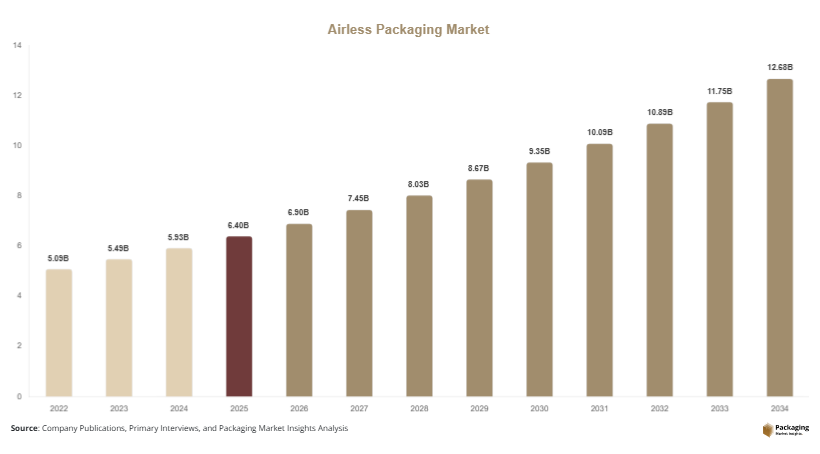
The global airless packaging market size was valued at approximately USD 6.4 billion in 2025 and is estimated to reach USD 6.9 billion in 2026. With increasing demand from personal care and pharmaceutical sectors, the market is projected to reach USD 12.7 billion by 2034, expanding at a compound annual growth rate (CAGR) of around 7.9% from 2025 to 2034. This growth trajectory reflects rising consumer awareness about product safety and the need for packaging that ensures precise dispensing and reduced product waste.
The airless packaging market is experiencing steady expansion as industries increasingly seek packaging solutions that preserve product integrity, extend shelf life, and reduce contamination risks. Airless packaging systems are designed to protect formulations from exposure to air, which helps maintain product quality while minimizing the need for preservatives. These systems are widely used in cosmetics, pharmaceuticals, and personal care products, where maintaining formulation stability is critical.
Key Highlights
- Global airless packaging market size reached USD 6.4 billion in 2025
- Market expected to grow at 7.9% CAGR from 2025 to 2034
- Projected market value of USD 12.7 billion by 2034
- Cosmetics and personal care sectors remain major demand drivers
- Sustainable and refillable packaging solutions are gaining adoption
Explore more data points, trends and opportunities Download Free Sample Report
Market Trends
Rising Adoption of Sustainable Airless Packaging Solutions
Sustainability has become a major trend influencing the airless packaging market. Packaging manufacturers are focusing on developing recyclable, refillable, and lightweight airless containers to meet environmental expectations from both consumers and regulatory authorities. Many cosmetic and personal care brands are adopting refillable airless systems that allow users to replace internal cartridges without discarding the entire container. This approach significantly reduces packaging waste and supports circular economy initiatives.
In addition, manufacturers are exploring bio-based plastics and mono-material designs that simplify recycling processes. These innovations help brands align with sustainability goals while maintaining the protective benefits of airless technology. As consumers increasingly prefer environmentally responsible products, demand for eco-friendly airless packaging solutions is expected to rise steadily.
Increasing Integration of Smart and Functional Packaging
Another emerging trend in the airless packaging market is the integration of functional and smart packaging features. Brands are adopting advanced pump technologies that provide controlled dispensing, enabling precise dosage and minimizing product waste. These innovations enhance the user experience while preserving product integrity.
In addition, digital integration such as QR codes and smart labels is being incorporated into packaging designs. These features allow consumers to access product information, authentication details, and usage instructions through mobile devices. Such innovations support brand transparency and customer engagement. As technology continues to evolve, the integration of functional and digital features within airless packaging is expected to become more widespread across premium product segments.
Market Drivers
Growing Demand for Premium Cosmetics and Skincare Products
The increasing popularity of premium cosmetics and skincare products is a major driver for the airless packaging market. Consumers are seeking high-performance skincare formulations that often contain active ingredients such as antioxidants, peptides, and botanical extracts. These ingredients are sensitive to air exposure, which can reduce their effectiveness over time.
Airless packaging helps preserve product stability by preventing oxidation and contamination. This makes it an ideal packaging solution for serums, creams, and lotions used in high-end cosmetic formulations. As beauty brands continue to launch advanced skincare products, the demand for protective packaging solutions is expected to grow significantly. The rising influence of beauty trends and consumer awareness about product quality further contributes to the adoption of airless packaging systems.
Expanding Pharmaceutical and Dermatology Applications
Another important growth driver for the airless packaging market is the expanding use of airless packaging in pharmaceutical and dermatology applications. Pharmaceutical companies require packaging solutions that ensure product safety and controlled dispensing, particularly for topical medications and dermatological treatments.
Airless packaging systems provide hygienic dispensing without allowing external contaminants to enter the container. This feature helps maintain the stability and effectiveness of pharmaceutical formulations. As healthcare industries continue to develop advanced dermatology products, the demand for airless packaging solutions is expected to increase. Growing investments in healthcare infrastructure and pharmaceutical innovation also support market growth.
Market Restraint
High Manufacturing Costs of Airless Packaging Systems
Despite strong demand, the airless packaging market faces challenges related to the relatively high cost of manufacturing airless packaging systems. Compared to conventional packaging solutions such as standard pumps or tubes, airless packaging requires more complex designs and additional components. These systems often include specialized pumps, internal pistons, and multiple layers of materials that ensure airtight dispensing.
The higher production cost can limit adoption among small and medium-sized cosmetic brands that operate within tight packaging budgets. Companies producing mass-market products may prefer simpler packaging options to reduce overall product costs. As a result, airless packaging adoption remains more concentrated in premium product segments.
Another challenge arises from the technical requirements associated with manufacturing these systems. Precise engineering is necessary to maintain airtight functionality and smooth dispensing. Any design flaws may lead to leakage or dispensing issues, which can affect product performance and brand reputation.
For example, emerging cosmetic brands entering the skincare market may initially choose traditional packaging formats due to lower costs. Only after establishing a strong customer base do they transition to airless packaging to enhance product quality and brand positioning. Although technological advancements are gradually reducing production costs, price sensitivity remains a key restraint in broader market adoption.
Market Opportunities
Growth of Clean Beauty and Natural Product Segments
The rapid expansion of clean beauty and natural skincare products presents a strong opportunity for the airless packaging market. Many natural formulations avoid synthetic preservatives, making them more vulnerable to contamination and oxidation when exposed to air. Airless packaging offers an effective solution by maintaining product stability without the need for additional preservatives.
As consumers continue to prioritize ingredient transparency and environmentally friendly products, demand for clean beauty formulations is increasing worldwide. Brands producing organic and natural cosmetics are adopting airless packaging to maintain product quality and extend shelf life. This trend is expected to create significant opportunities for packaging manufacturers specializing in advanced airless dispensing systems.
Expansion of E-commerce Packaging Solutions
The growth of e-commerce in the cosmetics and personal care industries is creating new opportunities for the airless packaging market. Online retail requires packaging solutions that are durable, leak-proof, and capable of protecting products during transportation. Airless packaging systems provide secure dispensing mechanisms that reduce the risk of product leakage during shipping.
Additionally, many direct-to-consumer brands rely on premium packaging to differentiate themselves in competitive online marketplaces. Airless containers enhance product presentation and support brand positioning in the premium segment. As e-commerce channels continue to expand globally, the demand for reliable and protective packaging solutions such as airless systems is expected to increase.
Report Scope
| Report Metric | Details |
|---|---|
| Market Size in 2025 | USD 6.4 Billion |
| Market Size in 2026 | USD 6.9 Billion |
| Market Size in 2034 | USD 12.7 Billion |
| CAGR | 7.9% (2026-2034) |
| Base Year for Estimation | 2025 |
| Historical Data | 2022-2024 |
| Forecast Period | 2026-2034 |
| Report Coverage | Revenue Forecast, Competitive Landscape, Supply Chain Disruption, Growth Factors, Environment & Regulatory Landscape and Trends |
| Geographies Covered | North America, Europe, APAC, Middle East and Africa, LATAM |
| Countries Covered | U.S., Canada, U.K., Germany, France, Spain, Italy, Russia, Nordic, Benelux, Rest of Europe, China, South Korea, Japan, India, Australia, Singapore, Taiwan, South East Asia, Rest of Asia-Pacific, UAE, Turky, Saudi Arabia, South Africa, Egypt, Nigeria, Rest of MEA, Brazil, Mexico, Argentina, Chile, Colombia, Rest of LATAM |
Explore more data points, trends and opportunities Download Free Sample Report
Segmental Analysis
By Type
The bottles segment dominated the airless packaging market in 2024, accounting for approximately 46% of the total market share. Airless bottles are widely used in cosmetics and personal care products due to their ability to protect sensitive formulations from oxidation and contamination. These bottles are designed with internal piston systems that allow product dispensing without air exposure. As a result, they help maintain product effectiveness and extend shelf life.
Another factor contributing to the dominance of bottles is their versatility in packaging various products, including creams, lotions, serums, and gels. Cosmetic brands often prefer airless bottles for premium skincare products because they provide precise dispensing and minimize product waste. The growing popularity of advanced skincare routines further supports the adoption of airless bottles across global markets.
The airless tubes segment is expected to be the fastest-growing subsegment, expanding at a CAGR of around 8.5% during the forecast period. Airless tubes are gaining attention due to their lightweight structure and convenient portability. These tubes provide effective protection for sensitive formulations while maintaining user convenience.
Increasing demand for travel-friendly packaging solutions is supporting the growth of airless tubes. Many cosmetic brands are introducing compact product formats designed for consumers who prefer portable skincare solutions. As manufacturers continue to improve tube design and dispensing mechanisms, the adoption of airless tubes is expected to increase significantly.
By Application
The personal care and cosmetics segment held the largest share of the airless packaging market in 2024, accounting for approximately 58% of the total market share. Airless packaging is widely used in skincare and cosmetic products because it protects formulations from contamination and preserves active ingredients. This is particularly important for products containing antioxidants, vitamins, and natural extracts.
The popularity of premium skincare products has significantly influenced the demand for airless packaging. Cosmetic brands rely on advanced packaging technologies to maintain product effectiveness and ensure controlled dispensing. In addition, increasing consumer awareness about product quality and hygiene further supports the adoption of airless packaging in the cosmetics industry.
The pharmaceutical application segment is expected to grow at the fastest CAGR of around 8.2% between 2025 and 2034. Pharmaceutical companies increasingly use airless packaging for topical medications and dermatological formulations. These packaging systems help maintain product sterility and ensure accurate dosage.
Growing investments in dermatology research and the development of advanced medical skincare treatments are supporting the expansion of this segment. As pharmaceutical companies continue to focus on patient safety and product stability, the demand for airless packaging solutions is expected to increase significantly.
By End-Use
The premium product segment dominated the airless packaging market in 2024, capturing nearly 52% of the total market share. Premium cosmetic and skincare brands often use airless packaging to enhance product presentation and maintain formulation stability. These brands prioritize packaging solutions that offer both functionality and aesthetic appeal.
Airless containers also support brand differentiation in competitive markets. Many high-end cosmetic companies incorporate innovative packaging designs to strengthen brand identity and attract consumers. As demand for luxury beauty products continues to rise, the premium segment is expected to maintain its leading position in the market.
The mass-market segment is projected to be the fastest-growing category, with a forecast CAGR of around 7.8% during the study period. Increasing affordability of airless packaging technologies is allowing more brands to adopt these solutions for mainstream products. Manufacturers are developing cost-effective packaging designs that maintain the benefits of airless systems while reducing production expenses.
The expansion of direct-to-consumer brands and online retail platforms is also supporting the growth of the mass-market segment. These brands often rely on efficient packaging solutions that protect products during shipping while maintaining consumer convenience.
Airless Packaging Market Segmentations
Type
- Airless Bottles
- Airless Jars
- Airless Tubes
- Airless Bags & Pouches
Application
- Personal Care & Cosmetics
- Pharmaceuticals
- Home Care
- Food & Beverages
End-Use
- Premium Products
- Mass-Market Products
Distribution Channel
- Direct Sales
- Packaging Distributors
- Online B2B Platforms
- Retail Packaging Suppliers
Regional Analysis
North America
North America accounted for approximately 32% of the global airless packaging market share in 2025, making it one of the leading regional markets. The region is expected to maintain steady growth with a forecast CAGR of around 7.4% between 2025 and 2034. Strong demand from cosmetics, personal care, and pharmaceutical industries contributes significantly to market expansion. Companies in the region continue to invest in advanced packaging technologies that improve product preservation and enhance consumer experience.
The United States dominates the North American market due to the presence of a well-established cosmetics industry and strong consumer demand for premium skincare products. One unique growth factor in this region is the rapid adoption of refillable packaging systems among beauty brands. Companies are introducing reusable airless containers that allow consumers to replace internal cartridges, supporting sustainability initiatives and reducing packaging waste.
Europe
Europe held around 27% share of the global airless packaging market in 2025 and is projected to expand at a CAGR of approximately 7.1% through 2034. The region’s strong focus on sustainable packaging solutions supports the adoption of airless systems across multiple industries. European consumers are increasingly aware of environmental concerns, prompting brands to invest in recyclable and refillable packaging technologies.
Germany leads the regional market due to its advanced packaging manufacturing sector and strong presence of cosmetic and pharmaceutical companies. A key growth factor in the country is the emphasis on environmentally responsible packaging solutions. Packaging manufacturers in Germany are developing mono-material airless systems that simplify recycling processes while maintaining product protection.
Asia Pacific
Asia Pacific represented approximately 29% of the airless packaging market share in 2025 and is expected to record the fastest CAGR of around 8.6% from 2025 to 2034. Rapid urbanization, rising disposable incomes, and increasing demand for personal care products are driving market expansion across the region. The growing beauty and skincare industry in several countries is also supporting the adoption of advanced packaging technologies.
China dominates the regional market due to its large cosmetics manufacturing base and expanding consumer market. One unique growth factor in China is the rapid development of domestic skincare brands that emphasize product innovation and premium packaging design. These brands are increasingly adopting airless packaging solutions to maintain product quality and enhance brand image.
Middle East & Africa
The Middle East & Africa region accounted for nearly 6% of the global airless packaging market share in 2025 and is expected to grow at a CAGR of around 6.8% through 2034. The market is supported by rising demand for luxury beauty products and expanding retail distribution networks. Cosmetic companies in the region are gradually adopting airless packaging to improve product protection and enhance consumer convenience.
The United Arab Emirates is a leading market within the region due to its strong retail sector and high demand for premium beauty products. One notable growth factor is the rising popularity of luxury skincare brands that rely on advanced packaging solutions. These brands use airless containers to maintain formulation stability in harsh climatic conditions.
Latin America
Latin America captured approximately 6% share of the global airless packaging market in 2025 and is projected to expand at a CAGR of about 6.9% during the forecast period. The region’s cosmetics industry continues to grow steadily, supported by increasing consumer spending on personal care products. Packaging innovation is becoming an important strategy for brands aiming to differentiate their products in competitive markets.
Brazil dominates the Latin American market due to its large cosmetics manufacturing industry and strong domestic demand. One key growth factor in the country is the increasing focus on dermatology-based skincare products. These formulations require protective packaging to maintain stability, which is encouraging the adoption of airless dispensing systems.
Competitive Landscape
The airless packaging market is moderately competitive, with several global packaging manufacturers focusing on innovation and product design improvements. Companies compete by developing advanced dispensing technologies, lightweight materials, and sustainable packaging solutions that meet evolving consumer expectations.
One leading company in the market is AptarGroup, known for its extensive portfolio of airless dispensing systems used in cosmetics and pharmaceutical applications. The company focuses on developing sustainable packaging technologies, including recyclable airless containers and refillable systems.
Other major companies are investing in research and development to improve packaging functionality and reduce manufacturing costs. Strategic partnerships with cosmetic brands and pharmaceutical companies are also common in the industry. These collaborations help packaging manufacturers develop customized solutions tailored to specific product formulations.
In recent years, several companies have introduced eco-friendly airless packaging systems designed to support sustainability goals. The development of mono-material packaging and refillable cartridges reflects the industry's focus on reducing environmental impact while maintaining product protection.
Key Players
- AptarGroup
- Silgan Holdings
- Albéa Group
- Quadpack Industries
- Lumson
- Fusion Packaging
- HCP Packaging
- Libo Cosmetics Company
- Raepak
- LUMEN Packaging
- Yonwoo Packaging
- East Hill Industries
- Frapak Packaging
- Taesung Industrial
- APC Packaging