Air Cushion Packaging Market Size and Growth
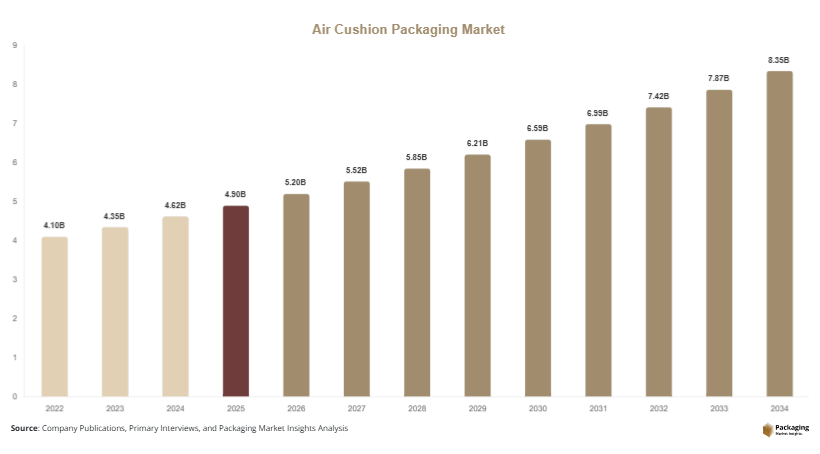
The global air cushion packaging market was valued at USD 4.9 billion in 2025 and is projected to reach USD 8.3 billion by 2034, expanding at a CAGR of 6.1% during the forecast period from 2025 to 2034. The market is experiencing strong growth due to increasing e-commerce shipments, rising demand for lightweight protective packaging, and growing focus on cost-efficient logistics solutions across industries such as electronics, healthcare, consumer goods, automotive, and food delivery. Air cushion packaging products are widely used to protect fragile and high-value products during transportation while minimizing packaging weight and storage space requirements.
In 2026, the market is estimated to reach USD 5.2 billion as global online retail activity continues expanding across developed and emerging economies. Companies are increasingly adopting air cushion packaging because it offers improved shock absorption, flexible customization, and lower shipping costs compared to conventional packaging fillers such as foam and paper stuffing. The ability of air cushions to reduce product damage during transit is supporting wider adoption across supply chain and warehouse operations.
Key Highlights
- Asia Pacific dominated the air cushion packaging market with a 38.6% share in 2025.
- Latin America is projected to grow at the fastest CAGR of 6.9%.
- Air pillows led the type segment with a 44.2% share.
- Polyethylene-based materials dominated the material segment with a 57.3% share.
- E-commerce and consumer electronics applications led the end-use segment with a 42.5% share.
- The US remained the dominant country with a market size of USD 1.1 billion in 2025 and USD 1.16 billion in 2026.
Explore more data points, trends and opportunities Download Free Sample Report
Market Trends
Growing Adoption of Sustainable Air Cushion Films
Sustainability is becoming a major trend in the air cushion packaging market as manufacturers and retailers increasingly focus on reducing plastic waste and improving recyclability. Packaging companies are developing recyclable polyethylene films, biodegradable air cushion materials, and compostable protective packaging solutions to meet changing environmental regulations and consumer preferences. Businesses are also reducing material thickness without compromising protective performance, helping lower overall plastic consumption across logistics operations.
Several e-commerce companies are replacing traditional foam packaging with recyclable air cushions because they occupy less storage space and generate lower shipping emissions. Retail brands are also adopting packaging materials with post-consumer recycled content to strengthen sustainability goals. Future market growth is expected to be supported by stricter packaging waste regulations in Europe and North America, encouraging packaging producers to accelerate investment in environmentally compliant cushioning materials and circular packaging systems.
Expansion of Automated Packaging Systems
Automation in warehouse and fulfillment operations is significantly influencing the air cushion packaging market. Companies are increasingly deploying automated air cushion dispensing machines to improve packaging speed, reduce labor dependency, and increase operational consistency. Automated systems allow businesses to produce air pillows and cushioning materials on demand, minimizing storage requirements and reducing packaging waste.
Large e-commerce distribution centers are investing heavily in automated protective packaging technologies to support rising order volumes and same-day delivery expectations. For example, fulfillment operators are integrating automated packaging stations capable of generating customized air cushions for different package sizes. The future impact of this trend is expected to include wider adoption of smart packaging systems connected to warehouse management software, improving inventory efficiency and packaging optimization across global logistics networks.
Market Drivers
Rapid Expansion of E-Commerce Logistics
The rapid growth of e-commerce logistics is one of the strongest drivers supporting the air cushion packaging market. Online retail shipments require lightweight and efficient protective packaging materials capable of preventing product damage during transportation. Air cushion packaging provides flexible void filling, shock absorption, and product stabilization while reducing overall package weight.
Retailers and logistics providers are increasingly using air pillows and bubble cushions for electronics, cosmetics, fashion accessories, and household goods. As cross-border e-commerce expands, companies are prioritizing packaging systems that improve transportation efficiency and reduce return-related costs. Large fulfillment operators are also adopting automated air cushion systems that improve packaging speed and warehouse productivity. The growing demand for fast and secure product delivery is expected to continue driving investment in advanced protective packaging solutions worldwide.
Increasing Demand for Lightweight Packaging Solutions
The growing emphasis on lightweight packaging solutions is another major factor accelerating market growth. Air cushion packaging materials reduce shipping weight compared to conventional protective packaging such as molded foam and corrugated inserts. Lower package weight helps businesses reduce transportation costs and improve fuel efficiency across logistics networks.
Manufacturers across automotive parts, electronics, healthcare, and industrial equipment sectors are increasingly using air cushions to optimize supply chain performance. Pharmaceutical companies are also adopting lightweight protective packaging for temperature-sensitive and fragile medical products. In addition, retailers benefit from reduced warehouse storage requirements because deflated air cushion films occupy minimal space before inflation. As transportation and fuel costs continue rising globally, businesses are expected to prioritize lightweight and cost-efficient packaging systems throughout the forecast period.
Market Restraint
Environmental Concerns Related to Plastic Packaging Waste
One of the major restraints affecting the air cushion packaging market is the increasing concern regarding plastic packaging waste and environmental sustainability. Most conventional air cushion packaging products are manufactured using polyethylene films, which contribute to plastic waste generation if not properly recycled. Governments and environmental organizations are implementing stricter packaging waste regulations that require businesses to reduce plastic consumption and improve recyclability.
Several countries are introducing extended producer responsibility policies and plastic reduction targets that increase compliance pressure on packaging manufacturers. Small and medium-sized businesses often face challenges in transitioning toward recyclable or biodegradable cushioning materials because of higher production costs and limited recycling infrastructure. Consumer awareness regarding sustainable packaging is also increasing, forcing companies to redesign existing packaging formats.
For example, some retailers in Europe are reducing the use of single-use plastic packaging and encouraging suppliers to shift toward paper-based protective materials. These regulatory and consumer pressures may slow adoption of traditional plastic air cushions in certain regions unless manufacturers continue investing in environmentally compliant material innovations.
Market Opportunities
Growth of Biodegradable Protective Packaging
The development of biodegradable and recyclable protective packaging solutions presents a major growth opportunity for the air cushion packaging market. Packaging companies are investing in compostable air cushion films and bio-based polymers to address sustainability concerns and regulatory requirements. Businesses across e-commerce and retail sectors are actively seeking environmentally responsible packaging alternatives that maintain cushioning performance while reducing environmental impact.
Biodegradable air cushions are gaining popularity in premium retail packaging, healthcare logistics, and food delivery applications where sustainability plays an important purchasing role. Manufacturers are also developing water-soluble cushioning materials and recyclable mono-material packaging structures to improve disposal efficiency. Future demand for sustainable protective packaging is expected to increase significantly as governments strengthen environmental policies and global retailers expand carbon reduction initiatives across supply chain operations.
Expansion in Pharmaceutical and Healthcare Logistics
The pharmaceutical and healthcare industries offer strong growth opportunities for air cushion packaging manufacturers. Medical devices, diagnostic equipment, laboratory products, and pharmaceutical shipments require reliable protective packaging during transportation and storage. Air cushions provide effective shock absorption while maintaining lightweight packaging characteristics suitable for temperature-controlled logistics.
Healthcare e-commerce and direct-to-patient delivery services are expanding rapidly, increasing demand for secure and hygienic protective packaging systems. Packaging manufacturers are introducing anti-static air cushions and temperature-resistant packaging materials specifically designed for sensitive medical products. Future growth opportunities are expected in biologics transportation, healthcare retail distribution, and laboratory sample logistics. Investments in healthcare infrastructure and pharmaceutical exports across Asia Pacific and Latin America are also expected to create long-term demand for advanced air cushion packaging solutions.
Report Scope
| Report Metric | Details |
|---|---|
| Market Size in 2025 | USD 4.9 Billion |
| Market Size in 2026 | USD 5.2 Billion |
| Market Size in 2034 | USD 8.3 Billion |
| CAGR | 6.1% (2026-2034) |
| Base Year for Estimation | 2025 |
| Historical Data | 2022-2024 |
| Forecast Period | 2026-2034 |
| Report Coverage | Revenue Forecast, Competitive Landscape, Supply Chain Disruption, Growth Factors, Environment & Regulatory Landscape and Trends |
| Geographies Covered | North America, Europe, APAC, Middle East and Africa, LATAM |
| Countries Covered | U.S., Canada, U.K., Germany, France, Spain, Italy, Russia, Nordic, Benelux, Rest of Europe, China, South Korea, Japan, India, Australia, Singapore, Taiwan, South East Asia, Rest of Asia-Pacific, UAE, Turky, Saudi Arabia, South Africa, Egypt, Nigeria, Rest of MEA, Brazil, Mexico, Argentina, Chile, Colombia, Rest of LATAM |
Explore more data points, trends and opportunities Download Free Sample Report
Segmental Analysis
By Type
Air pillows dominated the air cushion packaging market in 2024, accounting for nearly 35.2% of the total market share. These packaging products are widely used across e-commerce and retail industries because they provide lightweight cushioning while reducing storage and transportation costs. Air pillows are particularly effective in filling empty spaces within shipping cartons, preventing product movement during transit. Major online retailers use air pillow systems for packaging electronics, cosmetics, and household products because they improve shipping efficiency while minimizing material consumption. The flexibility of inflatable pillows also allows businesses to customize packaging configurations for different product sizes. In addition, the increasing availability of recyclable air pillow films is supporting wider adoption among companies seeking environmentally responsible packaging solutions.
Bubble wrap systems are expected to be the fastest-growing subsegment, registering a CAGR of 7.9% during the forecast period. Demand for advanced bubble cushioning solutions is increasing in industries such as automotive components, consumer electronics, and industrial equipment transportation. Manufacturers are developing multilayer bubble films with enhanced puncture resistance and shock absorption capabilities to support long-distance shipping operations. Automated bubble wrap production systems are also gaining popularity in fulfillment centers because they reduce material waste and improve packaging speed. Future growth is expected to be supported by innovations in biodegradable bubble films and recycled-content cushioning materials. As sustainability regulations become stricter, companies are likely to invest further in eco-friendly bubble packaging technologies.
By Material
Plastic-based materials held the largest market share of 60.8% in 2024 due to their durability, flexibility, and cost efficiency. Polyethylene-based inflatable films are widely used because they maintain air retention for extended periods and provide effective shock protection for fragile products. Major logistics companies prefer plastic air cushions because they are compatible with automated packaging systems and support high-volume fulfillment operations. In the electronics industry, plastic-based inflatable packaging is commonly used for protecting smartphones, tablets, and computer accessories during global transportation. Technological advancements in multilayer plastic films have also improved puncture resistance and reduced raw material usage, further strengthening demand for plastic-based packaging materials across industrial applications.
Biodegradable films are anticipated to be the fastest-growing material segment, expanding at a CAGR of 8.3% through 2034. Increasing environmental regulations and growing consumer awareness regarding plastic waste are encouraging manufacturers to develop compostable and recyclable inflatable packaging materials. Packaging companies are investing in bio-based polymers and starch-derived films capable of delivering comparable cushioning performance to traditional plastics. Several retail brands are already adopting biodegradable air pillows for premium product packaging applications. Future growth opportunities are expected to emerge from innovations improving moisture resistance and film durability. As corporate sustainability targets become stricter, biodegradable air cushion packaging materials are expected to gain broader adoption across retail, healthcare, and logistics industries.
By End-Use
E-commerce remained the dominant end-use segment in 2024, accounting for approximately 43.4% of the global market share. The rapid increase in online shopping activity has significantly increased the demand for lightweight protective packaging solutions capable of reducing product damage during delivery. Air cushion packaging is widely used in fulfillment centers because it minimizes package weight while offering reliable shock absorption. Major e-commerce companies are increasingly deploying automated inflatable packaging systems to improve warehouse productivity and support faster order processing. Rising demand for same-day and next-day delivery services has further strengthened the need for efficient and scalable packaging solutions. The growing shipment of fragile electronics and premium consumer products is expected to continue driving demand within this segment.
Pharmaceutical packaging is projected to register the fastest CAGR of 7.7% during the forecast period. Increasing transportation of medical devices, laboratory instruments, and healthcare products is driving the need for advanced protective packaging solutions. Air cushion packaging provides lightweight cushioning while reducing shipping expenses for pharmaceutical companies engaged in global distribution activities. Several healthcare manufacturers are adopting customized inflatable packaging systems designed specifically for fragile diagnostic equipment and sensitive medical products. Future market growth is expected to be supported by rising healthcare investments in emerging economies and increasing demand for direct-to-patient pharmaceutical delivery services. The expansion of temperature-controlled logistics networks is also expected to increase the use of protective inflatable packaging within healthcare supply chains.
Air Cushion Packaging Market Segmentations
By Type
- Air Pillows
- Bubble Cushion Packaging
- Air Tubes
- Inflatable Mailers
- Void Fill Cushions
By Material
- Polyethylene (PE)
- Polypropylene (PP)
- Biodegradable Films
- Recycled Plastic Films
- Paper-Based Hybrid Materials
By End-User
- E-commerce & Retail
- Consumer Electronics
- Food & Beverage
- Healthcare & Pharmaceuticals
- Automotive Components
- Industrial Goods
Regional Analysis
North America
North America accounted for 25.1% of the air cushion packaging market share in 2025 and is projected to grow at a CAGR of 5.8% during the forecast period. The region benefits from a mature e-commerce industry, advanced warehouse automation systems, and strong demand for protective packaging across electronics and healthcare sectors. Companies are increasingly adopting lightweight packaging materials to reduce logistics costs and improve shipping efficiency. The expansion of same-day delivery services and fulfillment centers is further strengthening demand for air cushion packaging products. In addition, sustainability initiatives are encouraging businesses to transition toward recyclable cushioning materials and environmentally responsible packaging systems.
The United States remained the dominant country in North America due to its large online retail industry and advanced logistics infrastructure. One unique growth driver in the country is the increasing investment in automated packaging technologies across fulfillment operations. Major e-commerce companies are deploying on-demand air cushion production systems that optimize warehouse productivity and reduce packaging waste. Electronics and consumer goods shipments continue driving demand for protective packaging solutions. In addition, pharmaceutical distribution networks in the U.S. are increasingly adopting air cushions for sensitive medical equipment transportation and secure healthcare logistics.
Europe
Europe held a 21.9% share of the air cushion packaging market in 2025 and is expected to register a CAGR of 5.6% through 2034. The region is strongly influenced by sustainability regulations, recycling targets, and increasing adoption of circular economy packaging systems. Businesses across retail and industrial sectors are focusing on reducing packaging waste while maintaining product protection standards. Air cushion packaging demand is increasing in e-commerce, automotive components, and luxury consumer goods applications. European packaging manufacturers are investing heavily in recyclable film technologies and low-emission packaging production processes to comply with regional environmental standards.
Germany dominated the European market due to its strong industrial manufacturing base and advanced logistics sector. A major growth driver in the country is the expansion of export-oriented industrial packaging demand. Automotive suppliers and machinery manufacturers increasingly use air cushions to protect sensitive components during international transportation. German retailers are also investing in sustainable fulfillment packaging to meet consumer expectations regarding environmentally friendly shipping practices. The country’s strong recycling infrastructure is encouraging wider adoption of recyclable air cushion materials across commercial packaging applications.
Asia Pacific
Asia Pacific dominated the air cushion packaging market with a 38.6% share in 2025 and is projected to witness a CAGR of 6.8% during the forecast period. Rapid growth in e-commerce, expanding manufacturing activities, and rising consumer electronics production are major factors driving regional market expansion. Countries across Asia Pacific are experiencing increased demand for protective packaging solutions due to urbanization and growth in online retail platforms. The region also benefits from cost-effective manufacturing capabilities and strong investment in logistics infrastructure development.
China emerged as the dominant country market because of its extensive manufacturing sector and rapidly growing e-commerce industry. One unique driver in the country is the expansion of cross-border export packaging demand. Chinese manufacturers increasingly use air cushion packaging for electronics, industrial equipment, and retail consumer goods shipped internationally. Large fulfillment centers are adopting automated cushioning systems to improve packaging efficiency and reduce shipping damage rates. In addition, government support for smart logistics infrastructure and warehouse modernization continues accelerating demand for advanced protective packaging technologies throughout the country.
Middle East & Africa
The Middle East & Africa region accounted for 6.7% of the global air cushion packaging market in 2025 and is projected to grow at a CAGR of 5.9% through 2034. Increasing retail modernization, rising import-export trade, and expanding healthcare logistics are contributing to regional market growth. Air cushion packaging demand is increasing steadily across Gulf countries due to the growth of e-commerce platforms and international product shipments. Businesses are also adopting lightweight protective packaging solutions to improve transportation efficiency in long-distance logistics operations.
The United Arab Emirates remained the dominant market within the region due to its strong logistics infrastructure and expanding trade activities. A key growth driver is the rapid development of regional distribution hubs serving international retail and industrial supply chains. E-commerce retailers and electronics distributors are increasingly using air cushion packaging for imported consumer goods and fragile products. In addition, healthcare logistics providers in the UAE are adopting advanced protective packaging systems to support pharmaceutical distribution and temperature-sensitive medical shipments across regional markets.
Latin America
Latin America represented 7.7% of the air cushion packaging market in 2025 and is forecast to grow at the fastest CAGR of 6.9% through 2034. The region is witnessing rising e-commerce activity, improving retail infrastructure, and growing demand for cost-efficient packaging solutions. Businesses across consumer goods and electronics sectors are increasingly adopting air cushion packaging to reduce shipping damage and improve logistics performance. Expanding warehouse infrastructure and regional manufacturing activities are also contributing to packaging demand growth.
Brazil dominated the Latin American market due to the rapid expansion of online retail and industrial goods transportation. One unique growth factor in the country is the increasing investment in third-party logistics and fulfillment center development. Retailers are introducing lightweight protective packaging systems to support nationwide product distribution and reduce shipping costs. Electronics and home appliance shipments continue driving demand for air pillows and bubble cushioning products. Additionally, local packaging companies are increasing investments in recyclable packaging films and automated production technologies to improve operational competitiveness across the region.
Competitive Landscape
The global air cushion packaging market remains moderately consolidated, with leading companies focusing on sustainable material innovation, automation technologies, and e-commerce packaging efficiency. Major players are expanding manufacturing capacities and investing in recyclable air pillow films to align with corporate sustainability goals and international packaging regulations. Competitive intensity has increased as logistics providers and online retailers demand lightweight, cost-effective protective packaging solutions that reduce shipping damage and transportation expenses.
Sealed Air Corporation continues to hold a leading position in the market due to its strong product portfolio, automated packaging systems, and global distribution network. The company has expanded its recyclable air cushion product line for e-commerce fulfillment centers and warehouse automation facilities. Pregis LLC has also strengthened its market position through investments in inflation-on-demand packaging systems and high-performance protective films designed for fragile consumer electronics and healthcare products.
Storopack Hans Reichenecker GmbH focuses on environmentally friendly air cushion systems using recycled-content films and energy-efficient inflation equipment. Automated Packaging Systems has increased adoption among third-party logistics companies by introducing compact packaging systems suitable for high-volume fulfillment operations. Meanwhile, Smurfit Kappa Group is integrating hybrid paper-air cushioning technologies to address growing sustainability concerns across Europe and North America.
Strategic partnerships with logistics providers, warehouse automation firms, and online retailers remain key competitive strategies across the industry. Companies are also increasing research investments in biodegradable air cushion films and smart packaging integration to improve operational efficiency and reduce packaging waste. Product customization, faster inflation systems, and regional manufacturing expansion continue to shape competitive developments in the market.
Key Players List
- Sealed Air Corporation
- Pregis LLC
- Storopack Hans Reichenecker GmbH
- Automated Packaging Systems, Inc.
- Smurfit Kappa Group
- Polyair Inter Pack Inc.
- Veritiv Corporation
- Inflatable Packaging, Inc.
- Free-Flow Packaging International, Inc.
- AirPack Systems
- FROMM Packaging Systems Inc.
- Shorr Packaging Corporation
- Rajapack Ltd.
- Kite Packaging Ltd.
- 3M Company
- Barton Jones Packaging Ltd.
- HexcelPack LLC
- Pacovis AG