Agricultural Films Market Size and Growth
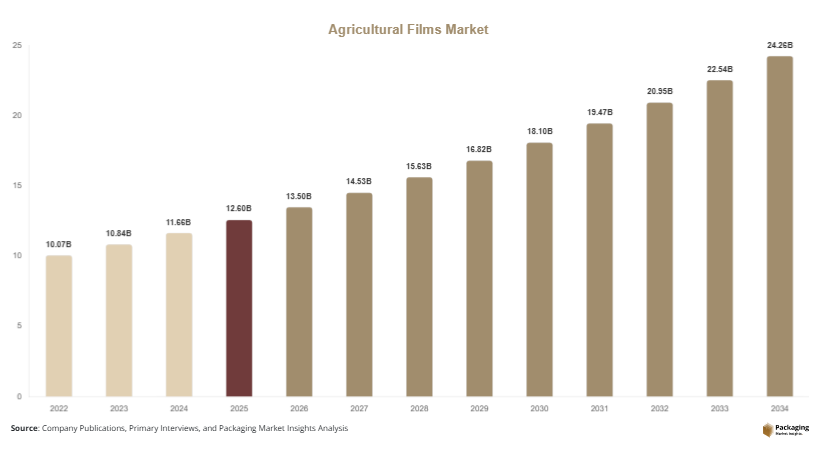
The agricultural films market is experiencing steady expansion due to the increasing need for enhanced crop productivity, efficient water management, and protection against climatic variability. Agricultural films are widely used in modern farming practices such as greenhouse cultivation, mulching, and silage wrapping, enabling farmers to improve yield quality and optimize resource utilization. The global market size was valued at approximately USD 12.6 billion in 2025 and is expected to reach USD 13.5 billion in 2026, reflecting a consistent rise in adoption across developed and emerging economies. By 2034, the market is projected to grow to USD 24.2 billion, registering a CAGR of 7.6% during 2025–2034.
One of the major growth factors driving the market is the rising demand for food due to population growth, which is compelling farmers to adopt advanced agricultural techniques. Agricultural films help in maintaining soil temperature, reducing weed growth, and conserving moisture, thereby improving crop yields. Another factor contributing to market growth is the increasing adoption of greenhouse farming, particularly in regions with unfavorable climatic conditions. These films create controlled environments that support year-round cultivation and enhance crop quality.
Key Highlights:
- Market size is projected to grow from USD 12.6 billion in 2025 to USD 24.2 billion by 2034, reflecting steady expansion in modern agricultural practices. This growth highlights increasing adoption of advanced materials to improve crop protection and productivity.
- The market is expected to register a CAGR of 7.6% during the forecast period from 2025 to 2034. This consistent growth rate indicates rising investments in agricultural technologies and sustainable farming solutions.
- Increasing adoption of greenhouse farming and plasticulture practices is driving demand for agricultural films. These methods help create controlled environments that enhance crop quality and enable year-round cultivation.
- Rising demand for high crop yield and efficient resource utilization is further supporting market growth. Agricultural films help conserve water, regulate soil temperature, and improve overall farm efficiency.
Explore more data points, trends and opportunities Download Free Sample Report
Market Trends
Increasing Adoption of Biodegradable Agricultural Films
The shift toward biodegradable agricultural films is becoming a prominent trend in the agricultural films market. Traditional plastic films, while effective, have raised concerns regarding environmental pollution and soil health. As a result, manufacturers are developing biodegradable alternatives that decompose naturally after use, reducing environmental impact. These films are gaining acceptance among farmers and regulatory bodies due to their sustainability benefits. The adoption of biodegradable films is also supported by government regulations aimed at reducing plastic waste in agriculture. As awareness of environmental issues continues to grow, the demand for eco-friendly agricultural films is expected to increase significantly.
Expansion of Greenhouse and Protected Cultivation Practices
The expansion of greenhouse and protected cultivation practices is another key trend shaping the agricultural films market. Farmers are increasingly adopting greenhouse farming to mitigate the effects of unpredictable weather conditions and improve crop productivity. Agricultural films used in greenhouses help maintain optimal temperature, humidity, and light conditions, enabling year-round cultivation. This trend is particularly prominent in regions with limited arable land or harsh climates. Additionally, advancements in film technology, such as UV stabilization and anti-fog properties, are enhancing the performance of greenhouse films, further driving their adoption.
Market Drivers
Rising Global Demand for Food Production
The growing global population is driving the demand for increased food production, which in turn is fueling the agricultural films market. Farmers are under pressure to maximize crop yields while minimizing resource usage. Agricultural films play a crucial role in achieving these objectives by improving soil conditions, conserving moisture, and protecting crops from pests and environmental stress. The use of mulching films, for instance, helps in maintaining soil temperature and reducing weed growth, leading to higher productivity. As food demand continues to rise, the adoption of advanced farming techniques, including agricultural films, is expected to increase.
Advancements in Agricultural Technology and Practices
Technological advancements in agriculture are significantly contributing to the growth of the agricultural films market. Innovations such as precision farming, drip irrigation, and controlled environment agriculture are driving the adoption of agricultural films. These technologies require efficient materials that can support optimal growing conditions, making agricultural films an essential component. Additionally, the development of high-performance films with enhanced durability and functionality is improving their effectiveness. As farmers increasingly adopt modern agricultural practices, the demand for advanced agricultural films is expected to grow.
Market Restraint
Environmental Concerns Related to Plastic Waste
Environmental concerns associated with plastic waste pose a significant restraint to the agricultural films market. Traditional agricultural films are made from non-biodegradable plastics, which can accumulate in the soil and cause long-term environmental damage. Improper disposal of these films can lead to soil contamination and affect crop productivity. Governments and environmental organizations are increasingly imposing regulations to limit the use of conventional plastic films, which can hinder market growth. For example, restrictions on single-use plastics in certain regions have led to a decline in the use of traditional agricultural films. Although biodegradable alternatives are being developed, their higher cost and limited availability can restrict widespread adoption. This environmental challenge remains a key barrier to the growth of the market.
Market Opportunities
Growth in Emerging Agricultural Economies
Emerging economies present significant opportunities for the agricultural films market. Countries in Asia Pacific, Latin America, and Africa are experiencing rapid agricultural development, driven by increasing food demand and government support. These regions are adopting modern farming techniques to improve productivity and reduce dependency on traditional methods. Agricultural films are becoming an integral part of these advancements, particularly in greenhouse farming and mulching practices. The expansion of irrigation infrastructure and availability of subsidies are further supporting market growth. Companies that focus on these emerging markets can benefit from increasing demand and expanding agricultural activities.
Development of Advanced and Sustainable Film Materials
The development of advanced and sustainable film materials is creating new growth opportunities in the agricultural films market. Innovations in polymer technology are enabling the production of films with improved strength, durability, and environmental compatibility. Biodegradable and recyclable films are gaining traction as they address environmental concerns while maintaining performance standards. Additionally, the integration of functional additives, such as UV stabilizers and anti-drip coatings, is enhancing the efficiency of agricultural films. As sustainability becomes a priority for both consumers and regulators, the demand for advanced film materials is expected to rise.
Report Scope
| Report Metric | Details |
|---|---|
| Market Size in 2025 | USD 12.6 Billion |
| Market Size in 2026 | USD 13.5 Billion |
| Market Size in 2034 | USD 24.2 Billion |
| CAGR | 7.6% (2026-2034) |
| Base Year for Estimation | 2025 |
| Historical Data | 2022-2024 |
| Forecast Period | 2026-2034 |
| Report Coverage | Revenue Forecast, Competitive Landscape, Supply Chain Disruption, Growth Factors, Environment & Regulatory Landscape and Trends |
| Geographies Covered | North America, Europe, APAC, Middle East and Africa, LATAM |
| Countries Covered | U.S., Canada, U.K., Germany, France, Spain, Italy, Russia, Nordic, Benelux, Rest of Europe, China, South Korea, Japan, India, Australia, Singapore, Taiwan, South East Asia, Rest of Asia-Pacific, UAE, Turky, Saudi Arabia, South Africa, Egypt, Nigeria, Rest of MEA, Brazil, Mexico, Argentina, Chile, Colombia, Rest of LATAM |
Explore more data points, trends and opportunities Download Free Sample Report
Segmental Analysis
By Type
The low-density polyethylene (LDPE) films segment dominated the agricultural films market in 2024, accounting for approximately 40% of the total market share. LDPE films are widely used due to their flexibility, durability, and cost-effectiveness. These films are commonly applied in greenhouse covers, mulching, and silage wrapping. Their ability to withstand varying environmental conditions makes them suitable for diverse agricultural applications. Additionally, LDPE films offer excellent moisture retention and UV resistance, which enhances crop productivity and reduces water usage.
The biodegradable films segment is expected to be the fastest-growing, with a CAGR of 9.8% during the forecast period. The increasing focus on sustainability and environmental protection is driving the demand for biodegradable films. These films decompose naturally, reducing plastic waste and minimizing environmental impact. Government regulations promoting eco-friendly materials are also supporting the growth of this segment. As awareness of environmental issues increases, the adoption of biodegradable films is expected to rise significantly.
By Application
The greenhouse films segment held the largest share of the agricultural films market in 2024, accounting for approximately 38% of the market. These films are essential for creating controlled environments that support plant growth. Greenhouse films help regulate temperature, humidity, and light, enabling year-round cultivation. The increasing adoption of greenhouse farming, particularly in regions with unfavorable climatic conditions, is driving the growth of this segment.
The mulching films segment is projected to be the fastest-growing, with a CAGR of 8.7% during the forecast period. Mulching films are widely used to improve soil quality, conserve moisture, and reduce weed growth. The increasing focus on efficient farming practices and resource conservation is driving the adoption of mulching films. Additionally, the use of biodegradable mulching films is gaining popularity, further supporting segment growth.
By End-Use
The commercial farming segment dominated the agricultural films market in 2024, accounting for approximately 45% of the total market share. Large-scale farms rely on agricultural films to enhance productivity and reduce operational costs. These films help in improving crop quality and yield, making them an essential component of modern farming practices. The increasing demand for high-quality agricultural products is driving the growth of this segment.
The horticulture segment is expected to be the fastest-growing, with a CAGR of 9.1% during the forecast period. The growing demand for fruits, vegetables, and ornamental plants is driving the adoption of agricultural films in horticulture. These films help create optimal growing conditions and improve crop quality. As consumer preferences shift toward fresh and high-quality produce, the demand for agricultural films in horticulture is expected to increase.
Agricultural Films Market Segmentations
By Type
- LDPE Films
- LLDPE Films
- HDPE Films
- Biodegradable Films
By Application
- Greenhouse Films
- Mulching Films
- Silage Films
By End-Use
- Commercial Farming
- Horticulture
- Others
Regional Analysis
North America
North America accounted for approximately 28% of the agricultural films market share in 2025 and is expected to grow at a CAGR of 6.8% during the forecast period. The region benefits from advanced agricultural practices and widespread adoption of modern technologies. The presence of large-scale commercial farms and well-established supply chains supports the demand for agricultural films. Additionally, government initiatives promoting sustainable farming practices are contributing to market growth.
The United States dominates the North American market due to its extensive agricultural sector and technological advancements. A unique growth factor in the region is the increasing adoption of precision agriculture, which relies on efficient materials such as agricultural films to optimize crop production. This approach enhances resource utilization and improves overall farm productivity.
Europe
Europe held a market share of approximately 25% in 2025 and is projected to grow at a CAGR of 6.5% through 2034. The region’s growth is driven by strong regulatory support for sustainable agriculture and the adoption of advanced farming techniques. The use of agricultural films in greenhouse farming and mulching is widespread, particularly in countries with limited arable land.
Spain is a key market in Europe, known for its extensive greenhouse farming practices. A unique growth factor in the region is the focus on reducing environmental impact through the use of biodegradable films. This emphasis on sustainability is encouraging the adoption of eco-friendly agricultural films across the region.
Asia Pacific
Asia Pacific is the fastest-growing region in the agricultural films market, accounting for around 30% of the global share in 2025 and projected to grow at a CAGR of 8.9%. The region’s growth is driven by increasing population, rising food demand, and expanding agricultural activities. Governments are investing in modern farming techniques to improve productivity and ensure food security.
China leads the Asia Pacific market due to its large agricultural base and rapid adoption of modern farming practices. A unique growth factor in the region is the increasing use of plasticulture techniques, including mulching and greenhouse cultivation, which are driving demand for agricultural films.
Middle East & Africa
The Middle East & Africa region accounted for approximately 9% of the market share in 2025 and is expected to grow at a CAGR of 7.2%. The region faces challenges such as water scarcity and harsh climatic conditions, which are driving the adoption of agricultural films. These films help in conserving water and protecting crops from extreme weather.
Saudi Arabia is a dominant market in the region, supported by government initiatives to improve agricultural productivity. A unique growth factor is the increasing investment in greenhouse farming, which enables cultivation in arid environments and supports food security goals.
Latin America
Latin America held around 8% of the market share in 2025 and is projected to grow at a CAGR of 7.5% during the forecast period. The region’s growth is driven by expanding agricultural activities and increasing exports of agricultural products. The adoption of modern farming techniques is also contributing to market growth.
Brazil dominates the Latin American market due to its large agricultural sector and favorable climatic conditions. A unique growth factor in the region is the growing demand for high-quality crops for export, which is encouraging the use of agricultural films to improve yield and quality.
Competitive Landscape
The agricultural films market is moderately competitive, with several key players focusing on innovation and product development. Companies are investing in research and development to create advanced films with improved performance and sustainability. Strategic partnerships and expansions are common strategies adopted by market players to strengthen their position.
Berry Global Inc. is one of the leading companies in the market, known for its extensive product portfolio and global presence. The company has recently introduced sustainable agricultural films designed to reduce environmental impact. Other major players are also focusing on developing biodegradable and recyclable films to meet evolving regulatory requirements and customer preferences.
Key Players List
- Berry Global Inc.
- BASF SE
- Dow Inc.
- ExxonMobil Corporation
- Kuraray Co., Ltd.
- RKW Group
- Armando Alvarez Group
- Trioplast AB
- Novamont S.p.A.
- Coveris Holdings S.A.
- Plastika Kritis S.A.
- AEP Industries Inc.
- RPC Group Plc
- Ab Rani Plast Oy
- Grupo Armando Alvarez