Aerosol Packaging Market Size and Growth
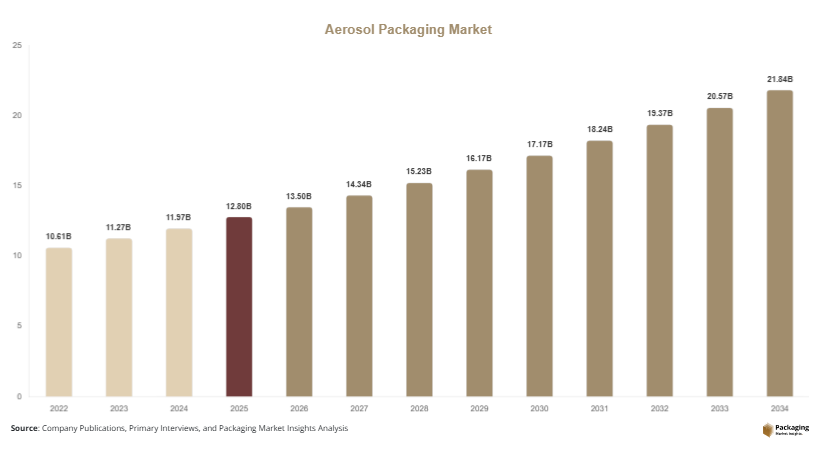
The global aerosol packaging market was valued at approximately USD 12.8 billion in 2025 and is projected to reach around USD 13.5 billion in 2026. By 2034, the market is forecasted to attain nearly USD 21.9 billion, registering a CAGR of 6.2% during 2025–2034. Aerosol packaging is widely used because it offers convenience, controlled dispensing, extended product shelf life, and contamination protection. Manufacturers are increasingly investing in lightweight and recyclable aerosol containers to improve sustainability and reduce packaging waste. The aerosol packaging market is experiencing stable growth due to increasing demand for personal care products, household sprays, pharmaceutical aerosols, and industrial dispensing solutions.
One of the key growth factors driving the aerosol packaging market is the rising consumption of personal care and cosmetic products such as deodorants, hair sprays, shaving foams, and dry shampoos. Urbanization, changing consumer lifestyles, and increasing disposable incomes are supporting strong demand for convenient packaging formats. Another major factor contributing to market growth is the expanding use of aerosol packaging in healthcare applications, particularly for inhalers, disinfectants, and pharmaceutical sprays. The healthcare industry continues to adopt advanced aerosol packaging systems due to their precision dispensing capabilities and ease of use.
Key Highlights
- Europe dominated the market with a 34.6% share in 2025.
- Asia Pacific is projected to grow at the fastest CAGR of 7.1%.
- Aluminum aerosol cans led the material segment with a 48.3% share
- Personal care applications dominated with a 41.7% share.
- Household products accounted for 24.9% share, while industrial applications are expected to grow at a CAGR of 6.3%.
- The US remained the dominant country with a market size of USD 2.8 billion in 2025 and USD 3.0 billion in 2026.
Explore more data points, trends and opportunities Download Free Sample Report
Market Trends
Increasing Demand for Sustainable Aerosol Packaging
Sustainability has become a major trend influencing the aerosol packaging market. Manufacturers are increasingly adopting recyclable aluminum and steel materials to reduce environmental impact and comply with sustainability regulations. Companies are also focusing on lightweight packaging designs that minimize raw material consumption and transportation costs. Consumer preference for environmentally responsible products is encouraging brands to use recyclable aerosol cans and low-emission propellants. Several personal care and household product manufacturers are introducing packaging recovery and recycling initiatives to strengthen sustainability performance. This trend is expected to continue as governments introduce stricter environmental standards for packaging waste reduction.
Growing Adoption of Aerosol Packaging in Healthcare Applications
Healthcare applications are increasingly driving innovation within the aerosol packaging market. Pharmaceutical companies are expanding the use of aerosol containers for inhalers, topical sprays, disinfectants, and wound care products. Aerosol systems provide accurate dosage control, improved hygiene, and convenient application methods for patients and healthcare professionals. The growing prevalence of respiratory disorders and rising demand for portable healthcare products are supporting segment expansion. Manufacturers are also developing advanced metered-dose aerosol systems that improve drug delivery efficiency and product safety. This trend is expected to accelerate with increasing investment in healthcare infrastructure and pharmaceutical manufacturing worldwide.
Market Drivers
Rising Demand for Personal Care and Cosmetic Products
The increasing consumption of personal care and cosmetic products is one of the primary drivers supporting growth in the aerosol packaging market. Products such as deodorants, hair sprays, shaving creams, body mists, and dry shampoos are widely packaged in aerosol containers because they offer convenience and controlled dispensing. Rapid urbanization, changing grooming habits, and rising disposable incomes are contributing to strong demand for these products globally. Cosmetic manufacturers are also introducing premium aerosol packaging designs to improve brand visibility and consumer experience. The continued growth of the beauty and personal care industry is expected to create substantial demand for aerosol packaging solutions.
Expansion of Household Cleaning and Industrial Applications
The growing use of aerosol packaging in household cleaning and industrial applications is another major factor driving market growth. Aerosol products such as disinfectants, air fresheners, furniture sprays, lubricants, and automotive cleaners provide efficient dispensing and improved product protection. Increased awareness regarding hygiene and sanitation has accelerated demand for aerosol-based disinfectants and cleaning products in residential and commercial environments. Industrial sectors are also adopting aerosol packaging for paints, coatings, and maintenance products due to ease of storage and application. Rising industrialization and infrastructure development are expected to further support demand for aerosol packaging products.
Market Restraint
Environmental Concerns Related to Propellants and Metal Waste
One of the major restraints affecting the aerosol packaging market is growing environmental concern regarding aerosol propellants and metal packaging waste. Although modern aerosol systems use safer propellants compared to older chlorofluorocarbon technologies, environmental regulations continue to increase pressure on manufacturers to reduce emissions and improve sustainability. The production of aluminum and steel aerosol containers also requires significant energy consumption, which can contribute to higher carbon emissions during manufacturing processes.
For example, small personal care brands may face increased operational costs when transitioning to recyclable aerosol packaging materials and environmentally compliant propellant systems. In regions with limited recycling infrastructure, discarded aerosol containers may contribute to landfill waste and resource loss. Regulatory restrictions on volatile organic compounds in aerosol formulations can also impact product development and manufacturing flexibility. These environmental and compliance challenges may limit adoption rates in certain markets and increase production costs for packaging companies.
Market Opportunities
Development of Eco-Friendly Propellant Technologies
The development of eco-friendly propellant systems presents significant opportunities for the aerosol packaging market. Manufacturers are increasingly investing in low-emission and compressed gas propellants that reduce environmental impact while maintaining product performance. Sustainable propellant technologies can help companies comply with changing environmental regulations and improve brand reputation among environmentally conscious consumers. Research into bio-based propellants and recyclable aerosol systems is also creating new innovation opportunities. Companies that successfully develop environmentally responsible aerosol packaging solutions are expected to strengthen their competitive position in global consumer and industrial markets.
Expansion of Aerosol Food Packaging Applications
The food industry offers growing opportunities for aerosol packaging manufacturers. Products such as whipped cream, cooking oils, flavored sprays, and beverage foams increasingly use aerosol systems because they provide convenience, product freshness, and portion control. Changing consumer lifestyles and increasing demand for ready-to-use food products are supporting growth in aerosol food packaging applications. Manufacturers are developing food-safe aerosol containers with improved dispensing accuracy and shelf-life performance. Rising adoption of premium food products and convenience-oriented packaging formats is expected to generate new revenue opportunities for aerosol packaging companies during the forecast period.
Report Scope
| Report Metric | Details |
|---|---|
| Market Size in 2025 | USD 12.8 Billion |
| Market Size in 2026 | USD 13.5 Billion |
| Market Size in 2034 | USD 21.9 Billion |
| CAGR | 6.2% (2026-2034) |
| Base Year for Estimation | 2025 |
| Historical Data | 2022-2024 |
| Forecast Period | 2026-2034 |
| Report Coverage | Revenue Forecast, Competitive Landscape, Supply Chain Disruption, Growth Factors, Environment & Regulatory Landscape and Trends |
| Geographies Covered | North America, Europe, APAC, Middle East and Africa, LATAM |
| Countries Covered | U.S., Canada, U.K., Germany, France, Spain, Italy, Russia, Nordic, Benelux, Rest of Europe, China, South Korea, Japan, India, Australia, Singapore, Taiwan, South East Asia, Rest of Asia-Pacific, UAE, Turky, Saudi Arabia, South Africa, Egypt, Nigeria, Rest of MEA, Brazil, Mexico, Argentina, Chile, Colombia, Rest of LATAM |
Explore more data points, trends and opportunities Download Free Sample Report
Segmental Analysis
By Material Type
Aluminum aerosol cans dominated the market in 2024, accounting for approximately 48.3% of total market share. Aluminum packaging is widely preferred because it offers lightweight properties, corrosion resistance, and strong recyclability advantages. Personal care and cosmetic manufacturers increasingly use aluminum aerosol cans for deodorants, hair sprays, and body care products due to their premium appearance and product protection capabilities. Aluminum containers also support longer shelf life and compatibility with various aerosol formulations. Growing sustainability initiatives and consumer preference for recyclable packaging materials continue to strengthen demand for aluminum aerosol packaging across multiple industries.
Recyclable steel aerosol containers are projected to register the fastest CAGR of 6.8% during the forecast period. Steel aerosol packaging offers durability, high pressure resistance, and cost efficiency, making it suitable for industrial sprays, household cleaners, and automotive products. Manufacturers are increasingly adopting recyclable steel materials to reduce packaging waste and improve environmental performance. Technological advancements in lightweight steel can manufacturing are also supporting segment growth. Rising industrialization and increasing demand for maintenance sprays, paints, and lubricant aerosols are expected to accelerate adoption of recyclable steel aerosol containers globally.
By Application
Personal care applications held the dominant market share of 41.7% in 2024 due to rising demand for aerosol deodorants, dry shampoos, hair sprays, shaving foams, and body sprays. Consumers prefer aerosol packaging because it offers convenience, hygiene, and controlled product dispensing. Cosmetic brands are increasingly introducing innovative aerosol packaging designs and premium dispensing technologies to improve customer experience and product differentiation. Expanding urban populations, increasing beauty awareness, and growth in men’s grooming products are also contributing to strong market demand within the personal care segment.
Pharmaceutical aerosols are expected to witness the fastest growth, registering a CAGR of 7.4% during the forecast period. Aerosol systems are widely used for respiratory inhalers, antiseptic sprays, wound care products, and topical medications because they provide precise dosage control and contamination protection. Rising prevalence of respiratory diseases and increasing healthcare expenditure are supporting demand for pharmaceutical aerosol packaging products. Manufacturers are also investing in advanced metered-dose inhaler technologies and sustainable propellant systems to improve drug delivery efficiency and regulatory compliance.
By End-Use Industry
Household products accounted for a significant market share of 24.9% in 2024 due to increasing use of aerosol cleaners, disinfectants, air fresheners, and furniture sprays. Aerosol packaging provides convenient dispensing, portability, and extended shelf life, making it highly suitable for household maintenance applications. Rising hygiene awareness and increased demand for sanitation products across residential and commercial spaces continue to support segment growth. Manufacturers are introducing eco-friendly aerosol packaging formats to address consumer concerns regarding sustainability and environmental impact.
Industrial applications are projected to grow at the fastest CAGR of 6.3% during the forecast period. Aerosol packaging is increasingly used for lubricants, paints, coatings, adhesives, and automotive maintenance products due to ease of handling and precise application capabilities. Growing industrial automation, infrastructure development, and manufacturing activities are contributing to higher demand for industrial aerosol packaging solutions. Technological advancements in corrosion-resistant aerosol containers and industrial dispensing systems are also expected to support long-term market expansion.
Aerosol Packaging Market Segmentations
By Material Type
- Aluminum Aerosol Cans
- Steel Aerosol Containers
- Plastic Aerosol Packaging
By Application
- Personal Care
- Household Products
- Pharmaceutical Aerosols
- Food Products
- Industrial Products
By End-Use Industry
- Cosmetics & Personal Care
- Healthcare & Pharmaceuticals
- Food & Beverage
- Automotive & Industrial
- Household Care
Regional Analysis
North America
North America accounted for approximately 26.3% of the global aerosol packaging market share in 2025 and is projected to grow at a CAGR of 5.8% during the forecast period. Strong demand for personal care products, household sprays, and pharmaceutical aerosols is supporting market growth across the region. Increasing adoption of recyclable aluminum aerosol cans and sustainable packaging initiatives are also contributing to market expansion. The presence of major personal care and healthcare product manufacturers further strengthens regional demand for aerosol packaging solutions.
The United States dominates the North American market due to its large consumer goods industry and advanced packaging infrastructure. A unique growth factor is the rising use of aerosol disinfectants and hygiene products across residential and commercial sectors. Increased focus on sanitation and convenience-oriented packaging formats continues to support strong market demand in the country.
Europe
Europe held the largest market share of 34.6% in 2025 and is expected to grow at a CAGR of 5.9% through 2034. The region benefits from strong demand for cosmetic aerosols, strict packaging quality standards, and widespread recycling infrastructure for aluminum and steel containers. Sustainability initiatives and environmental regulations are encouraging manufacturers to adopt recyclable aerosol packaging materials and low-emission propellants across consumer product industries.
Germany remains the dominant market within Europe due to its strong industrial manufacturing sector and established personal care industry. A unique growth factor is the country’s advanced metal recycling infrastructure, which supports sustainable aerosol packaging production and improves circular economy performance across packaging supply chains.
Asia Pacific
Asia Pacific represented approximately 28.7% of the global market share in 2025 and is projected to register the fastest CAGR of 7.1% during the forecast period. Rapid urbanization, increasing disposable incomes, and growing demand for personal care and household products are driving strong regional market growth. Expanding pharmaceutical manufacturing activities and rising use of aerosol healthcare products are also supporting adoption of aerosol packaging solutions across the region.
China dominates the Asia Pacific aerosol packaging market due to its large manufacturing base and rapidly growing consumer goods sector. A unique growth factor is the expansion of domestic cosmetic and personal care product production, which is increasing demand for lightweight and cost-efficient aerosol packaging systems throughout the country.
Middle East & Africa
The Middle East & Africa region accounted for approximately 4.8% of the global aerosol packaging market share in 2025 and is expected to grow at a CAGR of 5.2% during the forecast period. Increasing urbanization, rising hygiene awareness, and growing demand for household cleaning products are contributing to regional market development. Personal care and automotive maintenance applications are also supporting demand for aerosol packaging solutions.
Saudi Arabia remains the dominant market within the region due to growing consumer spending and expanding retail industries. A unique growth factor is the increasing use of aerosol air fresheners and household sprays in residential and hospitality sectors, where demand for convenience-oriented consumer products continues to rise steadily.
Latin America
Latin America accounted for approximately 5.6% of the global aerosol packaging market share in 2025 and is projected to grow at a CAGR of 5.7% during the forecast period. Rising consumption of personal care products, household sprays, and automotive maintenance products is supporting regional market growth. Increasing retail expansion and improving packaging manufacturing capabilities are also contributing to higher demand for aerosol containers.
Brazil dominates the Latin American market due to its large cosmetics industry and expanding consumer goods sector. A unique growth factor is the country’s growing domestic production of aerosol deodorants and hair care products, which continues to support strong demand for aluminum aerosol packaging solutions.
Competitive Landscape
The aerosol packaging market is moderately consolidated, with leading companies focusing on sustainable packaging innovation, advanced dispensing technologies, and strategic manufacturing expansions. Packaging manufacturers are increasingly investing in recyclable aluminum and steel aerosol containers to comply with environmental regulations and improve product sustainability. Companies are also emphasizing lightweight packaging solutions and eco-friendly propellant technologies to strengthen competitive positioning.
Ball Corporation remains one of the leading players in the aerosol packaging market due to its strong global manufacturing network and extensive aluminum aerosol can portfolio. In 2024, the company announced expansion of its sustainable aluminum aerosol packaging production capacity in North America to support growing demand from personal care and household product industries.
Other major companies operating in the market include Crown Holdings Inc., Ardagh Group, CCL Container, and Trivium Packaging. These companies continue focusing on product innovation, regional expansion, and strategic collaborations with consumer goods manufacturers to strengthen their market presence.
Key Players List
- Ball Corporation
- Crown Holdings Inc.
- Ardagh Group
- CCL Container
- Trivium Packaging
- Colep Packaging
- Tubex GmbH
- Exal Corporation
- Nussbaum Group
- Bharat Containers
- Casablanca Industries Pvt. Ltd.
- Montebello Packaging
- Mauser Packaging Solutions
- DS Containers Inc.
- Euro Asia Packaging