Aerosol Cans Market Size and Growth
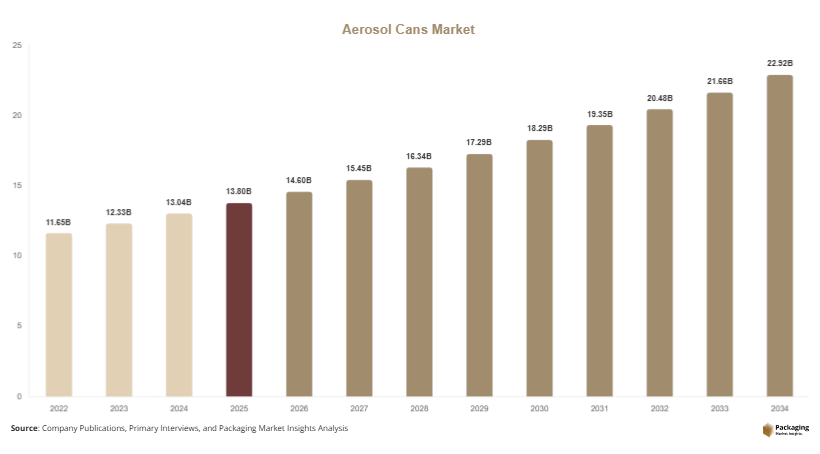
The aerosol cans market is witnessing consistent expansion due to increasing demand across personal care, household, healthcare, and industrial applications. Aerosol cans are widely used for dispensing products such as deodorants, hair sprays, paints, lubricants, and medical sprays, offering convenience, controlled dispensing, and extended shelf life. In 2025, the global aerosol cans market size is estimated at USD 13.8 billion, rising to approximately USD 14.6 billion in 2026. The market is projected to reach USD 22.9 billion by 2034, growing at a compound annual growth rate (CAGR) of 5.8% from 2025 to 2034.
One of the primary growth factors is the increasing consumption of personal care and cosmetic products, particularly in urban populations where convenience and hygiene are prioritized. Aerosol packaging enables easy application and enhances product performance, making it highly preferred by consumers. Another important factor is the rising use of aerosol cans in the automotive and industrial sectors for products such as spray paints, lubricants, and cleaning agents. These applications require precision and portability, which aerosol packaging provides effectively.
Key Highlights:
- The Aerosol Cans Market is projected to reach USD 22.9 billion by 2034, reflecting steady global expansion. This growth is supported by increasing demand for convenient and efficient packaging solutions across multiple industries.
- The market is expected to grow at a CAGR of 5.8% during 2025–2034. This consistent growth rate indicates stable demand driven by evolving consumer preferences and industrial applications.
- Demand for personal care and household aerosol products is rising significantly. Products such as deodorants, air fresheners, and cleaning sprays are widely used due to their ease of application and convenience.
- There is a growing shift toward recyclable and sustainable packaging materials. Manufacturers are adopting aluminum and steel cans to reduce environmental impact and meet regulatory requirements.
- Applications in industrial and healthcare sectors are increasing steadily. Aerosol cans are widely used for lubricants, paints, and medical sprays, supporting overall market growth.
Explore more data points, trends and opportunities Download Free Sample Report
Market Trends
Shift Toward Sustainable and Recyclable Aerosol Packaging
Sustainability is becoming a central focus in the aerosol cans market, with manufacturers increasingly adopting recyclable materials such as aluminum and steel. These materials offer durability while reducing environmental impact, aligning with global sustainability goals. Companies are redesigning aerosol cans to minimize material usage and improve recyclability without compromising performance. Additionally, regulatory pressures and consumer awareness regarding environmental issues are encouraging the use of eco-friendly propellants and coatings. This trend is reshaping production processes and driving innovation across the aerosol packaging industry.
Technological Advancements in Valve and Dispensing Systems
Technological innovations in valve systems and dispensing mechanisms are enhancing the functionality of aerosol cans. Advanced valves provide better control over spray patterns, improving product efficiency and user experience. Manufacturers are also integrating features such as 360-degree dispensing and precision nozzles to meet diverse application requirements. These advancements are particularly important in healthcare and industrial sectors, where accuracy and consistency are critical. The integration of smart dispensing technologies is further expanding the potential applications of aerosol packaging.
Market Drivers
Increasing Demand from Personal Care and Cosmetics Industry
The growing demand for personal care and cosmetic products is a major driver of the aerosol cans market. Products such as deodorants, hair sprays, and shaving foams rely heavily on aerosol packaging for ease of use and effective application. Rising urbanization and changing consumer preferences are contributing to higher consumption of these products. Additionally, the expanding middle-class population in emerging markets is driving demand for premium personal care products, further boosting the use of aerosol cans.
Expanding Industrial and Automotive Applications
The use of aerosol cans in industrial and automotive applications is significantly driving market growth. Products such as spray paints, lubricants, and cleaning agents require precise and controlled application, which aerosol packaging provides. The increasing demand for maintenance and repair products in the automotive sector is further supporting this trend. Industrial users also prefer aerosol packaging due to its portability and efficiency, making it a valuable solution for various applications.
Market Restraint
Environmental Concerns and Regulatory Restrictions
Environmental concerns related to aerosol propellants and packaging materials pose a significant restraint to the aerosol cans market. Certain propellants have been associated with environmental issues, leading to strict regulations on their usage. Compliance with these regulations increases production costs and requires continuous innovation in formulation and packaging. For example, manufacturers must invest in alternative propellants and eco-friendly materials, which can impact profit margins. Additionally, varying regulations across regions create challenges for global manufacturers, limiting market expansion and increasing operational complexity.
Market Opportunities
Growth in Pharmaceutical and Healthcare Applications
The increasing use of aerosol cans in pharmaceutical and healthcare applications presents significant growth opportunities. Products such as inhalers, antiseptic sprays, and topical medications benefit from aerosol packaging due to its precision and hygiene. The rising prevalence of respiratory and chronic conditions is driving demand for these products. Additionally, advancements in medical aerosol technologies are enabling more effective drug delivery systems, further expanding market potential.
Rising Demand in Emerging Markets
Emerging markets offer substantial opportunities for the aerosol cans market due to rapid urbanization and increasing disposable incomes. Consumers in these regions are adopting modern lifestyle products, including aerosol-based personal care and household items. The expansion of retail and e-commerce channels is also improving product accessibility. Manufacturers are focusing on establishing production facilities in these regions to reduce costs and meet growing demand, supporting long-term market growth.
Report Scope
| Report Metric | Details |
|---|---|
| Market Size in 2025 | USD 13.8 Billion |
| Market Size in 2026 | USD 14.6 Billion |
| Market Size in 2034 | USD 22.9 Billion |
| CAGR | 5.8% (2026-2034) |
| Base Year for Estimation | 2025 |
| Historical Data | 2022-2024 |
| Forecast Period | 2026-2034 |
| Report Coverage | Revenue Forecast, Competitive Landscape, Supply Chain Disruption, Growth Factors, Environment & Regulatory Landscape and Trends |
| Geographies Covered | North America, Europe, APAC, Middle East and Africa, LATAM |
| Countries Covered | U.S., Canada, U.K., Germany, France, Spain, Italy, Russia, Nordic, Benelux, Rest of Europe, China, South Korea, Japan, India, Australia, Singapore, Taiwan, South East Asia, Rest of Asia-Pacific, UAE, Turky, Saudi Arabia, South Africa, Egypt, Nigeria, Rest of MEA, Brazil, Mexico, Argentina, Chile, Colombia, Rest of LATAM |
Explore more data points, trends and opportunities Download Free Sample Report
Segmental Analysis
By Material Type
The aluminum segment dominated the aerosol cans market in 2024, accounting for approximately 62% of the total market share. Aluminum cans are widely preferred due to their lightweight nature, corrosion resistance, and recyclability. These properties make aluminum an ideal material for packaging a wide range of aerosol products, including personal care and pharmaceutical items. Additionally, aluminum cans provide excellent barrier protection, ensuring product stability and safety. The growing emphasis on sustainable packaging solutions is further supporting the dominance of this segment.
The steel segment is expected to be the fastest-growing, with a projected CAGR of 6.1% during the forecast period. Steel aerosol cans offer durability and cost-effectiveness, making them suitable for industrial applications such as paints and lubricants. The increasing demand for industrial and automotive products is driving the growth of this segment. Furthermore, advancements in coating technologies are improving the performance and recyclability of steel cans, contributing to their rising adoption.
By Application
The personal care segment held the largest share in 2024, accounting for nearly 55% of the market. Aerosol cans are extensively used for products such as deodorants, hair sprays, and shaving foams. The convenience and efficiency of aerosol packaging make it a preferred choice for consumers. The growing demand for grooming and hygiene products is driving this segment. Additionally, the introduction of innovative formulations and packaging designs is enhancing product appeal.
The healthcare segment is projected to be the fastest-growing, with a CAGR of 6.3% during the forecast period. Aerosol packaging is increasingly used for medical products such as inhalers and antiseptic sprays. The rising prevalence of respiratory diseases and the need for effective drug delivery systems are driving this segment. Technological advancements in aerosol-based medical devices are further supporting growth.
By End-Use
The consumer goods segment dominated the market in 2024, holding around 60% share. This segment includes personal care and household products, which are major users of aerosol cans. The increasing demand for convenient and easy-to-use packaging solutions is driving growth in this segment. Additionally, the expansion of retail and e-commerce channels is improving product accessibility.
The industrial segment is expected to witness the fastest growth, with a CAGR of 6.5%. Aerosol cans are widely used in industrial applications for products such as paints, lubricants, and cleaning agents. The growth of manufacturing and automotive industries is driving demand in this segment. Furthermore, the need for efficient and portable packaging solutions is supporting the adoption of aerosol cans in industrial applications.
Aerosol Cans Market Segmentations
Material Type
- Aluminum Aerosol Cans
- Steel Aerosol Cans
Application
- Personal Care Products
- Healthcare Products
- Household Products
- Industrial Products
End-Use
- Consumer Goods
- Industrial Sector
Regional Analysis
North America
North America accounted for approximately 34% of the aerosol cans market share in 2025 and is expected to grow at a CAGR of 5.4% during the forecast period. The region’s mature consumer base and high demand for personal care and household products are key factors supporting market growth. Additionally, the presence of established manufacturers and advanced production technologies contributes to consistent demand.
The United States dominates the regional market due to its strong consumer goods and industrial sectors. A unique growth factor in this region is the increasing adoption of sustainable packaging practices. Companies are focusing on recyclable materials and eco-friendly propellants, which is driving innovation and shaping market dynamics.
Europe
Europe held around 28% market share in 2025 and is projected to grow at a CAGR of 5.2%. The region’s strict environmental regulations and focus on sustainability are influencing the aerosol cans market. Manufacturers are adopting advanced technologies to comply with regulatory standards and reduce environmental impact.
Germany is a leading country in the European market, supported by its strong industrial base. A key growth factor is the increasing demand for aerosol-based industrial products, particularly in automotive and manufacturing sectors. This demand is driving innovation in packaging and dispensing technologies.
Asia Pacific
Asia Pacific accounted for approximately 23% market share in 2025 and is expected to register the highest CAGR of 6.7%. Rapid urbanization, population growth, and increasing disposable incomes are driving demand for aerosol products in this region.
China dominates the Asia Pacific market due to its large manufacturing base and growing consumer market. A unique growth factor is the expansion of personal care and household product industries. This is increasing the demand for aerosol packaging solutions across various applications.
Middle East & Africa
The Middle East & Africa region held about 8% market share in 2025 and is projected to grow at a CAGR of 5.9%. The region is experiencing growth due to improving economic conditions and rising consumer awareness of personal care products.
Saudi Arabia is a key market in this region, driven by increasing investments in consumer goods and industrial sectors. A unique growth factor is the growing demand for aerosol-based cleaning and maintenance products, supporting market expansion.
Latin America
Latin America accounted for nearly 7% market share in 2025 and is expected to grow at a CAGR of 5.6%. The region’s expanding consumer base and improving economic conditions are contributing to market growth.
Brazil dominates the Latin American market due to its large population and growing consumer goods industry. A key growth factor is the increasing adoption of aerosol-based personal care products, driven by changing consumer preferences and rising disposable incomes.
Competitive Landscape
The aerosol cans market is moderately competitive, with several global and regional players focusing on innovation and sustainability. Companies are investing in advanced manufacturing technologies and expanding their product portfolios to meet evolving consumer demands. Strategic partnerships and acquisitions are common as companies aim to strengthen their market presence.
Ball Corporation is a leading player in the market, known for its extensive range of aluminum aerosol cans. The company has recently introduced lightweight and recyclable packaging solutions to support sustainability initiatives. Other key players are also focusing on developing eco-friendly materials and improving production efficiency. The competitive landscape is characterized by continuous innovation and a strong emphasis on environmental responsibility.
Key Players List
- Ball Corporation
- Crown Holdings Inc.
- Ardagh Group
- CCL Industries Inc.
- Nampak Ltd.
- Trivium Packaging
- Tubex GmbH
- Exal Corporation
- DS Containers Inc.
- Bharat Containers
- Aero-Pack Industries Inc.
- Casablanca Industries Pvt. Ltd.
- Linhardt GmbH & Co. KG
- Colep Packaging
- Envases Universales Group