Adherence Packaging Market Size and Growth
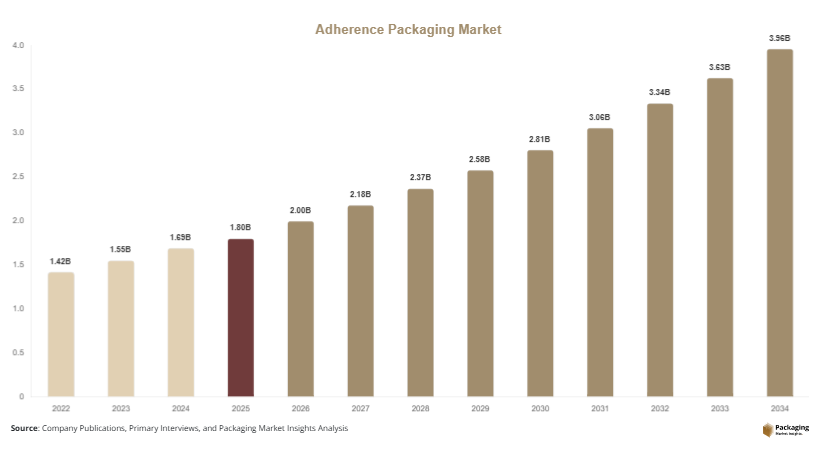
The global adherence packaging market was valued at approximately USD 1.8 billion in 2025 and is expected to reach USD 2.0 billion in 2026. With rising chronic disease prevalence and aging populations, the market is projected to grow to USD 4.3 billion by 2034, registering a CAGR of 8.9% during the forecast period (2025–2034). The adherence packaging market is gaining significant traction as healthcare systems increasingly prioritize medication compliance and patient safety. Adherence packaging, also known as compliance packaging, includes solutions such as blister packs, multi-dose pouches, and calendar-based packaging that help patients follow prescribed medication schedules.
One of the key growth factors driving the market is the increasing prevalence of chronic diseases such as diabetes, cardiovascular conditions, and respiratory disorders. These conditions often require long-term medication management, making adherence packaging essential for improving patient outcomes. For example, patients with multiple prescriptions benefit from multi-dose packaging that organizes medications by time and date.
Key Highlights:
- North America dominated the market with a 38.1% share in 2025.
- Asia Pacific is projected to grow at the fastest CAGR of 9.6%.
- Blister packaging led the type segment with a 44.8% share.
- Plastic materials dominated with a 62.5% share.
- Retail pharmacies led the end-use segment with 46.2% share.
- The US remained the dominant country with a market size of USD 0.72 billion in 2025 and USD 0.79 billion in 2026.
Explore more data points, trends and opportunities Download Free Sample Report
Market Trends
Integration of Smart and Connected Packaging Solutions
The integration of smart technologies into adherence packaging is a major trend shaping the market. Packaging solutions are increasingly being equipped with digital features such as QR codes, NFC tags, and electronic sensors that track medication usage. These technologies enable patients and caregivers to monitor adherence in real time and receive reminders.
For example, smart blister packs can record when a dose is taken and send notifications to mobile applications. This is particularly useful for elderly patients or those managing multiple medications. Healthcare providers can also use this data to track patient compliance and adjust treatment plans accordingly.
In the future, the adoption of connected packaging solutions is expected to increase, driven by advancements in digital health technologies. Integration with telemedicine platforms and electronic health records will further enhance the effectiveness of adherence packaging.Increasing Adoption of Multi-Dose Packaging Systems
Multi-dose packaging systems are gaining popularity due to their convenience and ability to improve medication adherence. These systems organize medications into pre-sorted pouches labeled with the date and time of administration, reducing confusion for patients.
For instance, pharmacies are increasingly offering multi-dose pouch services to patients with complex medication regimens. This approach not only improves adherence but also reduces the risk of medication errors.
Looking ahead, the demand for multi-dose packaging is expected to grow as healthcare providers emphasize patient-centric care. Innovations in packaging design and automation will further enhance efficiency and scalability.
Market Drivers
Rising Prevalence of Chronic Diseases
The increasing prevalence of chronic diseases is a significant driver of the adherence packaging market. Conditions such as hypertension, diabetes, and cardiovascular diseases require long-term medication management, which increases the risk of non-adherence.
Adherence packaging addresses this issue by simplifying medication schedules and providing clear instructions. For example, patients with diabetes often require multiple medications at different times of the day. Multi-dose packaging systems help organize these medications, improving compliance.
The cause-and-effect relationship is evident: as chronic disease rates increase, the demand for adherence packaging solutions rises. This trend is expected to continue as global healthcare systems focus on improving patient outcomes and reducing treatment costs.
Growth of Retail Pharmacy Services
The expansion of retail pharmacy services is another key driver. Pharmacies are increasingly offering value-added services such as medication synchronization and adherence packaging to attract customers.
For example, large pharmacy chains are investing in automated packaging systems to provide personalized medication packaging solutions. This not only enhances customer satisfaction but also improves operational efficiency.
As competition among pharmacies intensifies, the adoption of adherence packaging is expected to increase. This will drive market growth and encourage innovation in packaging solutions.
Market Restraint
High Implementation Costs and Operational Challenges
One of the primary restraints in the adherence packaging market is the high cost of implementation. Automated packaging systems, specialized materials, and compliance requirements can increase operational expenses for pharmacies and healthcare providers.
For instance, small pharmacies may find it challenging to invest in advanced packaging equipment and software systems. Additionally, training staff to operate these systems can add to costs and complexity.
The impact of these challenges is significant, as they can limit the adoption of adherence packaging solutions, particularly in developing regions. Furthermore, regulatory requirements related to labeling and patient safety can increase compliance costs.
Despite these challenges, technological advancements and economies of scale are expected to reduce costs over time. However, in the short term, high implementation costs remain a key barrier to market growth.
Market Opportunities
Expansion of Home Healthcare Services
The growth of home healthcare services presents a significant opportunity for the adherence packaging market. As more patients receive treatment at home, the need for effective medication management solutions is increasing.
For example, elderly patients and those with chronic conditions often rely on home healthcare services for medication administration. Adherence packaging helps ensure that medications are taken correctly and on time.
In the future, the expansion of home healthcare is expected to drive demand for personalized packaging solutions. Companies can capitalize on this opportunity by developing products tailored to home-based care settings.
Adoption in Emerging Markets
Emerging markets offer substantial growth potential for adherence packaging. Increasing healthcare awareness, rising disposable incomes, and improving access to medical services are driving demand in these regions.
For instance, countries in Asia Pacific and Latin America are witnessing growth in pharmaceutical consumption, which creates opportunities for adherence packaging solutions. Governments and healthcare organizations are also promoting initiatives to improve medication adherence.
As these markets continue to develop, the adoption of adherence packaging is expected to increase. This will create new opportunities for manufacturers and service providers.
Report Scope
| Report Metric | Details |
|---|---|
| Market Size in 2025 | USD 1.8 Billion |
| Market Size in 2026 | USD 2.0 Billion |
| Market Size in 2034 | USD 4.3 Billion |
| CAGR | 8.9% (2026-2034) |
| Base Year for Estimation | 2025 |
| Historical Data | 2022-2024 |
| Forecast Period | 2026-2034 |
| Report Coverage | Revenue Forecast, Competitive Landscape, Supply Chain Disruption, Growth Factors, Environment & Regulatory Landscape and Trends |
| Geographies Covered | North America, Europe, APAC, Middle East and Africa, LATAM |
| Countries Covered | U.S., Canada, U.K., Germany, France, Spain, Italy, Russia, Nordic, Benelux, Rest of Europe, China, South Korea, Japan, India, Australia, Singapore, Taiwan, South East Asia, Rest of Asia-Pacific, UAE, Turky, Saudi Arabia, South Africa, Egypt, Nigeria, Rest of MEA, Brazil, Mexico, Argentina, Chile, Colombia, Rest of LATAM |
Explore more data points, trends and opportunities Download Free Sample Report
Segmental Analysis
By Type
Blister packaging dominated the market in 2024, accounting for approximately 44.8% of the total share. This dominance is attributed to its ability to provide clear visibility of medication and protect individual doses from contamination. Blister packs are widely used in pharmaceutical packaging due to their convenience and effectiveness in ensuring adherence. For example, calendar blister packs indicate the day of the week, helping patients track their medication intake. The widespread use of blister packaging across healthcare settings supports its leading position in the market.
Multi-dose pouch systems are the fastest-growing segment, with a projected CAGR of 9.9%. These systems offer pre-sorted medications in labeled pouches, simplifying complex medication regimens. For instance, patients with multiple prescriptions benefit from organized packaging that reduces confusion. As demand for patient-centric solutions increases, the adoption of multi-dose packaging is expected to grow significantly.
By Material
Plastic materials dominated the market in 2024 with a share of 62.5%, owing to their durability and flexibility. Plastic is widely used in adherence packaging due to its ability to protect medications from moisture and contamination. For example, blister packs made from plastic provide secure storage and extend shelf life.
Paper-based materials are the fastest-growing segment, with a CAGR of 8.7%. This growth is driven by increasing demand for sustainable packaging solutions. Paper-based packaging offers environmental benefits and aligns with regulatory requirements. For instance, companies are developing recyclable paper-based blister packs to reduce plastic usage. As sustainability becomes a priority, the adoption of paper-based materials is expected to increase.
By End-Use
Retail pharmacies dominated the market in 2024, accounting for 46.2% of the total share. This dominance is due to their direct interaction with patients and ability to offer personalized packaging services. Pharmacies are increasingly adopting adherence packaging to improve customer satisfaction and retention. For example, medication synchronization programs often include adherence packaging services.
Home healthcare is the fastest-growing segment, with a CAGR of 9.4%. The increasing preference for home-based care is driving demand for adherence packaging solutions. For instance, elderly patients receiving home care benefit from organized medication packaging. As home healthcare services expand, this segment is expected to grow significantly.
Adherence Packaging Market Segmentations
By Type
- Blister Packaging
- Strip Packaging
- Multi-Dose Pouch Packaging
By Material
- Plastic
- Paper & Paperboard
- Aluminum
By End-Use
- Retail Pharmacies
- Hospital Pharmacies
- Home Healthcare
Regional Analysis
North America
North America accounted for approximately 38.1% of the global adherence packaging market share in 2025 and is projected to grow at a CAGR of 8.5% during the forecast period. The region has a well-established healthcare infrastructure and high adoption of advanced pharmaceutical services. Growth is driven by the increasing prevalence of chronic diseases and the need for improved medication management. Additionally, favorable reimbursement policies and government initiatives support the adoption of adherence packaging solutions. The presence of large pharmacy chains and advanced automation technologies further strengthens the market.
The United States dominates the regional market, driven by its large patient population and advanced healthcare system. A unique growth driver is the integration of adherence packaging with digital health platforms. For example, pharmacies are offering smart packaging solutions that connect with mobile applications to track medication usage. This trend is expected to enhance patient engagement and drive market growth.
Europe
Europe held a market share of 29.4% in 2025 and is expected to grow at a CAGR of 8.2%. The region is characterized by strong regulatory frameworks and increasing focus on patient safety. Demand for adherence packaging is driven by the aging population and the prevalence of chronic diseases. Healthcare providers are adopting packaging solutions to reduce medication errors and improve treatment outcomes.
Germany is the dominant country in the region, supported by its advanced healthcare system and strong pharmaceutical industry. A key growth driver is the adoption of automated packaging systems in pharmacies. For example, German pharmacies are using robotics to produce multi-dose packaging, improving efficiency and accuracy.
Asia Pacific
Asia Pacific emerged as the fastest-growing region, with a market share of 21.7% in 2025 and a projected CAGR of 9.6%. Rapid urbanization, increasing healthcare expenditure, and growing awareness of medication adherence are driving market growth. The expansion of pharmaceutical industries and retail pharmacies further supports demand.
China dominates the regional market, driven by its large population and increasing prevalence of chronic diseases. A unique growth driver is the government’s focus on improving healthcare access and quality. For example, initiatives to enhance pharmaceutical services are encouraging the adoption of adherence packaging solutions.
Middle East & Africa
The Middle East & Africa region accounted for 5.2% of the market share in 2025 and is expected to grow at a CAGR of 7.8%. The market is driven by improving healthcare infrastructure and increasing awareness of medication adherence. Demand is particularly strong in urban areas with better access to healthcare services.
South Africa is the leading country in the region, supported by its developing healthcare sector. A key growth driver is the expansion of private healthcare services. For example, private hospitals are adopting adherence packaging to improve patient outcomes and reduce medication errors.
Latin America
Latin America held a market share of 5.6% in 2025 and is projected to grow at a CAGR of 9.1%. The region is experiencing growth in pharmaceutical consumption and healthcare awareness. The expansion of retail pharmacies and government initiatives to improve healthcare access are driving demand.
Brazil is the dominant country in the region, supported by its large population and growing healthcare sector. A unique growth driver is the increasing adoption of personalized medicine. For instance, pharmacies are offering customized adherence packaging solutions to meet patient needs.
Competitive Landscape
The adherence packaging market is moderately competitive, with several key players focusing on innovation and service expansion. Companies are investing in automation technologies and digital solutions to enhance their offerings.
Omnicell, Inc. is identified as a leading player in the market, known for its advanced medication management systems and adherence packaging solutions. The company focuses on integrating technology with packaging to improve patient outcomes.
Other major players are adopting strategies such as partnerships, acquisitions, and product innovation to strengthen their market position. For example, companies are collaborating with healthcare providers to develop customized packaging solutions.
Recent developments include the introduction of smart packaging systems and expansion into emerging markets. These strategies are expected to drive competition and support market growth.
Key Players
- Omnicell, Inc.
- McKesson Corporation
- Cardinal Health
- TCGRx
- Parata Systems LLC
- Jones Healthcare Group
- WestRock Company
- Manrex Limited
- Medicine-On-Time
- Pharmacy Automation Supplies
- Euclid Medical Products
- Omnicare (CVS Health)
- Becton, Dickinson and Company
- AptarGroup, Inc.
- Amcor Plc