Active Vacuum Packaging Technology Market Size and Growth
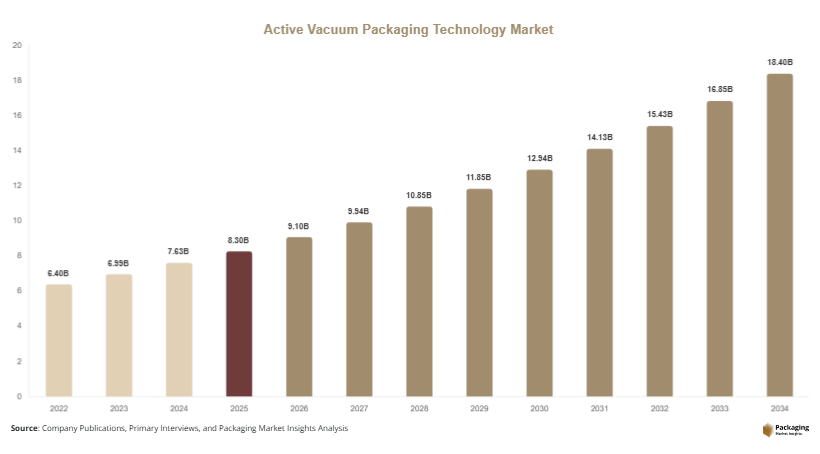
In 2025, the global Active Vacuum Packaging Technology Market size is estimated at USD 8.3 billion, which is expected to reach USD 9.1 billion in 2026. By 2034, the market is projected to reach approximately USD 18.7 billion, growing at a CAGR of 9.2% (2025–2034).The active vacuum packaging technology market is witnessing steady expansion as industries increasingly adopt advanced packaging solutions to enhance product shelf life, maintain freshness, and reduce food and pharmaceutical wastage. Active vacuum packaging combines vacuum sealing with oxygen scavengers, moisture regulators, and antimicrobial systems to improve product stability during storage and transportation.
The market growth is driven by rising demand for extended shelf-life food products, increasing global cold chain logistics, and rapid expansion of processed and convenience food industries. Active vacuum packaging technologies are widely used in meat, seafood, dairy, pharmaceuticals, and ready-to-eat meal segments due to their ability to preserve product quality without chemical preservatives.
Key Highlights
- The Active Vacuum Packaging Technology Market size was valued at USD 8.3 Billion in 2025, driven by increasing demand for advanced packaging solutions across multiple industries. This steady expansion reflects rising adoption of efficient preservation technologies in global supply chains.
- The market is projected to reach USD 9.1 Billion in 2026, supported by growing usage in food preservation, pharmaceutical packaging, and cold chain logistics. This growth highlights continued investment in modern packaging infrastructure and technology upgrades.
- The market is expected to reach a forecast value of USD 18.7 Billion by 2034, expanding at a CAGR of 9.2% during 2025–2034, indicating strong long-term growth potential. Expansion is fueled by rising demand for extended shelf-life and intelligent packaging systems.
- Strong demand is observed across food, pharmaceutical, and cold chain logistics sectors, where product safety, hygiene, and freshness are critical requirements. These industries are increasingly adopting advanced packaging solutions to reduce waste and improve product stability.
- Rising adoption of smart, sustainable, and extended shelf-life packaging systems is further accelerating market growth globally. This trend is driven by environmental concerns and increasing focus on reducing packaging-related carbon footprints.
Explore more data points, trends and opportunities Download Free Sample Report
Market Trends
Integration of Smart Active Packaging Systems
One of the most prominent trends in the active vacuum packaging technology market is the integration of smart packaging systems equipped with oxygen indicators, freshness sensors, and temperature monitoring features. These intelligent systems allow real-time tracking of product conditions, ensuring higher safety and quality assurance throughout the supply chain. Food manufacturers and pharmaceutical companies are increasingly adopting smart vacuum packaging solutions to reduce spoilage and improve inventory management. The integration of IoT-enabled sensors into packaging structures is further enhancing traceability and operational efficiency. Retailers also benefit from improved shelf monitoring, enabling better stock rotation and reduced product wastage.
Shift Toward Sustainable and Biodegradable Vacuum Materials
Another major trend is the shift toward sustainable and biodegradable materials in active vacuum packaging solutions. With rising environmental concerns and strict regulations on plastic usage, manufacturers are developing eco-friendly vacuum films and recyclable barrier materials. These innovations maintain oxygen and moisture control performance while reducing environmental impact. Biodegradable polymers and plant-based packaging materials are increasingly used in food and beverage applications. Companies are also investing in research to improve the durability and cost-effectiveness of sustainable packaging alternatives, supporting long-term adoption across global supply chains.
Market Drivers
Rising Demand for Extended Shelf-Life Food Products
The growing global demand for packaged and processed food products is a major driver of the active vacuum packaging technology market. Consumers are increasingly seeking convenience foods with longer shelf life and maintained nutritional value. Active vacuum packaging helps reduce oxygen exposure, microbial growth, and moisture contamination, significantly extending product freshness. This is particularly important in meat, seafood, dairy, and bakery segments. The expansion of modern retail chains and online grocery platforms is further increasing demand for advanced packaging solutions that ensure product integrity during long-distance transportation and storage.
Expansion of Cold Chain and Pharmaceutical Logistics
Another key driver is the rapid expansion of cold chain logistics and pharmaceutical distribution networks. Active vacuum packaging plays a critical role in preserving temperature-sensitive products such as vaccines, biologics, and specialty drugs. The increasing global demand for healthcare services and pharmaceutical exports has led to higher adoption of advanced packaging technologies. Additionally, stricter regulatory requirements for drug safety and traceability are pushing pharmaceutical companies to adopt high-performance packaging systems that ensure product stability throughout the supply chain.
Market Restraint
High Production Costs and Technical Complexity
A major restraint in the active vacuum packaging technology market is the relatively high cost of production and technological complexity associated with advanced packaging systems. Active vacuum packaging requires specialized materials such as multilayer barrier films, oxygen scavengers, and moisture regulators, which increase manufacturing costs. Additionally, integrating smart sensors and active components into packaging further raises production expenses.
Small and medium-sized food manufacturers often find it difficult to adopt these technologies due to budget constraints. The need for specialized machinery and controlled packaging environments also adds to operational complexity. In emerging economies, limited access to advanced packaging infrastructure further restricts adoption. As a result, cost-sensitive industries may continue to rely on conventional packaging methods, slowing down market penetration in certain regions.
Market Opportunities
Expansion in E-commerce Food Delivery Services
The rapid growth of online food delivery and grocery platforms presents a significant opportunity for the active vacuum packaging technology market. E-commerce companies require advanced packaging solutions that maintain food freshness during long delivery cycles. Active vacuum packaging helps preserve texture, flavor, and nutritional quality, making it highly suitable for prepared meals, frozen foods, and perishable items. The expansion of quick-commerce and same-day delivery services is further increasing demand for reliable packaging technologies.
Growth in Pharmaceutical and Nutraceutical Applications
Another major opportunity lies in the pharmaceutical and nutraceutical sectors. Active vacuum packaging ensures protection against oxygen, moisture, and contamination, making it ideal for sensitive drugs and dietary supplements. Increasing demand for biologics, vaccines, and health supplements is driving adoption of advanced packaging systems. Pharmaceutical companies are also exploring active packaging solutions with antimicrobial properties to enhance product safety and shelf life, creating long-term growth potential.
Report Scope
| Report Metric | Details |
|---|---|
| Market Size in 2025 | USD 8.3 Billion |
| Market Size in 2026 | USD 9.1 Billion |
| Market Size in 2034 | USD 18.7 Billion |
| CAGR | 9.2% (2026-2034) |
| Base Year for Estimation | 2025 |
| Historical Data | 2022-2024 |
| Forecast Period | 2026-2034 |
| Report Coverage | Revenue Forecast, Competitive Landscape, Supply Chain Disruption, Growth Factors, Environment & Regulatory Landscape and Trends |
| Geographies Covered | North America, Europe, APAC, Middle East and Africa, LATAM |
| Countries Covered | U.S., Canada, U.K., Germany, France, Spain, Italy, Russia, Nordic, Benelux, Rest of Europe, China, South Korea, Japan, India, Australia, Singapore, Taiwan, South East Asia, Rest of Asia-Pacific, UAE, Turky, Saudi Arabia, South Africa, Egypt, Nigeria, Rest of MEA, Brazil, Mexico, Argentina, Chile, Colombia, Rest of LATAM |
Explore more data points, trends and opportunities Download Free Sample Report
Segmental Analysis
By Packaging Type
Flexible vacuum packaging held the dominant share of approximately 42% in 2024, driven by its widespread use in food packaging applications such as meat, seafood, dairy, and ready-to-eat meals. Its lightweight nature, cost efficiency, and superior sealing capabilities make it highly suitable for preserving freshness and extending shelf life. The segment is widely adopted across retail and food service industries due to its ability to reduce oxygen exposure and microbial growth effectively.
Thermoformed vacuum packaging is expected to grow at the fastest CAGR of 10.6% (2025–2034), driven by increasing demand for high-barrier packaging solutions in pharmaceuticals and premium food products. Its rigid structure, improved product protection, and compatibility with automated packaging lines are supporting adoption. Rising demand for hygienic and tamper-resistant packaging is further accelerating segment growth.
By Application
Food & beverage dominated the market with approximately 55% share in 2024, due to extensive use of vacuum packaging in meat, poultry, seafood, dairy, and processed food segments. The need for extended shelf life, freshness retention, and reduced food waste is driving strong adoption across global supply chains. Growth in organized retail and online grocery platforms further strengthens this segment’s dominance.
Pharmaceutical applications are projected to grow at the fastest CAGR of 10.8% (2025–2034), driven by increasing demand for secure packaging of temperature-sensitive drugs, biologics, and nutraceutical products. Active vacuum packaging ensures protection against oxygen, moisture, and contamination, making it highly suitable for sensitive healthcare products. Rising global pharmaceutical production and stricter regulatory requirements are further supporting growth.
By Technology
Standard vacuum packaging held approximately 45% share in 2024, driven by its widespread use in food preservation and industrial packaging applications. It remains the most cost-effective solution for basic oxygen removal and product protection, making it widely adopted across small and medium-scale manufacturers. Its simplicity and compatibility with existing packaging lines contribute to its continued dominance.
Active and smart vacuum packaging technologies are expected to grow at the fastest CAGR of 11.2% (2025–2034), driven by integration of oxygen scavengers, moisture regulators, and sensor-based monitoring systems. These advanced systems provide real-time tracking of product freshness and environmental conditions. Increasing demand for intelligent packaging in food safety and pharmaceutical logistics is accelerating adoption.
Active Vacuum Packaging Technology Market Segmentations
By Packaging Type
- Rigid Vacuum Packaging
- Flexible Vacuum Packaging
- Thermoformed Packaging
By Application
- Food & Beverage
- Pharmaceuticals
- Industrial Goods
- Consumer Goods
By Technology
- Standard Vacuum Packaging
- Active Vacuum Packaging
- Smart Sensor-Enabled Packaging
Regional Analysis
North America
North America accounted for approximately 32% share of the active vacuum packaging technology market in 2025, with a projected CAGR of 9.0% (2025–2034). The region benefits from advanced food processing industries, strong cold chain infrastructure, and high adoption of smart packaging technologies. Rising demand for packaged convenience foods and pharmaceutical products is further supporting market expansion across the region.
The United States dominates the regional market due to its large-scale food manufacturing and pharmaceutical sectors. A key growth factor is the increasing adoption of smart and active packaging solutions to reduce food waste and enhance supply chain efficiency across retail and e-commerce channels.
Europe
Europe held around 28% share in 2025, with a projected CAGR of 9.3% (2025–2034). The market is strongly driven by strict food safety regulations, sustainability policies, and high consumer awareness regarding food quality and shelf life extension technologies. Demand for eco-friendly and recyclable packaging materials is particularly strong across the region.
Germany leads the European market due to its strong food processing and packaging machinery industry. A key growth factor is the European Union’s stringent regulations on food waste reduction and packaging sustainability, which are encouraging rapid adoption of active vacuum packaging solutions.
Asia Pacific
Asia Pacific accounted for approximately 30% share in 2025, and is expected to register the fastest CAGR of 10.1% (2025–2034). Growth is driven by rapid urbanization, expanding food processing industries, and rising demand for packaged and convenience foods. Increasing cold chain investments are also supporting market penetration across developing economies.
China dominates the regional market due to its large-scale food production and export-oriented supply chains. A key growth factor is the rising consumption of processed and ready-to-eat food products driven by changing consumer lifestyles and increasing disposable income.
Middle East & Africa
The Middle East & Africa region held approximately 5% share in 2025, with a projected CAGR of 8.5% (2025–2034). Growth is supported by expanding retail infrastructure, increasing food import dependency, and gradual adoption of modern packaging technologies. Demand for extended shelf-life products is rising due to harsh climatic conditions in several countries.
The United Arab Emirates leads the regional market due to its strong logistics and food import hub status. A key growth factor is the expansion of cold chain logistics infrastructure to support food security and pharmaceutical distribution.
Latin America
Latin America accounted for approximately 5% share in 2025, with a projected CAGR of 8.9% (2025–2034). Growth is driven by increasing food exports, expansion of retail chains, and rising adoption of modern food packaging technologies. The region is gradually transitioning toward advanced preservation solutions to reduce post-harvest and distribution losses.
Brazil dominates the regional market due to its strong agricultural processing industry. A key growth factor is the increasing investment in food export infrastructure and packaging modernization initiatives.
Competitive Landscape
The active vacuum packaging technology market is moderately consolidated with strong competition among global packaging and material science companies. Key players focus on innovation in barrier materials, smart packaging integration, and sustainable solutions. Major companies include Amcor plc, Sealed Air Corporation, Mondi Group, Berry Global Inc., and Winpak Ltd.
Amcor plc remains a leading player due to its extensive portfolio of flexible packaging solutions. A recent development includes expansion of its sustainable vacuum packaging line featuring recyclable high-barrier films designed for food and pharmaceutical applications.
Key Players List
- Amcor plc
- Sealed Air Corporation
- Mondi Group
- Berry Global Inc.
- Winpak Ltd.
- Coveris Holdings
- Huhtamaki Group
- Sonoco Products Company
- Smurfit Kappa Group
- Uflex Ltd.
- Tetra Pak International
- Multivac Group
- Klockner Pentaplast
- Flexopack SA
- Berry Global Medical Packaging