Active Packaging For Healthcare Market Size and Growth
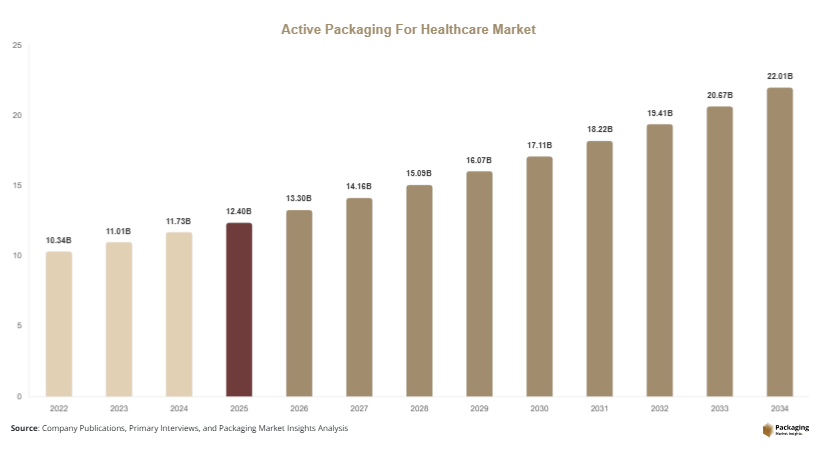
The global active packaging for healthcare market size was valued at approximately USD 12.4 billion in 2025 and is projected to reach USD 13.3 billion in 2026. Driven by advancements in pharmaceutical packaging and rising demand for temperature-sensitive and biologic drugs, the market is expected to grow at a CAGR of 6.5% from 2025 to 2034, reaching nearly USD 22.5 billion by 2034. The active packaging for healthcare market is gaining steady traction as the healthcare sector increasingly prioritizes product safety, extended shelf life, and contamination control.
Active packaging systems are designed to interact with the packaged product or its environment to maintain or improve quality. These include oxygen scavengers, moisture absorbers, antimicrobial agents, and temperature-regulating materials. One of the primary growth factors for the active packaging for healthcare market is the increasing demand for pharmaceutical products that require controlled environments, such as vaccines, biologics, and specialty drugs. These products are highly sensitive to environmental conditions, making active packaging essential.
Key Market Insights
- Asia Pacific dominated the market with a 35.8% share in 2025, while Latin America is projected to grow at the fastest CAGR of 6.9%.
- Oxygen scavengers led the type segment with a 28.7% share, while antimicrobial packaging is expected to grow at a CAGR of 6.8%.
- Plastic-based packaging dominated with a 51.9% share, while bio-based packaging is forecasted to grow at a CAGR of 6.6%.
- Pharmaceutical applications led the segment with 46.5% share, while medical devices are expected to grow at a CAGR of 6.7%.
- China remained the dominant country with a market size of USD 2.4 billion in 2025 and USD 2.6 billion in 2026.
Explore more data points, trends and opportunities Download Free Sample Report
Market Trends
Integration of Smart and Intelligent Packaging Technologies
The integration of smart and intelligent technologies is transforming the active packaging for healthcare market. Advanced packaging solutions now incorporate sensors, indicators, and tracking systems that monitor environmental conditions such as temperature, humidity, and oxygen levels. These technologies help ensure the quality and safety of healthcare products throughout the supply chain. Real-time monitoring allows manufacturers and distributors to detect any deviations and take corrective actions promptly.
In addition, smart packaging enhances traceability and transparency, which are critical in the pharmaceutical industry. Features such as QR codes and digital tracking systems enable better inventory management and reduce the risk of counterfeit products. As healthcare providers demand more reliable and efficient packaging solutions, the adoption of intelligent active packaging systems is expected to increase significantly.
Increasing Adoption of Sustainable and Bio-Based Materials
Sustainability is becoming an important consideration in the active packaging for healthcare market. Manufacturers are exploring the use of bio-based and recyclable materials to reduce environmental impact while maintaining functionality. The shift toward sustainable packaging is driven by regulatory requirements and growing awareness among stakeholders.
Bio-based materials offer similar performance characteristics to conventional plastics while reducing dependence on fossil fuels. Companies are also focusing on reducing material usage and improving recyclability. As sustainability becomes a priority, the adoption of eco-friendly active packaging solutions is expected to grow across the healthcare sector.
Market Drivers
Rising Demand for Temperature-Sensitive Pharmaceuticals
The increasing demand for temperature-sensitive pharmaceuticals is a major driver of the active packaging for healthcare market. Products such as vaccines, biologics, and specialty drugs require strict temperature control to maintain efficacy. Active packaging solutions, including temperature-regulating materials and phase change materials, help ensure product stability during storage and transportation.
The expansion of cold chain logistics is further supporting market growth. As pharmaceutical companies expand their global distribution networks, the need for reliable packaging solutions is increasing. Active packaging systems provide an effective way to maintain product quality and reduce the risk of spoilage, making them essential in the healthcare industry.
Growth in Pharmaceutical and Healthcare Industries
The growth of the pharmaceutical and healthcare industries is significantly contributing to the expansion of the active packaging for healthcare market. Increasing healthcare expenditure and the rising prevalence of chronic diseases are driving demand for pharmaceutical products. This, in turn, is increasing the need for advanced packaging solutions.
Additionally, the development of new drugs and therapies is creating demand for specialized packaging systems. Active packaging helps protect sensitive formulations and ensures compliance with regulatory standards. As the healthcare industry continues to grow, the demand for innovative packaging solutions is expected to increase.
Market Restraint
High Costs and Complex Implementation of Active Packaging Systems
The high cost associated with active packaging systems is a key restraint for the active packaging for healthcare market. These systems require advanced materials and technologies, which can increase production costs compared to traditional packaging solutions. The initial investment required for implementing active packaging technologies can be a barrier for smaller companies.
In addition, the complexity of these systems can pose challenges in manufacturing and integration. Ensuring compatibility between packaging components and pharmaceutical products requires careful design and testing. For example, the use of oxygen scavengers or antimicrobial agents must comply with regulatory standards, which can increase development time and costs. These factors may limit the adoption of active packaging solutions in certain markets.
Market Opportunities
Expansion of Cold Chain Logistics and Biologics Market
The expansion of cold chain logistics and the growing biologics market present significant opportunities for the active packaging for healthcare market. Biologic drugs are highly sensitive to environmental conditions and require specialized packaging solutions. Active packaging systems help maintain temperature stability and ensure product integrity during transportation.
As the demand for biologics continues to rise, the need for advanced packaging solutions is expected to increase. The development of efficient cold chain infrastructure is further supporting market growth. Companies are investing in innovative packaging technologies to meet the requirements of temperature-sensitive products.
Advancements in Material Science and Packaging Technologies
Advancements in material science are creating new opportunities in the active packaging for healthcare market. Researchers are developing innovative materials that offer improved barrier properties and functionality. These materials enhance the performance of active packaging systems and expand their applications.
In addition, the integration of smart technologies is enabling the development of multifunctional packaging solutions. These innovations provide added value by improving product safety and efficiency. As technology continues to evolve, the adoption of advanced packaging solutions is expected to increase.
Report Scope
| Report Metric | Details |
|---|---|
| Market Size in 2025 | USD 12.4 Billion |
| Market Size in 2026 | USD 13.3 Billion |
| Market Size in 2034 | USD 22.5 Billion |
| CAGR | 6.5% (2026-2034) |
| Base Year for Estimation | 2025 |
| Historical Data | 2022-2024 |
| Forecast Period | 2026-2034 |
| Report Coverage | Revenue Forecast, Competitive Landscape, Supply Chain Disruption, Growth Factors, Environment & Regulatory Landscape and Trends |
| Geographies Covered | North America, Europe, APAC, Middle East and Africa, LATAM |
| Countries Covered | U.S., Canada, U.K., Germany, France, Spain, Italy, Russia, Nordic, Benelux, Rest of Europe, China, South Korea, Japan, India, Australia, Singapore, Taiwan, South East Asia, Rest of Asia-Pacific, UAE, Turky, Saudi Arabia, South Africa, Egypt, Nigeria, Rest of MEA, Brazil, Mexico, Argentina, Chile, Colombia, Rest of LATAM |
Explore more data points, trends and opportunities Download Free Sample Report
Segmental Analysis
By Type
Oxygen scavengers dominated the market in 2024, accounting for approximately 28.7% of the total share. These packaging solutions are widely used to remove oxygen from packaging environments, preventing oxidation and maintaining product stability. They are particularly important for pharmaceuticals that are sensitive to oxygen exposure.
Antimicrobial packaging is expected to grow at the fastest CAGR of 6.8% during the forecast period. The increasing focus on infection control and product safety is driving demand for antimicrobial solutions. These packaging systems help inhibit the growth of microorganisms, ensuring product quality and safety.
By Material
Plastic-based packaging accounted for approximately 51.9% of the market share in 2024, driven by its versatility and cost-effectiveness. Plastics offer excellent barrier properties and are compatible with various active packaging technologies.
Bio-based materials are expected to grow at the fastest CAGR of 6.6%. The increasing emphasis on sustainability is driving the adoption of eco-friendly materials. These materials reduce environmental impact while maintaining performance.
By Application
Pharmaceutical applications held the largest share of 46.5% in 2024, supported by high demand for advanced packaging solutions. Active packaging plays a critical role in maintaining the quality and safety of pharmaceutical products.
Medical devices are expected to grow at a CAGR of 6.7%, driven by the need for sterile and contamination-free packaging solutions. The increasing demand for medical devices is supporting growth in this segment.
Active Packaging For Healthcare Market Segmentations
By Type
- Oxygen Scavengers
- Moisture Absorbers
- Antimicrobial Packaging
- Temperature-Control Packaging
By Material
- Plastic
- Paper & Paperboard
- Bio-Based Materials
By Application
- Pharmaceutical
- Medical Devices
- Diagnostics
Regional Analysis
North America
North America accounted for approximately 27.6% of the active packaging for healthcare market share in 2025 and is expected to grow at a CAGR of 6.2% during the forecast period. The region’s well-established pharmaceutical industry and advanced healthcare infrastructure are key factors driving market growth. Additionally, the increasing adoption of innovative packaging technologies is supporting market expansion.
The United States dominates the regional market due to its strong presence of pharmaceutical companies and research institutions. A unique growth factor is the high demand for biologic drugs, which require advanced packaging solutions.
Europe
Europe held a market share of around 24.3% in 2025 and is projected to grow at a CAGR of 6.4%. The region is characterized by strict regulatory standards and a strong focus on product safety. The adoption of active packaging solutions is increasing as companies seek to comply with these regulations.
Germany leads the European market, supported by its robust pharmaceutical manufacturing sector. A key growth factor is the increasing demand for temperature-sensitive drugs, which is driving the adoption of advanced packaging solutions.
Asia Pacific
Asia Pacific dominated the market with a share of 35.8% in 2025 and is expected to grow at the fastest CAGR of 6.9%. Rapid growth in pharmaceutical manufacturing and healthcare infrastructure is driving market demand in the region.
China is the leading country, supported by its large population and expanding healthcare sector. A unique growth factor is the increasing investment in healthcare infrastructure, which is boosting demand for advanced packaging solutions.
Middle East & Africa
The Middle East & Africa region accounted for approximately 6.8% of the market share in 2025 and is projected to grow at a CAGR of 6.3%. The increasing demand for healthcare services and pharmaceutical products is driving market growth.
Saudi Arabia is a major market in the region, supported by its growing healthcare sector. A unique growth factor is the rising investment in healthcare infrastructure and logistics.
Latin America
Latin America held a market share of around 5.5% in 2025 and is expected to grow at the fastest CAGR of 6.9%. The region is witnessing increasing demand for pharmaceutical products and improved healthcare services.
Brazil dominates the market, driven by its large population and expanding healthcare industry. A key growth factor is the increasing adoption of advanced packaging solutions to ensure product safety.
Competitive Landscape
The active packaging for healthcare market is moderately competitive, with several global players focusing on innovation and technological advancements. Amcor plc is a leading player, known for its advanced packaging solutions and strong market presence. The company has recently introduced new active packaging systems designed for pharmaceutical applications.
Other key players include Berry Global Inc., Sealed Air Corporation, 3M Company, and AptarGroup, Inc. These companies are investing in research and development to enhance product functionality and meet regulatory requirements. Strategic partnerships and product innovations are key strategies adopted by market participants.
Key Players List
- Amcor plc
- Berry Global Inc.
- Sealed Air Corporation
- 3M Company
- AptarGroup, Inc.
- Sonoco Products Company
- Huhtamaki Oyj
- WestRock Company
- Mondi Group
- Constantia Flexibles Group
- Clondalkin Group
- ProAmpac LLC
- Winpak Ltd.
- DS Smith Plc
- Coveris Holdings S.A.