Active And Intelligent Packaging Market Size and Growth
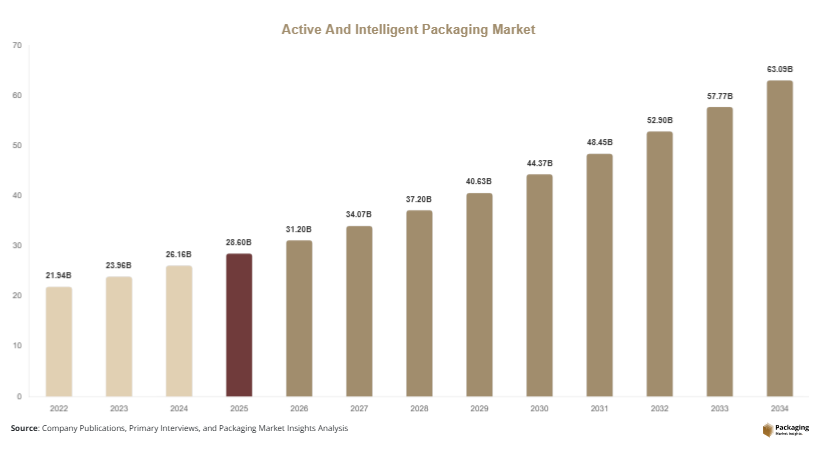
The global active and intelligent packaging market size was estimated at USD 28.6 billion in 2025 and is projected to reach USD 31.2 billion in 2026. With increasing adoption across food & beverages, pharmaceuticals, and logistics sectors, the market is forecast to grow to approximately USD 68.9 billion by 2034, registering a compound annual growth rate (CAGR) of 9.2% during the forecast period (2025–2034). This growth reflects a shift from conventional packaging toward advanced systems that actively interact with products and provide intelligent tracking capabilities. The active and intelligent packaging market is experiencing steady expansion driven by rising demand for product safety, extended shelf life, and real-time monitoring solutions across multiple industries.
One of the primary growth factors is the rising demand for food safety and quality assurance. Active packaging solutions such as oxygen scavengers and moisture absorbers help extend shelf life and maintain product integrity, especially in perishable goods. Secondly, the increasing penetration of IoT-enabled packaging technologies is transforming supply chain visibility. Intelligent packaging solutions, including RFID tags and QR codes, enable real-time tracking, authentication, and consumer engagement. Thirdly, stringent regulatory requirements across developed and emerging economies are encouraging manufacturers to adopt advanced packaging technologies that comply with safety and traceability standards.
Key Highlights:
- Market size reached USD 28.6 billion in 2025 and is projected to reach USD 68.9 billion by 2034, reflecting strong expansion driven by technological innovation and increasing demand across food, healthcare, and logistics industries.
- The market is expected to grow at a CAGR of 9.2% during the forecast period (2025–2034), supported by rising investments in advanced packaging systems and regulatory focus on product safety and traceability.
- Increasing adoption of IoT-enabled and smart packaging technologies is transforming supply chain operations by enabling real-time tracking, condition monitoring, and enhanced consumer engagement through connected packaging solutions.
- Rising demand for food safety and extended shelf-life solutions is accelerating the use of active packaging technologies such as oxygen scavengers and antimicrobial materials, helping reduce waste and maintain product quality.
Explore more data points, trends and opportunities Download Free Sample Report
Market Trends
Integration of Smart Sensors and IoT Technologies
The integration of smart sensors and Internet of Things (IoT) technologies into packaging systems is a major trend shaping the active and intelligent packaging market. These technologies enable real-time monitoring of temperature, humidity, and product freshness, providing valuable insights throughout the supply chain. Intelligent packaging equipped with sensors can alert stakeholders about deviations in storage conditions, reducing product waste and improving quality control. This trend is particularly prominent in pharmaceutical and perishable food industries, where maintaining optimal conditions is critical. Additionally, the use of cloud-based platforms to collect and analyze packaging data enhances decision-making and operational efficiency.
Growing Demand for Sustainable and Eco-Friendly Solutions
Sustainability is becoming a defining trend in the active and intelligent packaging market, as companies increasingly focus on reducing environmental impact. Manufacturers are developing biodegradable and recyclable active packaging materials that align with global sustainability goals. Intelligent packaging solutions are also being designed to minimize waste by providing accurate product usage information and expiration tracking. Consumers are showing preference for brands that adopt eco-friendly packaging, prompting companies to invest in green technologies. Furthermore, regulatory pressures aimed at reducing plastic waste are accelerating innovation in sustainable packaging formats, making this trend a key driver of long-term market evolution.
Market Drivers
Rising Demand for Food Safety and Shelf-Life Extension
The increasing focus on food safety and shelf-life extension is a significant driver of the active and intelligent packaging market. Consumers are becoming more conscious about the quality and freshness of food products, which has led to higher demand for packaging solutions that preserve product integrity. Active packaging technologies such as antimicrobial coatings, oxygen absorbers, and ethylene scavengers help extend the shelf life of perishable goods. This reduces food waste and enhances supply chain efficiency. Food manufacturers and retailers are increasingly adopting these solutions to maintain product quality during transportation and storage, especially in global distribution networks.
Growth of E-Commerce and Supply Chain Transparency
The rapid expansion of e-commerce has increased the need for advanced packaging solutions that ensure product safety and authenticity. Intelligent packaging technologies such as RFID tags, NFC chips, and QR codes provide real-time tracking and authentication capabilities. These features enhance supply chain transparency and help prevent counterfeiting and tampering. Logistics providers and retailers are leveraging intelligent packaging to monitor shipments and improve inventory management. The growing demand for seamless and reliable delivery experiences is encouraging companies to invest in packaging solutions that offer enhanced visibility and traceability.
Market Restraint
High Implementation Costs and Technological Complexity
Despite its advantages, the active and intelligent packaging market faces challenges related to high implementation costs and technological complexity. Advanced packaging systems require significant investment in materials, sensors, and integration technologies, which can be a barrier for small and medium-sized enterprises. Additionally, the complexity of integrating intelligent packaging solutions with existing supply chain systems can limit adoption. For instance, implementing RFID-based tracking systems requires infrastructure upgrades and technical expertise. These factors can increase operational costs and delay return on investment, particularly in cost-sensitive markets. As a result, companies may hesitate to adopt advanced packaging technologies despite their long-term benefits.
Market Opportunities
Expansion in Emerging Markets
Emerging markets present significant growth opportunities for the active and intelligent packaging market due to increasing industrialization and urbanization. Countries in Asia Pacific, Latin America, and Africa are witnessing rising demand for packaged food and pharmaceutical products. This is driving the adoption of advanced packaging solutions that enhance product safety and shelf life. Additionally, improving infrastructure and growing investments in supply chain modernization are creating favorable conditions for market expansion. Companies are focusing on these regions to tap into unmet demand and establish a strong presence.
Advancements in Digital Packaging Technologies
Technological advancements in digital packaging are creating new opportunities for market growth. Innovations such as printed electronics, smart labels, and blockchain integration are enhancing the functionality of intelligent packaging solutions. These technologies enable secure data sharing, product authentication, and enhanced consumer engagement. For example, blockchain-based packaging systems can provide end-to-end traceability, ensuring product authenticity and reducing fraud. As digital technologies continue to evolve, they are expected to drive the adoption of intelligent packaging across various industries.
Report Scope
| Report Metric | Details |
|---|---|
| Market Size in 2025 | USD 28.6 Billion |
| Market Size in 2026 | USD 31.2 Billion |
| Market Size in 2034 | USD 68.9 Billion |
| CAGR | 9.2% (2026-2034) |
| Base Year for Estimation | 2025 |
| Historical Data | 2022-2024 |
| Forecast Period | 2026-2034 |
| Report Coverage | Revenue Forecast, Competitive Landscape, Supply Chain Disruption, Growth Factors, Environment & Regulatory Landscape and Trends |
| Geographies Covered | North America, Europe, APAC, Middle East and Africa, LATAM |
| Countries Covered | U.S., Canada, U.K., Germany, France, Spain, Italy, Russia, Nordic, Benelux, Rest of Europe, China, South Korea, Japan, India, Australia, Singapore, Taiwan, South East Asia, Rest of Asia-Pacific, UAE, Turky, Saudi Arabia, South Africa, Egypt, Nigeria, Rest of MEA, Brazil, Mexico, Argentina, Chile, Colombia, Rest of LATAM |
Explore more data points, trends and opportunities Download Free Sample Report
Segmental Analysis
By Type
The active packaging segment dominated the active and intelligent packaging market in 2024, accounting for approximately 58% of the total market share. This dominance is attributed to the widespread use of oxygen scavengers, moisture absorbers, and antimicrobial packaging solutions in the food and beverage industry. These technologies help maintain product freshness and extend shelf life, making them essential for perishable goods. The increasing demand for convenience foods and ready-to-eat meals is further driving the adoption of active packaging solutions.
The intelligent packaging segment is expected to be the fastest-growing, with a projected CAGR of 10.8% during the forecast period. This growth is driven by the increasing adoption of smart technologies such as RFID, NFC, and QR codes. These solutions provide real-time tracking and authentication capabilities, enhancing supply chain transparency. The growing demand for product traceability and anti-counterfeiting measures is also contributing to the rapid expansion of this segment.
By Application
The food and beverages segment held the largest market share in 2024, accounting for approximately 45% of the total revenue. The dominance of this segment is driven by the need for packaging solutions that ensure food safety and extend shelf life. Active packaging technologies such as oxygen absorbers and antimicrobial coatings are widely used in this sector. The increasing demand for packaged and processed foods is further supporting market growth.
The pharmaceutical segment is expected to be the fastest-growing, with a CAGR of 10.2% during the forecast period. This growth is driven by the need for advanced packaging solutions that ensure product safety and compliance with regulatory standards. Intelligent packaging technologies are being used to monitor storage conditions and prevent counterfeit drugs. The increasing focus on patient safety and product authenticity is driving the adoption of these solutions.
By End-Use
The food industry dominated the market in 2024, accounting for approximately 40% of the total share. The demand for active packaging solutions in this sector is driven by the need to maintain product freshness and reduce food waste. The increasing consumption of packaged foods and the expansion of the retail sector are supporting market growth. Additionally, regulatory requirements related to food safety are encouraging the adoption of advanced packaging technologies.
The healthcare industry is expected to be the fastest-growing segment, with a CAGR of 10.6% during the forecast period. This growth is driven by the increasing demand for intelligent packaging solutions that ensure product safety and traceability. Technologies such as smart labels and RFID tags are being used to monitor drug storage conditions and prevent counterfeiting. The growing focus on patient safety and regulatory compliance is driving the adoption of these solutions.
Active And Intelligent Packaging Market Segmentations
By Type
- Active Packaging
- Intelligent Packaging
By Application
- Food & Beverages
- Pharmaceuticals
- Personal Care
- Others
By End-User
- Food Industry
- Healthcare Industry
- Retail
- Logistics
Regional Analysis
North America
North America accounted for a significant share of the active and intelligent packaging market in 2025, contributing approximately 32% of the global revenue. The region is expected to maintain steady growth with a CAGR of around 8.5% during the forecast period. The presence of advanced technological infrastructure and strong demand from food and pharmaceutical sectors are key factors supporting market growth. Additionally, regulatory frameworks focused on product safety and traceability are encouraging the adoption of intelligent packaging solutions.
The United States dominates the North American market due to its well-established packaging industry and high adoption of innovative technologies. A unique growth factor in the region is the increasing use of smart packaging in cold chain logistics. Companies are leveraging intelligent packaging to monitor temperature-sensitive products, ensuring quality and compliance with regulatory standards.
Europe
Europe held a market share of approximately 27% in 2025 and is projected to grow at a CAGR of 8.8% during the forecast period. The region's growth is driven by stringent regulations related to food safety and environmental sustainability. European countries are actively promoting the use of eco-friendly packaging materials, which is boosting the adoption of active packaging solutions.
Germany is the dominant country in the European market, supported by its strong manufacturing base and focus on innovation. A unique growth factor in Europe is the emphasis on circular economy practices. Companies are investing in recyclable and biodegradable packaging materials, aligning with sustainability goals and regulatory requirements.
Asia Pacific
Asia Pacific accounted for around 24% of the global market share in 2025 and is expected to register the highest CAGR of 10.5% during the forecast period. Rapid urbanization, growing population, and increasing demand for packaged goods are driving market growth in the region. The expansion of the e-commerce sector is also contributing to the adoption of intelligent packaging solutions.
China is the leading country in the Asia Pacific market due to its large manufacturing base and growing consumer demand. A unique growth factor in the region is the increasing adoption of smart packaging in the food delivery sector. Companies are using intelligent packaging to ensure product quality and enhance customer experience.
Middle East & Africa
The Middle East & Africa region held a market share of approximately 9% in 2025 and is expected to grow at a CAGR of 7.9% during the forecast period. The market is driven by increasing investments in infrastructure and the growing demand for packaged food and pharmaceuticals. Governments in the region are focusing on improving supply chain efficiency, which is supporting market growth.
The United Arab Emirates is a key market in the region, driven by its advanced logistics infrastructure. A unique growth factor is the increasing adoption of intelligent packaging in the retail sector. Retailers are using smart packaging solutions to enhance inventory management and reduce product losses.
Latin America
Latin America accounted for around 8% of the global market share in 2025 and is projected to grow at a CAGR of 8.2% during the forecast period. The region's growth is supported by the expanding food and beverage industry and increasing consumer demand for packaged products. Economic development and urbanization are also contributing to market expansion.
Brazil is the dominant country in the Latin American market due to its large consumer base. A unique growth factor is the growing adoption of active packaging solutions in the agricultural sector. Farmers and exporters are using these technologies to extend the shelf life of fresh produce and reduce spoilage during transportation.
Competitive Landscape
The active and intelligent packaging market is characterized by the presence of several global and regional players competing on the basis of innovation, product quality, and technological capabilities. Leading companies are focusing on research and development to introduce advanced packaging solutions that meet evolving consumer and regulatory requirements. Strategic partnerships, mergers, and acquisitions are common strategies adopted by market players to expand their market presence.
Amcor plc is considered a leading player in the market, known for its strong portfolio of sustainable packaging solutions. The company recently introduced advanced active packaging technologies designed to enhance food safety and extend shelf life. Other major players are also investing in smart packaging solutions, including RFID-enabled products and eco-friendly materials. The competitive landscape is expected to remain dynamic as companies continue to innovate and adapt to changing market trends.
Key Players List
- Amcor plc
- Sealed Air Corporation
- Berry Global Inc.
- Huhtamaki Oyj
- Avery Dennison Corporation
- 3M Company
- BASF SE
- Smurfit Kappa Group
- Mondi Group
- Crown Holdings Inc.
- Ball Corporation
- Sonoco Products Company
- WestRock Company
- Tetra Pak International
- DuPont de Nemours Inc.