Accessible Packaging Market Size and Growth
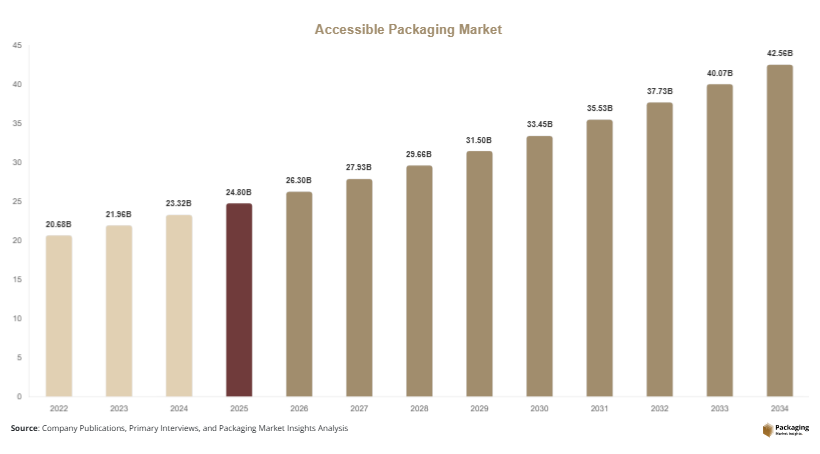
The global accessible packaging market size was valued at approximately USD 24.8 billion in 2025 and is projected to reach USD 26.3 billion in 2026. By 2034, the market is forecast to reach nearly USD 42.7 billion, expanding at a CAGR of 6.2% during 2025–2034. Rising aging populations, increasing focus on inclusive product design, and stricter accessibility regulations are among the primary factors driving market expansion.
The accessible packaging market is experiencing consistent growth as consumer goods manufacturers increasingly focus on inclusive packaging solutions that improve usability for elderly individuals, people with disabilities, and consumers with limited dexterity. Accessible packaging is designed to simplify product opening, handling, dispensing, and resealing while maintaining product safety and regulatory compliance. These packaging formats are widely used across food & beverage, pharmaceuticals, personal care, household products, and healthcare industries.
Key Highlights
- North America dominated the market with a 33.8% share in 2025.
- Asia Pacific is expected to grow at the fastest CAGR of 7.1%.
- Easy-open closures accounted for 41.6% market share in 2025.
- Pharmaceutical applications led the market with a 36.9% share due to increasing patient-centric packaging demand.
- Plastic-based accessible packaging materials dominated with a 52.4% market share.
- The US remained the leading country in North America with a market size of USD 6.7 billion in 2025 and USD 7.1 billion in 2026.
Explore more data points, trends and opportunities Download Free Sample Report
Market Trends
Rising Adoption of Senior-Friendly and Ergonomic Packaging Designs
One of the major trends shaping the accessible packaging market is the increasing adoption of senior-friendly packaging formats designed to improve usability for aging populations. Manufacturers are developing ergonomic packaging solutions featuring easy-grip caps, peelable seals, lightweight containers, and simplified dispensing mechanisms. Food and pharmaceutical companies are particularly investing in packaging designs that reduce hand-strength requirements and improve readability through larger fonts and tactile indicators. For example, several healthcare packaging manufacturers have introduced arthritis-friendly medicine bottle caps with enhanced grip textures and low-force opening mechanisms. This trend is expected to continue as aging demographics expand globally and consumer brands prioritize inclusive packaging experiences.
Integration of Smart Accessibility Features in Packaging
Another important trend is the integration of smart accessibility technologies into packaging formats. Companies are increasingly incorporating QR codes, NFC tags, audio instructions, and digital labeling systems to support visually impaired and cognitively challenged consumers. Smart packaging features allow users to access product information, dosage instructions, and usage guidance through mobile applications and voice-enabled systems. For instance, pharmaceutical packaging firms are deploying scannable medicine labels that provide audio instructions for patients with visual impairments. Future developments in connected packaging technologies and AI-assisted accessibility systems are expected to strengthen adoption across healthcare and consumer goods industries.
Market Drivers
Growing Aging Population and Healthcare Needs
The rapidly increasing aging population worldwide is a major factor driving the accessible packaging market. Elderly consumers often experience reduced hand strength, limited mobility, and vision impairments, making conventional packaging difficult to use. Accessible packaging solutions improve usability and help maintain consumer independence while reducing product frustration. Pharmaceutical companies are increasingly adopting easy-open blister packs, ergonomic closures, and simplified medication containers to support elderly patients. For example, healthcare manufacturers in Japan and Europe are introducing senior-friendly prescription packaging systems with larger labels and simplified opening mechanisms. The expanding elderly demographic is expected to continue driving long-term demand for accessible packaging solutions.
Increasing Focus on Inclusive Consumer Product Design
The growing emphasis on inclusive product design and user-centric packaging experiences is another important growth driver. Consumer goods companies are recognizing that accessible packaging improves customer satisfaction and brand loyalty across broader demographics. Retailers and manufacturers are redesigning packaging to reduce opening complexity and improve convenience for all consumers, not only individuals with disabilities. For example, beverage companies are introducing easy-twist bottle caps and lightweight containers to enhance consumer usability. Increasing awareness regarding accessibility standards and universal design principles is encouraging manufacturers to integrate inclusive features into mainstream packaging products.
Market Restraint
Balancing Accessibility with Child-Resistant and Safety Requirements
One of the major restraints affecting the accessible packaging market is the challenge of balancing accessibility with safety and child-resistant requirements. Packaging manufacturers must design products that are easy for elderly and disabled consumers to open while still preventing accidental access by children. This issue is particularly significant in pharmaceutical, household chemical, and cannabis packaging applications where regulatory standards require child-resistant packaging systems.
For example, pharmaceutical companies often face difficulties developing medicine packaging that can be easily opened by arthritis patients while remaining compliant with strict child safety regulations. Adding advanced safety mechanisms can increase packaging complexity and manufacturing costs. In some cases, overly secure packaging designs may negatively impact accessibility and consumer satisfaction.
Manufacturers also face technical challenges in maintaining packaging durability and product protection while integrating ergonomic and easy-open features. Redesigning packaging lines to accommodate accessible closures and resealable systems can require significant investment in tooling and production modifications. Furthermore, regional differences in accessibility and safety regulations can complicate product standardization for multinational packaging companies. These factors may limit rapid adoption, especially among cost-sensitive manufacturers operating in highly regulated industries.
Market Opportunities
Expansion of Accessible Pharmaceutical Packaging
The pharmaceutical sector presents substantial growth opportunities for accessible packaging manufacturers. Rising demand for patient-centric healthcare solutions is encouraging pharmaceutical companies to adopt packaging formats that improve medication adherence and ease of use. Easy-open blister packs, tactile labeling systems, and single-dose packaging solutions are gaining popularity across prescription and over-the-counter medicine categories. For example, healthcare providers are increasingly using accessible medication packaging to support elderly patients managing chronic illnesses. Future opportunities are expected to emerge from smart medicine packaging systems integrated with digital reminders and audio guidance technologies.
Growth in E-Commerce and Direct-to-Consumer Packaging
The rapid expansion of e-commerce and direct-to-consumer retail channels is creating additional opportunities for accessible packaging solutions. Consumers increasingly expect packaging that is easy to open, reseal, and handle during home delivery experiences. Packaging manufacturers are developing frustration-free shipping solutions with simplified tear mechanisms, lightweight structures, and reusable closures. For instance, household and personal care brands are introducing easy-open refill packaging for online retail channels. As online shopping continues to expand globally, demand for user-friendly and convenient packaging formats is expected to increase significantly.
Report Scope
| Report Metric | Details |
|---|---|
| Market Size in 2025 | USD 24.8 Billion |
| Market Size in 2026 | USD 26.3 Billion |
| Market Size in 2034 | USD 42.7 Billion |
| CAGR | 6.2% (2026-2034) |
| Base Year for Estimation | 2025 |
| Historical Data | 2022-2024 |
| Forecast Period | 2026-2034 |
| Report Coverage | Revenue Forecast, Competitive Landscape, Supply Chain Disruption, Growth Factors, Environment & Regulatory Landscape and Trends |
| Geographies Covered | North America, Europe, APAC, Middle East and Africa, LATAM |
| Countries Covered | U.S., Canada, U.K., Germany, France, Spain, Italy, Russia, Nordic, Benelux, Rest of Europe, China, South Korea, Japan, India, Australia, Singapore, Taiwan, South East Asia, Rest of Asia-Pacific, UAE, Turky, Saudi Arabia, South Africa, Egypt, Nigeria, Rest of MEA, Brazil, Mexico, Argentina, Chile, Colombia, Rest of LATAM |
Explore more data points, trends and opportunities Download Free Sample Report
Segmental Analysis
By Packaging Type
Easy-open closures dominated the accessible packaging market with a 41.6% share in 2024, primarily due to widespread use across food, beverage, pharmaceutical, and household product packaging. These packaging systems reduce the force required to open containers while improving convenience for elderly and physically challenged consumers. Manufacturers are increasingly integrating ergonomic grip textures, low-torque caps, and peelable seals into product packaging to improve usability. For example, beverage manufacturers are deploying easy-twist bottle closures that simplify opening without compromising product freshness. Pharmaceutical packaging companies are also adopting easy-open medicine containers to improve patient accessibility and medication adherence. Rising demand for frustration-free consumer experiences continues to strengthen segment dominance globally.
Resealable accessible packaging formats are projected to be the fastest-growing segment, registering a CAGR of 6.9% during the forecast period. Growth is driven by increasing demand for reusable and convenience-oriented packaging solutions in food and healthcare industries. Consumers increasingly prefer packaging that can be easily reopened and securely resealed using one hand or limited physical effort. Packaging manufacturers are developing innovative zipper systems, magnetic closures, and tactile resealable mechanisms for snacks, personal care products, and medicines. Future developments in lightweight materials and smart resealing technologies are expected to improve functionality and sustainability across accessible packaging applications.
By Material
Plastic-based accessible packaging materials accounted for approximately 52.4% market share in 2024, supported by their durability, lightweight properties, and flexibility in ergonomic packaging designs. Plastic materials are widely used in easy-open bottles, squeeze containers, resealable pouches, and pharmaceutical closures due to their ability to support customized accessibility features. For example, healthcare packaging manufacturers use molded plastic designs to create low-force medicine caps and grip-enhanced dispensing systems. Plastic materials also provide cost efficiency and compatibility with high-volume manufacturing processes, making them a preferred choice across consumer goods industries. Ongoing innovation in recyclable and bio-based plastics is expected to maintain segment growth.
Paper-based accessible packaging is expected to grow at the fastest CAGR of 7.2% during 2025–2034. Rising sustainability concerns and increasing demand for environmentally friendly packaging formats are supporting segment expansion. Packaging companies are introducing paperboard cartons with tear-friendly openings, tactile indicators, and lightweight ergonomic structures. Retail and e-commerce brands are also adopting frustration-free paper packaging systems to improve consumer convenience while reducing plastic waste. Advances in coated paper technologies and structural packaging engineering are enabling paper-based materials to support durable and accessible packaging applications across multiple industries.
By End-Use
The pharmaceutical segment dominated the accessible packaging market with a 36.9% share in 2024, driven by increasing demand for patient-centric medicine packaging solutions. Pharmaceutical companies are investing heavily in easy-open blister packs, tactile labeling systems, and ergonomic medicine containers to improve medication adherence and patient safety. Accessible packaging plays a critical role in helping elderly patients and individuals with disabilities manage prescription medications independently. For example, healthcare providers are increasingly using senior-friendly medicine packaging with larger text and simplified dispensing systems. Regulatory emphasis on patient safety and medication accessibility continues to strengthen segment growth across global healthcare markets.
Food & beverage applications are expected to register the fastest CAGR of 6.8% during the forecast period. Growth is supported by rising consumer demand for convenient and frustration-free packaging experiences. Food manufacturers are introducing lightweight containers, easy-peel lids, and resealable snack packaging designed for broader consumer accessibility. Beverage companies are also developing ergonomic bottle designs with improved grip structures and simplified opening systems. Expansion of e-commerce grocery delivery services and changing consumer lifestyles are expected to accelerate demand for accessible food packaging solutions globally.
Accessible Packaging Market Segmentations
By Packaging Type
- Easy-Open Closures
- Resealable Packaging
- Tactile Packaging
- Single-Hand Dispensing Systems
By Material
- Plastic Packaging
- Paper & Paperboard Packaging
- Glass Packaging
- Metal Packaging
By End-User
- Pharmaceuticals
- Food & Beverage
- Personal Care & Cosmetics
- Household Products
- Healthcare Products
By Distribution Channel
- Direct Sales
- Retail Packaging Suppliers
- E-commerce Packaging Providers
- Healthcare Packaging Distributors
- Industrial Packaging Integrators
Regional Analysis
North America
North America accounted for approximately 33.8% market share in 2025 and is projected to grow at a CAGR of 5.9% during 2025–2034. The region benefits from advanced healthcare infrastructure, strong consumer awareness regarding accessibility standards, and widespread adoption of inclusive product design practices. Pharmaceutical and food packaging companies are increasingly investing in ergonomic packaging systems to improve consumer usability. Rising demand for senior-friendly packaging formats is further supporting regional market growth.
The United States dominates the regional market due to its large healthcare industry and strong regulatory focus on accessible consumer products. A unique growth factor is the increasing adoption of frustration-free packaging standards in e-commerce fulfillment operations. Major retail and logistics companies are encouraging suppliers to implement user-friendly packaging designs that improve customer satisfaction and reduce packaging waste.
Europe
Europe held approximately 28.6% market share in 2025 and is expected to expand at a CAGR of 6.1% during the forecast period. The region’s growth is supported by aging populations and increasing implementation of inclusive packaging regulations. Pharmaceutical manufacturers and consumer goods companies are investing in ergonomic packaging technologies to improve accessibility and product usability across multiple demographic groups.
Germany dominates the European market due to its advanced packaging manufacturing industry and strong healthcare infrastructure. A unique growth factor is the increasing integration of tactile labeling and Braille packaging systems in pharmaceutical products. Healthcare packaging providers are collaborating with regulatory agencies to improve accessibility standards and patient safety across medicine packaging applications.
Asia Pacific
Asia Pacific represented nearly 25.7% market share in 2025 and is projected to register the fastest CAGR of 7.1% during the forecast period. Rapid urbanization, expanding healthcare industries, and rising elderly populations in countries such as Japan, China, and South Korea are supporting market growth. Increasing awareness regarding consumer convenience and accessibility is also driving packaging innovation across retail industries.
Japan dominates the regional market because of its aging population and advanced packaging innovation ecosystem. A unique growth factor is the strong demand for compact and easy-to-handle packaging formats designed for elderly consumers living independently. Japanese manufacturers are introducing lightweight packaging structures with ergonomic dispensing systems across food and healthcare sectors.
Middle East & Africa
The Middle East & Africa accounted for around 5.1% market share in 2025 and is expected to grow at a CAGR of 5.4% during the forecast period. Growing healthcare investments and increasing awareness regarding consumer-friendly packaging are contributing to regional market expansion. Pharmaceutical and food industries are gradually adopting accessible packaging solutions to improve usability and regulatory compliance.
The United Arab Emirates dominates the regional market due to expanding healthcare infrastructure and increasing retail modernization. A unique growth factor is the growing demand for multilingual and visually accessible packaging systems in healthcare and personal care products. Packaging companies are integrating clearer labeling formats and ergonomic dispensing mechanisms to support diverse consumer groups.
Latin America
Latin America represented approximately 6.8% market share in 2025 and is projected to expand at a CAGR of 6.5% during the forecast period. Increasing healthcare spending and rising demand for convenient consumer packaging are supporting market growth across the region. Brazil and Mexico are key contributors due to expanding pharmaceutical and packaged food industries.
Brazil dominates the regional market because of its growing pharmaceutical manufacturing sector and increasing retail packaging demand. A unique growth factor is the rising adoption of easy-open flexible packaging formats in household and food products. Consumer brands are introducing resealable and lightweight packaging solutions to improve usability and convenience in urban retail markets.
Competitive Landscape
The accessible packaging market is moderately competitive, with packaging manufacturers focusing on ergonomic design innovation, sustainability, and regulatory compliance. Key companies operating in the market include Amcor plc, Berry Global Inc., Sonoco Products Company, AptarGroup Inc., and WestRock Company. Among these, AptarGroup Inc. is recognized as a leading player due to its strong portfolio of user-friendly dispensing systems and accessible pharmaceutical packaging technologies.
Companies are investing in ergonomic closures, tactile labeling systems, and sustainable accessible packaging materials to strengthen market presence. Strategic collaborations with healthcare providers and consumer goods companies are supporting innovation in patient-centric and senior-friendly packaging solutions. Recent developments include the launch of recyclable easy-open closures and digitally connected packaging systems designed to improve accessibility for visually impaired consumers.
Key Players List
- AptarGroup Inc.
- Amcor plc
- Berry Global Inc.
- Sonoco Products Company
- WestRock Company
- Gerresheimer AG
- Mondi Group
- Huhtamaki Oyj
- Sealed Air Corporation
- Constantia Flexibles
- DS Smith plc
- Crown Holdings Inc.
- Silgan Holdings Inc.
- ProAmpac LLC
- Graphic Packaging International LLC