Market Overview
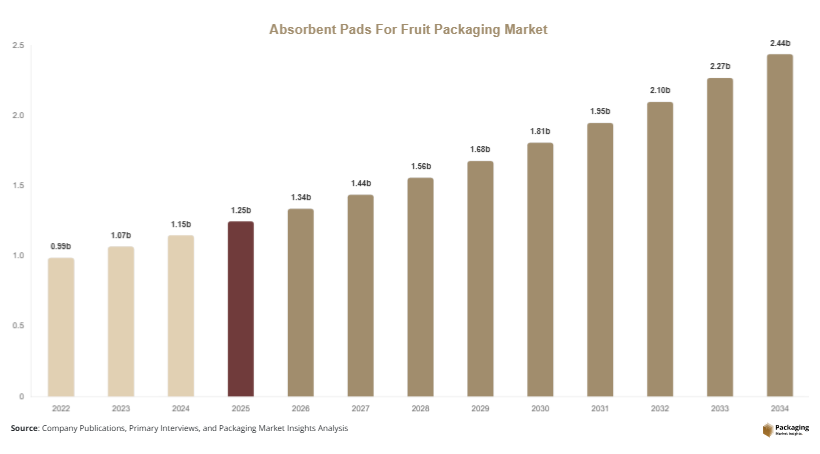
The Absorbent Pads For Fruit Packaging Market is experiencing steady expansion due to increasing global demand for fresh produce safety, extended shelf life solutions, and sustainable packaging innovations. In 2025, the global market size is estimated at USD 1.25 billion, and it is projected to reach USD 1.34 billion in 2026. By 2034, the market is expected to attain a value of approximately USD 2.45 billion, growing at a CAGR of 7.8% during the forecast period (2025–2034).
The growth of this market is strongly influenced by rising consumption of packaged fruits, expansion of modern retail and e-commerce grocery platforms, and increasing awareness regarding food waste reduction. Additionally, advancements in absorbent pad materials such as superabsorbent polymers (SAP), cellulose blends, and biodegradable fibers are further accelerating adoption across global supply chains. Regulatory pressure on food safety and hygiene standards is also driving manufacturers and distributors to adopt efficient moisture control solutions in fruit packaging.
Key Highlights:
- North America dominated the Absorbent Pads For Fruit Packaging Market with a share of 36.5% in 2025.
- Asia Pacific is expected to be the fastest-growing region during the forecast period, registering a CAGR of 9.2%.
- Based on material type, superabsorbent polymer (SAP)-based pads held the dominant share of 42.1% in 2025.
- Based on application, berries and soft fruits segment led the market with a share of 38.4% in 2025.
- Based on end-use, retail and supermarket packaging segment accounted for 46.7% share in 2025.
- The U.S. Absorbent Pads For Fruit Packaging Market size was valued at USD 410 million in 2025 and is projected to reach USD 438 million in 2026.
Explore more data points, trends and opportunities Download Free Sample Report
Market Trends
Shift Toward Biodegradable and Compostable Absorbent Pads
The market is witnessing a significant shift toward biodegradable and compostable absorbent pad materials driven by increasing environmental regulations and consumer preference for eco-friendly packaging. Manufacturers are investing in plant-based fibers, polylactic acid (PLA), and starch-based composites to replace conventional plastic-based absorbent materials. This transition is particularly strong in Europe and North America, where regulatory frameworks restrict single-use plastics in food packaging. Retailers are also prioritizing sustainable sourcing, encouraging suppliers to adopt greener solutions. As a result, innovation in material engineering is accelerating, leading to improved absorbency, durability, and cost efficiency in eco-friendly pads.
Integration of Advanced Moisture-Control Technologies
Another major trend shaping the Absorbent Pads For Fruit Packaging Market is the integration of advanced moisture-control technologies such as multilayer absorption systems, antimicrobial coatings, and smart humidity indicators. These innovations help extend shelf life while reducing spoilage during transportation and storage. Companies are developing hybrid pads that combine SAP with natural fibers to achieve higher efficiency. Additionally, smart packaging solutions that visually indicate moisture saturation levels are gaining attention in high-value fruit segments like berries, grapes, and exotic fruits. This technological advancement is improving supply chain efficiency and reducing post-harvest losses globally.
Market Drivers
Rising Global Demand for Fresh Fruits and Packaged Produce
One of the primary drivers of the Absorbent Pads For Fruit Packaging Market is the growing global demand for fresh fruits, particularly in urban populations. Consumers are increasingly shifting toward healthy eating habits, leading to higher consumption of packaged and ready-to-eat fruit products. This trend is further supported by the expansion of supermarkets, hypermarkets, and online grocery delivery platforms. Absorbent pads play a crucial role in maintaining freshness, reducing moisture accumulation, and improving visual appeal, which is essential for retail sales. Additionally, global fruit trade expansion requires efficient packaging solutions to maintain quality during long-distance transportation.
Increasing Focus on Food Waste Reduction
Food waste reduction initiatives are significantly driving the adoption of absorbent pads in fruit packaging. A large percentage of fruits are lost due to spoilage caused by excess moisture and microbial growth during storage and distribution. Absorbent pads help mitigate this issue by controlling condensation and maintaining optimal humidity levels. Governments and food organizations are promoting technologies that extend shelf life and reduce waste across the supply chain. Retailers are also adopting these solutions to minimize economic losses and improve sustainability performance. This increasing focus on reducing post-harvest losses is strengthening market demand globally.
Market Restraint
High Cost of Advanced Absorbent Materials and Recycling Challenges
A key restraint affecting the Absorbent Pads For Fruit Packaging Market is the relatively high cost of advanced absorbent materials, particularly those incorporating biodegradable polymers and antimicrobial coatings. Small and medium-sized packaging companies often find it difficult to adopt these premium solutions due to cost constraints. Additionally, recycling challenges associated with multi-layer absorbent pads pose environmental and operational issues. Many pads contain mixed materials that are difficult to separate during recycling processes, limiting their circular economy potential. In regions with underdeveloped waste management infrastructure, disposal inefficiencies further restrict adoption. For example, in emerging markets, cost-sensitive fruit exporters continue to rely on conventional packaging materials, slowing down the transition toward advanced absorbent technologies.
Market Opportunities
Expansion in Emerging Markets and Export-Oriented Agriculture
Emerging economies present significant growth opportunities for the Absorbent Pads For Fruit Packaging Market due to expanding agricultural exports and improving cold chain infrastructure. Countries in Asia Pacific, Latin America, and parts of Africa are increasingly investing in fruit export capabilities, requiring advanced packaging solutions to maintain quality during long transit times. Absorbent pads are becoming essential for exporters dealing with berries, citrus fruits, and tropical produce. Government initiatives supporting agro-processing and food export industries are further boosting adoption. As logistics networks improve, demand for efficient moisture-control packaging is expected to rise significantly across these regions.
Innovation in Smart and Active Packaging Solutions
The development of smart and active packaging technologies presents another strong opportunity in this market. Companies are exploring absorbent pads integrated with sensors, antimicrobial agents, and freshness indicators to provide real-time monitoring of fruit quality. These innovations help retailers and distributors reduce spoilage while enhancing consumer confidence. Active packaging solutions that release controlled agents to inhibit microbial growth are also gaining traction. As digital supply chain systems evolve, integration of smart absorbent pads with IoT-enabled tracking systems is expected to create new value-added applications in high-end fruit packaging segments.
Report Scope
| Report Metric | Details |
|---|---|
| Market Size in 2025 | USD 1.25 billion |
| Market Size in 2026 | USD 1.34 billion |
| Market Size in 2034 | USD 2.45 billion |
| CAGR | 7.8% (2026-2034) |
| Base Year for Estimation | 2025 |
| Historical Data | 2022-2024 |
| Forecast Period | 2026-2034 |
| Report Coverage | Revenue Forecast, Competitive Landscape, Supply Chain Disruption, Growth Factors, Environment & Regulatory Landscape and Trends |
| Geographies Covered | North America, Europe, APAC, Middle East and Africa, LATAM |
| Countries Covered | U.S., Canada, U.K., Germany, France, Spain, Italy, Russia, Nordic, Benelux, Rest of Europe, China, South Korea, Japan, India, Australia, Singapore, Taiwan, South East Asia, Rest of Asia-Pacific, UAE, Turky, Saudi Arabia, South Africa, Egypt, Nigeria, Rest of MEA, Brazil, Mexico, Argentina, Chile, Colombia, Rest of LATAM |
Explore more data points, trends and opportunities Download Free Sample Report
Segmental Analysis
Material Type Segment
Superabsorbent polymer (SAP)-based pads dominated the market with a 2024 share of 42.1%, driven by their high moisture absorption capacity and durability. These materials are widely used in premium fruit packaging due to their effectiveness in reducing spoilage during transportation and storage. Their compatibility with high-speed packaging lines also supports large-scale adoption.
Biodegradable fiber-based pads are expected to be the fastest-growing subsegment with a CAGR of 8.9%, driven by environmental regulations and sustainability initiatives. These materials are increasingly adopted in Europe and North America, where retailers prioritize eco-friendly packaging solutions.
Application Segment
The berries and soft fruits segment held the dominant share of 38.4% in 2024, as these fruits are highly sensitive to moisture and require specialized packaging. Absorbent pads are essential in maintaining freshness and preventing microbial growth in this category.
Stone fruits and citrus fruits represent the fastest-growing application segment with a CAGR of 8.3%, driven by increasing global trade and export activities. These fruits require longer transit times, increasing demand for moisture-control solutions.
End-Use Segment
Retail and supermarket packaging dominated the market with a 46.7% share in 2024, supported by strong consumer demand for packaged fresh produce. Absorbent pads are widely used in retail trays to enhance visual appeal and shelf life.
Food processing and export packaging is the fastest-growing segment with a CAGR of 8.6%, driven by increasing international trade and demand for extended freshness during shipping.
Absorbent Pads For Fruit Packaging Market Segmentations
Material Type
- Cellulose-Based Pads
- Superabsorbent Polymer-Based Pads
- Non-Woven Fabric Pads
- Others
Application
- Fresh Fruit Packaging
- Cut and Processed Fruit Packaging
- Export and Bulk Fruit Packaging
Absorption Capacity
- Low Absorption Pads
- Medium Absorption Pads
- High Absorption Pads
Distribution Channel
- Direct Sales
- Distributors and Wholesalers
- Online Retail
Region
- North America
- Europe
- Asia Pacific
- Middle East & Africa
- Latin America
Regional Analysis
North America
North America accounted for approximately 36.5% share of the global market in 2025, with a projected CAGR of 7.2% through 2034. The region benefits from advanced retail infrastructure, high consumption of fresh produce, and strong adoption of sustainable packaging technologies. Increasing demand for ready-to-eat fruit products is also supporting market expansion.
The United States dominates the regional market due to its large supermarket chains and advanced supply chain systems. A key growth factor is the strong regulatory emphasis on food safety and packaging hygiene standards, which encourages widespread adoption of absorbent pad solutions.
Europe
Europe held around 28.1% market share in 2025, with a projected CAGR of 7.6%. Strict environmental regulations and strong sustainability goals are driving adoption of biodegradable absorbent pads. The region also has a well-established fresh fruit import market.
Germany leads the European market, supported by advanced packaging manufacturing capabilities and strong retail demand. A major growth factor is the European Union’s plastic reduction policies, encouraging eco-friendly packaging innovation.
Asia Pacific
Asia Pacific accounted for 22.4% share in 2025 and is expected to grow at the highest CAGR of 9.2%. Rapid urbanization, rising disposable income, and expansion of organized retail are fueling demand for packaged fruits.
China dominates the region due to its large-scale fruit production and export activities. A key growth driver is the expansion of cold chain logistics infrastructure supporting long-distance fruit distribution.
Middle East & Africa
The Middle East & Africa region held 7.3% share in 2025, with a CAGR of 6.9%. Growth is supported by increasing import of fresh fruits and expansion of retail supermarket chains.
Saudi Arabia leads the region due to rising demand for imported fresh produce. A major factor driving growth is increasing investment in food supply chain modernization.
Latin America
Latin America accounted for 5.7% share in 2025, with a CAGR of 7.4%. The region benefits from strong fruit export activities, particularly in Brazil and Chile.
Brazil dominates the market due to its large agricultural base. A key growth factor is increasing export-oriented fruit production requiring advanced packaging solutions.
Competitive Landscape
The Absorbent Pads For Fruit Packaging Market is moderately consolidated, with leading players focusing on product innovation, sustainable material development, and strategic partnerships with food packaging companies. Key companies include Sealed Air Corporation, Duni Group, Novipax, Dexter-Russell Packaging, and Cellcomb AB. Among these, Sealed Air Corporation holds a leading position due to its strong global distribution network and advanced packaging technologies.
Recent developments include increased investment in biodegradable absorbent pad production and expansion of manufacturing facilities in Asia Pacific. Companies are also focusing on antimicrobial pad innovations to enhance shelf life and reduce food waste across supply chains.
Key Players List
- Sealed Air Corporation
- Duni Group
- Novipax
- Cellcomb AB
- Dexter-Russell Packaging
- Berry Global Inc.
- Mondi Group
- Amcor Plc
- Cascades Inc.
- Sirane Group
- McAirlaid’s Vliesstoffe GmbH
- Technipaq Inc.
- Suominen Corporation
- Kraton Corporation
- Polymer Logistics