3D Semiconductor Packaging Market Size and Growth
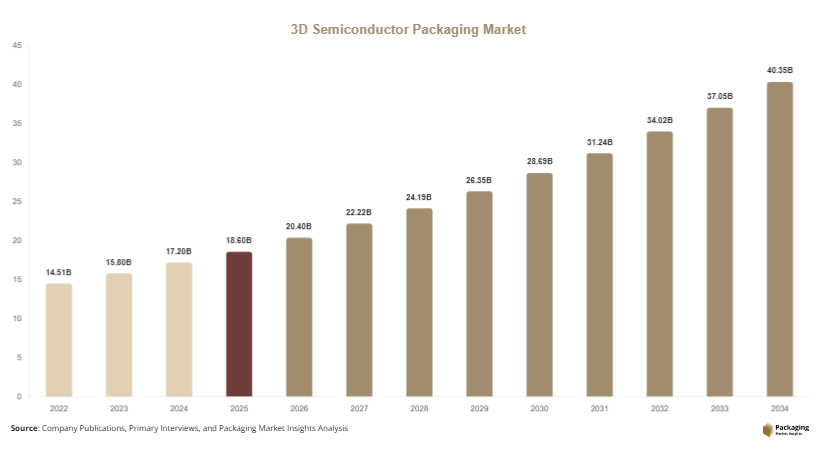
The global 3D semiconductor packaging market size was valued at USD 18.6 billion in 2025 and is projected to reach USD 20.4 billion in 2026. Over the forecast period from 2025 to 2034, the market is expected to grow at a CAGR of 8.9%, reaching approximately USD 44.7 billion by 2034. This growth reflects the increasing demand for high-performance computing, artificial intelligence, and advanced consumer electronics. The 3D semiconductor packaging market is witnessing sustained expansion as semiconductor manufacturers adopt advanced packaging technologies to meet performance, size, and power efficiency requirements.
One of the major growth factors driving the 3D semiconductor packaging market is the rising need for miniaturization and enhanced performance in electronic devices. Traditional 2D packaging is reaching its limits, prompting the adoption of 3D packaging solutions that allow stacking of multiple dies to improve functionality and reduce footprint. Another key factor is the rapid growth of data centers and cloud computing infrastructure, which require advanced semiconductor solutions to handle large volumes of data efficiently. The increasing deployment of 5G technology and IoT devices is also contributing to market growth, as these applications demand high-speed and energy-efficient semiconductor components.
Key Highlights
- Asia Pacific dominated the market with a 41.6% share in 2025, while Latin America is projected to grow at the fastest CAGR of 9.5%.
- TSV-based packaging led the type segment with a 34.2% share, while fan-out wafer-level packaging is expected to grow at a CAGR of 9.1%.
- Silicon interposers dominated with a 48.7% share, while organic substrates are forecasted to grow at a CAGR of 8.7%.
- Consumer electronics applications led the segment with 45.3% share, while automotive electronics are expected to grow at a CAGR of 9.3%.
- China remained the dominant country with a market size of USD 6.1 billion in 2025 and USD 6.8 billion in 2026.
Explore more data points, trends and opportunities Download Free Sample Report
Market Trends
Increasing adoption of heterogeneous integration technologies
The 3D semiconductor packaging market is being shaped by the growing adoption of heterogeneous integration technologies. These approaches allow different types of semiconductor components, such as logic, memory, and sensors, to be integrated into a single package. This enhances performance and reduces power consumption while enabling more compact device designs. Manufacturers are investing in advanced packaging methods to support these integrations, which are critical for applications such as artificial intelligence and high-performance computing. The trend is also supported by the need to overcome limitations of traditional scaling, making 3D packaging a practical solution for next-generation semiconductor designs.
Rising demand for advanced packaging in AI and high-performance computing
The increasing demand for artificial intelligence and high-performance computing is driving the adoption of 3D semiconductor packaging. These applications require high data processing capabilities and efficient thermal management, which can be achieved through advanced packaging technologies. 3D packaging enables faster data transfer and improved energy efficiency, making it suitable for AI processors and data center applications. As AI adoption continues to grow across industries, the demand for advanced semiconductor packaging solutions is expected to increase, supporting market growth.
Market Drivers
Growing demand for miniaturized and high-performance electronic devices
The demand for smaller and more powerful electronic devices is a major factor driving the 3D semiconductor packaging market. Consumers and industries are seeking compact devices with enhanced functionality, which requires advanced semiconductor packaging solutions. 3D packaging allows multiple chips to be stacked vertically, reducing space while improving performance. This is particularly important in applications such as smartphones, wearable devices, and portable electronics. As demand for these devices continues to grow, the adoption of 3D semiconductor packaging is expected to increase.
Expansion of data centers and cloud computing infrastructure
The rapid expansion of data centers and cloud computing infrastructure is another key driver of the market. These facilities require high-performance semiconductor components to process and store large volumes of data. 3D semiconductor packaging provides improved performance and energy efficiency, making it suitable for data center applications. The increasing use of cloud-based services and big data analytics is driving demand for advanced semiconductor solutions, supporting market growth.
Market Restraint
High manufacturing complexity and cost of advanced packaging technologies
One of the primary challenges in the 3D semiconductor packaging market is the high manufacturing complexity and cost associated with advanced packaging technologies. The production of 3D packaged semiconductors involves sophisticated processes such as wafer bonding, TSV formation, and precise alignment of multiple dies. These processes require significant investment in equipment and expertise, which can increase production costs. For example, small and medium-sized semiconductor companies may find it difficult to adopt these technologies due to financial constraints. Additionally, the complexity of the manufacturing process can lead to lower yields and higher defect rates, further impacting costs. These factors can limit the adoption of 3D semiconductor packaging, particularly in cost-sensitive markets.
Market Opportunities
Development of advanced materials and innovative packaging solutions
The development of advanced materials and innovative packaging solutions presents significant opportunities for the 3D semiconductor packaging market. Manufacturers are focusing on improving thermal management, electrical performance, and reliability through the use of new materials such as advanced substrates and interposers. These innovations are enabling the production of more efficient and durable semiconductor packages. As research and development efforts continue, new materials and packaging techniques are expected to drive market growth and expand application areas.
Increasing adoption in automotive and industrial electronics
The automotive and industrial electronics sectors are emerging as important growth areas for the market. The increasing use of electronic components in vehicles, particularly in electric and autonomous vehicles, is driving demand for advanced semiconductor packaging solutions. 3D packaging offers improved performance and reliability, making it suitable for automotive applications. Similarly, industrial automation and smart manufacturing are creating demand for high-performance semiconductor components, providing opportunities for market expansion.
Report Scope
| Report Metric | Details |
|---|---|
| Market Size in 2025 | USD 18.6 Billion |
| Market Size in 2026 | USD 20.4 Billion |
| Market Size in 2034 | USD 44.7 Billion |
| CAGR | 8.9% (2026-2034) |
| Base Year for Estimation | 2025 |
| Historical Data | 2022-2024 |
| Forecast Period | 2026-2034 |
| Report Coverage | Revenue Forecast, Competitive Landscape, Supply Chain Disruption, Growth Factors, Environment & Regulatory Landscape and Trends |
| Geographies Covered | North America, Europe, APAC, Middle East and Africa, LATAM |
| Countries Covered | U.S., Canada, U.K., Germany, France, Spain, Italy, Russia, Nordic, Benelux, Rest of Europe, China, South Korea, Japan, India, Australia, Singapore, Taiwan, South East Asia, Rest of Asia-Pacific, UAE, Turky, Saudi Arabia, South Africa, Egypt, Nigeria, Rest of MEA, Brazil, Mexico, Argentina, Chile, Colombia, Rest of LATAM |
Explore more data points, trends and opportunities Download Free Sample Report
Segmental Analysis
By Type
TSV-based packaging dominated the market in 2024, accounting for approximately 34.2% of the total share. This technology is widely used due to its ability to provide high interconnect density and improved performance. TSV-based packaging is particularly suitable for applications requiring high-speed data transfer and efficient power management. The increasing demand for advanced semiconductor solutions is supporting the growth of this segment.
Fan-out wafer-level packaging is expected to grow at the fastest CAGR of 9.1% during the forecast period. This growth is driven by the need for cost-effective and high-performance packaging solutions. Fan-out packaging offers improved electrical performance and flexibility, making it suitable for a wide range of applications.
By Material
Silicon interposers accounted for the largest share of 48.7% in 2024, driven by their ability to provide high-density interconnections and improved performance. These materials are widely used in advanced semiconductor packaging due to their compatibility with existing technologies. The demand for silicon interposers is supported by their reliability and performance.
Organic substrates are expected to grow at a CAGR of 8.7% during the forecast period. This growth is driven by the need for cost-effective and lightweight packaging solutions. Organic substrates offer advantages such as flexibility and lower production costs, making them suitable for various applications.
By Application
Consumer electronics held the largest share of 45.3% in 2024, driven by the increasing demand for smartphones, tablets, and wearable devices. The need for compact and high-performance electronic devices is supporting the growth of this segment. The expansion of the consumer electronics industry is contributing to increased demand for 3D semiconductor packaging.
Automotive electronics are expected to grow at the fastest CAGR of 9.3% during the forecast period. This growth is driven by the increasing adoption of electronic components in vehicles, particularly in electric and autonomous vehicles. The demand for reliable and high-performance semiconductor solutions is supporting the growth of this segment.
3D Semiconductor Packaging Market Segmentations
By Product Type
- TSV-Based Packaging
- Fan-Out Wafer-Level Packaging
- Fan-In Wafer-Level Packaging
- 3D System-in-Package
By Application
- Consumer Electronics
- Automotive Electronics
- Telecommunications
- Healthcare Devices
By Material
- Silicon Interposers
- Organic Substrates
- Glass Interposers
Regional Analysis
North America
North America accounted for 24.8% of the 3D semiconductor packaging market share in 2025 and is projected to grow at a CAGR of 8.2% during the forecast period. The region benefits from strong demand for advanced semiconductor technologies and the presence of leading technology companies. Increasing investment in research and development is supporting the adoption of 3D packaging solutions. The growth of data centers and cloud computing infrastructure is also contributing to market expansion.
The United States is the dominant country in North America, supported by its advanced semiconductor industry and strong technological capabilities. A key growth factor is the increasing adoption of artificial intelligence and high-performance computing applications, which require advanced semiconductor packaging solutions. This trend is driving demand for 3D semiconductor packaging in the region.
Europe
Europe held a market share of 20.6% in 2025 and is expected to grow at a CAGR of 8.0% through 2034. The region is characterized by strong industrial and automotive sectors, which are driving demand for advanced semiconductor technologies. The adoption of 3D packaging solutions is supported by increasing investment in research and development. Regulatory initiatives promoting innovation are also contributing to market growth.
Germany leads the European market due to its strong automotive industry and technological expertise. A unique growth factor is the increasing adoption of advanced electronics in vehicles, which is driving demand for 3D semiconductor packaging solutions. This trend is supporting market growth in the region.
Asia Pacific
Asia Pacific dominated the 3D semiconductor packaging market with a 41.6% share in 2025 and is projected to grow at a CAGR of 9.1%. The region benefits from a strong semiconductor manufacturing base and increasing demand for consumer electronics. Rapid industrialization and technological advancements are driving the adoption of 3D packaging solutions.
China is the leading country in the region, supported by its large manufacturing capacity and growing electronics industry. A key growth factor is the increasing demand for smartphones and consumer electronics, which require advanced semiconductor packaging solutions. This trend is driving market growth in the region.
Middle East & Africa
The Middle East & Africa accounted for 5.9% of the market share in 2025 and is expected to grow at a CAGR of 8.5%. The region is gradually adopting advanced semiconductor technologies, supported by increasing investment in infrastructure and technology. The growth of the telecommunications sector is also contributing to market demand.
The United Arab Emirates is a key market in the region, driven by its focus on technological innovation. A unique growth factor is the increasing adoption of smart city initiatives, which require advanced semiconductor components. This trend is supporting market growth.
Latin America
Latin America held a market share of 7.1% in 2025 and is projected to grow at the fastest CAGR of 9.5%. The region is experiencing growth in the electronics and industrial sectors, which is driving demand for semiconductor technologies. Increasing investment in technology infrastructure is also supporting market growth.
Brazil is the dominant country in Latin America, supported by its growing industrial base. A key growth factor is the increasing adoption of advanced electronics in manufacturing processes, which is driving demand for 3D semiconductor packaging solutions.
Competitive Landscape
The 3D semiconductor packaging market is characterized by the presence of several global and regional players focusing on innovation and technological advancements. Companies are investing in research and development to improve packaging solutions and expand their product portfolios. Taiwan Semiconductor Manufacturing Company is considered a leading player due to its strong capabilities in advanced semiconductor packaging. The company has recently introduced new 3D packaging solutions to support high-performance computing applications.
Other key players are focusing on strategic partnerships, mergers, and acquisitions to strengthen their market position. Companies are also expanding their production capacities to meet growing demand. The competitive landscape is expected to remain dynamic, with innovation and technological advancements driving competition.
Key Players List
- Taiwan Semiconductor Manufacturing Company
- Intel Corporation
- Samsung Electronics Co., Ltd.
- ASE Technology Holding Co., Ltd.
- Amkor Technology, Inc.
- JCET Group Co., Ltd.
- Powertech Technology Inc.
- SK Hynix Inc.
- Micron Technology, Inc.
- Broadcom Inc.
- Texas Instruments Incorporated
- STMicroelectronics N.V.
- Infineon Technologies AG
- Renesas Electronics Corporation
- United Microelectronics Corporation