3D Rendering Market Size and Growth
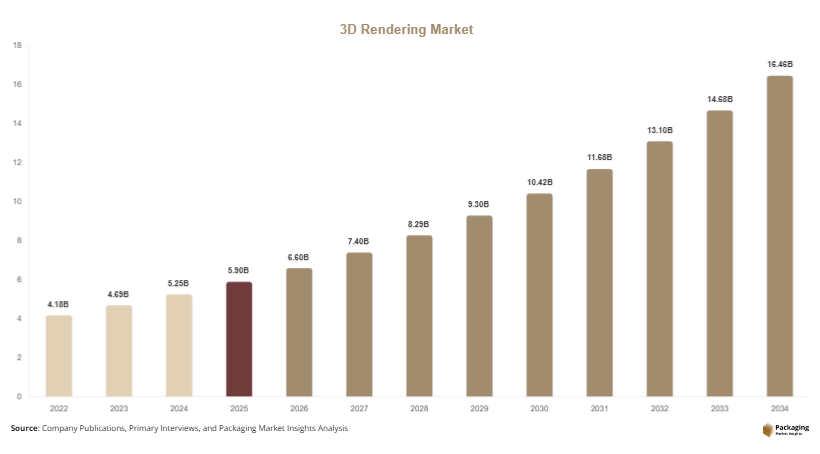
The 3D rendering market size was estimated at approximately USD 5.9 billion in 2025 and is projected to reach USD 6.6 billion in 2026. With increasing demand for digital visualization tools across construction, manufacturing, and entertainment industries, the market is expected to expand significantly over the forecast period. The market is projected to reach USD 18.4 billion by 2034, registering a compound annual growth rate (CAGR) of 12.1% from 2025 to 2034.
The global 3D rendering market has experienced steady growth over the past decade due to the rising use of visualization technologies across architecture, gaming, media, and product design industries. 3D rendering refers to the process of generating photorealistic or non-photorealistic images from 3D models using specialized software and computing infrastructure. These tools allow businesses to visualize objects, environments, and prototypes before physical production, which helps reduce costs and improve design efficiency.
Key Highlights
- Market size reached USD 5.9 billion in 2025
- Expected to grow to USD 18.4 billion by 2034
- Forecast CAGR: 12.1% (2025–2034)
- Strong demand from architecture, gaming, and product design sectors
- Increasing adoption of cloud rendering and AI-assisted visualization tools
Explore more data points, trends and opportunities Download Free Sample Report
Market Trends
Growing Adoption of Cloud-Based Rendering Platforms
One of the notable trends in the 3D rendering market is the growing adoption of cloud-based rendering platforms. Traditionally, rendering tasks required high-performance local hardware and long processing times. However, cloud rendering services now allow users to distribute rendering workloads across scalable computing resources. This approach significantly reduces processing time and infrastructure costs for design studios, animation companies, and architectural firms.
Cloud rendering also improves collaboration across distributed teams. Designers and artists can access rendering resources remotely and share project files in real time. Small and medium-sized studios are increasingly adopting subscription-based rendering services to access powerful computing resources without investing heavily in hardware. As cloud infrastructure continues to improve, the adoption of remote rendering workflows is expected to expand further.
Integration of AI and Real-Time Rendering Technologies
Another key trend shaping the 3D rendering market is the integration of artificial intelligence with real-time rendering technologies. AI-driven tools can automate lighting adjustments, texture generation, and scene optimization, which reduces manual design work. These tools help artists achieve photorealistic results more efficiently while improving rendering accuracy.
Real-time rendering engines are also becoming more common across industries such as gaming, film production, and architectural visualization. These engines allow designers to instantly view scene changes without waiting for long rendering cycles. The combination of AI automation and real-time rendering capabilities is transforming the design process and enabling faster project completion. As businesses prioritize speed and productivity, demand for intelligent rendering solutions is expected to increase.
Market Drivers
Expanding Use of 3D Visualization in Architecture and Real Estate
The increasing use of 3D visualization in architecture and real estate is a significant driver of the 3D rendering market. Architects and developers rely on detailed visual models to present building designs, interiors, and landscapes to clients and investors. High-quality renders allow stakeholders to evaluate design concepts before construction begins, which improves decision-making and reduces project risks.
Real estate companies also use 3D rendering to create virtual tours and promotional visuals for marketing properties. These digital presentations help potential buyers visualize completed projects even during early development stages. As urban development projects increase globally, demand for rendering services from architecture and real estate firms continues to grow.
Rising Demand from Media, Entertainment, and Gaming Industries
The media and entertainment sector represents another major growth driver for the 3D rendering market. Film studios, animation companies, and game developers rely on rendering technologies to create visually rich environments and characters. High-resolution graphics and advanced lighting effects are essential for delivering engaging digital experiences to audiences.
The gaming industry, in particular, requires advanced rendering engines capable of supporting real-time graphics and immersive gameplay. With the expansion of esports, mobile gaming, and virtual environments, developers are investing heavily in rendering technologies to improve visual quality. As consumer demand for interactive digital content continues to rise, the entertainment sector will remain an important contributor to market growth.
Market Restraint
High Infrastructure and Software Costs
Despite strong growth prospects, the 3D rendering market faces challenges related to high infrastructure and software costs. Professional rendering software, high-performance GPUs, and specialized workstations often require significant investment, which can limit adoption among small studios and independent designers. Many rendering projects also require substantial computing power, which increases operational expenses.
In addition, complex rendering workflows require skilled professionals who are trained in 3D modeling, lighting design, and animation. Organizations must invest in workforce training to effectively utilize rendering software and maintain productivity. These requirements can increase project costs and extend development timelines.
For example, small architectural firms may struggle to maintain in-house rendering infrastructure due to hardware upgrade cycles and software licensing expenses. As a result, some organizations rely on external rendering services, which can add additional costs and coordination challenges. Although cloud-based rendering solutions are addressing some of these barriers, infrastructure costs remain a key restraint affecting market adoption.
Market Opportunities
Expansion of Virtual Reality and Digital Twin Applications
The expansion of virtual reality and digital twin technologies presents a significant opportunity for the 3D rendering market. Digital twins are virtual replicas of physical assets, systems, or environments that allow organizations to simulate real-world scenarios. These models rely heavily on high-quality rendering to create accurate visual representations.
Industries such as manufacturing, healthcare, and urban planning are increasingly adopting digital twins for monitoring, simulation, and training purposes. For instance, city planners use digital twins to visualize infrastructure projects and analyze traffic patterns before implementation. As digital twin applications expand across sectors, demand for advanced rendering tools will continue to grow.
Increasing Adoption in E-Commerce and Product Visualization
Another emerging opportunity in the 3D rendering market is the growing use of product visualization in e-commerce. Online retailers increasingly rely on 3D product renders to showcase items from multiple angles, allowing customers to interact with products virtually before purchasing.
This approach improves customer engagement and reduces product return rates by providing more accurate product representations. Furniture brands, consumer electronics companies, and automotive manufacturers are adopting 3D rendering to create digital catalogs and interactive product displays. As online shopping continues to expand globally, rendering technologies are expected to play a larger role in digital marketing and product presentation.
Report Scope
| Report Metric | Details |
|---|---|
| Market Size in 2025 | USD 5.9 Billion |
| Market Size in 2026 | USD 6.6 Billion |
| Market Size in 2034 | USD 18.4 Billion |
| CAGR | 12.1% (2026-2034) |
| Base Year for Estimation | 2025 |
| Historical Data | 2022-2024 |
| Forecast Period | 2026-2034 |
| Report Coverage | Revenue Forecast, Competitive Landscape, Supply Chain Disruption, Growth Factors, Environment & Regulatory Landscape and Trends |
| Geographies Covered | North America, Europe, APAC, Middle East and Africa, LATAM |
| Countries Covered | U.S., Canada, U.K., Germany, France, Spain, Italy, Russia, Nordic, Benelux, Rest of Europe, China, South Korea, Japan, India, Australia, Singapore, Taiwan, South East Asia, Rest of Asia-Pacific, UAE, Turky, Saudi Arabia, South Africa, Egypt, Nigeria, Rest of MEA, Brazil, Mexico, Argentina, Chile, Colombia, Rest of LATAM |
Explore more data points, trends and opportunities Download Free Sample Report
Segmental Analysis
By Component
The software segment dominated the 3D rendering market in 2024, accounting for approximately 64% of the total market share. Rendering software solutions are widely used by architects, designers, and animation studios to create photorealistic visuals and simulations. Many software platforms offer advanced features such as lighting control, texture mapping, and real-time visualization tools. Companies across industries rely on these solutions to enhance product design workflows and improve project presentations.
The demand for rendering software continues to increase due to its ability to integrate with other design platforms such as CAD and BIM tools. These integrations allow designers to convert 3D models into high-quality renders without disrupting their workflow. As industries prioritize digital visualization for planning and marketing purposes, software solutions will remain the largest segment in the 3D rendering market.
The services segment is expected to be the fastest-growing component, registering a CAGR of around 13.8% during the forecast period. Rendering services include outsourcing solutions offered by specialized studios that handle complex visualization projects. Many organizations prefer outsourcing because it allows them to access skilled professionals and advanced rendering infrastructure without maintaining in-house resources.
Growth in the services segment is also driven by increasing demand for high-quality animations and visual simulations in marketing and product presentations. Real estate developers, automotive companies, and advertising agencies frequently outsource rendering tasks to specialized studios. As the complexity of rendering projects increases, the demand for professional rendering services is expected to rise.
By Deployment
The on-premise deployment segment accounted for about 58% of the market share in 2024, making it the dominant deployment model. Many large design studios and media production companies prefer on-premise infrastructure because it offers greater control over data security and processing performance. High-end rendering projects often require powerful local hardware that can handle large datasets and complex scenes.
On-premise deployment is also common in industries where data privacy is critical, such as defense simulation and engineering design. Organizations with dedicated IT infrastructure prefer to maintain in-house rendering systems to ensure consistent performance and secure project management. Despite rising cloud adoption, on-premise deployment continues to play a significant role in the 3D rendering market.
The cloud deployment segment is projected to grow at the fastest CAGR of 14.5% through 2034. Cloud-based rendering platforms allow organizations to access scalable computing resources without investing in expensive hardware. Users can upload project files to cloud servers and distribute rendering workloads across multiple machines, which significantly reduces processing time.
The flexibility and cost efficiency of cloud platforms make them attractive for small and medium-sized studios. Additionally, cloud rendering enables remote collaboration among design teams located in different regions. As businesses increasingly adopt remote workflows and subscription-based software services, cloud deployment is expected to gain strong momentum.
By End-Use Industry
The architecture and construction segment held the largest share of the 3D rendering market in 2024, accounting for approximately 37% of total revenue. Architectural firms rely heavily on rendering technologies to create visual representations of building designs, interior layouts, and urban landscapes. These renders help clients and investors understand project concepts before construction begins.
Architectural visualization also plays a crucial role in marketing real estate projects. Developers use photorealistic renders and animated walkthroughs to promote residential and commercial properties. As urban development projects increase globally, the architecture and construction industry continues to generate strong demand for rendering technologies.
The media and entertainment segment is expected to record the fastest CAGR of 15.1% during the forecast period. Film studios, animation companies, and game developers rely on advanced rendering engines to create immersive digital environments and characters. The increasing popularity of streaming platforms and online gaming is driving demand for visually rich content.
Advancements in real-time rendering and motion capture technologies are also contributing to growth in this segment. Production studios are investing in new rendering tools to reduce production timelines and improve visual quality. As digital entertainment consumption continues to expand worldwide, the media and entertainment industry will remain a major growth contributor.
3D Rendering Market Segmentations
Component
- Software
- Services
Deployment
- On-Premise
- Cloud
End-Use Industry
- Architecture & Construction
- Media & Entertainment
- Healthcare
- Manufacturing
- Others
Regional Analysis
North America
North America accounted for around 34% of the global 3D rendering market share in 2025, making it the leading regional market. The region is expected to grow at a CAGR of approximately 11.4% during the forecast period. Strong adoption of advanced visualization tools in architecture, media production, and gaming industries supports this growth. Technology companies in the United States and Canada continue to invest in high-performance computing infrastructure and software innovation.
The United States dominates the North American market due to its strong entertainment and gaming industries. One unique growth factor is the widespread use of real-time rendering technologies in film production and virtual studios. Movie production companies increasingly rely on real-time rendering engines to simulate environments during filming, which reduces post-production costs and improves creative flexibility.
Europe
Europe represented about 26% of the global 3D rendering market share in 2025 and is expected to expand at a CAGR of 10.8% through 2034. The region benefits from strong demand across architecture, engineering, and automotive industries. Many European design firms use rendering technologies to create detailed prototypes and simulations for construction and manufacturing projects.
Germany leads the European market due to its strong engineering and automotive sectors. One unique growth factor is the integration of rendering tools into industrial product design workflows. Automotive manufacturers rely on advanced visualization to develop vehicle prototypes and simulate materials, lighting, and aerodynamics before production.
Asia Pacific
Asia Pacific held approximately 24% of the global 3D rendering market share in 2025 and is projected to grow at the highest CAGR of 13.7% during the forecast period. Rapid urbanization, expanding gaming markets, and rising investments in digital media industries contribute to this growth. Countries across the region are also investing in infrastructure and smart city projects that require advanced visualization technologies.
China is the dominant country in the Asia Pacific market. A key growth factor is the rapid expansion of the gaming and animation industries. Chinese game developers and digital content creators are increasingly adopting real-time rendering engines to produce visually advanced games and animated films.
Middle East & Africa
The Middle East & Africa accounted for about 9% of the global 3D rendering market share in 2025 and is expected to grow at a CAGR of 10.5% during the forecast period. The market is supported by increasing investments in construction and large-scale infrastructure projects. Governments in the region often use 3D visualization to present urban development plans and tourism infrastructure projects.
The United Arab Emirates dominates the regional market. A unique growth factor is the large number of luxury real estate and tourism development projects. Developers frequently use high-quality 3D renders to market properties and present architectural concepts to investors before construction begins.
Latin America
Latin America captured around 7% of the global 3D rendering market share in 2025 and is expected to expand at a CAGR of 10.2% through 2034. The market is gradually growing due to increased adoption of visualization tools in architecture, advertising, and entertainment industries. Digital content production across the region is also expanding steadily.
Brazil leads the Latin American market. A key growth factor is the rising adoption of rendering technologies in advertising and digital marketing campaigns. Creative agencies increasingly rely on photorealistic renders to produce promotional visuals and product advertisements for online platforms.
Competitive Landscape
The 3D rendering market is moderately competitive, with several established software providers and emerging technology companies competing to enhance rendering performance and workflow efficiency. Leading companies focus on developing advanced rendering engines, integrating artificial intelligence features, and improving real-time visualization capabilities. Strategic partnerships, product upgrades, and cloud-based service offerings are common strategies adopted by key players.
One of the leading companies in the market is Autodesk, which provides widely used rendering and design software solutions for architecture, engineering, and media industries. The company continues to expand its product ecosystem by integrating cloud collaboration and visualization tools. In 2024, Autodesk introduced new AI-assisted rendering features designed to improve lighting simulation and automated scene optimization.
Other major companies such as Adobe, Chaos, and Unity Technologies are also investing in advanced rendering engines that support real-time visualization. These companies aim to provide tools that enable artists and designers to create high-quality visuals with faster rendering speeds. As demand for immersive digital experiences grows, competition among rendering software developers is expected to intensify.
Key Players List
- Autodesk
- Adobe
- Chaos Group
- Unity Technologies
- NVIDIA
- Dassault Systèmes
- Blender Foundation
- Trimble
- Pixar
- Epic Games
- Siemens Digital Industries Software
- Lumion
- Next Limit Technologies
- OTOY
- Solid Angle